
WBBSE Chapter 4 Survival Strategies Adaptation Introduction To The Concept Of Adaptation
Living organisms have to continuously react directly to the environments in which they grow and survive.
As the environment changes rapidly, to survive in those changed conditions, living organisms have to undergo modifications accordingly.
Modifications or changes allow an organism to better adapt to its environment and help it to survive and have more offspring. Otherwise, there is a chance of extinction.
These modifications which make the species best fitted to its environment are called adaptations. Organisms adapting themselves to new environments undergo genetic mutations to produce new varieties of offspring through the process of natural selection.

This process, happening over successive generations, results in evolution. Thus adaptation is the cause and evolution is the effect.
The permanent morphological, physiological, and behavioral modifications, that occur within an organism to enable it to survive successfully within a particular environmental condition, are known as adaptations.
Read and Learn More WBBSE Solutions For Class 10 Life Science
Adaptations can be morphological or anatomical, behavioral, and physiological. Anatomical or morphological adaptations are physical features such as an animal’s shape.
Behavioral adaptations can be inherited or learned and include tool use, language, and swarming behavior. Physiological adaptations include the ability to make venom; but also more general functions such as temperature regulation etc.
The types of adaptations are categorized by observable or measurable means, but genetic change is the basis of all adaptations.
Most organisms have combinations of all these types of adaptations based on how genetic changes are expressed in them to survive the new conditions.
Adaptation Class 10 Life Science
Significance Of Adaptations:
To cope with the changing environment to survive and propagate.
To enable organisms to adjust to the environment by morphological, physiological, and behavioral modifications.
To overcome the adverse conditions of the environment.
To propagate favorable modifications to the next generation to help the evolutionary process.
Relation Between Adaptation And Evolution:
All organisms undergo adaptations to survive and thrive. Some adaptations are structural. Structural adaptations are physical features of an organism like the bill of a bird or the fur of a bear.
Other adaptations are behavioral. Behavioral adaptations are the things organisms do to survive. For example, bird calls and migration are behavioral adaptations.
Based on body chemistry and metabolism, physiological adaptations usually don’t show from the outside.
They consist of features like more efficient kidneys for desert animals like kangaroo rats, compounds that prevent blood coagulation in mosquito saliva, etc.
Adaptations are the cause of evolution.
Evolution is a change in a species over long periods.
Adaptations usually occur because a gene mutates or changes by accident Some useful mutations can help an animal or plant to survive better than others without the mutation.
For example, imagine a bird species. Suppose, one day a bird is born with a beak that is longer than the beaks of other birds in the species.
The longer beak naturally helps the bird to catch more food. Because the bird can catch more food, it is healthier than the other birds lives longer, and breeds more.
In due course, the bird passes the gene for a longer beak onto its offspring. As a result, they also live longer and have more offspring and the gene continues to be inherited generation after generation.
Eventually, it so happens that the longer beak can be found in all of the resulting species. This doesn’t, of course, happen overnight. It takes thousands of years for a mutation to be found in an entire species.
Over time, finally, the animals that are better adapted to their environment survive and breed. Animals that are not well adapted to an environment may not survive.
Adaptation Class 10 Life Science
The characteristics that help a species to survive in an environment are passed on to future generations.
Those characteristics that don’t help the species to survive slowly disappear leading to the extinction of these particular species. This is the essence of natural selection which brings about evolution.
Thus it can be summarised that since evolution is the aggregate changes to the genotype of an organism as a result of natural selection, hence evolution is the long-term effect of adaptation.
WBBSE Chapter 4 Survival Strategies Adaptation Behavior And Adaptation
Behavioral adaptation is the process by which an organism or a species changes its pattern of action to better suit its environment, which allows better survival and reproduction.
Any behavior that helps to ensure the survival of an organism specifically, and its species generally, can be considered as a behavioral adaptation.
A behavioral adaptation is something an animal does – how it acts – usually in response to some type of external stimulus.
Examples of some behavioral adaptions are- what an animal can eat, how an animal moves, how an animal may protect itself, etc.
Animals adapt their behavior according to the requirements of the current situation.
The behavior may be learned and passed on from one generation to another or it may become an instinctive behavior passed on genetically.
A wide range of sensory organs supply the animal’s nervous system with information about the immediate environment (external cues, such as odor, sound, or visual signals), but also about the current state of the body (internal cues).
Depending on both external and internal cues, the nervous system switches modulates, or sustains the pattern of activity in its output organs to change the current behavior or to maintain it.
Some behavioral adaptations benefit the group while others benefit the individual to the detriment of the group.
Migration, for example, benefits the group because the target destination has conditions that favor the survival of the group although many individuals die due to the rigors of the journey.
By contrast, some behaviors, such as infanticide among lions, benefit only the individual. A male lion who displaces another usually kills all the offspring of the other male.
This does not enhance the survival of the group, but it causes the adult females to go into estrous and then they bear the offspring of the new leader, who ultimately benefits by the propagation of his genes.
WBBSE Chapter 4 Survival Strategies Adaptation Examples Of Adaptation
Adaptations are of three types. Some adaptive features of different organisms are discussed below.
Morphological Adaptations:
Morphological or structural adaptations are the physical features of an organism, such as shape, body covering, armament, etc that help the organism to survive in its ecological niches.
Some examples are-
Cactus (conversion of leaf into spine or reduction in the number of leaves):
Cacti are the most common forms of xerophytes that have adaptations to survive in an environment with little liquid water, such as a desert.
The desert climate, also known as the arid climate, is a climate in which there is an excess of evaporation over precipitation.
The often bald, rocky, or sandy surfaces of arid climates evaporate the scanty precipitation so that the water level becomes very low. The problem is compounded by intense sunshine all year round.
Adaptation Class 10 Life Science
Importance of water conservation:
If the water vapor potential inside a leaf is higher than outside, the water vapor will diffuse out of the leaf down this pressure gradient. This loss of water vapor is called transpiration.
The water vapor diffuses through the open stomata. Transpiration is natural and inevitable for plants and a significant amount of water is lost through this process.
However, plants living in dry conditions must be adapted to decrease the size of the open stomata, lower the rate of transpiration, and consequently, reduce water loss to the environment.
Without sufficient water, plant cells lose turgor. This is known as plasmolysis. If the plant loses too much water, it will pass its permanent wilting point and die.
Adaptations Of Cactus:
From the point of view of plants, the rate of transpiration is governed by the number of stomata, stomatal aperture i.e., the size of the stomata opening, leaf area (allowing for more stomata), and the presence of a waxy cuticle.
In cacti, leaves are small, much less in number, scaly, and often modified into sharply pointed spines.
Lamina may be long narrow needle-like or divided into many leaflets. Spines, thorns, or needles do not bear stomata. It prevents the loss of water by transpiration.
Foliage leaves become thick fleshy and succulent or tough and leathery in texture.
The epidermis is covered with a thick cuticle to reduce the rate of transpiration.
Stomata are generally confined to the lower epidermis of leaves called hypognathous. Stomata are present in pits called sunken stomata. They are lined with hair.
Examples: Opuntia, Acacia, Aloe, etc.

The swim bladder of fish:
The swim bladder or air bladder is an internal gas-filled organ that contributes to the ability of a fish to control its buoyancy, and thus to stay at its current water depth without having to waste energy in swimming.
The swim bladder is connected to the gut by a small duct called the pneumatic duct.
The Role Of the Swimbladder In the Aquatic Adaptation Of Fish Is Summarised As:
It is a specially built double-chambered sac (in some fishes swim bladder is single-chambered).
The anterior sac has a gland (Red gland) to release a gas to inflate the bladder and some special tuft of capillaries (Rete mirabile) of the posterior chamber suck the gas to squeeze it.
Thus, by increasing or decreasing the gas in the swim bladder, the fish changes the buoyancy of its body and can move at different levels of water.
The dorsal position of the swim bladder lowers the center of mass below the center of volume, allowing it to act as a stabilizing agent.
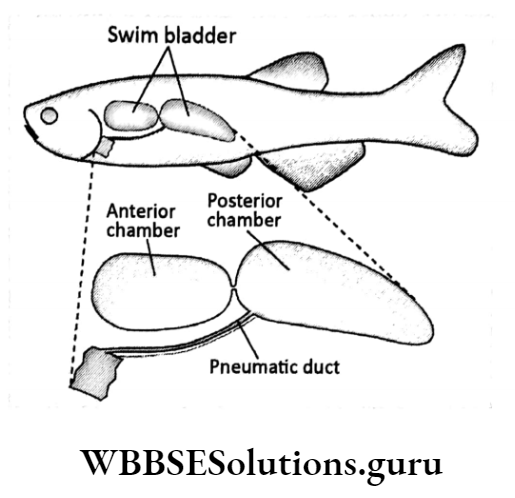
Detailed Functions Of Swim Bladder:
The normal gaseous content of the swim bladder of fresh-water fishes near the surface is approximately that of the atmosphere.
The composition varies with the species, pressure, temperature, amounts, and kinds of dissolved gases, and with the seasons of the year.
When fishes are placed in water containing little or no oxygen, the oxygen in the swim bladder diminishes; indicating that the swim bladder may act as a reservoir from which the blood may draw oxygen in times of need.
Adaptation Class 10 Life Science
A perch is enabled to go into the water with low oxygen content without asphyxiation.
The effect of increased pressure in the surrounding water is to increase both the percentage of oxygen and carbon dioxide in the swim bladder.
If carbon dioxide is increased in the medium in which perch are living, the volume of the fish is changed and the fish automatically rise in the water.
This response would be of adaptive value, causing the fish to move out of deeper water containing larger amounts of carbon dioxide into the safer zones above.
The primary function of the swim bladder of most freshwater fishes is hydrostatic.
Perch possesses no voluntary muscular control over the size of the swim bladder.
Under conditions where high oxygen percentages are found in the swim bladder, a higher tension of the gases exists than that in the blood. This indicates an active secretion.
Under conditions where fishes are not changing their depth rapidly, the gases in the swim bladder are probably kept constant by simple diffusion of gases from the blood.
A “rete mirabile” partially surrounds the walls of the swim bladder and furnishes a rich supply of blood. It is apparently how the gases are transferred from the blood to the swim bladder.
The mechanism by which gas is secreted into the swim bladder can be explained on a chemical and physical basis. The hydrogen ion concentration of the swim bladder gland is increased by external stimulation.
This indicates the secretion of a substance by the gland which may aid in the secretion of gases into the swim bladder.
The apparent secretion of oxygen is believed to be brought about by an increased flow of blood because of the dilatation of the capillaries and increased tension of the oxygen due to the local dissociation of oxygen from oxy-hashemoglobin.
The swim bladder is a mechanism that enables the fish to actively maintain its stability in the midst of changing external conditions.
Air sac of bird:
Because flight is a very energetically expensive activity, birds need a much more efficient respiratory system. They have lungs, but they have also developed numerous air sacs through which air circulates.
Usually, birds have nine air sacs (three paired and three unpaired).
Air sacs are very thin-walled with few blood vessels. So they do not play a direct role in gaseous exchange. They act as bellows to ventilate the lungs.
Some are tucked into the body cavity and some are inside some of the bird’s hollow bones. These air sacs allow a continuous flow of air through the respiratory system, without any wasted space. This is also called dual respiration.
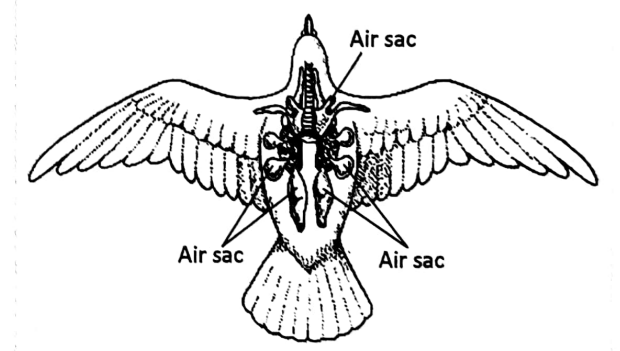
Most birds have 9 air sacs, as
- one interclavicular sac,
- two cervical sacs,
- two anterior thoracic sacs,
- two posterior thoracic sacs, and
- two abdominal sacs.
Functionally, these 9 air sacs can be divided into anterior sacs (interclavicular, cervicals, & anterior thoracics) & posterior sacs (posterior thoracics & abdominals).
Survival Strategies Class 10
Role Of Air Sacs:
Air sacs store oxygenated air which is used to supply additional oxygen during the flight. During inspiration, air comes in contact with the alveoli of the lungs causing the first gaseous exchange. Then air enters the air sacs.

During expiration, oxygenated air comes out of air sacs and flows over the alveoli thus coming in contact with the alveoli for the second time causing a second gaseous exchange.
Thus, in one complete breathing cycle, gaseous exchange takes place twice in the lungs.
This is how the air sacs facilitate dual respiration which provides increased functional efficiency of lungs, greater oxygen supply, higher rate of respiration, and consequent energy production that are needed for volant adaptation.
Air-filled sacs reduce the specific gravity of the body which helps in flight.
These also help in maintaining the body balance in flying conditions.
WBBSE Chapter 4 Survival Strategies Adaptation Physiological Adaptations
Physiological adaptations refer to the metabolic or physiological adjustments within the cells or tissues of an organism in response to external environmental stimuli resulting in the improved ability of an organism to maintain homeostasis or to cope with its changing environment.
Some examples are—
Salt adaptation in Sundri; A mangrove is a shrub or small vegetation that grows in coastal saline or brackish water, in areas with low-oxygen soft soil, and has to cope with varying salinity.
Many mangrove species have leaves with glands that excrete salt. Some species can also tolerate the storage of large amounts of salt in their leaves which are discarded when the salt load is too high.
All species of mangroves can exclude at least 80% of external salt during water uptake.
To deal with salt, all mangrove trees exclude some salt at the root level, and all can tolerate more salt in their tissues than other plants, often in quantities that would kill other plants.

Mangrove adaptations to their environment:
Mangroves have to physically adapt their leaves, their roots, and their reproductive methods to survive in a harsh, dynamic environment of soft, low-oxygen soils and varying salinity.
Leaf Adaptations To Saline Conditions:
Many mangrove species, such as the Grey Mangrove and the River Mangrove (common species along the Redlands coast), have leaves with glands that excrete salt.
Some species such as the Grey Mangrove can also tolerate the storage of large amounts of salt in their leaves – which are discarded when the salt load is too high.
Mangroves can also restrict the opening of their stomata (these are small pores through which carbon dioxide and water vapor are exchanged during photosynthesis).
Survival Strategies Class 10
This allows the mangrove to conserve its fresh water, an ability vital to its survival in a saline environment.
Mangroves can turn their leaves to reduce the surface area of the leaf exposed to the hot sun. This enables them to reduce water loss through evaporation.
Root Adaptations To Soft, Saline, Low Oxygen Soils:
A distinctive feature of mangroves is their far-reaching, exposed roots. While these roots come in many different shapes and sizes, they all perform an important function – structural support in soft soils.
Some species of mangroves have pneumatophores, which are aboveground roots showing negative geotropism.
These are filled with spongy tissue and peppered with small holes in the aerial portion that offer structural support and allow oxygen to be transferred to the roots trapped below ground in the anaerobic (low oxygen) soils.
The roots of many mangrove species are also adapted to stop the intake of a lot of salt from the water before it reaches the plant.
Reproductive Adaptations To Tidal Environment:
Some mangrove species have evolved to produce seeds that float. The tide acts as the method of dispersal to avoid the crowding of young plants.
Other mangrove species are viviparous.
They retain their seeds until after it has germinated and a long, cylindrical propagule has formed.
When it has matured to this stage, the parent tree drops it into the water, where it remains dormant until it finds the soil and can put out roots. This phenomenon is known as viviparous germination.
Adaptations of camel (Camel’s ability to withstand extreme water loss and the shape of RBC in camel):
Camels live in hot deserts.
Camels adapted to desert areas can survive and reproduce despite extreme temperatures and limited water availability using a variety of physiological adaptive mechanisms to either avoid or tolerate environmental conditions that can result in heat stress and dehydration.
Tolerance of fluid loss:
Camels can handle extreme dehydration since they are known to lose safely body water equivalent to 40% of their body weight, a loss that would be lethal in any other animal.
The small oval erythrocyte (RBC) of the camel can continue to circulate in situations of increased blood viscosity.
On the other hand, camels can take in a very large amount of water in one session to make up for previous fluid loss. In other animals, this would result in severe osmotic problems.
Camels can do this because water is absorbed very slowly from their stomach and intestines, allowing time for equilibration. Furthermore, their erythrocytes can swell to 40% over the normal size without bursting.
Formation of dry feces:
Cattle lose 20 to 40 liters of fluid daily through feces, whereas camels lose only 1.3 liters. Fluid is absorbed in the end part of the intestines where the small fecal balls are produced.
Role of the rumen (a compartment of the stomach):
The rumen helps maintain water balance in two ways. First, the rumen of hydrated ungulates and the foregut of camels contain a large volume of water, approximately equal to 20% of body weight, and may buffer ungulates against short-term water deprivations.
During the first few days of dehydration, the fluid contained in the rumen is used to maintain the water balance of blood and body tissues and represents a large portion (50-70%) of the water lost during dehydration.
Second, after dehydration in some species, the rumen plays a role in the prevention of hemolysis and osmotic tissue shock during rapid rehydration.
Role of the kidney:
The camel’s kidney plays a major role in the process of conserving water by increasing the osmolarity of urine. The kidney is characterized by a long loop of Henley and a well-developed medulla.
During dehydration, the kidneys reduce water losses both by decreasing the glomerular filtration rate and by increasing the tubular reabsorption of water. A dehydrated camel urinates only drops of concentrated urine.
This concentrated urine not only serves to conserve water but also allows camels to drink water that is more concentrated than seawater (above 3% NaCI) and to eat salty plants that would otherwise be toxic.
In response to increased blood osmolarity, a larger release of ADH hormone leads to a fast renal response that causes increased reabsorption of water. This leads to a smaller volume of more concentrated urine being excreted.
The shape of erythrocytes of camels:
The oval-shaped nonnucleated erythrocytes of camel can resist osmotic variation without rupturing; these cells can swell to almost twice their initial volumes following rehydration.
The oval RBC can easily flow quicker in a dehydrated state of the animals as compared to the round-shaped blood cells in other mammals. The RBCs are also enormously expansible.
Because of shorter and less saturated fatty acid chains in the red cell membranes, these are more fluid and have remarkable stretching ability.
Survival Strategies Class 10
The ellipsoid shape of camel erythrocytes is very stable and they may expand with distilled water to 400% before they rupture.
Another unique feature of the erythrocytes is their long life span when the camel is dehydrated. The life span of the erythrocytes of hydrated camels is 90 to 120 days.
When camels are chronically dehydrated during summer, the life span of erythrocytes extends to 150 days. Erythrocyte turnover is water and energy-expensive. Therefore, extending the life span of erythrocytes reduces energy and water expenditure.
WBBSE Chapter 4 Survival Strategies Adaptation Behavioral Adaptations
Behavioral Adaptations are inherited systems of behavior (whether inherited as instincts or as a neuro-psychological capacity for learning) that enable organisms to adjust to their environment to ensure survival.
Some examples are—
Problem-solving in chimpanzees:
Just like humans, chimpanzees create and use tools to make their lives easier.
Termites are one of the chimpanzee’s favorite foods, but how to reach the creatures deep within their mounds presents quite a problem to them. Chimpanzees pick up a twig and stripe the leaves off of it.
Then pushing the twig into one of the holes in the termite mound, they leave it there for a moment and slowly pull it out. As termites cling to the twig, they pick them off with their lips and scrunch them. This way they use the stem as a tool to ‘fish’ for insects.
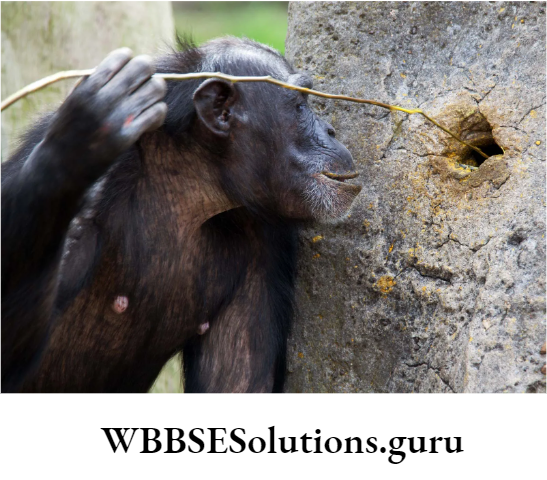
Chimpanzees have also been seen using tools such as stone hammers to chop up and reduce food into smaller bite-sized portions Chimpanzees like eating nuts.
They hammer them open with stone or wood.
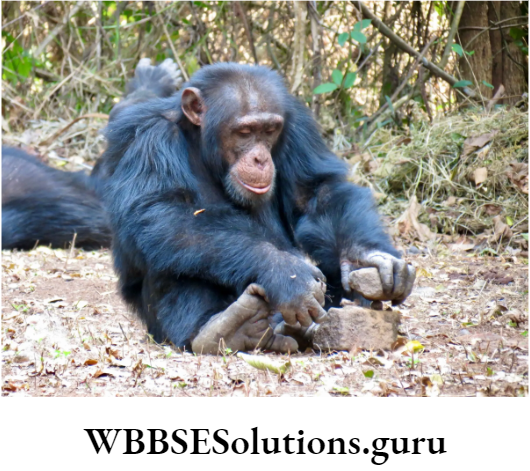
Non-human primates especially chimpanzees self-medicate. Chimpanzees in the wild appear to practice herbal medicine. They consume numerous items with medicinal properties, such as anti-bacterial agents and deworming herbs.
As they live in large groups, these animals are highly efficient in scaring away predators, finding food, and defending territory. They usually forage on the ground and never stick to a specific area for a long time.
Wbbse Class 10 Life Science Adaptation Notes
Chimpanzees, being adapted to form a highly social community, manipulate, deceive, control their emotions, and actively engage in a complex social environment.
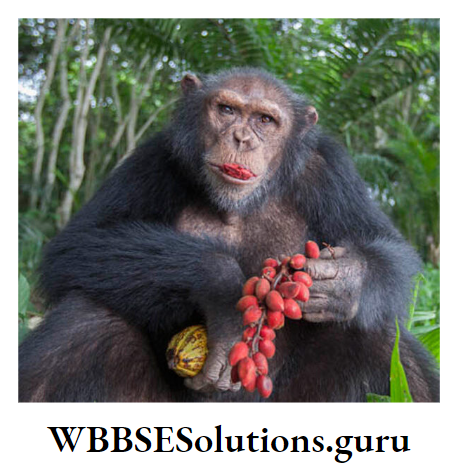
They can quickly pass on important information through visual or vocal means. Various body movements relay information about dominance, excitement, and aggression.
Chimpanzees and humans are “more closely related to each other than either is to any other living primate.
The average stretch of human DNA is almost 99% identical to the corresponding stretch of chimp DNA, but small differences in DNA can lead to numerous differences in the proteins generated by the DNA.
Comparing proteins from chimps and humans, only about 75% are found to be identical. Still, that is a lot of overlap, so it is not surprising that chimps are the closest to human intelligence of all non-human animal species.
For a long time, psychologists have been impressed by the intelligence of chimpanzees. Perhaps the most famous example comes from Wolfgang Kohler in his book The Mentality of Apes (1925).
Kohler suspended bananas out of the reach of chimpanzees. He found that chimps could assemble two sticks to make a single instrument to reach out to the bananas.
They also proved to be capable of piling up boxes to reach the bananas. And they could combine these techniques when necessary.
Communication in honeybees:
Communication is an adaptation that helps animals survive.
Animals use communication to attract mates, warn off predators, mark territory, and identify themselves. Bees communicate through dances, vibrations, and body chemical signals.
The most prominent mode of communication among honey bees is through a series of dances done by foraging worker bees who return to the hive with news of nectar, pollen, or water.
The details of the dance languages were worked out by Karl von Frisch (1967).
The Scout Or Collector Worker Bees Perform Two Common Types Of Dances:
The round dance and the waggle dance.
The round dance is simpler and it communicates that the food source is near the hive.
For a food source found at a greater distance from the hive, the worker bee performs the waggle dance in a figure-eight (8) pattern. It involves a shivering side-to-side motion of the abdomen.
Wbbse Class 10 Life Science Adaptation Notes
The bee first runs straight ahead for a precise distance wagging her abdomen from side to side. Then she turns left and circles back to the starting point, where she starts forward again, waggling the same distance as before.
When she reaches the point where she turns, she circles back to the right. Depending on how plentiful the nectar is, eight may be repeated several times.
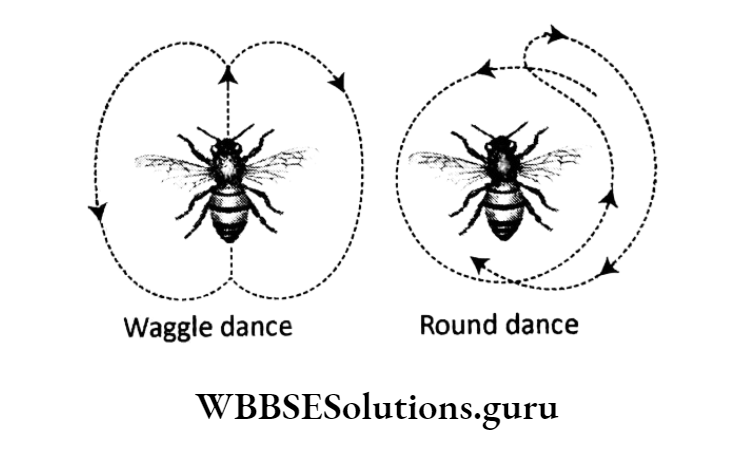
The waggle dance includes information about the direction and energy required to fly to the goal. Energy expenditure (or distance) is indicated by the length of time it takes to make one circuit.
For example, a bee may dance 8-9 circuits in 15 seconds for a food source 200 meters away, 4-5 for a food source 1000 meters away, and 3 circuits in 15 seconds for a food source 2000 meters away.
The direction of the food source is indicated by the direction the dancer faces during the straight portion of the dance when the bee is waggling.
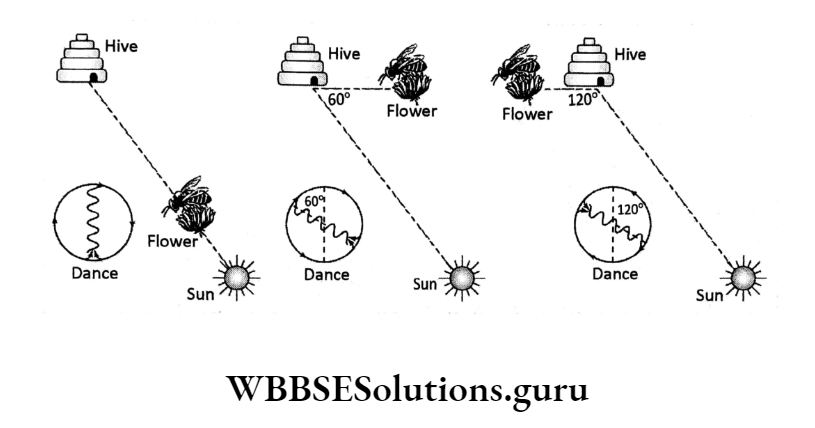
If she waggles while facing straight upward, then the food source may be found in the direction of the sun. If she waggles at an angle of 60 degrees to the left or upward, the food source may be found 60 degrees to the left of the sun.
Similarly, if the dancer waggles 120 degrees to the right or upward, the food source may be found 120 degrees to the right of the sun. The dancer emits sounds during the waggle run that help the recruits determine the direction in the darkness of the hive.
Chapter 4 Topic B Survival Strategies Adaptation Fill In The Blanks
Question 1. A ________________ adaptation is something an animal does how it acts – usually in response to some type of external stimulus.
Answer: Behavioural
Question 2. Cacti have many adaptations that allow them to live in ________________ areas.
Answer: Dry Leaves
Question 3. Most species of cacti have reduced or lost true ________________, retaining only spines.
Answer: Swim Bladder
Question 4. The________________ is an internal gas-filled organ that contributes to the ability of a fish to control its buoyancy.
Answer: Pneumtophores
Question 5. Breathing roots of Halophytes are known as Many species have leaves with glands________________
Answer: Mangrove
Question 7. ________________ have been known to lose safely body water equivalent to 40% of its body weight.
Answer: Camels
Question 8. Just like humans, chimpanzees create and use ________________ to make their lives easier.
Answer: Tools
Question 9. Chimpanzees in the wild appear to practice ________________ medicine.
Answer: Herbal
Wbbse Class 10 Life Science Adaptation Notes
Question 10. The details of the dance languages of________________ were worked out by Karl von Frisch.
Answer: Bees
Question 11. The tuft of capillaries present in the posterior chamber of the swim bladder is known as________________
Answer: Rete mirabile
WBBSE Chapter 4 Survival Strategies Adaptation Write True Or False
Question 1. Any behavior that helps ensure the survival of an organism specifically, and its species generally, can be considered as a behavioral adaptation.
Answer: True
Question 2. Animal migration is an example of behavioral adaptation.
Answer: True
Question 3. Cacti have many adaptations that allow them to live in saline areas.
Answer: False
Question 4. The spines protect the cactus from predators.
Answer: True
Question 5. The swim bladder or air bladder is an internal fluid-filled organ that contributes to the ability of a fish to control its buoyancy.
Answer: False
Question 6. Usually, birds have nineteen air sacs.
Answer: False
Question 7. All mangrove trees exclude some salt at the root level.
Answer: True
Examples Of Adaptation In Animals Class 10
Question 8. Camels can take in a very large amount of water in one session to make up for previous fluid loss.
Answer: True
Question 9. Chimpanzees use tools such as iron hammers to chop up and reduce food into smaller bite-sized portions.
Answer: False
Question 10. Two common types of bee dances are the so-called round dance and the waggle dance.
Answer: True
WBBSE Chapter 4 Survival Strategies Adaptation Very Short Answer Type Questions
Question 1. What is behavioral adaptation?
Answer: Behavioural adaptation is the process by which an organism or a species changes its pattern of action to better suit its environment, which allows better survival and reproduction,
Example: Migration.
Question 2. To which environmental condition are cacti adapted?
Answer: Dry, arid, desert conditions with low or very low precipitation.
Question 3. What are the uses of spines in cacti?
Answer: Protection from predators and reduction of loss of water by transpiration.
Question 4. State the main function of the swim bladder in a fish.
Answer: It contributes to the ability of a fish to control its buoyancy besides controlling its stability.
Question 5. How many air sacs are there in a bird?
Answer: Usually birds have nine air sacs (three paired and three unpaired).
Question 6. Are the air sacs of birds supplied with blood capillaries?
Answer: No.
Question 7. Name the network of blood vessels found around the swim bladder of fish.
Answer: Rete mirabile
Examples Of Adaptation In Animals Class 10
Question 8. How Sundari plants are adapted to the salty estuarine environment?
Answer: Their tissue fluid can tolerate more salt.
Question 9. State the utility of the hump of camels.
Answer: The fat within the hump can be metabolized for energy.
Question 10. Name two favorite foods of chimpanzees.
Answer: They prefer to eat termites and nuts.
Question 11. Give examples of two animals that exhibit secondary volant adaptation.
Answer: Draco and Tree Frog.
Question 12. A pair of related terms is given below. Based on the relationship in the first pair, write the suitable word.
Answer: In the gap of the second pair: developed root system : Hydrophytes:: Highly developed root system: Xerophytes.
Human erythrocytes: biconcave:: Camel’s erythrocytes: oval.
morphological adaptation: a thick layer of fat in polar bears:: physiological adaptation: production of venom
Question 13. Name a mammal that shows volant adaptation.
Answer: Bat.
Question 14. Among the following four terms, one includes the other three. Find out that term and write it: Hibernation, behavioral adaptation, migration, living in troops.
Answer: behavioral adaptation.
Question 15. Give an example of physiologically dry soil.
Answer: Salt marsh.
Question 16. Which part of the cactus performs photosynthesis?
Answer: Phylloclade containing chloroplasts performs photosynthesis in cacti.
Question 17. Name one fish that does not have a swim bladder.
Answer: Shark
Question 18. Name a secondary aquatic animal.
Answer: Whale
Examples Of Adaptation In Animals Class 10
Question 19. In which plant does viviparous germination occur?
Answer: Rhizophora
Question Name a plant that has a pneumatophore.
Answer: Sundari (Heritiera minor)
WBBSE Chapter 4 Survival Strategies Adaptation Short Answer Type Questions
Question 1. What is a phylloclade?
Answer:
Phylloclade
The thick, flat, fleshy green morphologically modified stems of cacti are known as phylloclade. These can perform photosynthesis besides the normal functions of a stem.
Question 2. What are the functions of the swim bladder of a fish?
Answer:
The functions of the swim bladder of a fish
The swim bladder or air bladder is an internal gas-filled organ that contributes to the ability of a fish to control its buoyancy, and thus to stay at its current water depth without having to waste energy in swimming.
Also, the dorsal position of the swim bladder moves the center of mass below the center of volume, allowing it to act as a stabilizing agent.
Question 3. What are the air sacs of birds?
Answer:
The air sacs of birds
Usually, birds have nine very thin-walled air sacs.
Some are tucked into the body cavity and some are inside some of the bird’s hollow bones. These air sacs allow a continuous flow of air through the respiratory system, without any wasted space.
Types Of Adaptation In Plants And Animals Class 10
Question 4. Write about the salt adaptations of Mangrove plants.
Answer:
The salt adaptations of Mangrove plants
Many mangrove species have leaves with glands that excrete salt.
Some species can also tolerate the storage of large amounts of salt in their leaves which are discarded when the salt load is too high. All species of mangroves can exclude at least 80% of external salt during water uptake.
Question 5. What are the adaptations of RBCs of camels?
Answer:
The adaptations of RBCs of camels
The small oval erythrocyte (RBC) of the camel can continue to circulate in situations of increased blood viscosity.
Furthermore, their erythrocytes can swell to 240% of normal size without bursting. The erythrocytes have a long life span when the carnal is dehydrated.
Question 6. How do chimpanzees collect termites as their food?
Answer:
Termites are one of chimpanzees’ favorite food but how to reach the creatures deep within their mounds presents quite a problem.
Chimps pick up a twig and stripe the leaves off it. Then pushing the twig into one of the holes in the termite mound, they leave it there for a moment and slowly pull it out.
As termites cling to the twig, they pick them off with their lips and scrunch them. They thus use the stem as a tool to ‘fish’ for insects.
Question 7. State the significance of the wagtail dance of honey bees.
Answer:
The significance of the wagtail dance of honey bees
The worker bee performs the waggle dance in eight (8) patterns to communicate the message about a food source that is located at a greater distance from the hive.
Depending on how plentiful the nectar is eight may be repeated several times. The waggle dance includes information about the direction and energy required to fly to the goal.
Energy expenditure (or distance) is indicated by the length of time it takes to make one circuit. The direction of the food source is indicated by the direction the dancer faces during the straight portion of the dance when the bee is waggling.
Question 8. Mention the significance of the modification of the leaves of cacti into spines.
Answer:
The leaves bear stomata, but the spines do not. Hence the leaves of cacti are modified into spines to reduce the rate of transpiration.
Question 9. What do you mean by physiologically dry soil?
Answer:
Physiologically dry soil
Plants cannot absorb water from soil that contains a greater concentration of mineral salts even if it is rich in water, because endosmosis cannot occur in the root hairs in such soil.
This type of soil is known as physiologically dry soil. This type of salt marsh is found in the river delta and along the coastline.
Question 10. What is halophyte?
Answer:
Halophyte
The plants that grow in a river delta and show morphological, physiological, and reproductive adaptations in response to tagline marshy lands are known as halophytes.
Examples: Sundari (Heritiera), Rhizophora, Garan, etc.
Question 11. Mention two adaptive features of halophytes.
Answer:
The presence of pneumatophores and viviparous germination are two adaptive features of halophytes.
Question 12. Differentiate between primary and secondary aquatic animals.
Answer:
Difference between primary and secondary aquatic animals

Question 13. Mention two adaptive features of secondary aquatic animals.
Answer:
Two adaptive features of secondary aquatic animal
- Adaptive features of secondary aquatic animals:
- Presence of blabber (thick layer of fat below the skin) to maintain body temperature in cold water
- Presence of an oar-shaped flipper which is the modified forelimb.
Types Of Adaptation In Plants And Animals Class 10
Question 14. What is meant by a secondary volant animal?
Answer:
Secondary volant animal
The animals that can fly in the air but whose ancestors were either terrestrial or aquatic are known as secondary volant animals.
Example: Flying lizard (Draco), Flying fish (Exocoetus), Flying squirrel (Petaurista), etc.
Question 15. What is mimicry?
Answer:
Mimicry
Mimicry is a type of defensive adaptation by which some animals and plants protect themselves by camouflage or by alarming coloration or structural pattern.
Example: Leaf insect (Phyllium) and stick insect (Euryacantha) camouflage with leaf and dry sticks respectively to escape predation.
Question 16. What is keel?
Answer:
Keel
The sternum of a pigeon is modified into a boat-shaped structure that provides added space to hold the sturdy flight muscles. This triradiate flat bony plate is called the keel.
Question 17. What is double adaptation?
Answer:
Double adaptation
Some animals are adapted to survive in two different environments. This is known as double adaptation.
Pigeons can walk on the ground as well as fly in the air, frogs can leap on land and swim in the water, etc. These are examples of double adaptation.
Question 18. What is vivipary germination?
Answer:
Vivipary germination
Plants growing in saline marshes show a peculiar type of germination known as vivipary. In such cases, the seeds begin germination before their liberation from the fruits.
The radicle becomes elongated and considerably swollen.
Then the seeds get detached from the parent plant and come vertically downward. The radicle pierces the muddy soil below and thus gets fixed. Lateral roots are soon formed for anchorage and the plumule is kept above the surface of saline water.
Examples: Rhizophora, Ceriops, etc.

Question 19. Mention the adaptive features of a halophyte which is adapted to grow in physiologically dry soil.
Answer:
Sundari (Heritiera minor) is a halophytic plant, which grows on salty marshes of river delta. It has the following adaptive features:
Root:
- The root system is not very elaborate.
- Stilt roots grow to support the plant body to stand erect in soft mud.
- Pneumatophores grow vertically above the substratum to get oxygen from the atmosphere.
- Root buttresses are also found to support the plants to stand erect on the soft muddy soil.
Stem:
Evergreen plants with strong and branched stems.
The epidermis is coated with cuticle or wax. Vascular and mechanical tissues are well developed.
Leaf:
Thick leaves, coated with cuticle and wax. Cells contain mucilage. Palisade parenchyma is dense. Stomata are sunken.
Question 20. Which is the special adaptation of maguro (Clarias) fish?
Answer:
Magur (Clarias) inhabits muddy water with very low oxygen concentration.
To solve the problem, the fish has adapted itself for aerial respiration with the help of a specially built air-breathing organ, called a respiratory tree placed at the two sides of its head.
Question 21. Which adaptive features are found in the hind limbs of a pigeon for perching?
Answer:
Pigeons show double adaptation.
Apart from volant adaptations, they are also adapted specially to sit on the branch of a tree.
Out of the four digits of the hindlimb, three are directed forward and one in a backward direction arrangement helps pigeons to grip the branches well while they sit on them.
Moreover, the hindlegs of the pigeon are fitted with the body in a ‘Z’ shape. This arrangement acts as a shock absorber while they land from a flight.
Types Of Adaptation In Plants And Animals Class 10
Question 22. Mention two behavioral adaptations of camels to survive in desert climates.
Answer:
Food habit:
Camels eat green herbs and this causes indirect intake of sufficient moisture to maintain the body’s hydration. On the other hand, they can survive for several months without food.
Water intake:
A camel can go a week or more without water. When a suitable opportunity arises, they can drink up to 32 gallons (46 liters) of water in one drinking session to make up for previous water loss.
WBBSE Chapter 4 Very Short Answer Type Questions
Question 1. Mention one morphological adaptation of cactus to prevent transpiration.
Answer: In cactus leaves are small, much less in number, scaly, and often modified into sharp pointed spines to prevent transpiration.
Question 2. Mention one adaptation of the Sundari plant for salt tolerance.
Answer: In Sundari, pneumatophores grow vertically above the substratum to get oxygen from the atmosphere.