
WBBSE Chapter 5 Environment Its Resources And Their Conservation Environmental Pollution Introduction To Pollution
Human activities introduce various types of contaminants into the natural environment. The contaminants bring about adverse changes to the biosphere.
This results in environmental pollution.
Pollution is an undesirable change in the physio-chemical and biological characteristics of the biosphere that has adverse effects on living organisms, the environment, living conditions, cultural assets of human beings, raw material resources, or industrial processes.
Pollutants:
The foreign substances or energies or naturally occurring materials causing pollution of the environment (i.e., the polluting agents) are called pollutants.
Examples: Particulate matter, oxides of carbon/sulfur/nitrogen, Hydrocarbons, sewage, discarded radioactive wastes, etc.
Read and Learn More WBBSE Solutions For Class 10 Life Science
WBBSE Chapter 5 Environmental Pollution Introduction To Pollution Types Of Pollution
The common pollution problems that we have to face can be classified in three ways –
According to the component of the environment that is being polluted; for example-
- Air pollution,
- Water pollution and
- Land (soil) pollution.
According to the physical nature of the pollutant; for example-
- Gaseous pollution,
- Dust pollution,
- Noise pollution,
- Thermal pollution,
- Radioactive pollution etc.
According To Origin:
Pollution can be classified into two broad groups – natural and artificial or anthropogenic (manmade).
1. Natural pollutions are those which originate from natural processes e.g., forest fires, volcanic eruptions, dust storms, natural organic and inorganic decays, the release of microbes, pollens, spores, etc.
2. Artificial or anthropogenic pollution is that whthatriginate due to activities of man; for example industrial pollution, agricultural pollution, automobile pollution, domestic pollution, etc.
3. The anthropogenic polpollutione isajor problem because they are increasing day by day due to overpopulation.
Among the various man-made pollution problems, the largest ones are air pollution, water pollution, soil pollution, noise pollution, and radioactive pollution because these are very common (i.e., frequently occurring) and they produce deleterious effects on a vast population.
WBBSE Chapter 5 Topic B Environmental Pollution Air Pollution Definition
Any adverse change in the composition of the atmosphere that occurs due to the activities of man or some natural event and endangers human life is called air pollution or atmospheric pollution.
Causes And Effects Of Air Pollution
Causes-
Greenhouse Gases:
1. CO2, CH4/ water vapor, N2O, SF6, and CFC are liberated from different industrial sources and have different grades of global warming potential (GWP) when they are compared wconcerningCO2, which has a GWP of 1.
2. CO2, NO2, SO2, and hydrocarbons from automobile and industrial sources.
3. SPM (Suspended Particulate Matter), which are of two types SPM10 (diameter of μ and SPM2.5μ (diameter of 2.5μ liberated from automobile exhaust, building dust, etc.
They may be fibrous material of plant or animal origin, fly ash particles, oil particles, or fungal spores.
Environmental Pollution Class 10
Effects-
1. Green House Effect:
GHGs absorb shorter UV rays of the sun and also those which are reflected from the Earth’s surface causing elevation of global temperature,
Global Warming:
It results in the melting of ice and snow in the permanent glaciers.
The water level in the ocean rises causing infiltration of saline water, flooding of low-lying areas, extreme reduction in agricultural productivity, and unprecedented changes in the wind and global precipitation pattern,
Effect On Biomes:
Due to the shifting of climatic belts as a consequence of global warming, vegetation would gradually also shift in the same direction to stay in favorable climatic conditions.
Those species which will be unable to do so shall die. Thus there will be losses of genetic resources on a large scale. All important biomes shall be affected.
2. Acid rain: These gases get dissolved in rainwater producing different types of acids like Carbonic acid (H2SO3), Nitrous acid (HNO2) Nitric acid (HN03), Sulphurous acid (H2SO3) or Sulphuric acid (H2SO4), etc.
The acid-laden aerosols come downwards as acid precipitation or acid rain. Acid rain is corrosive affects aquatic ecosystems, causes disbalance to mineral cycles, kills soil microbes by changing their pH, and damages monuments, plants, etc.
Oxides of nitrogen are responsible for the formation of peroxyacetyl nitrate (PAN) and peroxybenzoyl nitrate (PBN) which cause acute irritation of eyes and respiratory problems.
NO2 may cause pulmonary edema besides being an important constituent of photochemical smog.
NO is responsible for the depletion of the stratospheric ozone layer.
Sulphar retards photosynthesis and inhibits carbon assimilation. Plants exposed to SO2 for long durations suffer from necrosis and interveinal chlorosis.
SO2 is capable of causing the thickening of the mucous layer of the trachea, bronchial constriction, and hypertrophy of mucous glands.
Hydrocarbons in excess cause necrosis of leaves, chlorosis of floral buds, irritation of mucous membranes, and bronchial constriction. Many hydrocarbons are known to have carcinogenic properties.
3. SPM reduces visibility and prevents the sun rays from entering the atmosphere reducing photosynthetic productivity,
They may also cause lung diseases like chronic obstructive pulmonary disease (COPD) and other respiratory distress like apnoea, dyspnoea, or difficulty in breathing.
Environmental Pollution Class 10
It may damage the surfactant in the lining of alveolate and induce respiratory distress syndrome,
SPM is also capable of causing various types of allergies.
WBBSE Chapter 5 Environmental Pollution Control Of Air Pollution
The atmosphere has several built-in cleaning processes such as dispersion, gravitational settling, flocculation, absorption, rain-washout, etc., to cleanse the atmosphere.
However, control of contaminants at their source level is desirable through effective preventive methods or control technologies.
Source Control:
- Some measures that can be adopted in this direction are:
- Using unleaded petrol.
- Using fuels with low sulfur and ash content.
- Encouraging people to use public transport, walk, or use a cycle as opposed to private vehicles.
- Ensuring that houses, schools, restaurants, and playgrounds are not located on busy streets.
- Planting trees along busy streets as they remove particulates, and carbon dioxide and absorbs noise.
- Industries and waste disposal sites should be situated outside the city preferably on the downwind side of the city.
- Catalytic converters should be used to help control emissions of carbon monoxide and hydrocarbons.
Control Measures In Industrial Centres:
- Emission rates should be restricted to permissible levels by every industry.
- Incorporation of air pollution control
- Continuous monitoring of the atmosphere for pollutants should be carried out to know the emission levels.
Equipment Used To Control Air Pollution:
- Air Pollution can be reduced by adopting the following approaches.
- Ensuring sufficient supply of oxygen to the combustion chamber and adequate temperature so that the combustion is complete thereby eliminating much of the smoke consisting of partly burnt ashes and dust.
- To use mechanical devices such as scrubbers, cyclones, bag houses, and electrostatic precipitators in manufacturing processes. These methods retain hazardous materials allowing clean smoke to go out through the chimney.
- Wet scrubbers can additionally reduce sulfur dioxide emissions.
- The air pollutants collected must be carefully disposed of the factory fumes may be dealt with by chemical treatment.
WBBSE Chapter 5 Environmental Pollution Water pollution Definition
Water pollution is the phenomenon in which water is rendered unsuitable for consumption by man and other animals or habitation of aquatic plants and animals due to the mixing of any poisonous material or pollutant with it.
Causes And Effects Of Water Pollution
Causes-
1. Agricultural Runoff:
It includes pesticides, herbicides, phosphate and nitrate fertilizer, and other mixed organic pollutants including different phosphates and nitrates that are washed down by either rainwater or Irrigation water to nearby low-lying lakes and other water bodies.
2. Sewage disposal:
The sewage water contains some pathogens like Vibrio cholera, Micrococcus, Salmonella type, etc.
3. Industrial discharge and oil contamination
Effects-
The deposition of excess nutrients in the water bodies results in eutrophication causing an increase in BOD (Biochemical Oxygen Demand) and algal bloom.
It also increases COD, which oxidizes different chemical compounds and thereby reduces the DO (dissolved oxygen) killing aquatic life including fish.
The increase in sewage level causes contamination of water by different pathogenic organisms that cause cholera, gastroenteritis, and typhoid. The problem becomes more acute due to poor sanitation.
- Leads to an abundance of microbes.
- Creates a deficit of oxygen in aquatic systems.
- Algal blooms are created
- Causes an increase in toxic trace elements.
Reduction of growth:
Pesticides have some direct harmful effects on plants including poor root hair development, shoot yellowing, F, and reduced plant growth.
Effect On Animals:
Reduction in biodiversity:
Pesticides inflict extremely widespread damage to biota.
Reduction In Animal Feed:
Widespread application of pesticides can eliminate food sources that certain types of animals need, causing the animals to relocate, change their diet, or starve.
Food chain effect:
Poisoning from pesticides can travel up the food chain; for example, birds can be harmed when they eat insects and worms that have consumed pesticides.
The killing of earthworms:
The earthworms are killed, which reduces soil fertility. The pesticide also can accumulate in these organisms, which gets into the body of the predators.
Wbbse Class 10 Life Science Pollution Notes
Killing Of Birds:
In England, the use of pesticides in gardens and farmland has seen a reduction in the number of Common Chaffinches. About 72 million birds are killed by pesticides in the United States each year.
Bald eagles are common examples of non-target organisms that are impacted by pesticide use. Rachel Carson’s landmark book Silent Spring dealt with the loss of bird species due to the bioaccumulation of pesticides in their tissues.
Thinning of eggshell:
DDT-induced eggshell thinning has especially affected European and North American bird populations.
The herbicide paraquat (dipyridylium), when sprayed onto bird eggs, causes growth abnormalities in embryos and reduces the number of chicks that hatch successfully.
Additionally, it causes an increase in the amount of pesticides through the phenomenon called biomagnification.
Biomagnification simply denotes enhancement in the concentration of a particular substance (such as a toxic chemical) in the tissues of tolerant organisms at successively higher levels along the food chain.
By this method, a toxic substance enters the food chain at a very low concentration and as it moves up into the consumers of the higher trophic level, its concentration increases, which might induce lethality in these animals.
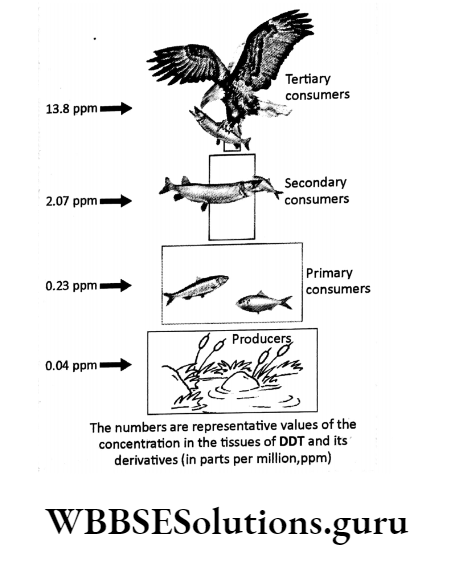
At each level of the food chain, more than half the biomass is lost through excretion, respiration, and decay; but most of the toxic substances (such as DDT) are retained since DDT is metabolized and excreted much more slowly than other nutrients.
Thus DDT accumulates in the bodies (especially in fat) and as a result, becomes highly concentrated in carnivores. This is why the hazard of DDT to nontarget animals is particularly acute for those species living at the top of food chains.
This phenomenon can operate both in terrestrial as well as aquatic ecosystems.
Barker in 1958 showed that the concentration of DDT in the soil below elm trees is 10 ppm, and the earthworm contained 86 ppm of DDT. The Robin bird died after consuming 11-12 such earthworms and the liver of the dead bird showed 744 ppm of DDT, while their brain showed 250 ppm of DDT.
Woodwell (1967) showed 0.002 ppm of DDT in the body of zooplanktons, it increased to 2.07 ppm in the body of needle fishes and 75.5 ppm in the body of fish-eating gulls.
Thus, the adverse effect of DDT is felt in the body of higher consumers by the phenomenon of biomagnification.
Effect On Human Beings:
Similar biomagnification can be observed in the case of heavy metals like mercury causing Minamata disease, and lead causing anemia in mammals.
Humans become more susceptible to cancers, liver and kidney failure, respiratory disorders, birth defects in pregnant women, and Brain damage and heart diseases as a result of mercury, cadmium, lead, cobalt, chromium, and other chemical poisonings.
For instance, diseases like hepatitis and cancer have been attributed to consuming seafood that has Been poisoned by mercury and aromatic hydrocarbons.
WBBSE Chapter 5 Environmental Pollution Control Of Soil Pollution
- Reduction of synthetic pesticides.
- Using organic manure.
- Use of biofertilizer.
- Adoption of biological control.
- Use of genetically modified crops that can resist insect pests, like Bt cotton
WBBSE Chapter 5 Environmental Pollution Noise Pollution Definition
An increase of noise i.e., unwanted and loud sound which is displeasing to the ear, in the surroundings is called noise pollution or sound pollution.
Control of Noise Pollution
Control At Receiver’s End:
For people working in noisy installations, ear-protection aids like earplugs, ear-muffs, noise helmets, headphones, etc. must be provided to reduce occupational exposure.
Suppression of Noise at Source:
This is possible if working methods are improved by:
Designing, fabricating, and using quieter machines to replace the noisy ones.
Proper lubrication and better maintenance of machines.
Installing noisy machines in soundproof chambers.
Covering noise-producing machine parts with sound-absorbing materials to check noise production.
Reducing the noise produced by a vibrating machine by vibration damping i.e. making a layer of damping material (rubber, neoprene, cork, or plastic) beneath the machine.
Using silencers to control noise from automobiles, ducts, exhausts, etc., and conveyor systems with ends opening into the atmosphere.
Use glass wool or mineral wool covered with a sheet of perforated metal for mechanical protection.
Acoustic Zoning:
Increased distance between source and receiver by the zoning of noisy industrial areas, bus terminals, railway stations, aerodromes, etc.
Being away from the residential areas would go a long way in minimizing noise pollution. There should be silence zones near residential areas, educational institutions, and above all, hospitals.
Wbbse Class 10 Life Science Pollution Notes
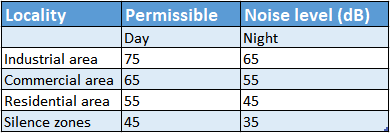
The permissible noise levels in different types of localities are:
Sound Insulation at Construction Stages:
- Sound travels through the cracks that get left between the door and the wall. To reduce noise, this space (jamb frame gap) should be packed with sound-absorbing material.
- Sound insulation can be done by constructing windows with double or triple panes of glass and filling the gaps with sound-absorbing materials.
- Acoustical tiles, hair felt, perforated plywood, etc., can be fixed on walls, ceilings, floors, etc., to reduce noise (especially for soundproof recording rooms, etc.)
Planting of Trees:
Planting green trees and shrubs along roads, hospitals, educational institutions, etc., helps in noise reduction to a considerable extent.
Legislative Measures:
Strict legislative measures need to be enforced to curb the menace of noise pollution.
Some of these measures could be:
- Minimum use of loudspeakers and amplifiers especially near silence zones.
- Banning pressure horns in automobiles.
- Framing and implementation of a strict Noise Pollution Act.
WBBSE Chapter 5 Environmental Pollution Fill In The Blanks
Question 1. The presence of life in the hydrosphere, lithosphere, and atmosphere constitutes the_______________
Answer: Biosphere
Question 2. The contaminating bacteria in the water body is called _______________.
Answer: Coliforms
Question 3. The diameter of ordinary SPM is_______________ .
Answer: 10
Question 4. COPD occurs due to _______________pollution.
Answer: Air
Question 5. Cholera causing virus is_______________ .
Answer: Rotavirus
Question 6. DDT’s full name is _______________.
Answer: Dichloro diphenyl trichloroethane
Question 7. Increased mineralization of the water body is called_______________.
Answer: Eutrophication
Question 8. Typhoid is a_______________ disease.
Answer: Waterborne
Question 9. _______________liberated from the agricultural field is a gas.
Answer: Methane, greenhouse
Question 10. Wetland is also called of_______________ nature.
Answer: Kidney
Question 11. _______________ cultivation along hill slopes prevents soil erosion.
Answer: Terrace
Question 12. The fertility of the soil is retained by crop_______________.
Answer: Rotation
Environmental Pollution Class 10 MCQs
Question 13. The global warming potential of CO2 is _______________.
Answer: One
Question 14. Too much humus in the soil makes it _______________.
Answer: Acidic
Question 15. The full form of PAN is_______________ .
Answer: Peroxy acetyl nitrate
Question 16. 03 layer is present in the _______________.
Answer: Stratosphere
Question 17. _______________ and should be present in the fertilizer.
Answer: Nitrogen, phosphorous; potassium
Question 18. The unit of noise pollution is _______________.
Answer: Decibel
Question 19. Noise pollution is measured by _______________.
Answer: Sound level matter
Question 20. The fungal spores of air are sampled by_______________ sampler.
Answer: Anderson
Question 21. PAN is a_______________ pollutant.
Answer: Secondary
Question 22. CFC was used as a _______________.
Answer: Coolant
Question 23. The limit of noise as per law in West Bengal is up to_______________.
Answer: 90(dB)
Environmental Pollution Class 10 MCQs
Question 24. The coliforms are kept under control by the use of_______________.
Answer: Chlorine
Question 25. _______________denotes enhancement in the concentration of a particular toxic substance along the food chain.
Answer: Biomagnification
WBBSE Chapter 5 Environmental Pollution Write True Or False
Question 1. SO2 and NO2 cause acid rain.
Answer: True
Question 2. Arsenic pollution causes Minamata disease.
Answer: False
Question 3. Volcanic eruptions are an example of natural pollution.
Answer: True
Question 4. Pesticides and fertilizers do not act as soil pollutants.
Answer: False
Question 5. Crop rotation should involve a legume crop.
Answer: True
Question 6. Oxides of nitrogen retard the rate of photosynthesis.
Answer: False
Environmental Pollution Class 10 MCQs
Question 7. Water vapor is a greenhouse gas.
Answer: True
Question 8. Overexposure to noise has a masking effect on ordinary sound intensities.
Answer: True
Question 9. Hookworm larvae enter the human body through contaminated water.
Answer: False
Question 10. Bioplastic is produced by fungi.
Answer: False
Question 11. Sewage disposal causes air pollution.
Answer: False
Question 12. Stone cancer is induced by acid rain.
Answer: True
Question 13. Pollen grain may cause allergy.
Answer: False
Question 14. CFC is used as a fuel.
Answer: False
Question 15. Fly ash is liberated from thermal power plants.
Answer: True
Question 16. SO2 is a greenhouse gas.
Answer: False
Question 17. Coliforms are units of soil pollution.
Answer: False
Question 18. Skin cancer is also called melanoma.
Answer: True
Question 19. Tinnitus is caused by air pollution.
Answer: False
Question 20. Eutrophication lowers both BOD and COD.
Answer: False
WBBSE Chapter 5 Environmental Pollution Match The Columns
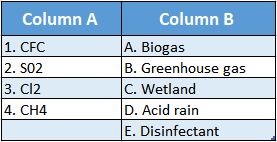
Answer: 1-B,2-D,3-E,4-A
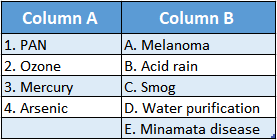
Answer: 1-C,2-D,3-E,4-A
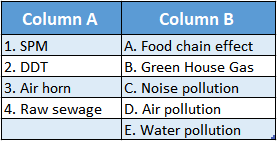
Answer: 1-D,2-A,3-D,4-E
WBBSE Chapter 5 Environmental Pollution Very Short Answer Type Questions
Question 1. Name two gases causing acid rain.
Answer: SO2, NO2.
Question 2. What type of pollution is associated with eutrophication?
Answer: Water.
Question 3. Name the gas having the highest global warming potential.
Answer: SF6¯
Question 4. What is the name given to pollution by algae?
Answer: Algal bloom.
Question 5. What is the name given to the increase in pollutants across the food chain?
Answer: Biomagnification.
Question 6. Name the most powerful anti-pollution act in India.
Answer: Environmental Pollution Act (EPA); 1986.
Question 7. State the level of sound at which pollution is caused.
Answer: 120 dB.
Control Measures Of Pollution Class 10
Question 8. Name two disinfectants used in water pollution.
Answer: Potassium permanganate, Chlorine.
Question 9. Give the full form of CNG.
Answer: Compressed Natural Gas.
Question 10. Which one is the most common indicator organism that represents polluted water?
Answer: E. coli
Question 11. Name the oxide of nitrogen acting as a greenhouse gas.
Answer: Nitrous oxide.
Question 12. Name the gas that brings about the depletion of oxygen from hemoglobin.
Answer: Carbon monoxide.
Question 13. What is the diameter of the respiratory particulate matter?
Answer: 2-5
Question 14. Among the following four terms, one includes the other three. Find out that term and write it:
PAH, Hydrocarbon pollutant, PBN, PAN.
Answer: Hydrocarbon pollutant.
Question 15. Give examples of two places that are categorized as silence zones in terms of noise levels.
Answer: Hospitals and educational institutions.
Question 16. A pair of related terms is given below. Based on the relationship in the first pair, write the suitable word in the gap of the second pair:
Answer: Cholera: Vibrio cholerae:: Typhoid: Salmonella typhi
Question 17. Choose the biodegradable pollutants from the list given below:
Answer: Radioactive waste, Sewage, DDT, Agricultural Waste
Question 18. What is the difference between bioaccumulation and biomagnification?
Answer: Bioaccumulation refers to the accumulation of a toxic chemical in the tissue of a particular organism.
Biomagnification refers to the increased concentration of a toxic chemical the higher an animal is on the food chain.
Control Measures Of Pollution Class 10
Question 19. Plants/animals from which of the following groups are most susceptible to biomagnification— primary producer, primary consumer, secondary consumers, or tertiary consumers?
Answer: Tertiary consumers
Question 20. Name two extremely toxic metals.
Answer: Cadmium and Arsenic.
WBBSE Chapter 5 Environmental Pollution Short Answer Type Questions With Answers
Question 1. Name the major air pollutants.
Answer:
The major air pollutants.
CO2, CO, SOx, NOx, and SPM
Question 2. How is the ozone hole formed?
Answer:
Formation of the ozone hole
The nascent chlorine liberated from industrial sources reacts with oxygen in the stratosphere to produce oxides of chlorine. This results in the prevention of ozone layer formation and thinning of the ozone layer causing ozone hole.
Question 3. What is the positive impact of the greenhouse effect?
Answer:
The positive impact of the greenhouse effect
The greenhouse effect in the world has created a suitable environment for the Earth to sustain life. Without naturally occurring greenhouse gases, the earth’s average temperature would be -18°C instead of the much warmer 15°C.
Thus the greenhouse effect keeps the earth warm enough to sustain life.
Question 4. Give examples (two each) of simple and complex biodegradable pollutants.
Answer:
Simple biodegradable pollutants: Domestic wastes, fecal matter
Complex biodegradable pollutants: Polymeric resins, synthetic persistent pesticides.
Question 5. What is photochemical smog?
Answer:
Photochemical smog
Water vapor, particulates, ozone, various hydrocarbons, and oxides of nitrogen react with each other in the presence of sunlight to create photochemical smog or oxidizing type of pollutants.
Radioactive waste, sewage, DDT, agricultural waste Sewage, and agricultural waste.
Causes And Effects Of Pollution Class 10
Question 6. What is eutrophication?
Answer:
Eutrophication
The addition of excess nutrients to a water body results in the overgrowth of algal forms causing an increase in BOD and killing of aquatic fauna including fish. This overgrowth of algae is known as eutrophication.
This prevents oxygen from getting into the water, making it hypoxic and creating a dead zone where no organisms can survive.
Question 7. What is the non-target effect?
Answer:
Non-target effect
The application of excess pesticide in a plant body results in its accumulation in the soil, which results in the killing of friendly organisms in the soil and a reduction in soil fertility, this is called the non-target effect.
In a paddy field, paddy pests may be the target organism but earthworms, rhizobium, etc are nontarget organisms. Indiscriminate use of pesticides kills target as well as non-target organisms.
Question 8. Explain BOD.
Answer:
BOD
The amount of biodegradable organics present in water is indirectly measured in terms of the requirement of oxygen in the microbial degradation process which is called BOD or Biological Oxygen Demand.
Polluted water contains biodegradable organics such as starch, fat, alcohol, esters, etc. Microbial degradation of these materials occurs through oxidation that lowers the dissolved oxygen level In water.
The higher the concentration of biodegradable organics In water, the less the concentration of dissolved oxygen In It.
Question 9. Mention the effects of acid rain. The damages of acid palpitation are as follows :
Answer:
The effects of acid rain
The corrosive action of the acid content in the rain damages buildings, steel, and stone structures.
Acid precipitation affects aquatic ecosystems, microbial communities, and mineral cycles.
Disturbs the soil chemistry. Low pH causes the release of toxic metals and trace elements which undergo biomagnification In living organisms.
An excessive amount of hydrogen ions adversely affects biological membranes, the electron transport system, and several pH-specific biochemical reactions.
Question 10. Briefly mention the effects of biomagnification. Effects of biomagnification:
Answer:
Impact On Human Health:
Humans become more susceptible to cancers, liver & kidney failures, respiratory disorders, brain damage, and heart diseases due to mercury, cadmium, lead, cobalt, and other chemical poisoning.
For instance, diseases like hepatitis and cancer happen due to the consumption of seafood that is poisoned by mercury and PAHs.
Effect on reproduction & development of marine creatures:
Seabird eggs are laid with thinner shells than normal and can result in birds crushing their eggs instead of incubating them. Selenium and mercury destroy the reproductive organs of fish.
Disruption Of the Food Chain:
Many sea creatures depend on the natural food chain for survival.
When chemicals and toxins are carried into soils, rivers, lakes, or oceans and taken up by various organisms, it disrupts the interconnected relationships within the food chain.
This happens when small animals ingest or plants absorb the toxic elements after which they are eaten by bigger animals, consequently affecting the entire natural food chain.
The creatures or plants are intoxicated with chemicals such as mercury, copper, chromium, cobalt, etc may be consumed by humans and top animals in the food chain leading to susceptibility to diseases, reproductive disorders, and even death.
Causes And Effects Of Pollution Class 10
Destruction Of Coral Reefs:
Coral reefs are destroyed by cyanide which is used in leaching gold and in fishing. When destroyed, the survival of aquatic creatures is highly compromised.
WBBSE Chapter 5 Environmental Pollution Long Answer Type Questions
Question 1. Define pollution. What is anthropogenic pollution? Give examples of two greenhouse gases.
Answer:
Types Of Pollution
The common pollution problems that we have to face can be classified in three ways –
According to the component of the environment that is being polluted; for example-
- Air pollution,
- Water pollution and
- Land (soil) pollution.
According to the physical nature of the pollutant; for example-
- Gaseous pollution,
- Dust pollution,
- Noise pollution,
- Thermal pollution,
- Radioactive pollution etc.
According To Origin:
Pollution can be classified into two broad groups – natural and artificial or anthropogenic (manmade).
1. Natural pollutions are those which originate from natural processes e.g., forest fires, volcanic eruptions, dust storms, natural organic and inorganic decays, the release of microbes, pollens, spores, etc.
2. Artificial or anthropogenic pollution is that whthatriginate due to activities of man; for example industrial pollution, agricultural pollution, automobile pollution, domestic pollution, etc.
3. The anthropogenic polpollutione isajor problem because they are increasing day by day due to overpopulation.
Among the various man-made pollution problems, the largest ones are air pollution, water pollution, soil pollution, noise pollution, and radioactive pollution because these are very common (i.e., frequently occurring) and they produce deleterious effects on a vast population.
Air Pollution Definition
Any adverse change in the composition of the atmosphere that occurs due to the activities of man or some natural event and endangers human life is called air pollution or atmospheric pollution.
Causes And Effects Of Air Pollution
Causes-
Greenhouse Gases:
1. CO2, CH4/ water vapor, N2O, SF6, and CFC are liberated from different industrial sources and have different grades of global warming potential (GWP) when they are compared concerning CO2, which has a GWP of 1.
2. CO2, NO2, SO2, and hydrocarbons from automobile and industrial sources.
3. SPM (Suspended Particulate Matter), which are of two types SPM10 (diameter of 10μ and SPM2.5μ (diameter of 2.5μ liberated from automobile exhaust, building dust, etc.
They may be fibrous material of plant or animal origin, fly ash particles, oil particles, or fungal spores.
Effects-
1. Green House Effect:
GHGs absorb shorter UV rays of the sun and also those which are reflected from the Earth’s surface causing elevation of global temperature,
Global Warming:
It results in the melting of ice and snow in the permanent glaciers.
The water level in the ocean rises causing infiltration of saline water, flooding of low-lying areas, extreme reduction in agricultural productivity, and unprecedented changes in the wind and global precipitation pattern,
Effect On Biomes:
Due to the shifting of climatic belts as a consequence of global warming, vegetation would gradually also shift in the same direction to stay in favorable climatic conditions.
Those species which will be unable to do so shall die. Thus there will be losses of genetic resources on a large scale. All important biomes shall be affected.
2. Acid rain: These gases get dissolved in rainwater producing different types of acids like Carbonic acid (H2C03), Nitrous acid (HNO2) or Nitric acid (HN03), Sulphurous acid (H2SO3) or Sulphuric acid (H2SO4), etc.
The acid-laden aerosols come downwards as acid precipitation or acid rain. Acid rain is corrosive affects aquatic ecosystems, causes disbalance to mineral cycles, kills soil microbes by changing their pH, and damages monuments, plants, etc.
Oxides of nitrogen are responsible for the formation of peroxyacetyl nitrate (PAN) and peroxybenzoyl nitrate (PBN) which cause acute irritation of eyes and respiratory problems.
NO2 may cause pulmonary edema besides being an important constituent of photochemical smog.
NO is responsible for the depletion of the stratospheric ozone layer.
Sulphar retards photosynthesis and inhibits carbon assimilation. Plants exposed to SO2 for long durations suffer from necrosis and interveinal chlorosis.
SO2 is capable of causing the thickening of the mucous layer of the trachea, bronchial constriction, and hypertrophy of mucous glands.
Hydrocarbons in excess cause necrosis of leaves, chlorosis of floral buds, irritation of mucous membranes, and bronchial constriction. Many hydrocarbons are known to have carcinogenic properties.
3. SPM reduces visibility and prevents the sun rays from entering the atmosphere reducing photosynthetic productivity,
They may also cause lung diseases like chronic obstructive pulmonary disease (COPD) and other respiratory distress like apnoea, dyspnoea, or difficulty in breathing.
It may damage the surfactant in the lining of alveolate and induce respiratory distress syndrome,
SPM is also capable of causing various types of allergies.
Types Of Pollution Class 10
Question 2. List out the major causes of air pollution. Mention two source control methods to check air pollution.
Answer:
Air Pollution Definition
Any adverse change in the composition of the atmosphere that occurs due to the activities of man or some natural event and endangers human life is called air pollution or atmospheric pollution.
Causes And Effects Of Air Pollution
Causes-
Greenhouse Gases:
1. CO2, water vapor, N2O, SF6, and CFC are liberated from different industrial sources and have different grades of global warming potential (GWP) when they are compared wconcerningCO2, which has a GWP of 1.
2. CO2, NO2, SO2, and hydrocarbons from automobile and industrial sources.
3. SPM (Suspended Particulate Matter), which are of two types SPM10 (diameter of 10μ and SPM2.5μ (diameter of 2.5μ liberated from automobile exhaust, building dust, etc.
They may be fibrous material of plant or animal origin, fly ash particles, oil particles, or fungal spores.
Effects-
1. Green House Effect:
GHGs absorb shorter UV rays of the sun and also those which are reflected from the Earth’s surface causing elevation of global temperature,
Global Warming:
It results in the melting of ice and snow in the permanent glaciers.
The water level in the ocean rises causing infiltration of saline water, flooding of low-lying areas, extreme reduction in agricultural productivity, and unprecedented changes in the wind and global precipitation pattern,
Effect On Biomes:
Due to the shifting of climatic belts as a consequence of global warming, vegetation would gradually also shift in the same direction to stay in favorable climatic conditions.
Those species which will be unable to do so shall die. Thus there will be losses of genetic resources on a large scale. All important biomes shall be affected.
2. Acid rain: These gases get dissolved in rainwater producing different types of acids like Carbonic acid (H2C03), Nitrous acid (HNO2) or Nitric acid (HN03), Sulphurous acid (H2SO3) or Sulphuric acid (H2SO4), etc.
The acid-laden aerosols come downwards as acid precipitation or acid rain. Acid rain is corrosive affects aquatic ecosystems, causes disbalance to mineral cycles, kills soil microbes by changing their pH, and damages monuments, plants, etc.
Oxides of nitrogen are responsible for the formation of peroxyacetyl nitrate (PAN) and peroxybenzoyl nitrate (PBN) which cause acute irritation of eyes and respiratory problems.
NO2 may cause pulmonary edema besides being an important constituent of photochemical smog.
NO is responsible for the depletion of the stratospheric ozone layer.
Sulphar retards photosynthesis and inhibits carbon assimilation. Plants exposed to SO2 for long durations suffer from necrosis and interveinal chlorosis.
SO2 is capable of causing the thickening of the mucous layer of the trachea, bronchial constriction, and hypertrophy of mucous glands.
Hydrocarbons in excess cause necrosis of leaves, chlorosis of floral buds, irritation of mucous membranes, and bronchial constriction. Many hydrocarbons are known to have carcinogenic properties.
3. SPM reduces visibility and prevents the sun rays from entering the atmosphere reducing photosynthetic productivity,
They may also cause lung diseases like chronic obstructive pulmonary disease (COPD) and other respiratory distress like apnoea, dyspnoea, or difficulty in breathing.
It may damage the surfactant in the lining of alveolate and induce respiratory distress syndrome,
SPM is also capable of causing various types of allergies
Question 3. What are the effects of water pollution? Does noise pollution affect animals? Explain.
Answer:
Water pollution Definition
Water pollution is the phenomenon in which water is rendered unsuitable for consumption by man and other animals or habitation of aquatic plants and animals due to the mixing of any poisonous material or pollutant with it.
Causes And Effects Of Water Pollution
Causes-
1. Agricultural Runoff:
It includes pesticides, herbicides, phosphate and nitrate fertilizer, and other mixed organic pollutants including different phosphates and nitrates that are washed down by either rainwater or Irrigation water to nearby low-lying lakes and other water bodies.
2. Sewage disposal:
The sewage water contains some pathogens like Vibrio cholera, Micrococcus, Salmonella type, etc.
3. Industrial discharge and oil contamination
Effects-
The deposition of excess nutrients in the water bodies results in eutrophication causing an increase in BOD (Biochemical Oxygen Demand) and algal bloom.
It also increases COD, which oxidizes different chemical compounds and thereby reduces the DO (dissolved oxygen) killing aquatic life including fish.
The increase in sewage level causes contamination of water by different pathogenic organisms that cause cholera, gastroenteritis, and typhoid. The problem becomes more acute due to poor sanitation.
- Leads to an abundance of microbes.
- Creates a deficit of oxygen in aquatic systems.
- Algal blooms are created.d
- Causes an increase in toxic trace elements.
Reduction of growth:
Pesticides have some direct harmful effects on plants including poor root hair development, shoot yellow, ng, and reduced plant growth.
Effect On Animals:
Reduction in biodiversity:
Pesticides inflict extremely widespread damage to biota.
Reduction In Animal Feed:
Widespread application of pesticides can eliminate food sources that certain types of animals need, causing the animals to relocate, change their diet, or starve.
Food chain effect:
Poisoning from pesticides can travel up the food chain; for example, birds can be harmed when they eat insects and worms that have consumed pesticides.
The killing of earthworms:
The earthworms are killed, which reduces soil fertility. The pesticide also can accumulate in these organisms, which gets into the body of the predators.
Killing Of Birds:
In England, the use of pesticides in gardens and farmland has seen a reduction in the number of Common Chaffinches. About 72 million birds are killed by pesticides in the United States each year.
Bald eagles are common examples of non-target organisms that are impacted by pesticide use. Rachel Carson’s landmark book Silent Spring dealt with the loss of bird species due to the bioaccumulation of pesticides in their tissues.
Thinning of eggshell:
DDT-induced eggshell thinning has especially affected European and North American bird populations.
The herbicide paraquat (dipyridylium), when sprayed onto bird eggs, causes growth abnormalities in embryos and reduces the number of chicks that hatch successfully.
Additionally, it causes an increase in the amount of pesticides through the phenomenon called biomagnification.
Biomagnification simply denotes enhancement in the concentration of a particular substance (such as a toxic chemical) in the tissues of tolerant organisms at successively higher levels along the food chain.
By this method, a toxic substance enters the food chain at a very low concentration and as it moves up into the consumers of the higher trophic level, its concentration increases, which might induce lethality in these animals.
Types Of Pollution Class 10
At each level of the food chain, more than half the biomass is lost through excretion, respiration, and decay; but most of the toxic substances (such as DDT) are retained since DDT is metabolized and excreted much more slowly than other nutrients.
Thus DDT accumulates in the bodies (especially in fat) and as a result, becomes highly concentrated in carnivores. This is why the hazard of DDT to nontarget animals is particularly acute for those species living at the top of food chains.
This phenomenon can operate both in terrestrial as well as aquatic ecosystems.
Barker in 1958 showed that the concentration of DDT in the soil below elm trees is 10 ppm, and the earthworm contained 86 ppm of DDT. The Robin bird died after consuming 11-12 such earthworms and the liver of the dead bird showed 744 ppm of DDT, while their brain showed 250 ppm of DDT.
Woodwell (1967) showed 0.002 ppm of DDT in the body of zooplanktons, it increased to 2.07 ppm in the body of needle fishes and 75.5 ppm in the body of fish-eating gulls.
Thus, the adverse effect of DDT is felt in the body of higher consumers by the phenomenon of biomagnification.
Effect On Human Beings:
Similar biomagnification can be observed in the case of heavy metals like mercury causing Minamata disease, and lead causing anemia in mammals.
Humans become more susceptible to cancers, liver and kidney failure, respiratory disorders, birth defects in pregnant women, and Brain damage and heart diseases as a result of mercury, cadmium, lead, cobalt, chromium, and other chemical poisonings.
For instance, diseases like hepatitis and cancer have been attributed to consuming seafood that has Been poisoned by mercury and aromatic hydrocarbons.
Question 4. What is soil pollution? Discuss its effects on animals in brief.
Answer:
Soil Pollution
- Reduction of synthetic pesticides.
- Using organic manure.
- Use of biofertilizer.
- Adoption of biological control.
- Use of genetically modified crops that can resist insect pests, like Bt cotton
Question 5. Mention two causes of noise pollution. How does it affect human beings? What is acoustic zoning?
Answer:
Noise Pollution Definition
An increase of noise i.e., unwanted and loud sound which is displeasing to the ear, in the surroundings is called noise pollution or sound pollution.
Control of Noise Pollution
Control At Receiver’s End:
For people working in noisy installations, ear-protection aids like earplugs, ear-muffs, noise helmets, headphones, etc. must be provided to reduce occupational exposure.
Suppression of Noise at Source:
This is possible if working methods are improved by:
Designing, fabricating, and using quieter machines to replace the noisy ones.
Proper lubrication and better maintenance of machines.
Installing noisy machines in soundproof chambers.
Covering noise-producing machine parts with sound-absorbing materials to check noise production.
Reducing the noise produced by a vibrating machine by vibration damping i.e. making a layer of damping material (rubber, neoprene, cork, or plastic) beneath the machine.
Using silencers to control noise from automobiles, ducts, exhausts, etc., and conveyor systems with ends opening into the atmosphere.
Use glass wool or mineral wool covered with a sheet of perforated metal for mechanical protection.
Acoustic Zoning:
Increased distance between source and receiver by the zoning of noisy industrial areas, bus terminals, railway stations, aerodromes, etc.
Being away from the residential areas would go a long way in minimizing noise pollution. There should be silence zones near residential areas, educational institutions, and above all, hospitals.
The permissible noise levels in different types of localities are:
Sound Insulation at Construction Stages:
- Sound travels through the cracks that get left between the door and the wall. To reduce noise, this space (jamb frame gap) should be packed with sound-absorbing material.
- Sound insulation can be done by constructing windows with double or triple panes of glass and filling the gaps with sound-absorbing materials.
- Acoustical tiles, hair felt, perforated plywood, etc., can be fixed on walls, ceilings, floors, etc., to reduce noise (especially for soundproof recording rooms, etc.)
Planting of Trees:
Planting green trees and shrubs along roads, hospitals, educational institutions, etc., helps in noise reduction to a considerable extent.
Legislative Measures:
Strict legislative measures need to be enforced to curb the menace of noise pollution.
Some of these measures could be:
- Minimum use of loudspeakers and amplifiers especially near silence zones.
- Banning pressure horns in automobiles.
- Framing and implementation of a strict Noise Pollution Act.
WBBSE Chapter 5 Fill In The Blanks
Question 1. An inflammable greenhouse gas produced from paddy fields is______________.
Answer: Methane (CH4).
Question 2. The fine droplets of smoke, ashes, dust, pollen grains, etc, are suspended in the air, collectively called which causes various lung diseases.
Answer: Suspended Particulate Matters (SPM).
WBBSE Chapter 5 Write True Or False
Question 1. A degradable pollutant is responsible for biomagnification.
Answer: False
Question 2. Acid rain is caused by SO2 and NO2 gases formed due to air pollution.
Answer: True
WBBSE Chapter 5 Very Short Answer Type Questions
Question 1. Among the following four terms, one includes the other three. Find it out and write it: Pesticides used in agriculture, Typhoid, Water pollution, liquid wastes from factories.
Answer: Water pollution.