
Geometry Chapter 2 Theorems Related To Tangent Of A Circle
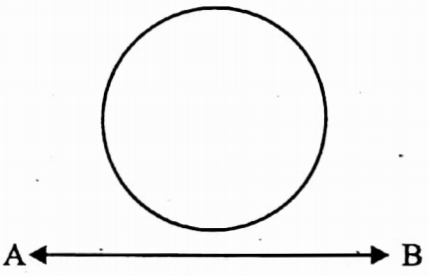
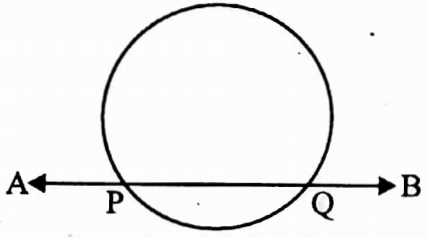
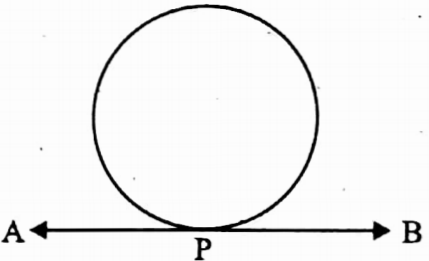
There are three different situations between a circle and a line in a plane.
⇔ The straight line AB does not intersect the circle.
⇔ The straight line AB intersects the circle at two points P and Q.
Read and Learn More WBBSE Solutions for Class 10 Maths

⇔ The straight line AB intersects the circle at point P.
⇔ Secant: A straight line which intersects a circle in two distinct points is called a secant of circle.

⇒ AB is a secant of a circle with centre O.
Class 10 Maths Geometry Chapter 2 Solutions
⇔ Tangent: When a straight line intersects the circle in only one point, the straight line is said to be a tangent to the circle and point is called the point contact of the tangent.
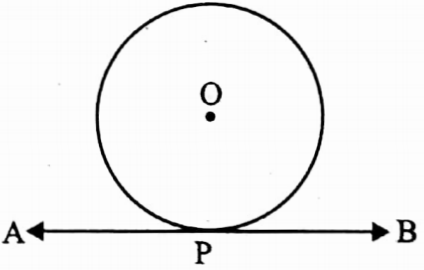
⇒ AB is a tangent and P is the point of contact.
⇔ Common tangent: If a straight line touches each of two circles, then the straight line is called a common tangent of two circles.
⇔ Common tangents are two types:
- Direct common tangent,
- Transverse common tangent.
⇔ Direct common tangent: If the position of two circles are the same side of a common tangent.
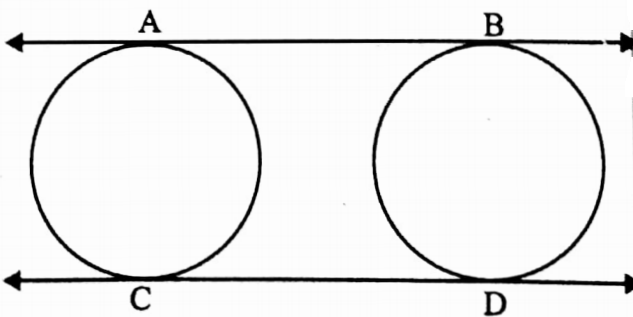
⇒ Then the tangent is called a direct common tangent. AB and CD are direct common tangents.
⇔ Transverse common tangent: If the position of two circles are the opposite side of a common tangent then the tangent is called a transverse common tangent.
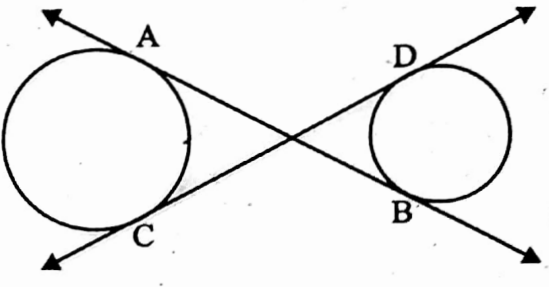
⇒ AB and CD are transverse common tangents.
Theorems:
- The tangent and the radius passing through the point of contact are perpendicular to each other.
- If two tangents are drawn from an external point, the line segments joining the point of contact and the exterior point are equal and they subtend equal angles at the centre.
- If two circles touch each other, then the point of contact will lie on the line segment joining the two centres.
Geometry Chapter 2 Theorems Related To Tangent Of A Circle True Or False
Example 1. P is a point inside a circle. Any tangent drawn on the circle does not pass through the point P.
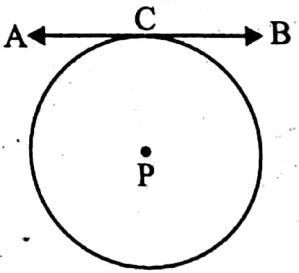
Solution: Clearly the statement is true.
Circles Class 10 Solutions
Example 2. There are more than two tangents can be drawn to a circle parallel to a fixed line.

Solution: Clearly the statement is false.
Geometry Chapter 2 Theorems Related To Tangent Of A Circle Fill In The Blanks
Example 1. If a straight line intersects the circles at two points, then the straight line is called _______ of circle.

Solution: Intersection.
Example 2. If two circles do not intersect or touch each other, then the maximum number of common tangents can be drawn is _________

Solution: Four
Example 3. Two circles touch each other externally at the point A. A common tangent drawn to two circles at the point A is _______ common tangent.
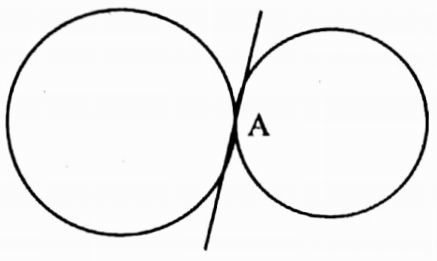
Solution: Transverse
Geometry Chapter 2 Theorems Theorems Related To Tangent Of A Circle Short Answer Type Question
Example 1. O is the centre and BOA is a P diameter of the circle. A tangent drawn to a circle at the point P intersects the extended BA at the point T. If ∠PBO = 30°, find the value of ∠PTA.

Solution: In ΔPOB, OP = OB [radii of same circle]
∴ ∠OPB = ∠PBO
⇒ Again exterior ∠POT = ∠PBO + ∠OPB
= 30° + 30° = 60°
As TP is tangent and P is a radius of the circle with centre O
∴ OP ⊥ PT ; ∠OPT = 90°
In ΔPOT, ∠PTA = 180° – (∠OPT + ∠POT)
∠PTA = 180° – (90° + 60°) = 30°
Class 10 Geometry Chapter 2 Solved Examples
Example 2. ΔABC circumscribed a circle and touches the circle at the points P, Q, R. If AP = 4 cm, BP = 6 cm, AC = 12 cm and BC = x cm, then determine the value of x.

Solution: I join, O, A; O, B; O, C; O, P; O, Q and O, R
AP and AR are two tangents to a circle with centre O, drawn from the exterior point A,
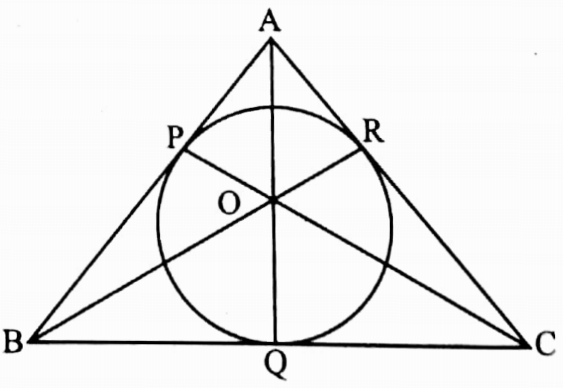
So, AR = AP = 4 cm
⇒ Similarly, BQ = BP = 6 cm and CQ = CR
= AC – AR = (12 – 4) cm = 8 cm
∴ BC = BQ + CQ = (6 + 8) cm = 14 cm
∴ The value of x is 14.
Example 3. The circles with centres A, B, C touch one another externally. If AB = 5 cm, BC = 7 cm and CA = 6 cm. Find the length of radius of circle with centre A.

Solution: Two circles with centres A and B touch each other externally at P
∴ A, P and B are collinear.
⇒ Similarly, A, Q and C are collinear
⇒ B, R and C are collinear
⇒ Let AP = AQ = x cm [radii of same circle]
⇒ BP = BR = y cm
⇒ and CR = CQ = z cm
⇒ AP + BP = AB
⇒ x + y = 5…….(1)
⇒ BR + CR = BC
⇒ y + z =7……(2)
⇒ CQ + AQ = CA
⇒ z + x = 6………(3)
(1) + (2) + (3)
⇒ 2(x + y + z) = 5 + 7 + 6
⇒ or, x + y + z = 9 ………(4)
(4) – (2)
⇒ x + y + z – y – z = 9 – 7
⇒ x = 2
∴ The length of the radius of a circle with centre O is 2 cm.
Example 4. Two tangents drawn from enternal point C to a circle with centre Q touches the circle at the points P and Q respectively. A tangent drawn at another point R of a circle intersects CP and CA at the points A and B respectively. If CP = 11 cm and BC = 7 cm, determine the length of BR.

Solution: CP and CQ are tangents of a circle with centre O.
⇒ So, CQ = CP = 11 cm
⇒ BQ = CQ – BC = (11 – 7) cm = 4 cm
⇒ Again, BR = BQ = 4 cm [as BR and BQ are two tangent of a circle]
Example 5. The lengths of radii of two circles are 8 cm and 3 cm and distance between two centre is 13 cm. Find the length of a common tangent of two circles.
Solution: Let BE is a direct common tangent of two circles with centres A and B respectively.
I join A, D and B, E
The distance between two circle is AB where AB = 13 cm

A perpendicular BC is drawn from B to AC, DE is a tangent and AD is a radius of the circle with centre A
∴ AD ⊥ DE similarly BE ⊥ DE
∴ AD || BE i.e. CE || BE
⇒ Again, BC ⊥ AD and DE ⊥ AD ∴ BC || DE
⇒ In quadrilateral BCDE, CD || BE and BC || DE
∴ BCDE is a parallelogram
∴ DC = BE = 3 cm and DE = BC
⇒ AC = AD – DC = (8 – 3) cm = 5 cm
⇒ In right angled ΔABC, ∠ACB = 90°
∴ AC2 + BC2 = AB2 [from Pythagorus theorem
⇒ BC = \(\sqrt{\mathrm{AB}^2-A C^2}\)
= \(\sqrt{13^2-5^2} \mathrm{~cm}\)
= √144 cm = 12 cm
∴ DE = BC = 12 cm
∴ The length of a common tangent of two circle is 12 cm.
Wbbse Class 10 Geometry Notes
Example 6. The length of radius of a circle with centre O is 6 cm. P is a point at the distance of 10 cm from the centre. Find the length of the tangent PQ from the point P to the circle.
Solution: PQ is a tangent to the circle with centre O and OQ is a radius of the circle.
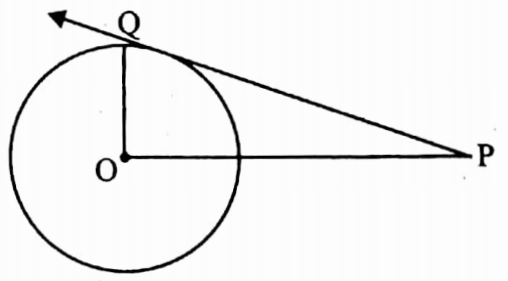
∴ OQ ⊥ PQ
⇒ In right-angled ΔPOQ, ∠OQP = 90°
∴ OQ2 + PQ2 = OP2 [from Pythagorus teorem]
⇒ PQ = \(\sqrt{\mathrm{OP}^2-\mathrm{OQ}^2}\)
= \(\sqrt{(10)^2-(6)^2} \mathrm{~cm}\)
= √64 cm = 8 cm
∴ Length of the tangent is 8 cm.
Example 7. A circle with centre O, a point P is 20 cm away from the centre of the circle and the length of the tangent PQ to the circle is 16 cm. Find the length of the diameter of the circle.
Solution: OQ is a radius and PQ is tangent to the circle with centre O
∴ OQ ⊥ PQ

⇒ In right angled triangle ΔPOQ, ∠OQP = 90°
⇒ OQ2 + PQ2 = OP2 [From Pythagoras theorem]
⇒ OQ = \(\sqrt{\mathrm{OP}^2-\mathrm{PQ}^2}\)
= \(\sqrt{20^2-16^2} \mathrm{~cm}=\sqrt{400-256} \mathrm{~cm}=\sqrt{144} \mathrm{~cm}=12 \mathrm{~cm}\)
⇒ length of radius is 12 cm
⇒ Length of a diameter of the circle is (12 x 2) cm or 24 cm
Example 8. The lengths of radius of two concentric circles arc 3 cm and 5 cm respectively. If a tangent of the smaller circle is a chord of the larger circle, find the length of that chord.
Solution: Let O be the centre of two concentric circles.
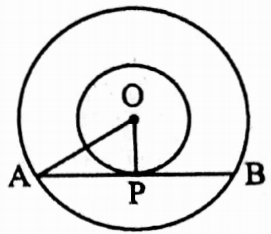
⇒ AB is a tangent of the smaller circle at point P
⇒ So AB is a chord of the larger circle.
⇒ Radius of smaller circle (OP) = 3 cm and radius pf larger circle (OA) = 5 cm
⇒ As AB is a tangent and OP is a radius of the circle
∴ OP ⊥ AB ∴ ∠APO = 90°
⇒ In right angled ΔAPO, AP2 + OP2 = OA2
⇒ AP = \(\sqrt{\mathrm{OA}^2-\mathrm{OP}^2}\)
⇒ = \(\sqrt{5^2-3^2} \mathrm{~cm}\) = √16 cm = 4 cm
⇒ In larger circle, AP ⊥ AB
∴ AB = 2AP = (2 x 4) cm = 8 cm
∴ Length of the chord is 8 cm.
Circle Theorems Class 10 Solutions
Example 9. The length of a chord AB of a circle with centre O is 6 cm at the length of radius of that circle is 5 cm. Two tangents are drawn at the points A and B of the circle intersect at P. Find the length each of the tangent.
Solution: I join O, A; O, B and O, P.
AB and OP are intersect at M.
If two tangents are drawn to a circle from a point outside it, then the line segments joining the points of contact and the exterior are equal and they subtend equal angles at the centre.
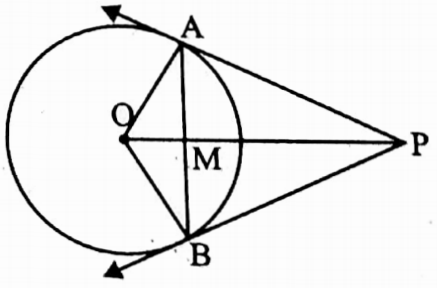
∴ PA = PB and ∠AOP = ∠BOP
⇒ i.e. ∠AOM = ∠BOM
⇒ In ΔAOM and ΔBOM,
⇒ OA = OB [radii of same circle]
⇒ OM = OM [common side]
⇒ and ∠AOM = ∠BOM
∴ ΔAOM ≅ ΔBOM [By SAS axiom of congruency]
∴ AM = BM = \(\frac{1}{2}\) AB
= (\(\frac{1}{2}\) x 6) cm = 3 cm and ∠AMO = ∠BMO = \(\frac{180^{\circ}}{2}\) = 90°
In right angled triangle AOM, OM2 + AM2 = OA2
⇒ OM = \(\sqrt{\mathrm{OA}^2-\mathrm{AM}^2}\)
= \(\sqrt{5^2-3^2} \mathrm{~cm}\)
∴ Let PM = x cm and PA = PB = y cm ∴ OP = (4 + x) cm
As PA is a tangent at A and OA is a radius of the circle.
∴ OA ⊥ AP ∴ ∠OAP = 90°
In right-angled ΔAOP, OA2 + PA2 = OP2
52 + y2 = (4 + x)2
⇒ y2 = (4 + x)2 – 25…….(1)
In right-angled ΔAMP, AM2 + PM2 = AP2
32 + x2 = y2 ……(2)
From (1) and (2), (4 + x)2 – 25 = 9 + x2
⇒ 16 + 8x + x2 – 25 = 9 + x2
⇒ 8x = 18
⇒ x = \(\frac{9}{4}\)
From (2), y2 = 32 + \(\left(\frac{9}{4}\right)^2\) = 9 + \(\frac{81}{16}\) = \(\frac{225}{16}\)
y= \(\sqrt{\frac{225}{16}}=\frac{15}{4}\) = 3.75
∴ Length of each tangent is 3.75 cm.
Example 10. PQ is a chord of a circle with centre O. A tangent Is drawn at the point Q which intersects extended PQ at the point R. If ∠PRQ = 30° then calculate the value of ∠RPQ.
Solution: In joining O, Q
RQ is a tangent at Q and OQ is a radius of that circle
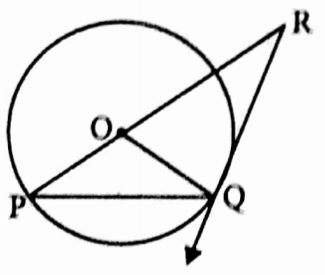
∴ OQ ⊥ RQ ∴ ∠OQR = 90°
⇒ In ΔPOQ, OP = OQ [radii of same circle]
⇒ ∠OPQ = ∠OQP
⇒ the exterior ∠QOR = ∠OPQ + ∠OQP
⇒ 60° = ∠OPQ + ∠OPQ
⇒ 2 ∠OPQ = 50°
⇒ ∠OPQ = 30°
i.e. ∠RPQ = 30°
Class 10 Maths Geometry Important Questions
Example 11. AB and CD are two tangents of a circle with centre O at P and Q respectively. Another tangent EF is drawn which intersects AB and CD at E and F respectively. If AB || CD then find the value of ∠EOF.
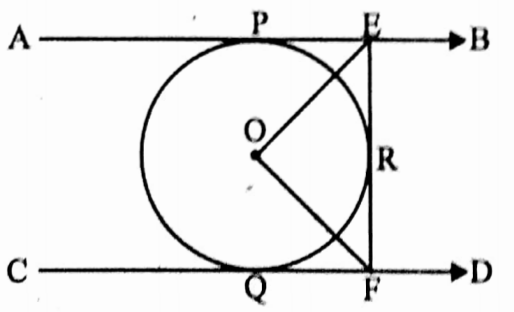
Solution: I join, O, P; O, Q and O, R.
⇒ EP and ER are tangents to a circle with centre O.
∴ PE = RE
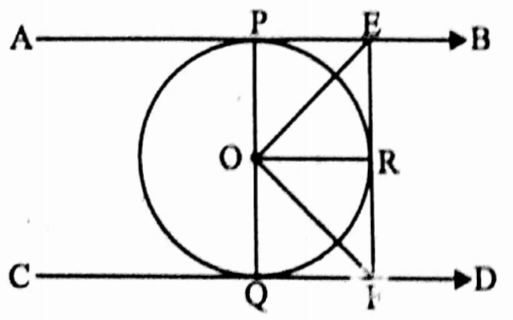
In ΔPOE and ΔROE
⇒ OP = OR [radii of same circle]
⇒ OE = OE [common side]
⇒ PE = RE
∴ ΔPOE = ΔROE [by SSS axiom of congruency]
∴ ∠POE = ∠REO = \(\frac{1}{2}\) ∠PER
Similarly ΔROF = ΔQOF
∴ ∠RFO = ∠QFO = \(\frac{1}{2}\) ∠QFR
AB || CD and EF is intersection
∴ ∠PER + ∠QFR = 180°
∴ 2 ∠REO + 2 ∠RFO = 180°
⇒ ∠REO + ∠RFO = 90°
⇒ In ΔEOF, ∠EOF = 180° – (∠REO + ∠RFO)
= 180° – 90° = 90°
Example 12. Two tangents AB and AC drawn from an external point A of a circle with centre O touch the circle at an point B and C. A tangent drawn to a point D lies on minor arc BC intersects AB and AC at points E and F respectively. If AB = 4 cm then find the perimeter of the ΔAEF.
Solution: As AB and AC are tangents to a circle with centre O,
∴ AB = AC

⇒ Similarly, EB = ED and FD = FC
⇒ Perimeter of ΔAEF, AE + EF + AF
= AE + (ED + FD) + AF = AE + (EB + FC) + AF
= (AE + EB) + (FC + AF) = AB + AC = AB + AB
= 2AB = 2 x 4 cm s 8 cm
Example 13. Three equal circles touch one another externally. The length of radius of each circle is 5cm. Find the perimeter of the triangle obtained by joining the centres.
Solution: Three circles with centre A, B and C touch one another externally at points P, Q and R.
⇒ The points A, P, and B are collinear; B, Q, and C are collinear and C, R, and A are collinear.
⇒ Again, AP = BP = BQ = CQ = CR = AR = 5 cm
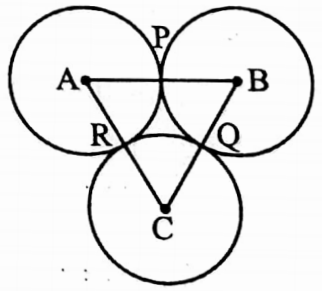
∴ AP + BP = BQ + CQ = CR + AR = (5 + 5) cm
⇒ i.e. AB = BC = CA = 10 cm
∴ Perimeter of the ΔABC is (10 x 3) cm = 30 cm
Class 10 Maths Board Exam Solutions
Example 14. BC is diameter of the circle with centre O and PAQ is a tangent at A. If ∠PAB = 60°, then find the values of ∠CAQ and ∠ABC.
Solution:

⇒ ∠BAC = 90° [semi circular angle]
⇒ ∠PAB + ∠BAC + ∠CAQ = 180°
⇒ 60° + 90° + ∠CAQ = 180°
⇒ ∠CAQ = 30°
∠ABC = alternate circular ∠CAQ = 30°