
Arithmetic Chapter 6 Time And Distance
Question 1. Choose the correct answer:-
1. The time taken to travel 48kmat 36 km/h is.
- 1hr somin.
- 1hr 20min
- 1hr 40 min
- None of these.
Solution:
Distance = 48Km
speed = 36 km/h
Time =?
Speed = \(\frac{\text { Distance }}{\text { Time }}\)
Time = \(\frac{\text { Distance }}{\text { speed }}\)
⇒ \(\frac{48}{36}\)
= 1.33
Time = 1-33hr ⇒ 1hr.30 min
∴ The option (1) Thy 30 min is the correct answer.
Class 7 Maths Arithmetic Chapter 6 Solutions
Read and Learn More Class 7 Maths Solutions

2. The distance covered in 4.5hɣmpat 8.4km/hr is.
- 37.8km
- 36 km
- 36.8 km
- 37Km.
Time (T) = 4.5hrs
Distance =?
Speed(s) = 8.4 km/hr.
Speed\(=\frac{\text { Distance covered }}{\text { Time taken. }}\)
Distance covered = Speed x Time taken.
= 8.4×4.5
Distance covered = 37.8 Km
∴ The option (1) 37.8 km is the correct answer.
3. If the bus covers a distance of 50 km in 3hrs 45 mins. then its speed is.
- 45km/hr.
- 42.5km/hr
- 40km/hr
- None of these.
Distance = 150 KM.
Time = 3hrs 45mins ⇒ 1hr = 60 min
= 45 ⇒ \(\frac{45}{60} \times 1\) = 0.75
Speed =?
Speed = \(\frac{\text { Distance covered }}{\text { time taken }}\)
⇒ \(\frac{150}{3.75} \mathrm{~km} / \mathrm{hr}\)
= 40Km/hr
∴ The option (3) 40km/hr is the correct answer.
Question 2. Write true or False:
1. Speed remaining fixed the distance traveled and time taken are inversely proportional.
→ False
Speed = \(\frac{\text { Distance }}{\text { time }}\)
Speed ∞ Distance
⇒ \(\text { speed } \infty \frac{1}{\text { time. }}\)
2. Speed = Distance travelled × Time taken.
→ False
Speed = \(\frac{\text { Distance traveled. }}{\text { Time taken }}\)
3. when two objects move in the same direction their relative speed will be different of their actual speed.
→ True
Class 7 Arithmetic Chapter 6 Questions
Question 3. Fill in the blanks.
1. If two objects move in opposite directions, then relative speed is equal to the sum of their speed
2. \(4 \frac{1}{2}\) km/hr = 1.25 m/sec
⇒ \(4 \frac{1}{2} \Rightarrow \frac{9}{2}\) = 4.5km/hy
1Km = 1000meters
1hr = 60min = 3600sec
1 minute = 60 sec
60minute = ? 3600sec
4KM → 4000 meters
⇒ \(\frac{1}{2}\) km → 500 meters.
Total distance = 4500 meters
1hr = 3600 sec
m/sec= \(\frac{4500}{3600}\)
= 1.25
3. The time taken to travel 60km at 15 km/hr is 4 hr.
Distance = 60Km
Speed = 15km/hr
Time =?
Speed \(=\frac{\text { Distance covered }}{\text { Time taken }}\)
Time = \(\frac{\text { Distance covered }}{\text { speed }}\)
⇒ \(\frac{60}{15}\)
Time = 4hr
The time taken to travel 60 km at 15km/hr is 4hr
Question 4. A train of length 150m, moving with a speed of 75km/hr passes a tree calculate how long will it take to do so.
Solution:
Given:
Length of train = 150m
Speed of train = 75km/hr
⇒ \(75 \times \frac{5}{18}\) = 20.83 m/sec.
Time \(=\frac{\text { Distance covered }}{\text { Time taken }}\)
⇒ \(\frac{150}{20.83}\)
Time = 7.2 seconds.
So it will take approximately 7.2 seconds for the train to pass the tree.
Question 5. A train with a length of 100m takes 20 sec to pass a light post calculate the speed of the train.
Solution:
Length of the train = 100m
Time (t) = 20sec.
speed= ?
Speed \(=\frac{\text { Distance covered }}{\text { time taken }}\)
⇒ \(\frac{100 \mathrm{~m}}{20 \mathrm{sec}}\)
Speed = 5 m/sec
⇒ \(5 \times \frac{18}{5}\)
Speed = 18km/hr
∴ The speed of the train is 18km/hr
Class 7 Arithmetic Textbook Solutions
Question 6. A 120m long train with a speed of 45km/hr passes a platform in 30 sec. calculate the length of the Pat platform.
Solution:
Length of train = 120m
speed of train = 45 km/hr ⇒ \(45 \times \frac{5}{18}\) = 12.5m/s
Time required to pass the platform = 30 sec.
Let ‘x’ be the length of the platform.
The total length to pass the platform is (x+120)m
Speed \(=\frac{\text { Distance covered. }}{\text { Time taken to cover Distance }}\)
12.5 = \(\frac{x+120}{30}\)
375 = X+120
x = 375-120
x = 255m
∴ The length of the platform is 255m
Question 7. A train takes 6sec to pass a lamp post and 30 sec to pass a 280m long platform. Find the length of the train and also its speed.
Solution:
Let L be the length of the train
S be the speed of the train
For passing a lamp post
L = S × 6
For passing the platform
L+280 = S×30
6S+280 = S×30
280 = 30S-6S
280 = 24S
S = \(\frac{280}{24}\)
S = 11.67 m/s
S = \(11.67 \times \frac{18}{5}\)
S = 42.01Km/h
L = 6×S ⇒ 6 × 11.67
L≈70m
∴ The Speed of the train is 11.67mls of 42 km/h
The length of the train is 70m
Class 7 Maths Arithmetic Problems
Question 8. Two trains 120m and 105m long respectively come running at the rate of 60 km/hr and 45km/hr. respectively. How long will they take to cross each other if the two trains are running in the same direction?
Solution:
After the two trains meet, they would pass each other ie, the two trains would simultaneously pass a distance equal to the sum of their own length
The distance two trains will cover (120+105) mo8 225m
The relative speed. in the same direction
If two objects are moving in the same direction then the
relative speed = difference of their speeds.
= 60-45
relative speed = 15 km/hr
The time to cross each other.
T \(=\frac{\text { Total length }}{\text { Relative speed }}\)
⇒ \(\frac{225}{15}\)
= 15 sec
The time to cross each other is 15 sec
Question 9. A train passes two platforms of length. 275m and 140m In 28sec and 16 sec respectively calculate the length and Speed of the train
Solution:
Let the length of the train be xm
when the train passes a platform of length 275m Then the train has to cover a distance of length (275+2) m
ly
To pass the second platform of length 140m
Then the train has to cover a distance of length (140+x) m
Mathematically represent
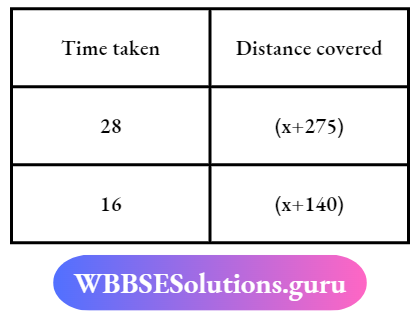
Speed remains constant, and time and distance are in direct proportion.
28:16:: (x+275): (X +140).
⇒ \(\frac{28}{16}=\frac{x+275}{x+140}\)
⇒ 28(x+140) = 16(2+275)
⇒ 28(x+140) = 16(x+275)
⇒ 28x+ 28×140 = 16x+16×275
⇒ 28x+3920 = 16x +4400
⇒ 28x-16X = 4400-3920
⇒ 12x = 480
x = \(\frac{480}{12}\)
x = 40 meters.
∴ The length of the train is 40 meters
In 28 sec the train travels (40+275) =315m
In 1 Sec the train travels \(\frac{315}{28} \mathrm{~m}\)
In 1hr or 3600 sec the train travels = \(\frac{315 \times 3600}{28}\)
⇒ \(\frac{1134,000}{28}\)
⇒ 40,500meters
⇒ 40.5km/hr.
∴ The length of the train is 40 meters.
The Speed of the train is 40.5 km/hr.
Class 7 Arithmetic Formulas
Question 10. Two trains of equal length running in opposite directions, pass a man standing by a side of railway line in 18 secs and 12 secs respectively. At what time will the two trains cross each other?
Solution:
Let’s denote the length of each train by L meters.
Let the speed of the first train be V1 meters per second
The speed of the second train be V2 meters per second
First train
L = V1 x 18 ⇒ V1 = \(\frac{L}{18}\)
second train
L = V2 x 12 ⇒ V2 = \(\frac{L}{12}\)
Relative speed is the sum of their speeds.
The relative speed Vr is given by
Vr = V1+V2
Vr = \(\frac{L}{18}+\frac{4}{12}\)
⇒ \(\frac{2 L+3 L}{36}\)
⇒ \(\frac{5 L}{36}\)
The total length to be covered when the two trains cross each other is the sum of their lengths
Total length = L + L = 2L
The time taken to cross each other is the total length divided by the relative speed:
T \(=\frac{\text { Total length }}{\text { Relative speed }}\)
⇒ \(\frac{2 L}{\frac{5 L}{36}}\)
⇒ \(2 L \times \frac{36}{5 L}\)
⇒ \(\frac{24}{\frac{5 L}{36}}\)
⇒ \(2 L \times \frac{36}{5L}\)
⇒ \(\frac{36 \times 2}{5}\)
= 14.4 Sec
∴ The two trains cross each other at 14.4 Sec