Geometry Chapter 1 Revision Of Old Lesson
Question 1. Choose the correct answer
1. The acute angle is
- 30°
- 90°
- 105°
- 270°
The acute Angle lies between 0° to 90°
∴ The option (1) 30° is the correct answer
Class 7 Maths Geometry Chapter 1 Solutions
2. The surface of the pyramid is.
- Rectangle
- Square
- Triangle
- None of these
∴ The option (3) triangle is the correct answer.
Read and Learn More Class 7 Maths Solutions

3. The number of vertices of a cube is
- 4
- 6
- 8
- 12
∴ The option (3) 8 is the correct answer
Question 2. write true or false
1. Only one curved line can be drawn through two points. → False
2. Two straight lines can be drawn through two Fixed points → False
3. 120° is an obtuse angle → True
Class 7 Geometry Chapter 1 Questions
Question 3. Fill in the blanks
- The greatest chord of a circle is known as the Diameter
- 180° is called a straight angle
- Many straight lines can be drawn through one fixed point.

Question 4. write the definition with a Figure of the Following
1. Adjacent angle
Adjacent angles: are two angles that share a common side and a common vertex, and do not overlap.
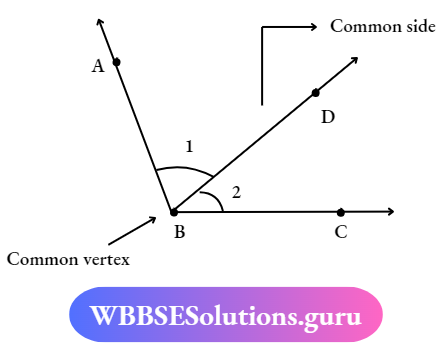
In the given diagram ∠ABD and ∠CBD are adjacent angles.
They share the common arm or common side BD and a common vertex B.
2. Vertically opposite angle
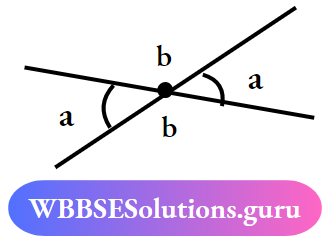
vertically opposite angles are angles that are opposite one another at a specific vertex and are created by two straight intersecting lines.
vertically opposite angles are equal to each other.
WBBSE Class 7 Maths Geometry Solutions
3. Reflex Angle:
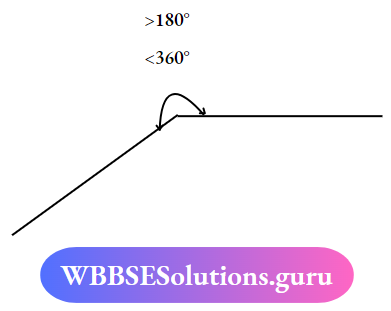
A reflex Angle is an angle that is more than 180° and less than 360°
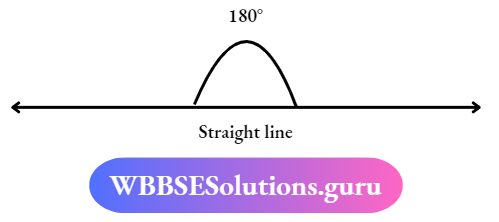
4. Straight Angle
A straight angle measures 180° and looks like a straight line
Mathematically
It is an angle whose arms lie in opposite directions from the vertex and they join together to form 180°.
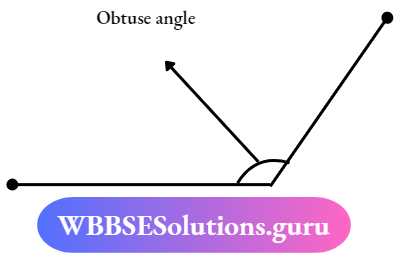
5. Obtuse Angle
An angle that is larger than go but smaller than 180° is called an obtuse angle.
Question 5. Draw a line segment of length 10cm with a scale and divide it into four equal parts. Measure
Solution:
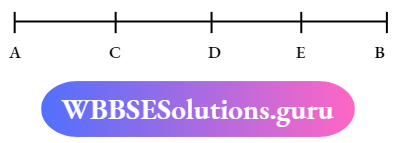
Line segment AB = 10cm
It is divided into ‘4’ equal parts.
Each part is divided into 2.5CM
AC = 2.5cm,
CD = 2.5 cm,
DE = 2.5 CM,
EB = 2.5 cm
∴ AB = AC+ CD +DE+EB
= 2·5+2·5+2·5+2·5
AB = 10cm
∴ The parts are equal AC = CD= DE = EB.
Class 7 Geometry Textbook Solutions
Question 6. Draw an angle of 120° with the help of a protractor and divide it into four equal parts with the help of a compass.
Solution:
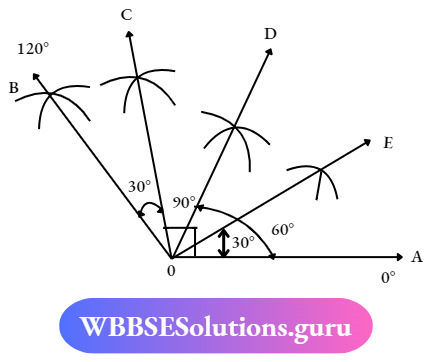
∠BOA = 120°
∠OAE = 30°
∠AOD = 60°
∠AOC = 90°
Question 7. Draw a triangle ABC and bisect each of the three angles and find if the angle bisectors are concurrent.
Solution:
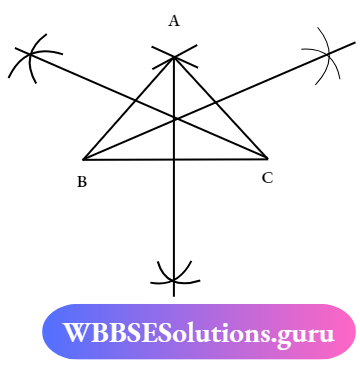
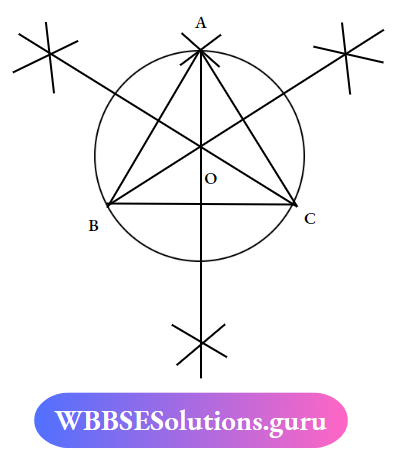
Question 8. Draw a triangle ABC and bisect the sides BC, AC, and AB perpendicularly. If the three perpendicular bisectors are concurrent then name it’ Now with. center o and radius equal to the line segment AO draw a circle.
Solution:
Class 7 Maths Geometry Problems
Question 9. Draw a triangle PQR and from the three vertices P, Q, and R of the triangle, perpendicular PA, BQ, and RC are drawn on the sides QR, RP, and PQ respectively If the line segment PA, QB, and RC are concurrent.
Solution:
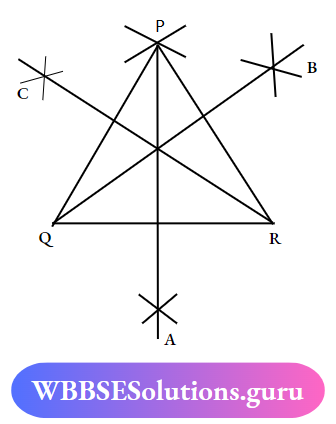
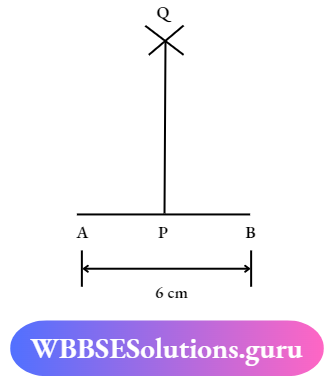
Question 10. A line segment AB of length 6cm is drawn. A point p is taken on the line segment AB. With the help of a scale and pencil compass draw a perpendicular PQ on AB at p.
Solution:
- Draw a line segment AB of length 6cm
- Draw a point ‘P’ on a line segment
- Draw a perpendicular on ‘AB’.