
WBBSE Chapter 10 Direct And Indirect Speech
Ram says, “He will come.”
Ram says that he will come.
প্রথম বাক্যে রামের উক্তি অবিকল উদ্ধৃত করা হয়েছে, কিন্তু দ্বিতীয় বাক্যে রামের কথার মর্ম বক্তা নিজের ভাষায় প্রকাশ করেছে। এইরূপ
বক্তার উক্তি অবিকল উদ্ধৃত করা হলে তাকে Direct Speech বা Direct Narration বলে।
বক্তার উক্তির মর্ম প্রকাশ করা হলে তাকে Indirect Speech বা Indirect Narration বলে।
Read And Learn More WBBSE Class 8 English Functional Grammar
যে উক্তিটি অবিকল উদ্ধৃত করা হয় (এখানে He will come) তাকে Reported Speech বলে, এবং যে verb (এখানে says) এই উক্তিটিকে সূচনা করে তাকে Reporting Verb বলে।
নীচের Sentence-গুলি লক্ষ্য করো :
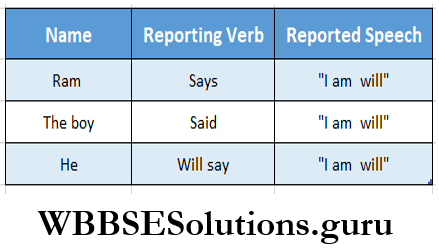
1. Ram says, “I am ill.”-Direct speech
Ram says that he is ill.-Indirect speech
2. The boy said, “I am ill.”-Direct speech
The boy said that he was ill.-Indirect speech
3. He will say, “I am ill”.-Direct speech
He will say that he is ill.-Indirect speech.
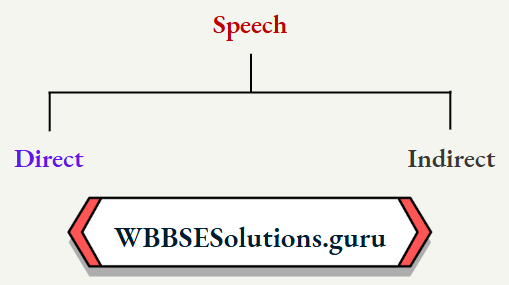
মনে রেখো :
Direct:
- Direct speech -এ Reported speech-f inverted comma (“— ”)-র মধ্যে রাখতে হয়।
- Direct speech-এ Reporting verb- একটি comma বসে।
- Reported speech capital letter হয়।’
Indirect:
- Indirect speech-এ inverted comma
- Sentence-এ সামান্য কিছু পরিবর্তন আসে।
Direct Speech-কে Indirect করার নিয়ম :
Statement or Assertive Sentence:
1. Indirect Speech-এ Reporting Verb- that :
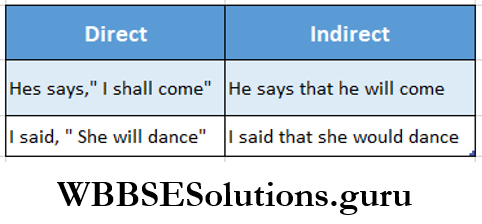
2. Reporting Verb- Present,Future Tense, Indirect- Reported Speech-এর Verb-টির Tense-এর কোনো পরিবর্তন হয় না :
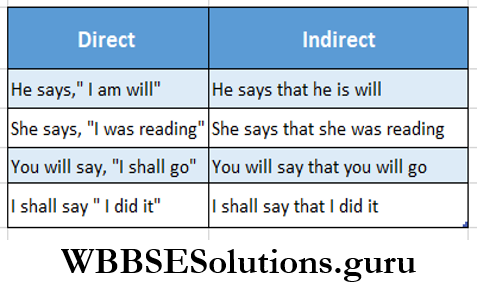
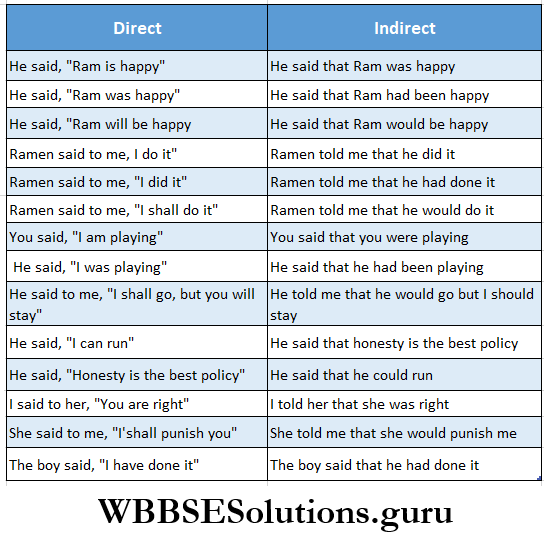
3. Reporting Verb Past Tense-এ Indirect-এ Reported Speech-এ Verb-be অনুরূপ Past tense-এ পরিবর্তিত হয় :

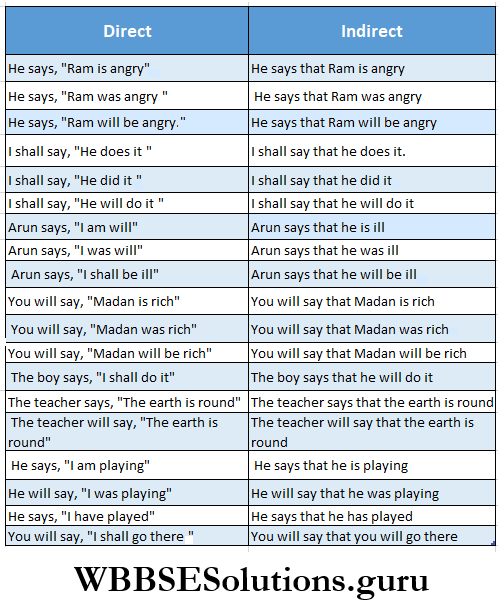
নীচের Chart-টি লক্ষ্য করো :

Note :
- লক্ষ্য করো Reported Speech-এর Pronoun- ও Indirect-এ পরিবর্তিত হচ্ছে। প্রথম উদাহরণে I কথাটি Satish-কে বোঝায় বলে Indirect-এ তা he হয়েছে। চতুর্থ উদাহরণে I কথাটি you-কে বোঝায় বলে Indirect-এ তা you হয়েছে। অন্যান্য উদাহরণগুলিও লক্ষ্য করো, দেখতে পাবে বক্তার অথবা যাকে বলা হয় তার person অনুসারে Reported Speech-এর Pronoun-এর Person পরিবর্তিত হয়।
অনেক সময় Indirect narration-এ পরিবর্তিত করবার পর Pronoun-গুলি ঠিক কাকে বোঝাচ্ছে এ ব্যাপারে ভ্রান্তি হয়। সেক্ষেত্রে Pronoun-এর পাশে bracket-এ ব্যক্তির নাম বসান বাঞ্ছনীয়।

- আরও লক্ষ্য করো Direct Speech-এর shall Indirect Speech-এ will ( বা তার past form ‘would’)-এ পরিবর্তিত হয়েছে। তার কারণ “শুধু ভবিষ্যৎ” বোঝাতে I এর পর shall বসে বটে, কিন্তু you ও he (she, it, etc.)-এর পর will হয়। সুতরাং person-এর পরিবর্তন অনুসারে shall বা will-এরও পরিবর্তন হবে।
- উপরের (c) chart-এর তৃতীয়, চতুর্থ ও সপ্তম উদাহরণে লক্ষ্য করো Direct-এ Reporting Verb-টি said ; কিন্তু Indirect- এ তা told করা হয়েছে। That-এর পূর্বে ‘said to me’, ‘said to her’ ইত্যাদি ভাল ইংরাজি নয়— ‘told me,’ ‘told her’ এরূপ হবে।
- Reporting Verb-এর কোনো পরিবর্তন হয় না।
4. কিন্তু Reported Speech-টি যদি কোনো চিরন্তন সত্য (universal truth) বা নিত্যকার অভ্যাস (habitual action) বোঝায় তবে Reporting Verb-টি Past Tense হলেও Indirect – এ ঐ Reported Speech-এর
Verb-টির Tense-এর কোনো পরিবর্তন হয় না :
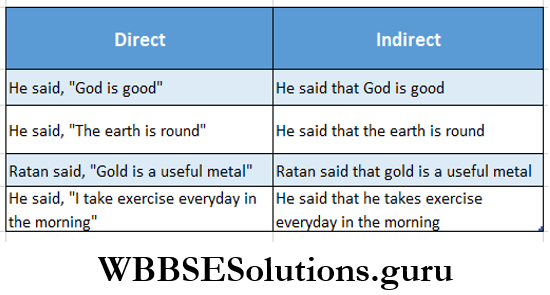
WBBSE Chapter 10 Direct And Indirect Speech Examples Worked Out table
Question 1.
Question 2.
WBBSE Chapter 10 Direct And Indirect Speech Exercise
Change the following sentences into Indirect form. One is done for you;
The girl says, “I am well”. The girl says that she is well.
The girl will say”I am well.” He says, “I am reading.” The girl said, “I am well.” You said, “Amar is hungry.” You say, “Amar is hungry.” You said, “Mr. Bose will talk.” I said to him, “You are wrong.” He said to him, “I shall run.” You will say, “I am tired.”
You said, “I am tired.” You said, “I take exercise everyday.” I shall say, “I shall go there.” You will say, “I shall go there.” Ramala says, “I was reading a book.” Ramala said, “I am reading a book.”
She said, “I can sing.” He says, “I went there.” He said, “I went there.” She said, “I know her.” The girl says, “I am ill.” The boy said, “I did it.” I said to him, “I shall follow you.” The girls say, “We are happy.” He said, “We worked out the sum.”
Rani said to Babu, “God is good.” He said to me, “You are wrong.” They said, “We are doing our work.” She said to me, “I have seen it.”
Arati said to me, “I shall go out but you will stay.” I said to her, “I like tea.” The boy said, “The earth moves round the sun.” You said, “We are helping him.” You said, “I saw the boy,”
Interrogative Sentences (প্রশ্নবোধক বাক্য):
যদি Reported Speech টি প্রশ্নবোধক বাক্য হয় তবে
1. Reporting Verb- ask enquire
2. যদি প্রশ্নটির উত্তর “হ্যাঁ” বা “না” দিয়ে করা চলে তবে ask বা enquire-এর পর whether বা if বসবে। কিন্তু যদি প্রশ্নটি interrogative pronoun বা adjective বা adverb (যেমন whis, which, what, why, when, where, how, etc.) দ্বারা শুরু হয় তা হলে ask বা enquire-এর পরে কিছুই বসবে না।
3. Indirect-এ Reported Speech-টির Interrogative form থাকে না- সাধারণ statement-এর form হয়, অর্থাৎ Assertive Sentence-এ পরিণত হয়। Interrogative sentence-এ সাধারণত Verb-এর পরে Subject বসে, কিন্তু এখন এটা Assertive sentence হয়ে যাওয়ায় Subject-এর পর Verb বসবে।
4. Indirect Speech-এ Reporting Verb-এর পরে that ব্যবহার করবে না।


লক্ষ্য করো : Indirect Speech-এ বাক্যের শেষে কোনো জিজ্ঞাসাবোধক চিহ্ন “ (?)” ব্যবহৃত হয় না।
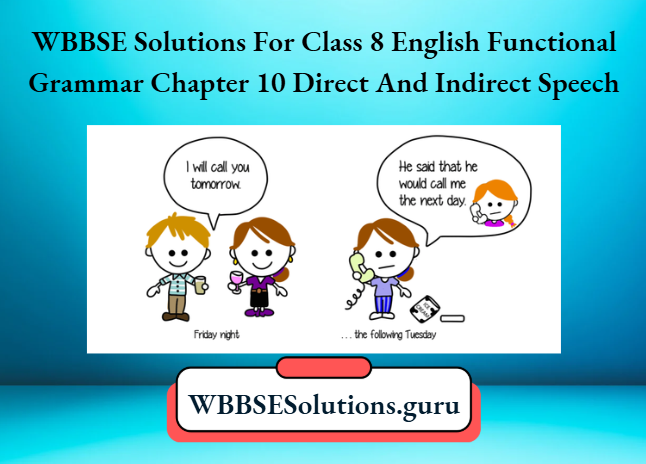
WBBSE Chapter 10 Direct And Indirect Speech Examples Worked Out
Question 1.
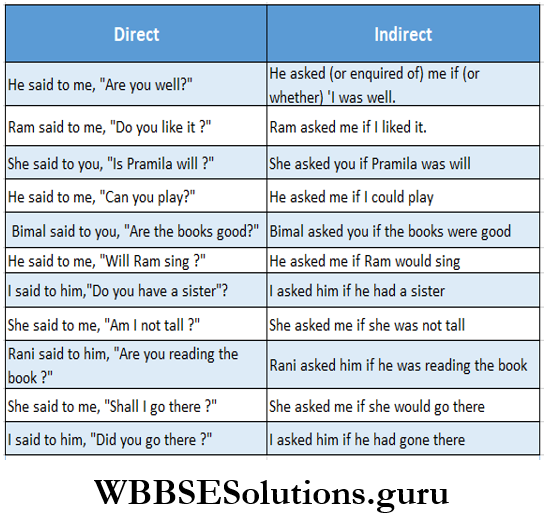
Question 2.
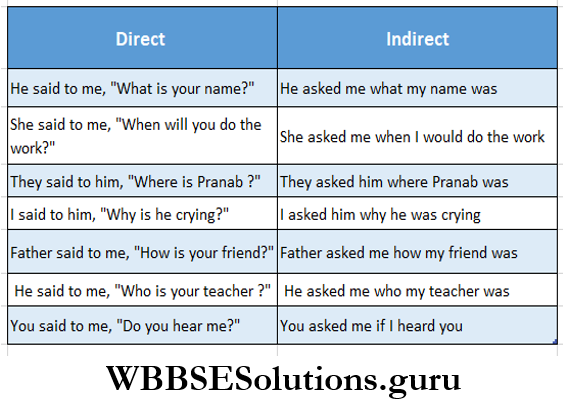
WBBSE Chapter 10 Direct And Indirect Speech Exercise
Change into Indirect form. One is done for you.
I said to him, “Are you happy?”.→ I asked him if he was happy.
She said to me, “When will you come. ?” I said to him, “Why are you so angry?” He says to me, “Have you seen my brother ?” He said, “Where are you going?” The teacher said to me, “Have you
done the work?” I said to him, “What are you doing?” He said, “Is there any hope for me?” She says to me, “Are you angry with me?” The boy said, “Why did you not call me ?” She said to me, “Will you go to Calcutta?”
Arup said to me, “How is your father ?” They said to me, “Will you come to our house?” I said to her, “May I come into your room ?” I said to him, “Do you know his name ?”
| WBBSE Class 8 English Functional Grammar | WBBSE Class 8 English Reading Skills |
| WBBSE Solutions For Class 8 English | WBBSE Solutions For Class 8 Maths |
Imperative Sentences (আদেশ বা অনুরোধজ্ঞাপক বাক্য) (Request, order, advise, suggestion):
এইরকম বাক্যকে Indirect করবার সময়-
1. Reporting Speech-Reporting Verb- request, order, advise, beg, command, entreat বা tell ইত্যাদিতে পরিবর্তিত করবে।
2. Reported Speech-এর Verb-টির পূর্বে “to” বসবে।

অনেক সময় request, order, advise, let, command ইত্যাদি কোন্ Verb-টি ব্যবহার করতে হবে তা সঠিকভাবে স্থির করতে না পারলে “tell” ব্যবহার করাই ভাল।
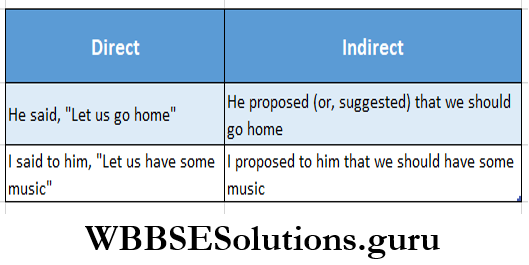
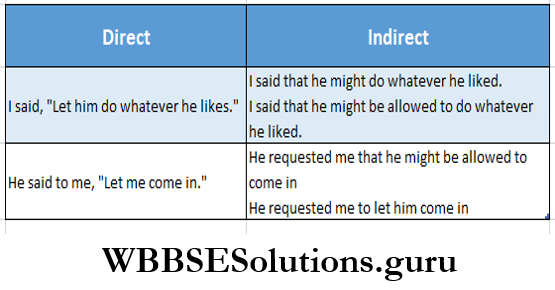
Imperative Sentences with ‘Let’:
Reported Speech অনেক সময় Let’ দিয়ে আরম্ভ হয়।
1. Ler’ দ্বারা কোনো suggestion বা proposal (প্রস্তাব) বোঝালে Reporting Verb-কে propose’ বা ‘suggest’ ইত্যাদিতে পরিবর্তিত করে ‘Let’-এর স্থানে should বসাতে হয়। যথা:
2. কিন্তু ‘Ler দ্বারা কোনো proposal বা suggestion (প্রস্তাব) না বোঝালে অর্থানুসারে let-এর পরিবর্তে ‘might’, ‘might be allowed’ বা ‘to let’ ইত্যাদি verb ব্যবহৃত হয়। যথা
WBBSE Chapter 10 Direct And Indirect Speech Examples Worked Out
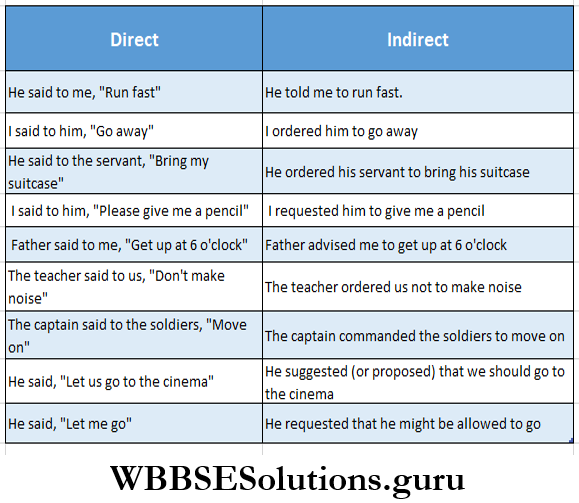
WBBSE Chapter 10 Direct And Indirect Speech Exercise
Change into Indirect Speech. One is done for you.
He said to me, “Go there.” → He ordered me to go there.
She said to him, “Come to my house.” I said to her, “Do not do it.” They said to me, “Try to do it.” The teacher said to him, “Obey your parents.” She said to me, “Come to me and I shall help you.” She said to me, “Do as ‘I tell you.”
He said to me, “Excuse me, please.” He said to me, “Sit down.” She said to me, “Do not go there.” The man said to me, “Please help me.” He said to me, “Let me try.” Ram said to his friends, “Let us do it.” He said to me, “Let us eat.” I said, “Let the boy go.”
Optative Sentences (ইচ্ছা বা প্রার্থনাসূচক বাক্য):
এই রকম বাক্যকে Indirect করবার সময়
1. Reporting Verb-টি অর্থানুযায়ী wish, pray, bless ইত্যাদিতে পরিবর্তিত করবে এবং তার পরে that বসাবে।
2. Optative Sentence-টিকে Assertive Sentence বা Statement-এ পরিবর্তিত করবে।
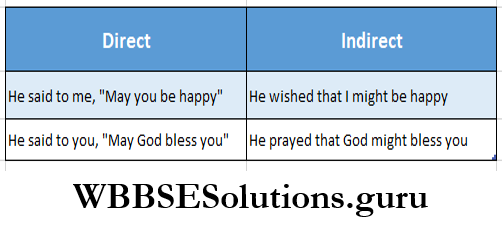
Exclamatory Sentences (বিস্ময়, উচ্ছ্বাস ইত্যাদি জ্ঞাপক বাক্য):
এই রকম বাক্যকে Indirect করতে হলে
1. Reporting Verb-টিকে পরিবর্তন করে মনের আকস্মিক ভাব প্রকাশক একটি verb (exclaim, ery out, pray, wish ইত্যাদি) ব্যবহার করতে হয়। প্রয়োজন হলে অর্থানুযায়ী নতুন কোনো word বা phrase-ও যোগ করতে হয়।
2. Interjection-টি বাদ দিয়ে Exclamatory Sentence-টিকে Assertive Sentence-এ পরিবর্তিত করতে হয়।

অনেক সময় what, how এবং who—এই wordগুলি exclamatory sentence-এ ব্যবহৃত হয়ে আতিশয্য (excess) বা অভাব (absence) বোঝায়। Indirect narration করবার সময় তাদের পরিবর্তে অর্থানুযায়ী greal, greatly, very, very much, none বা ঐজাতীয় word ব্যবহার করতে হয়। যথা

WBBSE Chapter 10 Direct And Indirect Speech Exercise
Change into Indirect Speech. One is done for you.
She said, “How beautiful it is!” → She exclaimed with joy that it was very beautiful.
I said, “What a sight!” I said, “Alas! she is ill.” They said, “Hurrah! we have done it.” He said to her, “May you live long.” You said, “Good morning, my friend.”
He said to us, “May you all succeed.” The old man said, “How happy I am !” The boy said, “Alas! I have no money with me.” He said, “What a fun!”
Words indicating Time and Place:
Reported Speech-এ নিকটে বোঝায় (স্থানবাচক ও কালবাচক) এইরূপ word-গুলি Indirect Speech-এ সাধারণত দূরত্ববোধক অনুরূপ word-এ পরিবর্তিত করতে হয় :

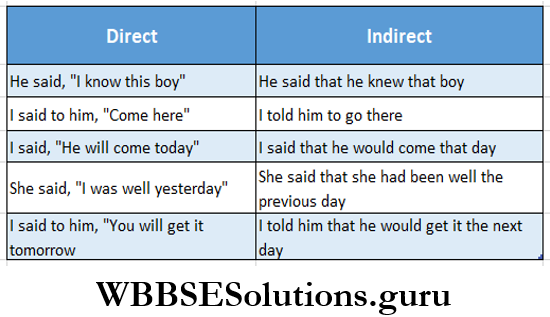
কিন্তু this, here ইত্যাদি word-গুলি যদি বক্তার সম্মুখস্থ কোনো কিছুকে নির্দেশ করে তা হলে Indirect করবার সময় তাদের কোনো পরিবর্তন হয় না। যথা :
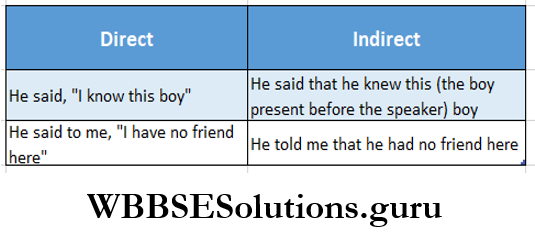
মনে রেখো : ‘It’ কখনো ‘that’ হয় না। , ‘It’ সর্বদাই অপরিবর্তিত থাকে।
WBBSE Chapter 10 Direct And Indirect Speech Exercise
Change into Indirect Speech. One is done for you.
He said to you, “I am busy now.” He told you that he was busy then.
He said to me, “Come again tomorrow.” The girls said, “We shall finish the work today.” He said to me, “Why do you treat me thus ?” I said to him, “We shall be happy here.”
She said, “I have no hope here.” She said, “I saw you yesterday.”
Narration change of passages:
একই passage-এ একই ধরনের একাধিক sentence থাকলে Indirect করবার সময় reporting verb-টি একবারই থাকে এবং sentence-গুলি সাধারণত and, but ইত্যাদি Conjunction দ্বারা যুক্ত হয়। যথা :
Direct : Ram said to me, “What is your name? What do you want ?”
Indirect : Ram asked me what my name was and what I wanted.
Direct : She said, “Ram is a good student. He is very poor.”
Indirect : She said that Ram was a good student but he was very poor.
কোনো-কোনো সময় Direct Narration এ Reported Speech-এর মধ্যে বিভিন্ন প্রকারের sentence থাকে, কোনেটি Assertive, কোনোটি
Interrogative, কোনোটি Imperative, অথবা কোনোটি Exclamatory। এইরূপ speech-কে Indirect করবার সময় পূর্বোক্ত নিয়ম অনুসারে বিভিন্ন প্রকারের verb ব্যবহার করতে হয়। যথা :
Direct : The teacher said, “Stand up, Nabin. Why have you not prepared your lesson ? I shall write to your father.”
Indirect: The teacher ordered Nabin to stand up and asked him why he (Nabin) had not prepared his lesson. He also told him that he would write to his (Nabin’s) father.
Reporting Dialogues and Conversations:
আমাদের প্রাত্যহিক জীবনে আমরা প্রায়ই dialogue, গল্প বা ঘটনা report করে থাকি। এই reporting বক্তা নিজে, শ্রোতা বা অন্য যে কোনো তৃতীয় ব্যক্তি করতে পারে। নীচের উদাহরণটি দেখো :
Anil: Yesterday I told Ramen that my sister would go to Bombay. (Anil) এইবার দেখো Ramen কীভাবে Anil-এর বক্তব্যটিকে নিজের ভাষায় report করছে।
Ramen: Yesterday Anil told me that his sister would go to Bombay. (Ramen). প্রথম Report এবং দ্বিতীয় report-এ Noun / Pronoun-এর পরিবর্তন দেখো) :
I – Changes – To – Anil
Ramen – Changes – To – me
My – Changes – To – hIs
এইবার তৃতীয় কোনো ব্যক্তি উপরের report-টিকে নিজের ভাষায় কীভাবে বলবে তা দেখো
Gopal: Yesterday Anil told Ramen that his sister would go to Bombay.
দ্বিতীয় report-এর সাথে তৃতীয় report-এর পার্থক্য লক্ষ্য করো :
Me – Changes – To – Ramen
এইরূপ আরও কিছু উদাহরণ দেখো :
Conversation Mr. Dutta had with Arati and Anjali last week.
Mr. Dutta: I am your friend’s uncle.
Arati and Anjali: We are your neighbours
এইবার উপরের dialogue-টি তিনভাবে reporting করা হচ্ছে।
1. As reported by Mr. Dutta:
I told Arati and Anjali last week that I was their friend’s uncle. They told me that they were my neighbours.
2. As reported by Arati and Anjali. :
Last week Mr. Dutta told us that he was our friend’s uncle. We told him that we were his neigh- bours.
3. As reported by Shyamali-(a third person):
Last week Mr. Dutta told Arati and Anjali that he was their friend’s uncle. Arati and Anjali said that they were his neighbours.
উপরের report গুলিতে Pronoun-গুলির পরিবর্তন লক্ষ্য করো।
Modification of Tense:
Reporting-এর ক্ষেত্রেও verb-এর পরিবর্তন হয়।
1. Present Continuous Tense Past Continuous Tense:
Pubali and Dipali (at 9 a.m. Yesterday): We are painting pictures.
Ruma: I am reading a book.
Reported by a third person:
Yesterday at 9 a.m. Pubali and Dipali told Ruma that they were painting pictures. Ruma told them that she was reading a book.
2. Will+verb (simple future) usually changes into would + verb.
Teacher: I will teach you English in the morning.
Student: I will work hard to learn it.
Reported by a third person:
The teacher told the student that he would teach the student English in the morning. The student replied that he would work hard to learn it.
3. Simple Past Tense reporting-এর ক্ষেত্রে Past Perfect Tense- এ রূপান্তরিত হয়।:
Teacher: Akbar built Fatehpur Sikri.
Student: Shahjahan built the Taj Mahal.
Reported by a third person:
The teacher told the student that Akbar had built Fatehpur Sikri. The student told him that Shahjahan had built the Taj Maha
Reporting-এর ক্ষেত্রে নিম্নলিখিত পরিবর্তনগুলি করা হয় :
Can – Changes – To – Could
May – Changes – To – Might
As reported by a third person: Ten years ago Mr. Sen told Malabika that he could do it in half an hour. Malabika told him that she could dance for two hours.
WBBSE Chapter 10 Direct And Indirect Speech Exercise
1. Change the following from Direct to Indirect Speech:
Rita says, “You are tall.” He said to me, “Go away.” He said to me. “What do you want?” I said to him, “Don’t shout.” He said to her, “When will you play?” They said to me, “Are you sick?” You said, “I have a bag.”
She said to him, “Please go there.” I said to him, “You are wrong.” She says, “I shall go to your house.” They said to her, “You have done a great wrong.”
The teacher said to the girl, “Why do you cry?” I said to him, “When will you come ?” The boy said, “I swim in the pond everyday.”
She said to him, “Can you do this sum?” The boy said to me, “Help me.” He will say, “I have seen the picture.” The lady said, “Let us read the book again.”
Father said to me, “Do not go there.” You said to them, “Have you done the work ?” The boy said, “Alas! she is no more.” She said to me, “May I come in ?” Salil said, “What a fool I am.”
The teacher said, “Let him go there.” I said to her, “Make no noise.” I said to her, “Go to school at once.” He said to the members, “Obey the. chair.”
The girl said, “I am reading a book now.” She said to him, “Is there no hope for me?” The boy said, “We went to the fair yesterday.” She said to me, “I was drawing a picture.”
He said, “The sun rises in the east.” I said, “The sky is blue.” You said to your mother, “I shall obey you.” He said to you, “I shall go there tomorrow.” You will say, “I am busy.” He said to me, “Come again tomorrow.” The girls said to me, “We shall finish the work today.”
The police said to the boy, “Who is your master?” The son said to his mother. “Please give me a rupee.” She asked me, “When will you come to our house?” The teacher said to me, “Never go there.”
2. Report the following dialogues. One is done for you:
1. The wolf asked, “What are you carrying in the basket ?” “Food for my grandmother”, said the girl. “Where does your grandmother live ?” asked the wolf.
Answer: The wolf asked the girl what she was carrying in the basket. The girl replied that it was food for her grandmother. The wolf then asked her where her grandmother lives.
2.
Rama : Did you see my white dog?
Chameli : Yes, it was playing in the field.
Rama: But, where has it gone now?
Chameli: I cannot tell you that.
3.
Bina: Hallo! What a good news. I am really glad to hear that you have got first division.
Lekha: Thank you very much.