
WBBSE Chapter 16 Clauses
As he is ill, he cannot come.
This is the boy who did it.
প্রথম বাক্যে দুইটি অংশ “As he is ill” এবং “he cannot come” – প্রত্যেকটি একটি সম্পূর্ণ Sentence, কারণ প্রত্যেকটিতেই Subject ও Predicate আছে। আবার প্রত্যেকটিই “As he is ill, he cannot come”—এই সম্পূর্ণ Sentence-টির একটি অংশ।
এইরূপ দ্বিতীয় বাক্যে “who did it” ও “This is the boy”—এই দুইটি ছোটো Sentence সম্পূর্ণ বড়ো Sentence-এর অংশ।
এইরূপ যে ছোটো Sentence কোনো বৃহত্তর Sentence-এর অংশ তাকে Clause বলে। A Clause is a sentence forming part of a bigger sentence.
Kinds of Clauses
Clause তিন শ্রেণির, যথা ঃ
- Principal Clause
- Subordinate বা Dependent
- Co-ordinating Clause
Principal Subordinate Dependent Clause
- As he is ill, he cannot come.
- This is the boy who did it.
উপরের উদাহরণ দুটি নিয়ে আরও আলোচনা করা যাকঃ
Read And Learn More WBBSE Class 8 English Functional Grammar
প্রথম উদাহরণে “he cannot come” এই clause-টিই প্রধান বক্তব্য প্রকাশ করছে। “As he is ill” এই clause-টি “he cannot come”—এই clause-টির উপর নির্ভর না করে সম্পূর্ণ বক্তব্য প্রকাশ করতে পারে না।
দ্বিতীয় বাক্যে “This is the boy” এই clause-টিই প্রধান বক্তব্য প্রকাশ করছে। “who did it” এই clause-টি “this is the boy” এই clause-টির উপর নির্ভর না করে সম্পূর্ণ অর্থ প্রকাশ করতে পারে না।
এইরূপ যে Clause প্রধান বক্তব্য প্রকাশ করে তাকে Principal Clause এবং যে Clause অন্য Clause-এর উপর নির্ভরশীল তাকে Dependent Clause বা Subordinate Clause বলে।
A clause that is dependent on another clause is called a Subordinate or Dependent Clause. A clause which stands by itself and on which the Subordinate Clause depends is called the Principal Clause.is ill” “who did it”
“he cannot come” “this is the boy”
| WBBSE Class 8 English Functional Grammar | WBBSE Class 8 English Reading Skills |
| WBBSE Solutions For Class 8 English | WBBSE Solutions For Class 8 Maths |
নীচের sentence-গুলিতে আরও কিছু Principal ও Subordinate Clause-এর উদাহরণ দেওয়া হল ঃ
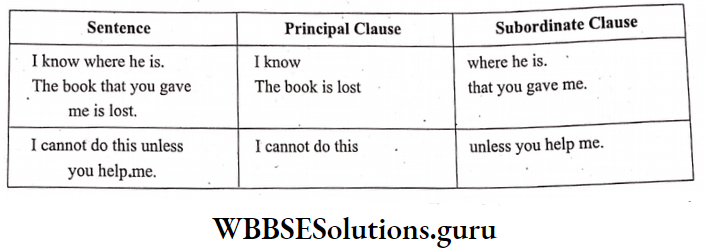
মনে রেখো, Finite Verb-ই Clause-এর মূল জিনিস। প্রত্যেক Clause-এ একটি Finite Verb থাকতে হবে এবং একটি Sentence-এ যতটি Finite Verb’ ততটি Clause থাকে।
Co-ordinate Clause
নীচের sentence-গুলি দেখোঁ :
He went home and then left for Delhi.
He is poor, but he will help you.
প্রথম বাক্যে “He went home” এবং “then (he) left for Delhi” এই দুইটি clauses ; কিন্তু কেউ কারও উপর নির্ভর না করে পুরোপুরি অর্থ বোঝায়। এরা উভয়েই সমপদস্থ এবং and দ্বারা যুক্ত হয়েছে। দ্বিতীয় বাক্যে “He is poor” ও “he will help you”এই দুইটি clauses সমপদস্থ, bit দ্বারা যুক্ত হয়েছে।
বলে।
এইরূপ একই sentence-এর মধ্যে সমপদস্থ যে সব clause থাকে তাদেরকে Co-ordinate Clause
A Co-ordinate Clause is of the same rank as another and is connected by a Co-ordinating Conjunction with the latter.
Co-ordinating clause- and, but, for, or, not only – but also, either-or, neither-nor, therefore Co-ordinating Conjunctions
He left the place, but I remained there.
He is poor and cannot do it.
Either you must come or I shall go.
I cannot come, for I am ill.
Read or you will fail.
Subordinate Clauses তিন রকমের :
- Noun Clause – Noun
- Adjective Clause – Adjective
- Adverbial Clause – Adverb
Noun Clause
Noun Clause বাক্যে Noun-এর কাজ করে। এটি সাধারণত Conjunction that (expressed or understood) what, whose, how, why Interrogative Pronoun Interrogative Adverb
Noun Clause-কে Nominal Clause ও বলা হয়।
Noun Clause-এর ব্যবহার :
1. Subject to a verb:
That he is ill is known to all.
When he will come is uncertain.
বাক্য দুটিতে “That he is ill” ও “When he will come” এই দুটি Noun Clauses যথাক্রমে ‘is known” ও “is”-Subjects.
2. Object to a verb:
I know when he will come.
He said that he would go.
বাক্য দুটিতে “when he will come” ও “that he would go ” এই দুটি Noun Clauses যথাক্রমে “know” “said”- Objects.
3. Object to a preposition:
It rests on how he behaves.
এখানে Noun Clause-টি “on” এই Preposition-এর Object-রূপে ব্যবহৃত হচ্ছে।
4. In apposition to a noun or “it”.
There is a rumour that he is ill.
It is true that he has come.
“that he is ill” “that he has come” “rumour” “it”- Apposition.
Adjective Clause
Adjective Clause বাক্যে adjective-এর কাজ করে এবং ইহা কোনো Noun বা Pronoun-কে qualify করবে। এরা সাধারণতঃ Relative Pronoun বা Relative Adverb দ্বারা introduced হয় :
Relative Pronouns-who, which, that, as.
Relative Adverbs-when, where, how, why, whence, as.
Adjective Clause-এর ব্যবহার :
I know the boy who did it.
This is the place where he was born.
I have lost the book (which) you gave me.
I know the time when he will come.
This is the reason why he failed.
উপরের বাক্যগুলিতে italicised clauses পাঁচটি যথাক্রমে “boy”, “place”, “book”, “time”, “reason”-কে Adjective রূপে qualify করছে।
লক্ষ্য করো, প্রত্যেকটি Subordinate Clause একটি Relative Pronoun বা Relative Adverb দ্বারা আরম্ভ হয়েছে, এবং এই Relative-এর Antecedent আছে। সেইজন্য Adjective Clause-কে অনেক সময় Relative Clause বলা Antecedent Clause- Noun Clause 1, I know who did it (object to know).
I have lost what you gave me. (obj. to have lost)
নীচের উদাহরণগুলি দেখো :
1. I know the boy who did it.
এখানে Adjective Clause-টি who এই Relative Pronoun দ্বারা শুরু হয়েছে। Adjective Clause which, what, that, whatever, whoever প্রভৃতি অন্যান্য Relative Pronoun দ্বারাও শুরু হতে পারে।
2. I know the reason why (for which) he was crying.
এখানে Adjective Clause-টি why এই Relative Adverb দ্বারা শুরু হয়েছে। where = in which, when (= on which, at which) প্রভৃতি অন্যান্য Relative Adverb দ্বারাও Adjective clause শুরু হতে পারে :
This is the place where he was born.
I know the time when he will come.
Non-Defining Relative Clause
My grandmother, who is over ninety, is still healthy.
উপরের sentence-টি হতে “who is over ninety” এই Relative Clause-টি সরিয়ে নিয়ে sentence-টি হয় My grandmother is still healthy এবং sentence-টিতে এটাই আসল কথা। অর্থাৎ who is over ninety—এই word-গুলি দ্বারা grandmother সম্বন্ধে বেশি information দেওয়া হয়েছে।
এইরূপে যে clause-দ্বারা Noun সম্বন্ধে অতিরিক্ত information দেওয়া হয় তাকে Non-Defining Relative Clause বলা হয়। আরও উদাহরণ :
Rabin babu, who is a teacher, lives here.
My uncle, whom everybody loves, is in Kanpur.
WBBSE Chapter 16 Clauses Examples
Question 1. Join the words under Column A with those under B using the Relative Pronouns ‘who’, ‘what’, ‘whose’, ‘which’, ‘whom’, ‘that’ to complete the sentences. Two are done for you.
Answer:
It is Arun whose uncle is a doctor.
This is the story that was told by Ramen.
Question 2. Join the pair of sentences using a Relative Pronoun where necessary. Begin the new sentence with words given in italics. (You may change a or a to the if necessary). One is done for you.
I am reading a book. It has two pages missing.
Answer: The book that I am reading has two pages missing.
- We used to live in a flat. It has just been sold.
- An old lady lives in this house. She is over seventy.
- Pranab wrote this book. He lives at Jadavpore.
- You are looking for Pranati. She has just come.
- The boy is my brother. He came top in the examination.
- My sister gave me a wall clock. It costs over five hundred rupees.
Adverbial Clause
Adverbial clause বাক্যে Adverbial-এর কাজ করে। ইহা কোনো Verb, Adjective বা অন্য Adverb-কে modify করে। Adverbial clause নিম্নলিখিত প্রকারের হয় :
1. Adverbial Clauses of Time এর দ্বারা সময় নির্দেশ হয় এবং এর পূর্বে সাধারণতঃ when, while, after, before, till, until, since
He came when I was there. You went after I had come.
Strike while the iron is hot.
2. Adverbial Clauses of Place এর দ্বারা কোনো স্থান নির্দেশ হয় এবং এর পূর্বে সাধারণতঃ where, whence, wherever প্রভৃতি শব্দ ব্যবহৃত হয়। যথা ঃ
Stay where you are.
Return whence you came.
3. Adverbial Clauses of Reason or Cause – Because, as, since, that প্রভৃতি শব্দগুলি এইরূপ clause-এর পূর্বে বসে। যথাঃ
He cannot come because he is ill.
As he is ill, he cannot come.
Since you are ill, you need not come.
4. Adverbial Clauses of Purpose এর দ্বারা কোনো উদ্দেশ্য বোঝায় এবং এর পূর্বে সাধারণতঃ that, in order that, so that, lest
We read that we may learn.
He works hard in order that he may succeed.
5. Adverbial Clauses of Result that, so that, such, that ইত্যাদি শব্দ বসে। যথা ঃযথাঃ
What have I done that you rebuke me?
I am so tired that I cannot walk.
He is such a fool that I cannot depend on him.
6. Adverbial Clauses of Manner এর দ্বারা ধরন বা রকম বোঝায় এবং এর পূর্বে as ব্যবহৃত হয়।
Travel as you like.
It happened as I expected.
7. Adverbial Clauses of Condition or Supposition এর দ্বারা কোনো শর্ত বোঝায় এবং এর পূর্বে if, unless, in case, whether, on condition, supposing that f যথাঃ
If I succeed, I shall help you.
I shall not go unless you come.
I may come in case I have time.
8. Adverbial Clauses of Concessions though, although, even if, even
Though he is poor, he is honest.
I shall go even if you do not come with me.
9. Adverbial Clauses of Comparison or Degree এর দ্বারা তুলনা বোঝায় এবং এর পূর্বে so-as, as-as, than প্রভৃতি শব্দ বসে। যথাঃ
He is not so fooling as you think.
He is as wise as you (are).
e is taller than you (are).
একই Clause প্রয়োগ অনুসারে তিন প্রকারেরই হতে পারে :
I know where he lives-Noun clause, object to ‘know’.
I know the place where he lives-Adj. clause, qualifying the noun ‘place’.
I shall go where he lives-Adv. clause, modifying the verb ‘shall go.’
Question 3. Find out the Noun, Adjective, Adverbial clauses from the following sentences:
Answer:
Noun clause:
- I know where he lives. – where he lives
- I know when he will come. – when he will come
- The truth is he is ill. – he is ill
- When he will come is uncertain. – when he will come
- I heard what he had said. – what he had said
- I do not believe what he says. – what he says
- It depends on how he fares. – how he fares
- It is said that he will resign. – that he will resign
- That he is intelligent is admitted by all.- that he is intelligent
Adjective Clause:
- The book that you gave me is lost. – that you gave me
- This is the man whom I saw.- whom I saw
- I know the day when he will come – when he will come
- The plan that you wish to follow is very complicated. – that you wish to follow
- The girls you saw are my sisters. – you saw
- The story that you told me is very interesting – that you told me
- People who are. rich are not always happy.- who are rich
- Tell me the way how he did it.- the way how he did it
Adverbial Clause:
- He came here when there was none.- when there was none
- As he is ill, he cannot come. – As he is ill
- If you sit idle, you cannot. prosper. – If you sit idle
- He could not come since he is ill. – since he is ill
- Do as I tell you.- as I tell you
- Because you are ill, you should take rest – Because you are ill
- He spoke so loud that everybody could hear him.- so loud that everybody could hear him
- When I was a child, I learnt how to swim.- when I was a child
- Though he is weak, he will try – though he is weak
More About Conditional Sentences
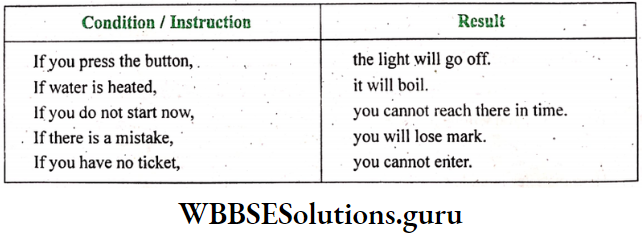
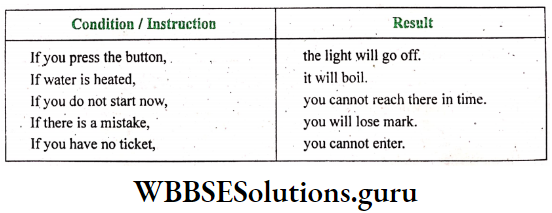
‘If’ clause সর্বদাই conditional sentence-এ ব্যবহৃত হয় এবং তা sentence-এর প্রথমে বা পরে বসতে পারে। এতে sentence-এর অর্থের কোনো পরিবর্তন হয় না। Instruction দিতেও এই clause ব্যবহৃত হয়। নীচের উদাহরণগুলি লক্ষ্য করো।
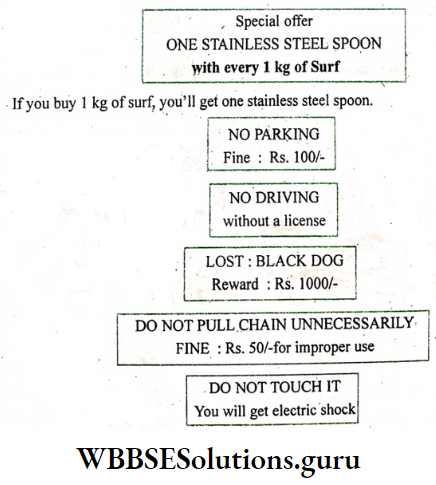
Question 4. Write a conditional sentence for each of the following signs. One is done for you.
Answer:
1.
2.

You’ll Probably Be Safe If You Stay In Your Car.

You’ll Probably Get An Electric Shock.

You’ll Probably Cause A Fire.
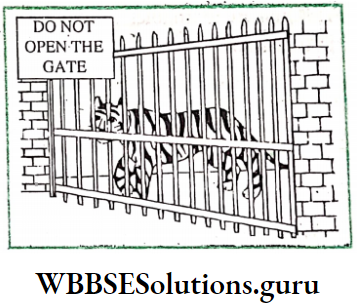
The Tiger Will Probably Bite You.
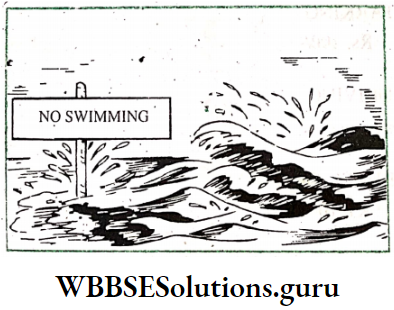
You’ll Probably Get Into Difficulties.
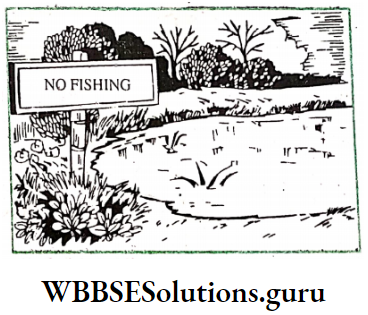
You’ll Probably Get Into Troubles.