
WBBSE Solutions For Class 8 English Functional Grammar Chapter 2 Pronouns
Pronoun এবং Pronoun-এর বিভিন্ন রূপ তোমরা পূর্বে পড়েছ। নীচে Reflexive Pronoun, Emphatic Pronoun এবং Relative Pronoun’ সম্বন্ধে আলোচনা করা হল।
WBBSE Chapter 2 Pronouns Reflexive Emphatic
My, your, him, her, it-এর পরে — “self” এবং our, your, them-এর পরে – “selves” যোগ করে Reflexive ও Emphatic Pronoun গঠিত হয়। নীচের chart-টি দেখো :

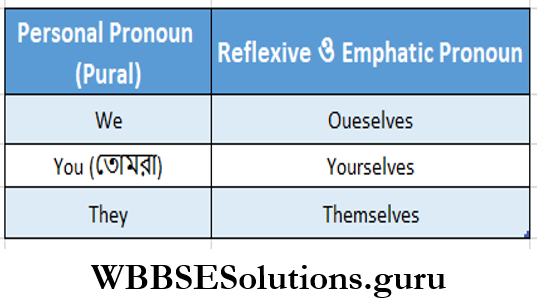
Reflexive ও Emphatic Pronoun এর forms এক রকম হলেও এদের ব্যবহারে পার্থক্য আছে।
WBBSE Solutions For Class 8 English Functional Grammar Chapter 2 Pronouns Reflexive Pronoun
- He hurt himself — সে নিজেকে আঘাত করল।
- She gave herself much trouble — সে নিজেকে খুব কষ্ট দিল।
- They lost themselves — তারা নিজেদের হারিয়ে ফেলল।
- Take care of yourselves – (তোমরা) নিজেদের প্রতি যত্ন নাও।
- I wash myself when I get up — আমি ঘুম হতে উঠে হাত মুখ ধুই।
Read And Learn More WBBSE Class 8 English Functional Grammar
উপরের প্রথম sentence-টিতে He যে ব্যক্তি himself-ও সেই ব্যক্তি অর্থাৎ subject ও object একই ব্যক্তি। সেরূপভাবে অন্যান্য সবগুলি sentence-এ subject ও object একই ব্যক্তি ।
Subject ও Object যখন একই ব্যক্তি বা বস্তুকে বোঝায়, তখন Reflexive Pronoun দ্বারা Object-টি বোঝায়। উপরের উদাহরণগুলিতে himself, herself, themselves, yourselves, myself & Reflexive Pronoun 4 4 Reflexive Pronoun-গুলিই object.
WBBSE Solutions For Class 8 English Functional Grammar Chapter 2 Pronouns Emphatic Pronoun
- I myself did it—আমি নিজেই এটা করেছিলাম।
- He himself will do it — সে নিজেই এটা করবে।
- They themselves were present there —তারা নিজেরাই সেখানে উপস্থিত ছিল।
পূর্বের প্রথম sentence-টিতে ‘আমি’ ছাড়া আর যে কেউ কাজটি করেনি তা জোর দিয়ে বোঝাবার জন্য “myself ” wordটি ব্যবহৃত হয়েছে। ‘Myself” wordটি এখানে ‘I’-এই Pronoun-কে emphasise করতে (অর্থাৎ বিশেষ করে নির্দেশ করতে) ব্যবহৃত হয়েছে। সেরকমভাবে দ্বিতীয় sentence-এ ‘himself’ wordy দ্বারা ‘He’-এর উপর এবং তৃতীয় sentence-এ ‘themselves’ word টি দ্বারা ‘They’-এর উপর emphasise (বিশেষভাবে নির্দেশ) করা হয়েছে।
Myself, himself, themselvesword-s Noun Pronoun- emphasise করতে অর্থাৎ তাদের উপর জোর দেবার জন্য ব্যবহৃত হয় তখন তাদের Emphatic Pronoun হয়। নীচে আরও কতকগুলি sentence- এ Emphatic Pronoun এর ব্যবহার লক্ষ্য করো :
- You yourself can do it—তুমি নিজেই এটা করতে পার।
- The girl herself did the sum- মেয়েটি নিজেই অঙ্কটি কষে ছিল।
- I myself saw the man – আমি নিজেই লোকটিকে দেখেছিলাম।
- I saw the man himself — আমি লোকটিকেই দেখেছিলাম (অন্য কাউকে নয়)।
| WBBSE Class 8 English Functional Grammar | WBBSE Class 8 English Reading Skills |
| WBBSE Solutions For Class 8 English | WBBSE Solutions For Class 8 Maths |
WBBSE Solutions For Class 8 English Functional Grammar Chapter 2 Pronouns Examples Worked Out
1. Combine the following sets of sentences using suitable “self” forms.
Question 1. The boys swept and cleaned the ground. Nobody helped them.
Answer: The boys themselves swept and cleaned the ground
Question 2. Samik does his homework. He does not take anybody’s help.
Answer: Samik does his homework all by himself
Question 3. My mother prepares our food. She takes nobody’s help.
Answer: My mother herself prepares our food
Question 4. I went to Delhi. I did not ask anybody to go to Delhi for me,
Answer: I myself went to Delhi
Question 5. I talked to Ramen. I did not talk to anybody else.
Answer: I talked to Ramen himself
Question 6. Samir went to the market. Nobody accompanied him.
Answer: Samir himself went to market
WBBSE Solutions For Class 8 English Functional Grammar Chapter 2 Pronouns Relative Pronoun
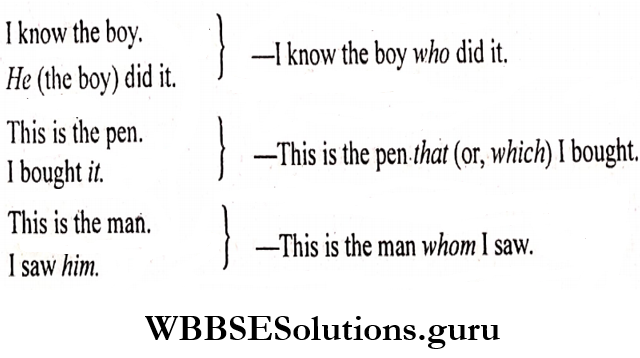
পূর্বের উদাহরণগুলির ডানদিকের বাক্যে who, that বা which, whom যথাক্রমে বামদিকের একটি বাক্যের একটি Noun বা Pronoun-এর পরিবর্তে বসে এই দুইটি বাক্যকে সংযুক্ত করেছে। এইরূপ __
যে সমস্ত Pronoun পূর্ববর্তী কোনো Noun বা Pronoun-এর পরিবর্তে বসে দুইটি বাক্য বা বাক্যাংশকে যুক্ত করে তাদেরকে Relative Pronoun বলে।
A Relative Pronoun is a word that not only refers to some Noun or Pronoun mentioned before but also joins two sentences or parts thereof: who, which, that, what, whose, whom.
Antecedent : Relative Pronoun-টি যে word পরিবর্তে বসে তাকে তার Antecedent বলে।
যথা : He is the boy who did it
এখানে who এই Relative Pronoun-টি পূর্ববর্তী boy-এর পরিবর্তে বসেছে। অতএব boy কথাটি who-এর Antecedent.
উপরের sentence-গুলিতে boy, pen ও man যথাক্রমে who, that (or which) ও whom এর antecedents.
WBBSE Solutions For Class 8 English Functional Grammar Chapter 2 Pronouns Relative Pronoun-এর ব্যবহার
1. Who (ও, তার রূপান্তর whom এবং whase) শুধু ব্যক্তি বা persons-এর পরিবর্তে বসে।
যথা :
- This is the boy who came.
- She is the girl whose father is ill.
- He knows the man whom I saw.
2. Which শুধু বন্ধু, ইতর প্রাণী ও শিশুর পরিবর্তে বসে।
যথা :
- This is the book which he bought.
- This is the dog that I saw.
- The baby which was crying is now quiet.
3. What শুধু বস্তুর পরিবর্তে বসে।
যথা :
- I know what he says.
4. That ব্যক্তি, বস্তু ও ইতর প্রাণী সকলের পরিবর্তেই বসে।
যথা :
- This is the boy that (also who did it.
- This is the pen that (also which) I bought.
- I have seen the dog that (also which) he bought.
5. Same ও such-এর পর যখন ‘a’ বসে তখন ঐ ‘as’ Relative Pronoun.
যথা :
- This is the same book as ( যা) that.
- Such a man as he cannot do this.
6. But-এর অর্থ যখন who not অর্থাৎ “যে না” বোঝায় তখন সেটা Relative Pronoun.
যথা :
- There is no mother but loves (= who does not love ) her child.
WBBSE Chapter 2 Pronouns Examples Worked Out
1. Join the following sentences using Relative Pronouns:
Question 1. This is a horse. It won the race.
Answer: This is the horse that won the race.
Question 2. There is a man. He saved my life.
Answer: There is the man who saved my life
Question 3. These are the pens. We lost them yesterday.
Answer: These are the pens that we lost yesterday
Question 4. I met a man. You know him.
Answer: I met a man whom you know
Question 5. He sent me a gift yesterday. I received it.
Answer: I received the gift (or, that) he sent me yesterday
Question 6.I have given him a book. He wanted it.
Answer: I have given him the book which (or, that) he wanted
Question 7. This is the beggar. He stole my purse.
Answer: This is the beggar who stole my purse
Question 8. He is a man. You can trust him
Answer: He is the man whom you can trust