Reading Skill Seen Lesson 13 The Man Who Planted Trees
Word meanings:
Part 1
hike (হাইক)—দীর্ঘ পদযাত্রা ; absolutely (অ্যাবসলিউট্লি)—সম্পূর্ণরূপে, একেবারে; penetrate (পেনিট্রেট)— প্রবেশ করেছে ; Provence (প্রভেন্স ) – দক্ষিণ-পূর্ব ফ্রান্সের একটি পূর্বতন প্রদেশ; barren (ব্যারেন) — অনুর্বর ; monotonous : (মনোটোনাস)—একঘেয়ে; wild (ওয়াইল্ড) – বুনো; desolation (ডেসোলেশন) — নির্জনতা; abandoned (অ্যাবান্ডাড —পরিত্যক্ত; ruined (রুইল্ড) – ধ্বংসপ্রাপ্ত, ভাঙ্গাচোরা; spring (স্প্রিং) – ঝরনা ; plenty of sun— রোদে ভরা; continually (কন্টিউনিয়ালি)—একনাগাড়ে।
Part 2
dryness (ড্রাইনেস্)—শুষ্কতা ; woody (উডি) – কাঠ কাঠ ; headed (হেডেড) – এগিয়ে গেলাম; shepherd (শেফার্ড)–মেষপালক; scorching (স্করচিং) – খুব গরম, ঝলসানো; dispersed (ডিস্পার্সড) – ছড়িয়ে ছিটিয়ে থাকা; flanks (ফ্ল্যঙ্কস্)—আশেপাশে; inhabited (ইহ্যাবিটেড)—বাস করত; charcoal (চারকোল্) – কাঠকয়লা; acorns (অ্যাকর্নস) – ওক গাছের বীজ; separating (সেপারেটিং) – আলাদা করা; intrigued (ইট্রি গড)— কৌতূহল হচ্ছিল।
Read And Learn Also WBBSE Class 8 English Reading Skills
Part 3
soak (সোক)—ভেজানো; pound (পাউন্ড) – ঠোকা; solitary (সলিটারী) – নিঃসঙ্গভাবে, একা একা; solitude (সলিচুড়)—নির্জনতা; pleasure (প্লেজার) – আনন্দ, তৃপ্তি; concluded (কনক্লুডেড) – সিদ্ধান্তে উপনীত হল; resolved (রিসলড)—মনস্থির করল, ঠিক করল; remedy (রেমিডি) – সুরাহা করা, প্রতিকার করা; parted (পার্টেড)—বিদায় নিলাম; trail (ট্রেল্)—চলার পথ; deserted (ডেসার্টেড)—পরিত্যক্ত; disturbed (ডিস্টার্বড)—বিচলিত; impressive (ইমপ্রেসিভ)—চোখ জুড়ানো; speechless (স্পিচ্লেশ)—হতবাক্ ; sprung (স্প্রাং)— গজিয়ে উঠেছে; soul (সোল্) – আন্তরিক প্রচেষ্টা; technical (টেক্নিকাল) – প্রযুক্তিগত; aid (এইড্ )–সাহায্য; effective (এফেক্টিভ)—কার্য্যকারী; ফলপ্রসূ; domains (ডোমেইন্স্) – ক্ষেত্রে; destruction (ডেস্ট্রাকশান্)—ধ্বংস।

Reading Skill Seen Lesson 13 The Man Who Planted Trees Examples
Read the texts carefully and do as directed.
Question 1. About forty years ago I went on a long hike through hills absolutely unknown to tourists, in that very old region where the Alps penetrate into Provence. It consisted of barren and monotonous lands. Nothing grew there except wild lavender.
I was crossing this country at its widest part, and after walking for three days, I found myself in the most complete desolation. I was camped next to an abandoned village. I had used the last of my water the day before and I needed to find more. These ruined houses of the village made me think that there must, at one time, have been a spring or a well there. There was indeed a spring, but it was dry. All life had disappeared.
| WBBSE Class 8 English Functional Grammar | WBBSE Class 8 English Reading Skills |
| WBBSE Solutions For Class 8 English | WBBSE Solutions For Class 8 Maths |
1. Answer the questions below:
- Where did the author go about forty years ago?
- How was the place where the author went ?
- What was the author’s feeling after walking for three days?
- Where did the author camp?
- Why do you think the village was abandoned?
Answer:
- About forty years ago the author went on a long hike to a hilly region where the Alps penetrated into Provence.
- The place was totally barren and monotonous, and nothing grew there except wild lavender.
- After walking for three days, the author found himself in a state of complete desolation.
- The author camped next to an abandoned village.
- The author could see only ruined houses in the village. There was no trace of any water source. There was a spring, but it was dry. There was no sign of any life. The village, therefore, looked abandoned.
2. Choose the correct answers from the alternatives given.
Question 1. The author was speaking of his experience
- Of recent times,
- About forty years ago,
- Of his childhood.
Answer: 2. About forty years ago
Question 2. Alps is the name of a famous-
- Mountain range,
- River,
- Desert.
Answer: 1. Mountain range
Question 3. The village near which the author was camped looked-
- Moderately inhabited,
- Densely populated,
- Abandoned.
Answer: 3. Abandoned
Question 4. The land could produce-
- Plants of all types,
- Only wild lavender,
- Oak trees.
Answer: 2. Only wild lavender
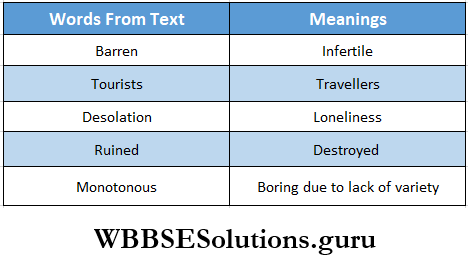
3. Complete the table with information from the text.

Answer:
Question 2. Everywhere there was the same dryness, the same stiff, woody plants. I thought I saw in the distance the shadow of a figure. On a chance I headed towards it. It was a shepherd. Thirty lambs or so were resting near him on the scorching ground.
He gave me a drink and a little later he led me to his shepherd’s cottage. He shared his soup with me. It had been agreed immediately that I would pass the night there, the closest village being still more than a day and a half farther on. There are four or five villages dispersed far from one another on the flanks of the hills in this area. They are inhabited by woodcutters who make charcoal.
1. Complete the sentences with information from the text.
Question 1. The author saw from a distance __________
Answer: The author saw from a distance the shadow of a figure which, in fact, was that of a shepherd.
Question 2. After giving him a drink, the shepherd led __________
Answer: After giving him a drink, the shepherd led the author to his cottage.
Question 3. The shepherd’s cottage would be the shelter for the author __________
Answer: The shepherd’s cottage would be the shelter. for the author for the might as the closest village was still more than a day and a half farther on.
Question 4. The shepherd shared his __________
Answer: The shepherd shared his soup with the author.
Question 5. On the flanks of the hill there __________
Answer: On the flanks of the hill there are four or five villages dispersed far from one another.
2. Write ‘T’ for true and ‘F’ for false statements.
Question 1. The area the author reached was different from the areas he visited earlier.
Answer: False
Question 2. The shadow the author had seen was that of the lambs.
Answer: False
Question 3. The shepherd was very helpful to the author.
Answer: True
Question 4. The villages were inhabited by woodcutters.
Answer: True
Question 5. The shepherd offered rice to the author.
Answer: False
3. Rearrange the following sentences in the correct order as they happened.
1. The shepherd gave the author a drink.
2. He headed towards it.
3. He shared his soup with the author.
4. The author saw the shadow of a figure from a distance.
5. He took him to his cottage.
6. The author agreed to pass the night in the shepherd’s cottage.
7. It was a shepherd.
Answer:
4. The author saw the shadow of a figure from a distance.
2. He headed towards it.
6. The author agreed to pass the night in the shepherd’s cottage.
1. The shepherd gave the author a drink.
5. He took him to his cottage.
7. It was a shepherd.
3. He shared his soup with the author.
4. Match the words with their meanings.
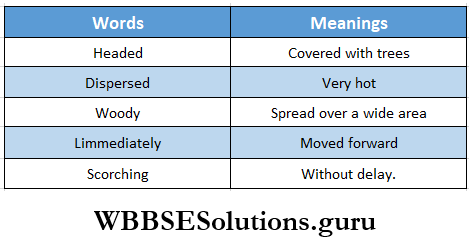
Answer:
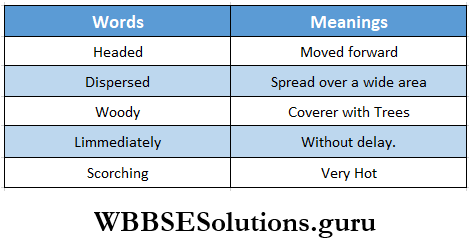
Question 3. The shepherd took out a bag and poured a pile of acorns out onto the table. He began to examine them one after another with a great deal of attention, separating the good ones from the bad. When he had before him one hundred perfect acorns he stopped, and we went to bed. The company of this man brought me a feeling of peace. He gave me the impression that nothing could disturb him. I was intrigued and I wanted to find out more about this man.
1. Answer the questions below:
- “The shepherd took out a bag”-What did the bag contain?
- What did the shepherd do with the a corn?
- How did the author feel?
- Why did the author feel intrigued?
Answer:
- Before going out the next day, the shepherd soaked the acorns in a bucket of water.
- The shepherd dug the ground with an iron rod and made several holes. He then placed an acorn in each hole and filled the hole again with soil.
- The shepherd planted one hundred acorns when the author was with him.
- So far he planted one hundred thousand acorns and, of them, twenty thousand survived.
2. Complete the sentences with information from the text.
Question 1. With a great deal of attention, the shepherd ___________
Answer: With a great deal of attention, the shepherd began to examine the acorns, separating the good ones from the bad.
Question 2. The shepherd stopped his job __________
Answer: The shepherd stopped his job when he collected one hundred perfect acorns.
Question 3. The shepherd poured a __________
Answer: The shepherd poured a pile of acorns out onto a table.
Question 4. The author developed the impression that __________
Answer: The author developed the impression that nothing could disturb the shepherd.
Question 5. The company of the shepherd brought the author __________
Answer: The company of the shepherd brought the author a feeling of peace.
3. Choose the correct answers from the alternatives given:
Question 1. From the bag, the shepherd took out many-
- Coins,
- Charcoal pieces,
- Acorns.
Answer: 3. Acorns
Question 2. The shepherd chose to retain-
- All the acorns,
- The bad acorns,
- The good acorns.
Answer: 3. The good acorns
Question 3. Seeing the shepherd’s activities, the author became
- Curious,
- Shocked,
- Frightened.
Answer: 1. Curious
Question 4. The author wanted to know
- About the acorns,
- More about the shepherd,
- About the shepherd’s village.
Answer: 2. More about the shepherd
4. Make sentences of your own with the following words taken from the text.
- Examine;
- Attention;
- Company;
- Disturb;
- Perfect.
Answer:
- Her mother started to examine the articles he had brought.
- He turned his attention back to his lessons.
- I enjoyed his company during the journey.
- I am sorry to disturb you.
- It was a perfect day for picnic.
Question 4. Before going out the next day, he soaked in a bucket of water the acorns that he had so carefully chosen and counted. He carried an iron rod too, as a walking stick. He invited me to come along with him.
Having arrived at the place he had been heading for, he began to pound his iron rod into the ground. This made a hole in which he placed an acorn, and covered over the hole again. He was planting oak trees. In this way, he planted his one hundred acorns with great care.
He told me that for three years now he had been planting trees in this solitary way. He had planted one hundred thousand. Of these one hundred thousand, twenty thousand had come up.
1. Answer the questions below:
- What did the shepherd do with the acorns before going out the next day?
- How did the shepherd plant the acorns?
- How many acorns did he plant when? the author was with him?
- How many acorns did he plant so far? How many survive among them?
Answer:
- Before going out the next day, the shepherd soaked the acorns in a bucket of water.
- The shepherd dug the ground with, an iron rod and made several holes. He then placed an atom in each hole and filled the hole again with soil.
- The shepherd planted one hundred acorns when the author was with him.
- So far he planted one hundred thousand acorns and, of them twenty thousand survived.
2. Write ‘T’ for true and ‘F’ for false statements. Give supporting sentences for each of your answers.
Question 1. The shepherd soaked the acorns in a soap solution before planting.
Answer: He soaked in a bucket of water the acorns.
Question 2. For walking stick, the shepherd took an iron rod.
Answer: He carried an iron rod too, as a walking stick.
Question 3. The next morning the shepherd left his house all by himself.
Answer: He invited me to come along with him.
Question 4. The shepherd had been planting acorns for three years.
Answer: He told me that for three years now he had been planting trees.
Question 5. The shepherd was planting oak trees.
Answer: He was planting oak trees.
3. Find words in the text which mean the following.
- Fruits of oak trees;
- Put in liquid;
- Hit;
- Sowing seeds;
- Lonely
Answer:
- Acorns;
- Soak;
- Pound;
- Planting;
- Solitary.
Question 5. It was at this moment that I began to wonder about his age. He was clearly more than fifty. Fifty-five, he told me. His name was Elzeard Bouffier. He had owned a farm in the plains, where he lived most of his life. He had lost his only son, and then his wife. He had retired into this solitude, where he took pleasure in living slowly, with his flock of sheep and his dog. He had concluded that this country was dying for lack of trees. He added that having nothing more important to do, he had resolved to remedy the situation.
1. Complete the sentences with information from the text.
Question 1. The family members whom the shepherd had lost were ______________
Answer: The family members whom the shepherd had lost were his wife and only son.
Question 2. After retirement, the companions of the shepherd were __________
Answer: After retirement the companions of the shepherd were solitude, his flock of sheep, and his dog.
Question 3. He concluded that __________
Answer: He concluded that this country was dying for lack of trees.
Question 4. Having nothing more important to do the shepherd ___________
Answer: Having nothing more important to do, the shepherd resolved to remedy the situation in which the country was dying for lack of trees.
2. Answer the questions below:
- What did the author guess about the age of the shepherd?
- What was the age of the shepherd and what was his name?
- Where did the shepherd spend most of his life?
- Why did the shepherd retire into a life of solitude?
- What situation did the shepherd resolve to solve and how?
Answer:
- The author guessed that the age of the shepherd would be clearly more than fifty.
- The age of the shepherd was fifty-five and his name was Elzeard Bouffier.
- The shepherd spent most of his life in his farm in the plains.
- The shepherd retired into a life of solitude to enjoy the pleasure in living slowly with his flock of sheep and his dog.
- The country was dying for lack of trees, and the shepherd resolved to remedy that situation by planting more trees.
3. Write ‘T’ for true and ‘F’ for false statements. Write supporting sentences for each of your answers.
Question 1. The author was correct in assessing the shepherd’s age.
Answer: True
I began to wonder about his age. He was clearly more than fifty. Fifty-five he told me.
Question 2. The shepherd had spent most of his life in the hills.
Answer: False
He has owned a farm in the plains, where he lived most of his life.
Question 3. The shepherd enjoyed living his retired life in solitude.
Answer: True
He had retired into this solitude, where he took pleasure in living slowly.
Question 4. He lost his wife before his son’s death.
Answer: False
He had lost his only son, and then his wife.
Question 5. He resolved to plant more trees.
Answer: True
This country was dying for lack of trees he had resolved to remedy the situation.
4. Fill in the blanks with suitable words from the text.
Question 1. It was a great ______ meeting him.
Answer: Pleasure
Question 2. I __________ who she is.
Answer: Wounder
Question 3. She longed for peace and __________
Answer: Solitude
Question 4. This house is ________ by my friend Subir.
Answer: Owned
Question 5. He has ___________ the essay with a quotation from Tagore.
Answer: Concluded
Question 6.
The next year the war came, in which I was engaged for five years. With the war behind me, I had a great desire to breathe a little pure air, and I set out again along the trail through that deserted country. The land had not changed. Ever since the day before, I had been thinking about the shepherd who planted trees. Ten thousand oaks, I had said to myself, must really take up a lot of space.
When I met Elzeard Bouffier this time, I found that the war had not disturbed him at all. He had continued with his planting. The oaks of 1910 were now ten years old and were taller than me and than him. The scene was impressive. I was actually speechless and we passed the whole day in silence, walking through his forest. It was in three sections, eleven kilometers long overall and, at its widest point, three kilometers wide. When I considered that this had all sprung from the hands and from the soul of this one man-without technical aids-it struck me that men could be as effective as God in domains other than destruction.
1. Answer the questions below:
- How long was the author engaged in war?
- How many years later did the author revisit the country?
- How did the war affect Elzeard Bouffier?
- What impressed the author?
- How did he spend the day?
- What was the realization of the author after seeing the oak forest?
Answer:
- The author was engaged in war for five years.
- The author revisited the country after ten years.
- The war had not disturbed him at all and he continued with his planting.
- The sight of the oak trees planted in 1910, growing into a vast forest eleven kilometers long and three kilometers wide at the widest point impressed the author very much.
- The author spent the whole day in silence by walking through the oak forest with the shepherd.
- After seeing the vast oak forest that had sprung from the hands and the soul of just one man-the shepherd-without any technical help, the author realised that men could be as effective as God in domains other than destruction.
2. Choose the correct answers from the alternatives given:
Question 1. The author found that the land had
- Remained the same,
- Changed,
- Become barren.
Answer: 1. The woodcutters
Question 2. The oak trees were planted by-
- The woodcutters,
- The gardener,
- The shepherd.
Answer: 3. The shepherd
Question 3. The oak trees the author saw were-
- Fifteen years old,
- Ten years old.
- Five years old.
Answer: 2. Ten years old
Question 4. The forest was grown with the effort of
- Men and machineries,
- One man only
- All the villagers
Answer: 2. One man only
Question 5. The number of sections of the oak forest was-
- Three,
- Five,
- Six.
Answer: 1. Three
3. Write ‘T’ for true and ‘F’ for false statements. Quote words or expressions in support of your choice.
Question 1. The author remained engaged in war for a decade.
Answer: False
The next year the war came, in which I was engaged for five years.
Question 2. The author met Elzeard Bouffier after a time span of five years.
Answer: False
The oaks of 1910 were now ten years old.
Question 3. The author longed for breathing fresh air.
Answer: True
I had a great desire to breath a little pure air.
Question 4. The war broke out in 1911.
Answer: True
The next year the war came the oaks of 1910 were now ten years old.
Question 5. The author was highly impressed seeing the oak forest.
Answer: True
T The scene was impressive.
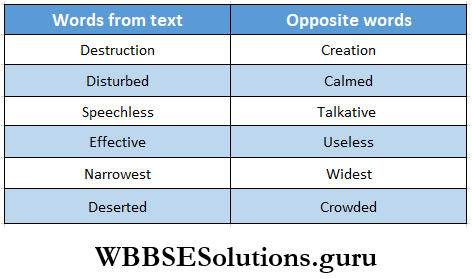
4. Complete the chart with suitable words from the text.
Question 1.

Answer: