
Detailed Reading Examples
Read the following passages carefully and then answer the questions that follow each.
Question 1. It was on January 30, 1948. Bapuji was coming for his evening prayer. He was resting on the shoulders of Ava and Manu, his grandchildren. Godse had shot the frail old man with his revolver thrice. He was arrested by the crowd present there. The police investigation continued for five months. The special court began in Red Fort in New Delhi on June 22, 1948. On February 10, 1949, the court sentenced Godse to death.
Read And Learn Also WBBSE Solutions For Class 8 English
1. Answer the questions:
Question 1. Who murdered Gandhiji and how?
Answer: Godse murdered Gandhiji by shooting him down thrice with a revolver.
Question 2. When was he murdered?
Answer: He was murdered on January 30, 1948, when he was coming for his evening prayer.
Question 3. Who were his grandchildren?
Answer: Ava and Manu were his grandchildren.
Question 4. What was the punishment of the murderer?
Answer: The murderer Godse was sentenced to death as punishment
| WBBSE Class 8 English Functional Grammar | WBBSE Class 8 English Reading Skills |
| WBBSE Solutions For Class 8 English | WBBSE Solutions For Class 8 Maths |
2. Complete the sentences with the word/words from the passage:
Question 1. The frail old man was ___________
Answer: The frail old man was Gandhiji.
Question 2. Two companions of Gandhiji were ___________
Answer: Two companions of Gandhiji were Ava and Manu.
Question 3. The day on which he was murdered ___________
Answer: The day on which he was murdered was 30th January 1948.
Question 4. The murderer was arrested by ___________
Answer: The murderer was arrested by the crowd present on the spot.
3. Some of the following statements are true and some are false. Write ‘True’ or ‘False’.
Question 1. Gandhiji was stabbed to death.
Answer: False
Question 2. He was murdered by Godse with his revolver.
Answer: False
Question 3. People present there caught the murderer.
Answer: False
Question 4. Godse shot Gandhiji with a revolver once.
Answer: False
Question 5. The police investigated the matter for five years.
Answer: False
Question 2. During the reign of Queen Elizabeth, there lived a famous Englishman named Sir Walter Raleigh. He was a gentleman and a favorite with the Queen. He was a scholar, a poet, and a brave and daring soldier. He sailed to the new world which we call America, and had many adventures there. He did two useful things. He brought back from America two plants that became very popular with Europeans. One was tobacco, the other was the potato. Before his time the potato was unknown in Europe, but it is now one of the commonest foods all over the world.
Raleigh first planted potatoes in Ireland, and the potato became to the Irish what wheat is to the Punjabi, and rice to the Bengalee and the Madrasi-their chief food.
[Word meaning: reign — রাজত্বকাল ; favourite – প্রিয় ; scholar — বিদ্বান ; daring – সাহসী ; adventure — দুঃসাহসিক ঘটনা ]
1. Answer the questions.
Question 1. Who was Sir Walter Raleigh?
Answer: Sir Walter Raleigh, was a famous English man who was a scholar, a poet, and a brave and daring soldier.
Question 2. What is the new world?
Answer: The new world referred to here is America.
Question 3. What were the two useful things Raleigh did?
Answer: The two useful things Raleigh did were that he brought from America two plants-one tobacco and the other potato- to Europe and he first planted potatoes in Ireland.
Question 4. What is the importance of the potato?
Answer: The importance of potato lies in the fact that it has become one of the commonest foods all over the world.
2. Some of the statements are true and some are false. Write ‘T’ against the true and ‘F’ against the false statements.
Question 1. Sir Raleigh lived during the time of Queen Elizabeth.
Answer: True
Question 2. The Queen did not like him.
Answer: False
Question 3. He was a learned soldier.
Answer: True
Question 4. He went on a pleasure trip of America.
Answer: False
3. Complete the following statements.
Question 1. The chief food of the Bengalee is _______
Answer: The chief food of the Bengalee is rice.
Question 2. The chief food of the Madrasi is _______
Answer: The chief food of the Madrasi is rice.
Question 3. The chief food of the Irish is _______
Answer: The chief food of the Irish is potato.
Question 4. The chief food of the Punjabi is _______
Answer: The chief food of the Punjabi is wheat.
4. Write the opposites of ‘Favourite’ and ‘Popular’.
Answer:
Favorite: unfavourite
Popular: unpopular
Question 3.
It was a dark night. A blind man was going along a road. He had a lamp in his hand. Two men laughed at him. One of them said, “What is the use of a lamp to a blind man?” The other called the blind man a fool. The blind man heard this. He said, “The lamp is not for me. It is for those people who are careless. They will not notice me in darkness. The lamp will show them the way.” They felt sorry for their foolishness.
[Word meaning: blind— অন্ধ; laughted at — উপহাস করল ; careless — অসাবধানী ; foolishness বোকামি
1. Answer the following questions.
Question 1. Who laughed at the blind man?
Answer: Two men laughed at the blind man.
Question 2. Do you think the lamp was useful to the blind man?
Answer: Yes, it was useful to the blind man in the dark.
Question 3. Why did the blind man carry the lamp with him?
Answer: The blind man carried the lamp with him to make others careful about him in the dark.
Question 4. Why did the two men laugh at the blind man?
Answer: The two men laughed at the blind man as they thought the lamp would be of no use to him.
2. Complete the following sentences with information from the text.
Question 1. In a dark night a blind man was going with ___________
Answer: In a dark night a blind man was going with a lamp in his hand.
Question 2. Two men laughed at the blind man as there was no use of ___________
Answer: Two men laughed at the blind man as there was no use of the lamp for the blind man.
Question 3. The blind man was carrying a lamp because _______
Answer: The blind man was carrying a lamp because it was a dark night and careless people might collide with him in the darkness.
Question 4. Two men, at last, could understand ___________
Answer: The two men at last could understand their foolishness.
3. Say whether the following statements are true or false.
Question 1. The blind man had a torchlight in his hand.
Answer: False
Question 2. The blind man was also deaf.
Answer: False
Question 3. The light would make others careful about the blind man.
Answer: True
Question 4. The two men hated the blind man.
Answer: False
Question 4.
Once there was a greedy farmer. He had a goose. When she laid her first egg, he was very much happy and excited to find that it was not an ordinary egg, but a golden one. The next day, too, the goose laid another golden egg. In this way the farmer got in possession of a number of golden eggs. He became rich by selling them one by one. But the more he got, the more did his greed increase. He thought the goose had many golden eggs in her belly. So he resolved to get them out all at once in order that he might become very rich in the quickest possible time. With this object in view, he one day killed the goose and cut open her belly. Alas! there was no golden egg inside. The farmer repented of having lost the treasure he had been getting so long daily.
[Word meaning: greedy – লোভী ; excited — উত্তেজিত; belly — পেট ; resolved —মন স্থির করল; quickest সবচেয়ে তাড়াতাড়ি। object উদ্দেশ্য; repented আপশোষ করল; treasure – সম্পদরাশি ]
1. Pick out the correct alternative from each group.
Question 1. The farmer
- Was very lazy.
- Was very cruel.
- Wanted to be rich very quickly.
Answer: 3. Wanted to be rich very quickly
Question 2. The goose laid a golden egg
- Everyday.
- Very often.
- Every alternate day.
Answer: 1. Everyday
Question 3. The farmer became rich by
- Selling the golden eggs.
- Selling the goose.
- Selling goose meat.
Answer: 1. Selling the golden eggs
Question 4. On cutting open the belly of the goose the farmer got
- Many golden eggs.
- No golden eggs.
- A few golden eggs.
Answer: 2. No golden eggs
Question 5. The goose was
- Made of gold.
- An ordinary goose.
- A magician.
Answer: 2. An ordinary goose
2. Write ‘T’ for true and ‘F’ for false.
Question 1. The farmer was very kind.
Answer: False
Question 2. The goose used to lay an ordinary egg daily.
Answer: False
Question 3. The farmer killed the goose to be rich very quickly.
Answer: True
Question 4. The farmer found no golden egg in the belly of the dead goose.
Answer: True
Question 5. The farmer felt happy after killing the goose.
Answer: False
3. Answer the questions in short.
Question 1. What was the specialty of the goose?
Answer: The specialty was that she would lay a golden egg every day.
Question 2. What was the farmer’s wish?
Answer: The farmer wished to become rich very quickly by getting many golden eggs from the belly of the goose all at a time
Question 3. What did he do to fulfill his wish?
Answer: He killed the goose and cut open her belly.
Question 4. What was the result?
Answer: He found no golden egg inside the belly and lost the source of his fortunes.
Question 5.
Formerly many people believed that cholera was caused by a goddess ‘Sitala’ and these super- stitous people tried to please the goddess by offering puja instead of calling in a doctor when a person is attacked with cholera.
Now we know that cholera germs get into our body through food and drink. People often sell food and sweets and cut-fruits which are often covered with flies. These make them infectious and dangerous. And people often drink unclean water from ponds and wells. Sometimes clothes used by cholera patients are washed in ponds. This should be strictly prohibited. When someone is attacked with cholera, we should give him for immediate relief plenty of salted water sweetened with sugar. This is to make up for loss of water caused by dehydration. In critical cases medical advice should be taken immediately. However, vaccination against cholera can protect us against this deadly disease.
[Word meaning: superstitious – কুসংস্কারাচ্ছন্ন; infectious — সংক্রামক ; dangerous— ভয়াবহ; prohibited—নিষিদ্ধ ; plenty — প্রচুর পরিমাণে; make up for-ক্ষতিপূরণ করে; dehydration—শরীরে জলীয় ভাগ কম হওয়া; critical — সংকটাপন্ন ; vaccination—টিকা; protect — রক্ষা করা ]
1. Fill in the chart below with information from the text.
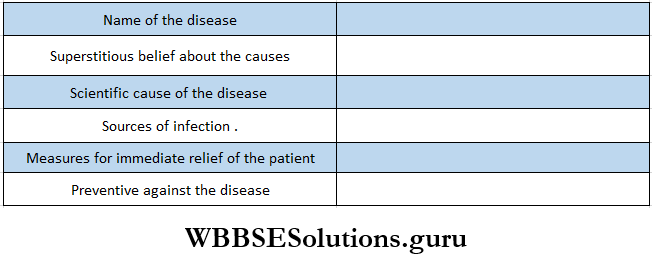
Answer:

2. Some precautionary measures have been suggested against the disease cholera. Write them in brief.
Answer:
- Food, sweets, and cut fruits kept in the open should be avoided.
- We should not drink unclean water from ponds and wells.
- Clothes of cholera patients should not be washed in ponds.
3. Pick out the correct answers.
Question 1. Cholera is caused by
- Anger of goddess.
- Infection from germs.
- Bites of mosquitoes.
Answer: 2. Infection from germs
Question 2. Cholera patients need
- Dehydration.
- Rehydration. (“tificeer weer we offer)
- Vaccination.
Answer: 2. Rehydration
Question 3. Dehydration causes
- High temperature.
- Infections.
- Loss of fluid.
Answer: 3. Loss of fluid
Question 4. Vaccination is meant for
- Prevention of cholera.
- Treatment of cholera.
- Cure of cholera.
Answer: Prevention of cholera
4. Answer the questions in brief.
Question 1. How do cholera germs get into our body?
Answer: Cholera germs get into our body when we take uncovered food, sweets and cut fruits and drink unclean water from ponds and wells.
Question 2. What should be given to a cholera patient for immediate relief?
Answer: A cholera patient should be given plenty of salt water sweetened with sugar for immediate relief.
Question 3. How can we protect ourselves against this deadly disease?
Answer: We can protect ourselves against the disease by taking the cholera vaccine.
5. Write ‘T’ for true and ‘F’ for false statements.
Question 1. Cholera disease occurs because of an act of sin.
Answer: False
Question 2. Cholera is an infectious disease.
Answer: True
Question 3. We should always drink pure water to avoid infection from cholera.
Answer: True
Question 4. A cholera patient should be immediately shifted to a hospital.
Answer: False
Question 5. Vaccination is the real prevention of this disease.
Answer: True
Question 6. Flies are carriers of cholera germs.
Answer: True
6. Find words from the passage which mean the following.
Question 1. Showing unreasoning belief in supernatural influences
Answer: Superstitious
Question 2. That which spreads from one person to another
Answer: Infections
Question 3. Large quantity
Answer: Plenty
Question 4. Make up for
Answer: Compensate
Question 6.
Einstein was very simple in his ways of life and indifferent to his great fame. Once the queen of Belgium invited him to Brussels. When he got down from the train at Brussels, he could not think that there were many gorgeously dressed officials to receive him at the station. The officials also expected somebody who would appear to be rich and aristocratic to them. They never imagined that this shabby man would be Einstein himself. So they went back to the queen and informed her that he had not come by train. Einstein; however, walked the whole way with a suitcase in one hand and a violin in the other. When he reached the destination the queen said to him, “I sent a car for you, Dr. Einstein.” “I did not think,” replied the great scientist with a smile, “that anybody would send a car for me. But I can assure you, I have greatly enjoyed the walk.”
[Word meaning: indifferent; fame-; gorgeously; aristo- cratic—অভিজাত; shabby—মলিন বস্ত্র পরিহিত; destination—গন্তব্যস্থল ; assure—নিশ্চিত করা
1. Choose the correct answer.
Question 1. Einstein used to live a
- Gorgeous life.
- Simple life.
- Bohemian life.
Answer: 2. Simple life
Question 2. He was dressed
- Nicely.
- Gorgeously.
- Shabbily.
Answer: 3. Shabbily
Question 3. The officials missed Einstein because they expected to see a
- Simple man.
- Rich and aristocratic-looking man.
- Poorly dressed man.
Answer: 2. Rich and aristocratic-looking man
Question 4. Einstein missed the officials sent by the queen because he
- Found none at the station.
- Did not expect any officials.
- Did not wait long at the station.
Answer: 2. Found none at the station
Question 5. On hearing that the queen had sent a car for him Einstein said that
- He did not need the car and he had enjoyed the walk.
- He had not seen any car at the station.
- He found none.
Answer: 1. He did not need the car and he had enjoyed the walk
2. Write ‘T’ for true and ‘F’ for false statements.
Question 1. Einstein was very conscious of his fame.
Answer: False
Question 2. He went to Brussels, to attend a seminar.
Answer: False
Question 3. The queen sent a car to receive him.
Answer: True
Question 4. Einstein went to the palace by the queen’s car.
Answer: False
Question 5. Einstein was a great scientist.
Answer: True
3. Answer the questions in short.
Question 1. What was unexpected to Einstein at the Brussels Railway station?
Answer: Einstein did not expect that gorgeously dressed officials would come to the station with a car to receive him.
Question 2. What did the officials expect to see at the station?
Answer: The officials expected to see a rich and aristocratic-looking person as their guest.
Question 3. Describe the dress of Einstein as he came down from the train.
Answer: Einstein’s dress was quite poor and shabby.
Question 4. What did he carry in his hands?
Answer: He carried a suitcase and a violin in his hands.
Question 5. Describe Einstein’s attitude towards life and fame.
Answer: Einstein lived a simple life and was indifferent to fame.
Question 6. What did the officials report to the Queen?
Answer: The officials reported to the queen that Einstein had not come.
4. Complete the sentences with information from the text.
Question 1. The queen of Belgium invited ____________
Answer: The queen of Belgium invited Einstein to Brussels.
Question 2. The officials did not ____________
Answer: The officials did not expect that their guest would look like ordinary man in a poor dress.
Question 3. Einstein enjoyed the walk to _________
Answer: Einstein enjoyed the walk to the queen’s palace.
Question 4. The officials reported to the queen _______
Answer: The officials reported to the queen that Einstein had not come.
5. Match the words in ‘A’ with the words nearest in meaning in ‘B’.
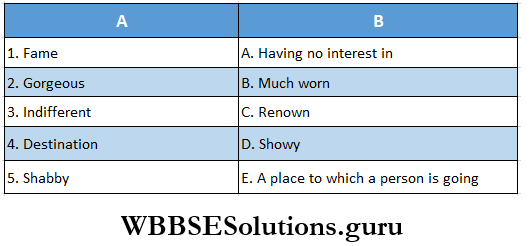
Answer: 1. C, 2. D, 3. A, 4. E, 5. B
Question 7.
There was a venomous snake in a field. One day a sage passed by that field and the snake ran after him to bite. The sage advised the snake not to bite anyone. The snake promised to follow his advice. The sage went away. The snake entered his hole and began to live without attempting to harm anyone. In a few days, the people concluded that the snake had lost its venom and was no longer danger- ous. They teased him, pelted him with stones, and dragged him mercilessly. Fortunately, the sage again passed by that field. Seeing the injured condition of the snake the sage enquired of the cause. “Holy Sir”, the snake replied, “this is because I do not injure anyone after your advice.” The sage smilingly said, “My friend, I simply advised you not to bite anyone, but I did not tell you not to frighten them in your self-defense.”
[Word meaning: venomous – বিষধর ; promised — প্রতিজ্ঞা করেছিল; concluded— সিদ্ধান্তে উপনীত হল; dangerous বিপদসঙ্কুল। teased বিরক্ত করল; pelted হয়েছিল; mercilessly নির্ণয়ভাবে injured—আহত; frighten — ভয় দেখানো ]
1. Answer in short.
Question 1. Where did the snake live?
Answer: The snake lived inside a hole in a field.
Question 2. What happened when a sage passed by the snake?
Answer: When the sage was passing, the snake ran after him to bite.
Question 3. What did the sage advise? Did the snake obey him?
Answer: The sage advised the snake not to bite anyone. The snake obeyed him.
Question 4. What was the conclusion of the people?
Answer: The people concluded that the snake had lost its venom and was no longer dangerous
Question 5. What did they do to the snake?
Answer: They teased the snake, pelted him with stones, and dragged him mercilessly.
Question 6. Give a suitable title to the passage.
Answer: The Sage and the Snake
2. Write ‘T’ for true and ‘F’ for false statements.
Question 1. The snake bit the sage.
Answer: False
Question 2. The snake followed the sage’s advice.
Answer: True
Question 3. The snake lost its venom.
Answer: False
Question 4. The people injured the snake.
Answer: True
Question 5. The sage advised the snake not to frighten anybody.
Answer: False
3. Complete the following sentences
Question 1. The snake wanted ___________
Answer: The snake wanted to bite the sage.
Question 2. The sage advised the snake _________
Answer: The sage advised the snake not to bite anyone.
Question 3. The people were ___________
Answer: The people were merciless
4. Find words in the passage meaning the following:
- Something with venom
- Made fun unkindly
- Without any mercy or compassion
- Cause to be afraid
Answer:
- Venomous,
- Teased,
- Mercilessly,
- Frighten
Question 8.
Astronomers, those people who study the stars, tell us that long, long ago the earth and all the planets were part of the sun. The sun was then as it is now a mass of flaming matter, terribly hot. Somehow little bits of the sun got loose and they shot out into the air.
In this way our earth also shoot out from the sun. It must have been very hot, with terribly hot gases and air all around it, but as it was very much smaller than the sun it started to cool. The sun also is getting less hot but it will take millions of years to cool down. The earth took much less time to cool. When it was hot of course, nothing could live on it—no man or animal or plant or tree. Everything should have been burnt up then.
Just as a bit of the sun shot out and became the earth, so also a bit of the earth shot out and became the moon. Many people think that the moon came out of the great hollow which is now the Pacific Ocean, between America and Japan.
[Word meaning : Astronomer – জ্যোতির্বিদ ; planet — গ্রহ; flaming — জলন্ত ; bit—অল্প অংশ ]
1. Pick out the correct alternatives.
Question 1. According to astronomers, long ago
- The earth was separate from the sun.
- The planets were separate from the sun.
- The earth and the planets were part of the sun.
Answer: 3. The earth and the planets were part of the sun
Question 2. Initially, the earth was
- Very cold.
- Very hot.
- Moderately hot.
Answer: 2. Very hot
Question 3. The moon originated from
- The Pacific Ocean.
- The earth.
- The sun.
Answer: 2. The earth
Question 4. The Pacific Ocean has been formed due to the shooting out of a portion of
- The earth.
- The moon.
- The sun.
Answer: 1. The earth
2. Write ‘T’ against true and ‘F’ against false statements.
Question 1. The sun was originally a mass of flaming matter but not now.
Answer: False
Question 2. The earth shot out of the moon.
Answer: False
Question 3. Initially, the earth had hot gases and air all around it.
Answer: True
Question 4. The sun will take a very long time to cool down.
Answer: True
Question 5. There was no life on earth when it was formed.
Answer: True
3. Complete the sentences with information from the text.
Question 1. The earth originated from _________
Answer: The earth originated from the sun.
Question 2. A bit of the earth shot out and became _________
Answer: A bit of the earth shot out and became the moon.
Question 3. People studying stars are called _________
Answer: People studying stars are called astronomers.
4. Give a suitable title to the passage.
Answer: The Origin of the Earth and the Moon

Question 9.
One wintry night an old infirm beggar, shivering with cold, knocked at the door of a farmer who was sitting with his children around his hearth. In a feeble voice he begged for shelter and hospitality. His feet were trembling and he could no longer drag his weary body in the chilly weather of the night. His tattered clothes could hardly afford him protection against the snow. The farmer opened the door and when the children saw the old, infirm beggar standing at the door, they ran to comfort him. They warmed his frozen limbs and gave him food and did all they could to cheer him up. The beggar was moved to tears. In the midst of their sorrow for the misery of that man, the farmer’s children felt that night a joy they had never felt in their happiest days.
[Word meaning: infirm-; hearth-s; feeble-; hospitality-fr weary— দুর্বল ; tattered— ছিন্নভিন্ন ]
1. How would you classify the text?
- A description;
- A public notice;
- A report
- A story
Answer: 4. A story
2. Choose the correct answers in the following:
Question 1. An old infirm beggar knocked at the door of
- A prince.
- A weaver.
- A peasant.
Answer: 3. A peasant
Question 2. The beggar asked for
- Shelter and hospitality.
- Power and position.
- Money and clothes
Answer: 1. Shelter and hospitality
Question 3. The farmer and his children
- Drove the beggar.
- Served the beggar.
- Beat the beggar
Answer: 2. Served the beggar
Question 4. The children of the farmer
- Fed the beggar
- Clothed the beggar
- Gave the beggar money
Answer: 1. Fed the beggar
Question 5. The beggar was moved by the farmer and his children’s
- Sympathy.
- Kindness
- Hospitality.
Answer: 3. Hospitality
3. Write ‘T’ against correct statements and ‘F’ against incorrect statements.
Question 1. The farmer was a selfish man.
Answer: False
Question 2. The farmer’s children felt for the beggar.
Answer: True
Question 3. When the beggar came, the farmer was standing at the door.
Answer: False
Question 4. It was raining when the beggar came in.
Answer: False
Question 5. The beggar was weak.
Answer: True
4. Match the causes with the results.
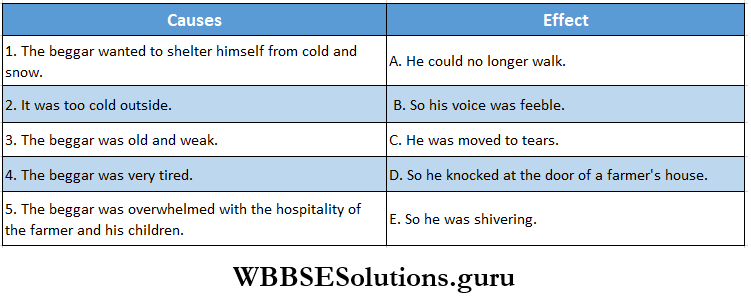
Answer: 1. D, 2. C, 3. E, 4. A, 5. B
5. Write the nearest meaning of the following words from the above text:
- Torn
- Weak
Answer:
- Torn: Tatters
- Weak: Infirm
Question 10.
Conan Doyle was a young doctor who had just entered practice. In those days it took some time for a doctor to become popular and get patients. He spent many hours in his room waiting for patients. He began to think of other ways in which he could earn his living. He tried his hand at writing and wrote a novel. It did not attract much attention. Nobody seemed interested in it. But after several years Conan Doyle wrote some short detective stories about the detective Sherlock Holmes which brought him money and fame.
[Word meaning young practice-551; popular; living- AHA: attention; interested; detective – রহস্যমূলক ]
1. Write ‘T’ for true and ‘F’ for false statements.
Question 1. Conan Doyle had a good practice as a young doctor.
Answer: False
Question 2. To earn money he took to writing.
Answer: True
Question 3. In the beginning, Doyel earned great reputation as a writer.
Answer: False
Question 4. Doyle became famous as a detective story writer.
Answer: True
Question 5. Sherlock Holmes was the name of a detective.
Answer: True
2. Answer the questions in short.
Question 1. What was Conan Doyle by profession?
Answer: Conan Doyel was a doctor by profession
Question 2. Why did he try to earn money in other ways?
Answer: Because he was not successful as a young doctor.
Question 3. How did he meet success?
Answer: He met success as a writer of short detective stories which brought him money and fame
3. Pick up a sentence from the passage that shows that Doyle’s first novel had no market.
4. Fill in the blanks with words taken from the text. Change their forms if necessary.
Question 1. He is a ______ businessman.
Answer: Successful
Question 2. Pay ____ to your studies.
Answer: Attention
Question 3. The loud sound ________ our attention.
Answer: Attracted
Question 4. She is _______ in music.
Answer: Interested
Question 11.
There lived in a certain town of Persia two painters, whose name had spread far. Both were so good at their work that it was hard to say who the better painter was. So it was settled that each was to draw a picture and there would be judges to decide who had done the better work. One of the painters painted a bunch of grapes that looked so natural that birds came and pecked at it.
The judges were struck with wonder and thought he was surely going to win. When they went to see what the other painter had done, he pointed to a screen that was before their eyes. The rival painter thought that the picture was behind the screen and went forward to see to it. He was greatly surprised to find that there was no screen there but only the picture of one that had been painted on the wall. The judges were speechless with wonder and gave the second painter the place of honor as his picture had deceived a man while that of his rival had deceived only the birds.
[Word meaning : hard — কষ্টসাধ্য; settled — স্থির করা হল; decides — মীমাংসা করা ; natural— স্বাভাবিক; pecked ঠোকরাল ; struck — হতভম্ব হল surprised — বিস্মিত; speechless নির্বাক; wonder-fe; deceived-affe; rivals]
1. Read the passage carefully and pick out the correct answers from the statements below:
Question 1. The first painter’s picture deceived.
- The judges.
- The rival painter.
- The birds.
Answer: 3. The birds
Question 2. The second painter’s picture deceived
- The judges.
- The rival painter.
- The birds.
Answer: 2. The rival painter
Question 3. The painter who had painted a screen was given the place of honour by the judges because
- He was the better painter.
- He was the best painter.
- He was one of the best painters.
Answer: 1. He was the better painter
Question 4. The bunch of grapes misled
- The judges and the birds.
- The birds.
- The rival painter.
Answer: 2. The birds
Question 5. The screen misled
- The birds.
- The rival painter.
- The rival painter as well as the judges.
Answer: 2. The rival painter
2. Some of the following statements are true and some are false. Write ‘T’ against the true and ‘F’ against the false statements.
Question 1. The two painters were unknown.
Answer: False
Question 2. The two painters were quite famous.
Answer: True
Question 3. One of the painters was very good but the other was quite inferior.
Answer: False
Question 4. The first painter’s painting deceived the judges.
Answer: False
Question 5. The second painter was declared the winner.
Answer: True
Question 12.
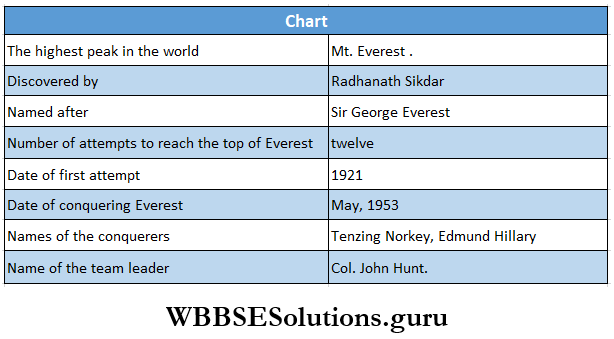
You all know that Everest, a peak of the Himalayas, is the highest mountain in the world. It was discovered by a Bengalee named Radhanath Sikdar, an officer in the Government of India. It, however, came to be called after his chief, Sir George Everest.
For many years, people have been trying to get to the top of Everest. The first attempt was made in 1921, followed by ten others up to 1952. But so great are the difficulties of the climb that they ended in failure. Even several lives were lost.
The sides of Everest are always covered with snow. It often slips and falls, and in falling, kills the climbers. There are also fearful storms of frost and snow at the top almost all the year.
No wonder, Everest stood unconquered so long. But its pride was humbled at last. The top was reached in the twelfth attempt in May, 1953, by the party led by Col. John Hunt. And the heart of every Indian is filled with pride that, of the two that reached the top, one was an Indian, Tenzing Norkey. The other was a man from New Zealand, Edmund Hillary. It is in the fitness of things that the peak which was discovered by an Indian should also be conquered by another Indian.
[Word meaning: peak – চূড়া; discovered — আবিষ্কৃত হয়েছিল; failure — ব্যর্থতা; fearful — ভয়াবহ ; frost— তুষারপাত ; unconquered — অপরাজিত; humbled — হতমান হয়েছিল; prise — গর্ব ; fitness of things— সঙ্গত কারণেই; conquered — জয় লাভ করল ]
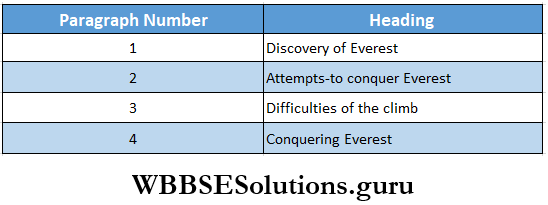
1. Four headings are written for the four paragraphs in the above text. Match the proper headings for the paragraphs.
Headings
- Conquering Everest
- Discovery of Everest
- Attempts to conquer Everest
- Difficulties of the climb
Answer:
2. Fill in the chart below with information from the text.

Answer:
3. Write ‘T’ against the true and ‘F’ against the false statements.
Question 1. Radhanath Sikdar was an Englishman.
Answer: False
Question 2. Everest was conquered in the twelfth attempt.
Answer: True
Question 3. There was no risk in climbing up the peak.
Answer: False
Question 4. Indians were proud at the conquest of Everest.
Answer: True
Question 5. The top of Everest remains covered with snow only for a few months.
Answer: False
Question 13.
Long ago there was a slave in a country. His name was Androcles. He committed an offence. So he was punished. Out of fear he ran away from his master’s house and lived in a cave. In that cave lived a big lion. A thorn stuck into his left foot. So he felt great pain and could not walk properly. He came limping towards Androcles. Androcles saw the thorn. He boldly came forward and drew it out. The lion got rid of the pain and felt relieved. Later on Androcles was caught and brought to the town and was asked to fight a hungry lion. It was the same lion whose thorn Androcles had drawn out. The lion at once recognized him and quietly lay down at his feet.
[Word meaning : committed – কোনো দুষ্কর্মাদি করা; offence – অপরাধ; limping – খুড়িয়ে b; got rid of মুক্ত’ হল ; relieved – নিবৃত্তি হল ; hungry – ক্ষুধার্ত ; recognised — চিনতে পারল ; quietly – ধীর ভাবে ]
1. Pick out the correct answers and write in full sentences.
Question 1. Androcles was a
- Greek god.
- A slave.
- A king.
Answer: 2. A slave
Question 2. Androcles ran away from his master’s house and took shelter secretly
- In a village.
- In a forest.
- In a cave.
Answer: 3. In a cave
Question 3. The lion came limping towards Androcles because
- A thorn stuck into his left foot.
- One of his legs was broken.
- He could recognize Androcles.
Answer: 1. A thorn stuck into his left foot.
Question 4. The lion which Androcles was asked to fight was
- A new lion.
- The same lion whose thorn he had drawn out.
- A lion used in a circus.
Answer: 2. The same lion whose thorn he had drawn out.
Question 5. The lion lay down quietly beside Androcles because
- He was grateful to him.
- He was angry with him.
- He was afraid of him.
Answer: 3. He was afraid of him.
2. Suggest a suitable title for the passage.
Answer: Androcles and the lion
3. Fill in the following chart with information from the text.
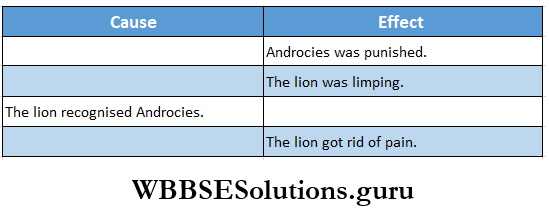
Answer:

4. How would you classify the above text?
- A public notice
- A description
- A report
- A story
Answer: 4. A story
5. Which of the following statements are true and which are false?
Question 1. Androcles saw the lion in a cave.
Answer: True
Question 2. Androcles was killed by the lion.
Answer: True
Question 3. The lion had pain in his stomach.
Answer: True
Question 4. The lion was limping because he had lost one of his legs.
Answer: True
Question 5. The lion had a sense of gratitude.
Answer: True
Question 14.
Although Louis Braille died when he was only forty-three years old, he succeeded in devising a system of reading and writing for the blind which is now taught all over the world.
Braille lost his sight accidentally as a child. Nevertheless, he was able to complete his education at a school for the blind in Paris and became a teacher. In his days the few books that were available for the blind people were printed in big, raised type; the letters used were those of the ordinary alphabet. The reading of such books required immense effort. And writing was almost impossible, for a blind person was still restricted to an alphabet which was extraordinarily difficult to reproduce on paper. Braille’s idea was to use raised dots instead of raised letters. He evolved a system that made use of only six dots in all. By various combinations of these dots, it not only proved possible to represent each letter in the alphabet but punctuation marks, numbers, and notation as well. Reading and writing have thus been enormously simplified. The sensitive fingers of a blind person can travel rapidly over the dots; and there is a small machine something like a typewriter, which enables the blind to write quickly and clearly.
[Word meaning: Devising-; alphabet-; immense-2, restricted– সীমাবদ্ধ; extraordinarily — অস্বাভাবিক ভাবে ; reproduce — অনুলিপি করা; evolved – বের করেছিলেন; enormously-b]
1. Answer the following questions:
Question 1. How did Braille become blind?
Answer: Braille became blind accidentally.
Question 2. What type of books were available for the blind in Braille’s time?
Answer: The books available for the blind at that time were printed in big raised type ordinary alphabet.
2. Write ‘T’ for true statements and ‘F’ for false ones:
Question 1. Braille was blind from his birth.
Answer: False
Question 2. Braille died at the age of 43.
Answer: True
Question 3. Braille evolved a system of raised type using ordinary alphabet.
Answer: False
Question 4. It is easy to use the Braille system of reading and writing.
Answer: True
Question 5. Musical notation can also be written in Braille language.
Answer: True
3. Complete the following with information from the passage:
Question 1. Luois Braille became a ____________
Answer: a teacher after completing his education at a school for the blind.
Question 2. He completed his education in ____________
Answer: Paris
Question 3. Reading books for the blind in Braille’s time required ____________
Answer: immense effort.
Question 4. Braille system used only ____________
Answer: six raised dots.
4. Find out words from the text to match meaning of the following:
- Signs or symbols to represent numbers, amounts, etc.:
- Came after:
- Thinking out a plan:
- Put a limit:
- Greatly:
Answer:
- Signs or symbols to represent numbers, amount etc.: dots.
- Came after: evolved
- Thinking out a plan: devising
- Put a limit: restricted
- Greatly: enormously
Question 15.
We know that plants and trees do not move about as cats and dogs do, and so men at first thought that plants and trees are not actually alive. But now we know that plants and trees are not only alive but they can feel as well, like other living things. Sir Jagadish Chandra Bose was able to prove this and spread the idea throughout the world.
He showed that there is no difference between the life of plants and that of animals. If we give the plants a blow, they feel it, and if we make them drink a poison, they are affected by it like us. Like human beings they also sleep at night and wake up in the morning. They even die like men. He proved all these by experimenting in the laboratory with the most delicate instruments. He added something new to science and brought about a great change in the world of science.
Honors were heaped upon him. He received a knighthood and came to be known as Sir Jagadish Chandra Bose. He was asked by the various scientific institutions of the world to deliver lectures on his research. These lectures made him world-famous as a scientist. Thus we see that his discoveries gave a new light to the world and brought honour and glory to India. Jagadish Chandra is in the world of science what Rabindranath is in the world of letters.
throughout the world
Word meaning: alive; able; spread পৃথিবী ব্যাপি; difference— তফাৎ ; poison – বিষ; affected – ক্ষতিগ্রস্ত হয়; delicate— সূক্ষ্ম ; heaped — স্তূপীকৃত করা হয়েছিল; deliver lectures -বক্তৃতা দেওয়া; researches famous বিখ্যাত; glory” “গৌরর+ world of letters সাহিত্য জগত
1. Answer the questions in brief:
Question 1. Why did people think that plants had no life?
Answer: Because plants cannot move like living animals.
Question 2. Who was Sir Jagadish Chandra Bose?
Answer: Sir Jagadish Chandra Bose was a famous Indian scientist.
Question 3. What did he discover?
Answer: He discovered that plants and trees have life and they can also feel like other living things.
Question 4. How did he become famous?
Answer: He became famous by his discovery that there is no difference between the life of plants and that of animals.
Question 5. What was his contribution to science?
Answer: His discovery gave a new idea to science and brought about a great change in the world of science.
2. Complete the sentences with information from the text.
Question 1. In recognition of his great work, Jagadish Chandra was awarded ____________
Answer: In recognition of his great work, Jagadish Chandra was awarded a knighthood and came to be known as Sir Jagadish Chandra Bose.
Question 2. He proved that plants react to a poison as ____________
Answer: He proved that plants react to a poison as a man does.
Question 3. He was asked to deliver ____________
Answer: He was asked to deliver lectures on his researches at various scientific institutions of the world.
Question 4. His discovery made him ____________
Answer: His discovery made him a world-famous scientist.
Question 5. He brought honour and glory to India by ____________
Answer: He brought honour and glory to India by his famous discoveries.
Question 6. Jagadish Chandra is famous in ____________ as Rabindranath is in ____________
Answer: Jagadish Chandra is famous in the scientific world as Rabindranath is in the literary world.
3. Write ‘T’ for true and ‘F’ for false statements.
Question 1. Jagadish Chandra became famous because of his discoveries.
Answer: True
Question 2. The scientific world did not accept his theories.
Answer: False
Question 3. Plants and trees can feel and respond like human beings.
Answer: True
Question 4. India was proud of Jagadish Chandra.
Answer: True
Question 5. Rabindranath earned fame both in arts and science.
Answer: False
Question 6. Plants sleep in the daytime and wake up at night.
Answer: False
4. Make sentences of your own with the following words.
- Alive;
- Throughout;
- Difference;
- Affected;
- Delicate.
Answer:
- The animal was injured but it is still alive.
- He suffered a lot throughout his life.
- There is no difference between the two schemes.
- They were affected by the flood.
- It is a very delicate matter.
5. Write words opposite in meaning of the following.
- Alive;
- Able;
- Difference;
- Delicate;
- Glory.
Answer:
Alive: Dead;
Able: Unable;
Difference: Similarity;
Delicate: Coarse;
Glory: Disgrace.
Question 16.
One morning a boy, tending cattle by the side of a railway line, noticed that a small railway bridge had given way following the previous night’s heavy shower. He also saw a passenger train in the distance, coming towards it at full speed. A simple cowboy as he was, he at once realised the great danger that awaited the train and its passengers. He ran up to the line and standing on it began to wave his shirt as a warning to the driver. The driver thought that this was a mere prank of a village urchin. So the train continued to advance, whistling furiously to scare away the boy. But he would not leave his post. The driver was at last compelled to stop the train a little distance from the boy. As he and the guard came down, the boy took them to the breach. They now realized what a great danger they had escaped. The boy was later richly rewarded by the railway authorities.
Word meaning tending: চড়াচ্ছিল ; previous = আগের দিন ; realised বুঝতে পারল awaited- অপেক্ষা করছিল; wave ওড়ানো ; warning — বিপদের সঙ্কেত ; prank— দুষ্টামি কাজ urchin— দুরন্ত শিশু ; furiously – জোরে জোরে ; scare away- ভয় দেখিয়ে বিরত করা; compelled- বাধ্য হল ; breach—— ফাটল ; escaped — পরিত্রাণ পেয়েছে ; rewarded —— পুরস্কৃত হল
1. Complete the following sentences with information from the above text. You may also use your own words:
Question 1. The train driver thought __________
Answer: The train driver thought that the boy was waving his shirt just to enjoy a playful trick,
Question 2. The boy was rewarded for ____________
Answer: The boy was rewarded for preventing an accident.
Question 3. The boy saved __________
Answer: The boy saved the train and the passengers from a serious accident
Question 4. The train whistled __________
Answer: The train whistled to scare away the boy from the railway lines.
Question 5. At last the driver and __________
Answer: At last the driver and the guard came down up to the boy who took them to the breach
2. Arrange the following sentences in their proper order.
- The driver was forced to stop the train.
- The cowboy began to wave his shirt.
- The bridge developed a breach due to heavy overnight rain.
- The cowboy got the reward from the railway authorities.
- The train advanced whistling furiously.
Answer:
4. The cowboy got the reward from the railway authorities.
2. The cowboy began to wave his shirt.
1. The driver was forced to stop the train.
5. The train advanced whistling furiously.
3. The bridge developed a breach due to heavy overnight rain.
3. Choose an answer against the most suitable of the titles for the above text:
- The train and the breach
- A cowboy waved his shirt
- A cowboy prevented a train accident
- A heavy shower and a train accident
Answer: 3. A heavy shower and a train accident
Question 17.
Forests are far from towns and cities. So people who live in cities and towns do not think that they have any connection with the forests. But they are dependent on forests for timber, which is nothing but wood used in building houses, carts, boards, bridges, plows, paper, and many other things. People in villages also use wood as fuel for cooking their meals.
In the past there was no fear of shortage of wood. But random cutting of trees has created scarcity of firewood. It has also caused soil erosion and less rainfall.
We can, however, overcome the problems by stopping the destruction of forests and planting more trees.
[Word meaning: dependent-; random-; scarcity-; fire-wood- জ্বালানী কাঠ; soil erosion — ভূমিক্ষয়; overcome— বশে আনা ]
1. Correct the following sentences according to the passage:
Question 1. People of cities and towns are connected with forests.
Answer: People of cities and towns do not think that they have any connection with the forests.
Question 2. People of cities and towns use wood only as fuel.
Answer: People of cities and towns use wood as fuel and also for building houses, carts, boards, bridges, paper and many other things.
Question 3. Soil erosion helps trees to grow.
Answer: Soil erosion is caused by random cutting of trees.
Question 4. The cutting of trees has increased the amount of rainfall.
Answer: The cutting of trees has decreased the amount of rainfall.
Question 5. Planting of more trees is not essential.
Answer: Planting of more trees is essential.
2. Random cutting of trees has created three problems. Write them in the space. Answer in words not in sentence.
Answer:
- Less rainfall
- Soil erosion
- Scarcity of firewood
3. Answer in brief:
Question 1. Why do people of cities and towns think that they have no connection with forests?
Answer: As the people of cities and towns live far away from forests, they think that they have no connection with forests.
Question 2. Where do village people get firewood from?
Answer: Village people get firewood from timber which is obtained from trees.
Question 3. For what purposes is timber used?
Answer: Timber is widely used as fuel, in building houses, in making carts, boards, bridges, plows, paper, and many other things.
Question 4. Why should we plant more trees?
Answer: We should plant more trees to obtain wood which is needed for various purposes, and also for inducing rain and preventing soil erosion.
4. Find out words from the passage that mean:
- Link or relation
- Lack
Answer:
- Connection
- Shortage
5. Find out words opposite in meaning to the following: (from the passage)
- More
- Creation
Answer:
- More: less
- Creation: Destruction
Question 18.
The Kimono is the national dress of Japan worn by both men and women. The word Kimono means ‘clothing’ or literally ‘something to wear’ and it has been just that for the Japanese for several hundred years. With changing times though, the people of Japan now wear the Kimono only on special or ceremonial occasions.
Kimonos are ‘T’ shaped robes that fall up to the ankles. The garment has a flat collar and wide sleeves that fall to the wrists. It is always worn left side over night and held together at the waist by a broad sash called ‘obi’. Most women’s Kimonos are one standard size and tucked in to fit the weaver. However, very tall and large sized women have to have their Kimonos stitched to their size. Men wear a shorter version of the women’s Kimono, called haori, along with hakama or loose-fitting pants.
These days a kimono can cost up to 10,000 dollars! Also, a silk one is but naturally more expensive than a cotton one. Today, in Japan, more women than men wear kimonos but only on special occasions like tea ceremonies, weddings, and funerals.
[Word meaning literally — আক্ষরিক অর্থে; ceremonial — আনুষ্ঠানিক ; tucked গুটিয়ে নিয়ে।
1. Find a word from the passage that means the same as the words below:
- Wide
- Costly
- Dresses
Answer:
- Wide: Broad
- Costly: Expensive
- Dresses: Clothing
2. Choose the correct answer:
Question 1. The kimono
- Used to be the national dress of men and women in Japan.
- Is the national dress of men and women in Japan.
- Is the national dress of women in Japan.
Answer: 2. Is the national dress of men and women in Japan.
Question 2. The kimono is worn
- Left side over right.
- Right side over left.
- Left side under right.
Answer: 1. Left side over right.
Question 3. Very tall women need to get their kimonos
- Tucked in.
- With an ‘obi’.
- Stitched up.
Answer: 3. Stitched up.
3. Write answers to the following questions:
Question 1. Describe a kimono.
Answer: A kimono is a ‘T’ shaped robe that falls up to the ankles. It has a flat collar and wide sleeves that fall to the wrists. It is always worn left side over right and held together at the waist by a broad sash called ‘obi’.
Question 2. What is a hakama?
Answer: A hakama is a loose-fitting pant worn by men in Japan.
Question 3. What can be the cost of a kimono?
Answer: A kimono can cost up to 10,000 dollars.
Question 4. On what occasions do the Japanese wear kimonos?
Answer: The people of Japan wear the kimono only on special or ceremonial occasions like tea ceremonies, weddings, and funerals.
4. Write whether the following statements are True or False.
Question 1. The kimono is the national dress of Jamaica.
Answer: False
Question 2. Men’s kimono in Japan is called haori.
Answer: True
Question 3. ‘Obi’ is a loose-fitting pant.
Answer: False
Question 19.
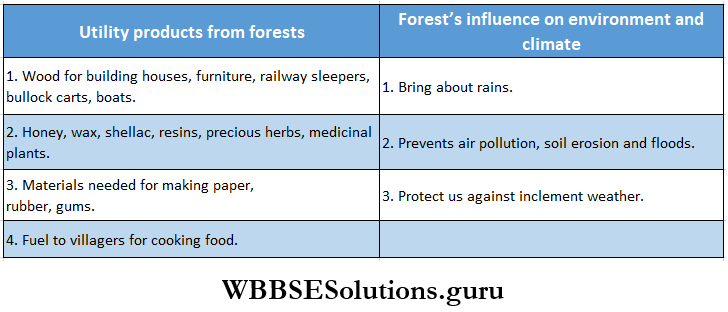
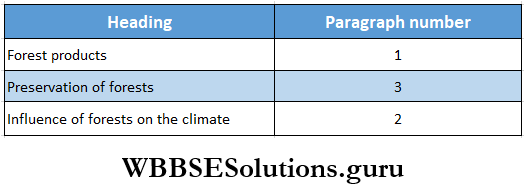
Forests are called the green gold of a country because they provide immense wealth and riches for the country. They produce wood for building houses, furniture, railway sleepers, bullock carts, boats, and ships. People in the villages use wood as fuel for cooking food.
The other useful products from forests are honey, wax, shellac, resins, precious herbs, and medicinal plants. They are also great sources of material for paper, rubber, and gums.
Forests have a direct influence on the climate of a region. They bring about rain and prevent air pollution. An area devoid of forests will go barren and turn into a desert in the course of time. The roots of trees bind loose soil and prevent soil erosion: The top fertile soil is thus retained which is so vital for agriculture. The arrest of soil erosion also prevents siting and raising of river beds and the subsequent overflowing of rivers causing floods. Forests protect us from inclement weather also.
The thoughtless cutting of trees has reduced forest wealth considerably. It has caused less rainfall, a lowering of groundwater level, and droughts. We can, however, overcome the problems by stopping the destruction of forests and planting more trees. People have to be made tree-conscious.
Word meaning: immense • প্রচুর; riches– সম্পদ; produce – উৎপাদন করে; shellac- লাক্ষা; resin— রজন; herb — ঔষধি; bring about — ঘটানো; devoid— হীন, বর্জিত ; erosion— ক্ষয় inclement— ঝড়ো ; drought— খরচ
1. Answer the questions in brief.
Question 1. Why are forests called the green gold of a country?
Answer: Forests are called green gold as they are the health of the country.
Question 2. How are forests important for us?
Answer: Forests are important because they give us useful products like wood, fuel, wax, honey, shellac, precious herbs, etc. They also bring about rains and prevent air pollution and soil erosion.
Question 3. How do forests influence the climate of a place?
Answer: Forests influence the climate of a place because they bring about rains, and prevent air pollution, soil erosion, and floods.
Question 4. Why are forests so useful to the village people?
Answer: Because villagers use wood as fuel for cooking food.
Question 5. What should be done to save forests?
Answer: To save forests, we should stop random cutting of trees and encourage tree planting.
2. Complete the chart with information from the text.

Answer:
3. Thoughtless cutting of trees has created some problems. Write them down in brief.
Answer:
- Causing less rainfall
- Lowering groundwater level
- Causing droughts
4. Write ‘T’ for true and ‘F’ for false statements.
Question 1. Forests are very useful to people.
Answer: True
Question 2. Soil erosion helps trees to grow and survive.
Answer: False
Question 3. Rural people use wood as fuel.
Answer: True
Question 4. Rainfall has increased as a result of cutting of trees.
Answer: False
Question 5. Soil erosion should be controlled to prevent floods.
Answer: True
Question 6. Mass consciousness is necessary to prevent the cutting of trees.
Answer: True
5. Given below are three headings. Match them with the paragraphs. Write their numbers only against the headings.
Headings
- Forest products
- Preservation of forests
- Influence of forests on the climate
Answer:
Question 20.
There was once a little girl who lived with her mother in a small house near a village. The mother worked as hard as she could every day but still they were very poor. Often they did not have enough to eat.
One day when there was nothing left in the house, the little girl went out in the woods, hoping to find some wild fruit or flowers. There she met a strange-looking old woman. The little girl’s face was sad. So the old woman said, “You seem in trouble my child. What’s the matter ?” “I’m looking for food for my mother and myself, for we have none at home,” replied the little girl.
The old woman gave her a small iron pot and said, “This is a magic pot. Just say to it, ‘Cook, little pot, cook,’ and it will cook you nice sweet porridge. And when you say, ‘Stop, little pot, stop’, it will stop cooking”. The little girl was happy.
[Word meaning : worked as hard as she could – যতটা সম্ভব পরিশ্রম সে করত; woods – বন; cook— রান্না করা; porridge — একপ্রকারের খাবার (যবের মণ্ড]
1. Answer the following questions:
Question 1. Where did the little girl live and with whom?
Answer: The little girl lived in a small house near a village with her mother.
Question 2. Who gave a small iron pot to the little girl?
Answer: An old woman gave a small iron pot to the little girl.
Question 3. Why did the little girl go out in the woods?
Answer: The little girl went to the woods to find some wild fruit or flowers.
Question 4. How was the old woman in the woods?
Answer: The old woman was very strange-looking.
Question 5. Why is the small iron pot called a ‘magic pot’?
Answer: The small iron pot was called a magic pot because it would cook nice sweet porridge when asked to cook and it would stop doing so when asked to stop.
2. Complete the following with the information from the text above:
Question 1. Though the mother worked as hard as possible __________
Answer: Though the mother worked as hard as possible, she and her daughter did not get enough to eat.
Question 2. The old woman told the little girl that she was looking quite depressed __________
Answer: The old woman told the little girl that she was looking quite depressed and wanted to know the reason for it.
Question 3. Ordering the little pot to stop will lead to __________
Answer: Ordering the little pot to stop will lead to a stoppage of cooking.
3. State whether the following statements are True or False:
Question 1. The mother and the little girl were very idle by nature.
Answer: False
Question 2. They were so poor that they went without food everyday.
Answer: False
Question 3. Finding no fruit or flowers in the woods, the little girl’s face was very sad.
Answer: True
Question 4. The little girl was in search of food for herself and her parents.
Answer: True
Question 5. The strange-looking woman troubled the little girl.
Answer: False
4. Find out the appropriate words from the passage meaning the following:
- Sorrowful;
- Sufficient
Answer:
- Sorrowful: Sad
- Sufficient: Enough
Question 21.
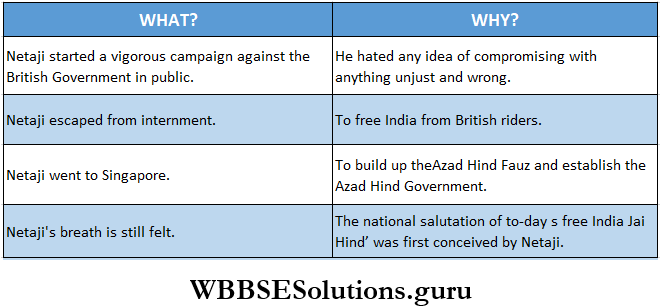
Netaji Subhas Chandra was not a man to appeal to the grace of the British ruler for the freedom of the country. He hated any idea of compromising with anything unjust and wrong. So he started a vigorous campaign against the British Government in public. The foreign ruler sent him behind bars but could not curb his indomitable spirit. In the third week of January 1941, befooling the British Police Force he escaped from internment in his own house and went to Germany in disguise. From there he went to Japan traveling under waters in a submarine. From Japan he went to Singapore and built up the Azad Hind Fouj and established the Azad Hind Government. He was called ‘Netaji’ by the soldiers of the Azad Hind Fauj, the first Indian National Army (INA). As the leader of the Azad Hind Fauj, Netaji said to the soldiers of the Fauj. ‘Comrades! Soldiers! Let your battle cry be-to Delhi, to Delhi !’
The national salutation ‘Jai Hind’ was first conceived by Azad Hind Fauj. Netaji’s breath is still felt in this national salutation of today’s free India: ‘Jai Hind’!
[Word meaning : grace – অনুগ্রহ ; compromise — আপসে নিষ্পত্তি করা; indomitable — অদম্য; befooling— বোকা বানিয়ে; internment— গৃহবন্দী অবস্থা ; conceived— কল্পনা করা হয়েছিল ]
1. Choose the correct alternatives
Question 1. Netaji did not like to appeal to the British rulers because-
- He did not like to compromise with injustice hated the British
- He did not like the rulers
- He hated the British
Answer: 1. He did not like to compromise with injustice hated the British
Question 2. The foreign rulers sent Netaji to jail because-
- Netaji campaigned against the rulers in public
- Netaji killed many Britishers
- Netaji escaped from his house
Answer: 1. Netaji campaigned against the rulers in public
Question 3. Netaji escaped from internment
- In Cuttack
- In Calcutta
- In jail
Answer: 2. In Calcutta
Question 4. The Azad Hind Government was established in-
- Japan
- India
- Singapore
Answer: 3. Singapore
Question 5. The first Indian National Army was established in-
- New Delhi
- Singapore
- Calcutta
Answer: 2. Singapore
2. Complete the following chart with information from the text:
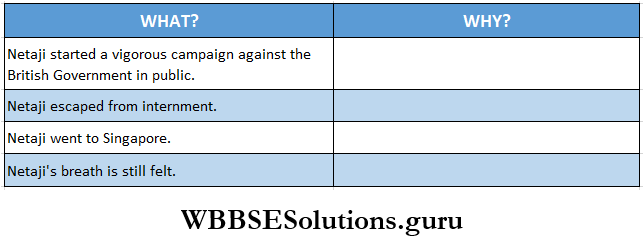
Answer:
3. Match the words in column A with their meanings in column B.
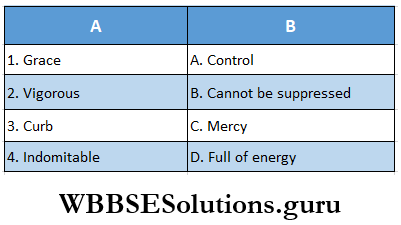
Answer: 1. C,2. D, 3. A, 4. B
Question 22.
Today we know the virus. It is a microbe when it is inside our body. A microbe is a living being so small that we cannot see it with our bare eyes. It is so called because it can be seen only with a microscope which enlarges a microbe thousand times and makes it visible to us. In fact, some microbes cannot be seen at all. It was Louis Pasteur who discovered microbes.
In the middle of the nineteenth century, people laughed at Pasteur when he said that microbes were man’s worst enemies. Pasteur insisted that all microbes, or germs came from the air and that it was possible, therefore, to protect milk, wine, and so on, from microbes. But the professors who thought they understood science said that Pasteur was wrong. They insisted that microbes were born spontaneously, and it was, therefore, nonsense to think that Pasteur could keep microbes out of milk or wine.
In order to convince these doubting professors, Pasteur boiled some broth in bottles, protected the broth from the air, and proved that no germs were created in this liquid. The professors answered that germs must have air in order to generate themselves. Pasteur was furious. He insisted that it was the ‘dust’ in the air and not the air itself that carried germs into the broth.
[Word meaning: microbe – জীবাণু; insisted– জোর দিয়ে বলতেন; spontaneously——-স্বতঃস্ফূর্তভাবে; -nousenise——অর্থহীন; convince – বিশ্বাস জন্মানো ]
1. Answer the following Questions:
Question 1. What is a microbe?
Answer: A microbe is a very small living being that cannot be seen with our bare eyes.
Question 2. Why is it called so?
Answer: It is so-called because it can be seen only with a microscope.
Question 3. What did the professors believe?
Answer: The professors believed that microbes were born spontaneously and they could not be kept out of milk or wine.
Question 4. How did Louis Pasteur prove that he was right?
Answer: Pasteur boiled some broth in bottles, protected the broth from the air, and showed that no germs were created in this liquid. Thus he proved himself right that it was dust in the air and not the air itself that carried germs into the broth.
Question 5. What is a microscope?
Answer: A microscope is an optical instrument that enlarges a microbe thousand times.
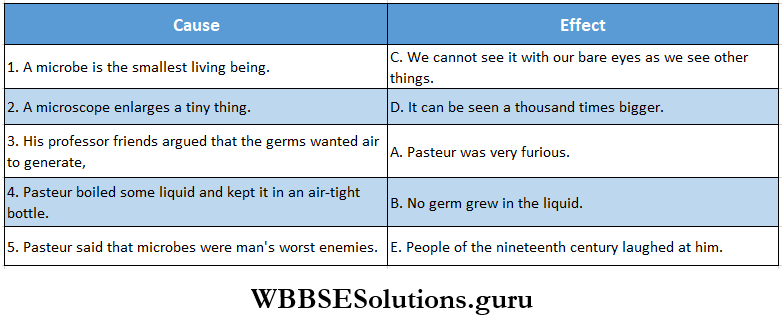
2. Match the cause and effect chart:
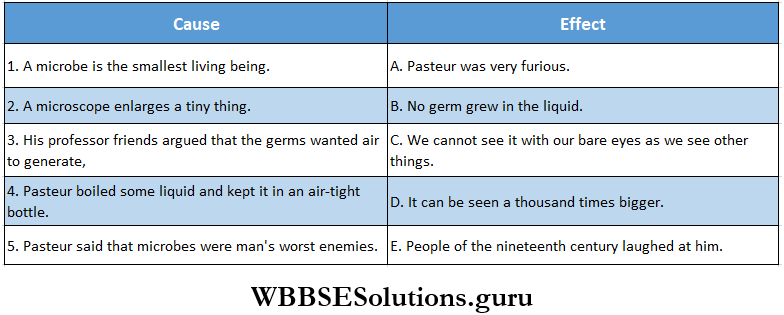
Answer:
3. Fill up the blanks with information from the passage:
Question 1. There are many things that we can see without the use of a ________
Answer: Microscope
Question 2. A powerful machine can ________ the smallest thing to make it _____ to our eyes.
Answer: Visible
Question 3. It is really ______ to say that smoking is not harmful.
Answer: Wrong
Question 4. I told him the truth but could not ____ him.
Answer: Convince
Question 23.
David Livingstone was born many years ago at a small village in Scotland. His father was a poor man. So David was sent to work in a cotton mill at the age of ten. After a long day at the loom, he would read his books late into the night until his mother ordered him to go to bed. As he grew older, David began to go to school in the evening. In this way, he learnt a good deal of Latin, Greek, and medicine. And then he gave up his work in the cotton mill and went to Africa to find new rivers and lakes in that dark land and to teach the people there the story of the Bible. Accompanied by some faithful men, Livingstone set out to cross the Kalahari Desert. On the northern edge of the desert, he found the river Zuga and a great lake. Two years later he crossed the Zuga and pushed further north till he reached the great river Zambesi. Following the course of the river, he came upon the mighty falls which he named the Victoria Falls after Queen Victoria. From a distance, Livingstone had noticed five colors of spray. They were so high that they seemed to mingle with the clouds. They were white below and higher up became dark and thus looked like smoke. Tearing himself away from the beautiful sight, Livingstone pushed on down the river and reached the coast safely. In two and a half years he crossed Africa and completed one of the most wonderful travels.
[Word meanings : late into the night – অনেক রাত্রি পর্যন্ত ; tearing himself away – নিজেকে সরিয়ে নিয়ে।]
1. Choose the answer against the correct alternative:
Question 1. Livingstone’s attempt to cross Kalahari was-
- With some brave companions.
- With some reliable companions.
- With some able-bodied companions.
Answer: 2. With some reliable companions.
Question 2. Livingstone had to work in a loom-
- For experience.
- For poverty.
- For attending school in the evening.
Answer: 2. For poverty.
Question 3. Livingstone saw the great falls
- When he reached the river Zuga.
- When he reached the great lake.
- When he reached the river Zambesi.
Answer: 3. When he reached the river Zambesi.
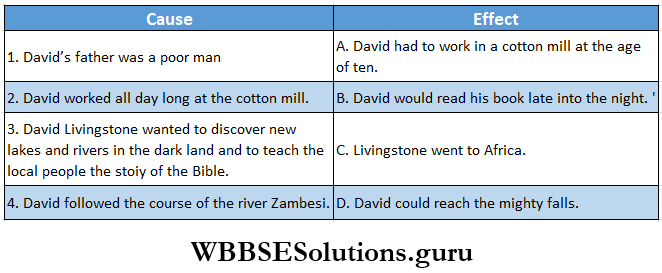
2. Fill in the chart with information from the text:

Answer:
3. Supply the following information from the text:
Question 1. Birthplace of David Livingstone _________
Answer: At a small village in Scotland.
Question 2. Languages learnt by Livingstone ______
Answer: Latin and Greek.
Question 3. Time taken to complete the travel by Livingstone __________
Answer: Two and a half years.
Question 4. Subject matter of teaching the people _________
Answer: The story of the Bible.
Question 5. Name of the dark land ________
Answer: Africa
Question 6. Location of the lake _________
Answer: On the northern edge of the Kalahari Desert.