
Paragraph Writing
অল্প কয়েকটি sentence-এ কোনো বিষয়বস্তু সম্বন্ধে কিছু লেখাকে অনুচ্ছেদ রচনা (paragraph writing) বলে।
যে-কোনো একটি রচনা বা প্রবন্ধ বা গল্প লক্ষ্য করলে তোমরা দেখবে সেটা বিভিন্ন paragraph-এ লেখা হয়েছে এবং এক-একটি paragraph-এ সমগ্র বক্তব্য বিষয়ের এক-একটি অংশ বা point বা topic বিশদভাবে আলোচনা করা হয়েছে। Paragraph রচনায় এটাই বৈশিষ্ট্য।
Read And Learn Also WBBSE Solutions For Class 8 English
A paragraph is a group of sentences all relating to the same topic or subject.
Paragraph লিখবার নির্দিষ্ট নিয়ম আছে :
(১) প্রতি paragraph -এর প্রথম word টি margin হতে কিছুটা ডান দিকে সরিয়ে লেখা হয়।
(২) এক-একটি paragraph-এ এক একটি ভিন্ন ভিন্ন point (topic) বা ভাব নিয়ে আলোচনা হয়ে থাকে। (৩) সাধারণত একটি paragraph-এর প্রথম sentence-এ এই আলোচ্য point-এর উল্লেখ থাকে। একে key sentence বলা হয়। পরের sentence গুলির ভিতর দিয়ে এর বিশদভাবে আলোচনা করা হয়।
(৪) Sentence-গুলি এলোমেলো ভাবে লিখলে চলে না। পরপর সুসঙ্গতভাবে লিখতে হয়। তা ছাড়া একটি কথা দুবার বলা যায় না।
(৫) শেষের sentence-টি এমন হবে যেন পড়লেই বুঝা যায় যে আলোচনা এখানেই শেষ হল।
| WBBSE Class 8 English Functional Grammar | WBBSE Class 8 English Reading Skills |
| WBBSE Solutions For Class 8 English | WBBSE Solutions For Class 8 Maths |
কোনো বিষয়বস্তুর উপর একটি paragraph লিখবার পূর্বে উদ্দেশ্যটি (purpose) ঠিক করে নিতে হয়। নিজেকে প্রশ্ন করে নিতে হয়—আমি সঠিক কী লিখতে চাই ? Class-এ যদি My Family-র উপর লিখতে বলা হয়, ভিন্ন ভিন্ন point নিয়ে ভিন্ন ভিন্ন paragraph লিখতে পারা যায়। যেমন,
- Family member দের পরিচয় করে দিতে একটি paragraph লিখতে পারা যায়।
- ্রতিটি family member-এর nature (স্বভাব) সম্বন্ধেও একটি paragraph অথবা এক-একটি paragraph লিখতে পারা যায়।
এইরূপ আরও অনেক অনেক points ভিত্তি করে অনুচ্ছেদ লিখতে পারা যায়। আবার একটি নির্দিষ্ট point-ও বিভিন্নভাবে লিখতে পারা যায়। নীচের উদাহরণ দুইটি লক্ষ্য করো। দুইটি paragraph-এ এই family member-দের পরিচয় দেওয়া হয়েছে, কিন্তু প্রতিটি sentence-ই একটু অন্যভাবে লেখা হয়েছে। Sentence-গুলিও একটু অন্যভাবে সাজানো হয়েছে।
My Family
- AI am Saroj Ghose. Let me introduce you to the members of my family. My father is Sri Dilip Ghose. He works in a factory. My mother’s name is Smt. Ila Ghose. She does not go out to work. She does all the work in the house for us because we do not have any servant. My elder brother, Swapan, is in class 8 and my little sister is Manju. She is only three years old and does not go to school. I must not forget to tell you that we have a pet dog. We call him Jimmy. He is also an important member of our family.
- We are five in the family. I am the second child and my name is Saroj Ghose. The other members are my parents, my elder brother Swapan, and my little sister Manju. My brother is in class 8 and my sister is too young to go to school.
- My father’s name is Sri Dilip Ghose. He is employed in a factory. My mother’s first name is Ila. We have no servants, so she does all the household work. There is our pet dog Jimmy. We love him and so we consider him a member of our family.
নীচে, করগুলি paragraph-এর উদাহরণ দেওয়া হল। প্রতিটি paragraph-এর main point বা key sentence বার করো। প্রথম paragraph-এর main point বা key sentence হল প্রথম sentence । প্রতিটি paragraph একটু অন্য ভাবে লেখার চেষ্টা করো, যেমন My family লেখা হয়েছে।
Your Friend
- I have a friend named Pinku. He is the best boy in our class. Although he is intelligent and the best boy. he is not at all proud. Besides, he is very kind-hearted. If anyone falls ill, Pinku is the first to pay him visit.
- If anybody is sad, he is sad too. In fact, he comes forward to help anybody any time. Pinku is also a very good sportsman. He plays football and cricket in our school team and he has bagged many prizes. His manner and behavior attract everybody. Indeed, there is none who does not like Pinku. Pinku is my best friend and I like him very much.
Your Hobby
Gardening is my hobby. It simply fascinates me. Every season I have to prepare the soil with water and manure. Constant watch is to be kept against worms. A variety of season flowers are always on bloom there.
During winter there are flowers like Marigold, Rose, Daliah, Chrysanthemum, etc. In summer, the garden looks colorful with sunflowers, Zinnia, Karabi, Tagar, Jui, etc. Some of these are sweet-smelling.
While I look at this scenic beauty, I forget myself in sheer delight. There is a kitchen garden behind our house. I grow vegetables there. It not only saves money but also gives me fresh things. No doubt, gardening is laborious but the results of this hard toilare indeed very pleasant. It is for this reason that I like gardening very much.
Your Aim in Life or Profession You Like to Adopt in Future
- Every man must have an aim in life. For that, he has to choose a profession in advance. My aim is to be an agricultural scientist. I have chosen it for various reasons.
- Our country is an agricultural country. Its prosperity depends on good agricultural output. For this, we need modern scientific methods of agriculture. Unfortunately, we still follow the old methods of cultivation.
- There have been developments in agricultural science these days in other parts of the world. I want to apply these methods in our country. The farmers and agriculturists will have to be trained and guided properly on the latest technologies. This will lead to agricultural production. The economic conditions of the country will also improve.
My Favourite Subject in School
- History is my favourite subject. When I read history, I become fully engrossed in it. History is not a mere record of certain dates and events. It is in fact a record of human evolution. It tells us how man has come to this present state of civilization.
- It also tells us how so many empires simply fell because of the folly of the ruling classes. We can learn how unarmed masses brought down powerful rulers through revolutions.
- It also tells us the intricate politics of different nations that brought disaster in the whole world. There are so much to learn from it. One can learn lessons from history and take proper precautions.
A Book You Have Recently Read
- Recently I read the book Ramer Sumati by Sarat Chandra. The story is all about a joint family. The central figure Ram was almost a terror to everyone that worried Narayani, his sister-in-law.
- But Narayani’s motherly love and affection gave him constant protection and saved the joint family from breaking. In fact, Narayani was more than a mother to Ramlal.
- The author’s portrayal of Ramlal appeals to me the most. Though he was a terror to others, he was like a lamb to his sister-in-law, Narayani. He was a love-hungry boy and Narayani could understand his moods well. She loved her with all affection. These tender feelings have been nicely shown in the novel. I really liked the book.
My Favourite Game
Football is my most favourite game. The game is very exciting and there is no dull moment in it. All twenty-two players have a common goal to score and win the game. The game builds up strength and stamina in the players. It also helps to develop team spirit among them. It is not an expensive game. It can be played any season, anywhere. It is the most exciting game of all. For this it is played all over the world.
Winter in Bengal Or, Your Favourite Season
- Winter is the best of all seasons in Bengal and I like this season very much. December, January, and February are the three winter months. The weather at this time is very pleasant.
- Only in the hilly areas of Darjeeling district and in some parts of North Bengal the winter is quite severe. In this season we can work hard but do not get tired. We put on warm clothes and enjoy the bright sunshine.
- The nights are very cold. The night in a warm bed under a quilt is very comfortable. Paddy is harvested in this season. Colorful seasonal flowers grow in gardens. Fish, vegetables, and fruits are also available in plenty in this season. They are very cheap also.
- This is the most suitable time for holding picnics in the open air. We can go out for holding excursions in winter. Various types of fairs and festivals like Saraswati Puja, Christmas, and New Year’s Day are also celebrated in this season. While we enjoy the cool comfort of the winter, the poor people suffer a lot during these months.
Rainy Season
- The rainy season comes after summer. It begins at the end of June and lasts till the end of August. These are the months when it rains for days together. Tanks, ponds and canals get filled up.
- Sometimes the rain is so heavy as to cause floods. The crops and thatched houses are then damaged. In some parts people have to use boats to go from one place to another. The roads become muddy. People cannot go out. Their work suffers much.
- It is the time when jute and paddy are grown. We see green trees, green grass, and green paddy fields. We get the hilsa fish in this season. Many sweet and juicy fruits like pineapple, jamrul, jackfruit, guava are found in plenty in this season. Rathjatra and Janmashtami are two important festivals in rainy season.
My Village
- The name of my village is Gouripur. It is near Bandel junction in Hooghly district. It is a small village with about one thousand villagers living mostly in thatched houses.
- There is no metalled road. Our village is connected with the main road, which is some 3 k.m. away by a kutcha road. The villagers are mostly farmers. Though there is a primary school in the village, there is no high school. The post office is about 4 km. away.
- There are two big ponds from which we collect drinking water. There is a health center where we often go for medical care. During monsoon the condition of the roads are miserable. But in winter, it is green all over. The villagers live here in an atmosphere of friendliness and amity.
Your School
- Our school, Bankura Zilla School, is a famous school in the district of Bankura. It is a Government School set up in the year 1916. It is situated in a calm and quiet area of the town. The surroundings are also beautiful with sal and eucaliptus trees all around.
- The school building is a pucca two-storeyed building. There are spacious lawns on all sides of the building. It has many rooms in which the classes are held. It has also a good laboratory for science classes.
- The student strength of the school is 700 and the number of teachers is 40. The teachers take great care of our studies. Academic record of the school is also very good. This year in the Madhyamik Examination, out of 100 students, 85 students passed in the first division and the rest in the second division. I am very proud of my school.
Your School Magazine
- A school magazine is a magazine written by the students and teachers of a particular school. We have also a school magazine and it is brought out every year on the Saraswati Puja day.
- Our assistant Headmaster is the editor and a student of class 10 is the assistant editor of the school magazine. It contains poems, short stories, articles of educational interest-all written by the students and teachers of the institution.
- The school magazine serves as a training ground for literary composition. A student feels proud and happy when he finds his writing in print. Gradually his literary talents are developed. The school magazine also serves as a link between the past and present students of the school. Old boys contributing articles in the magazine get into touch with the present students.
Flood
- Floods are generally caused by excessive rainfall. The normal rainwater flows down the river to the sea. But when the rain is too heavy, the river overflows the banks and submerges the land on either side causing flood.
- A flood causes great damage to life and property. Crops are destroyed; low-lying houses, particularly mud and thatched ones, tumble down. Domestic pets like cats, dogs, and cattle are swept away.
- Very often people remain stranded in water-logged areas for several days. They suffer much for want of food and drinking water. Besides, the stagnant water becomes the source of diseases like cholera and dysentery.
- All these create great problems to people during a flood. But a flood has its good effects too. It washes away the accumulated filth that produces germs of various diseases. The alluvial deposit it leaves behind fertilizes the soil.
The Newspaper
- The newspaper plays an important role in our life. By reading it we can know what is happening around us at home and abroad. Newspapers keep us informed of politics, trade, sports and games, films, literary and scientific matters, and many other things.
- We are also apprised of public opinions on various issues. It keeps us informed of the current events all over the world. When we feel tired or lonely we often take up a paper for relief and recreation.
- Reading newspaper is a good habit. It is essential for our general knowledge. A person not reading newspapers regularly cannot take part in any discussions on current affairs. But there are some party papers. We should be careful about choosing a newspaper. We should not be misguided by it.
Visit to a Book Fair
- In February first. I with my friend Bithika went to visit the Calcutta Book Fair in the Calcutta Maidan. When we reached there we found long queues in front of every ticket counter.
- After buying tickets we went inside and saw a large number of book stalls opened by publishers and booksellers. They were of different sizes and shapes and were beautifully decorated. Books on different subjects such as arts, science, and fiction were on display in the counters. They looked so attractive with their smart covers.
- However, the most crowd-pulling ones were the stalls selling children’s books. I bought one book on sports and games. The other one was a storybook. Bithika also bought one book on interior decoration. We took some rest taking refreshments in a cafeteria. It was an experience indeed to be at the fair. I enjoyed every moment of it.
A Village Fair
- A village fair is an important event in a village life. It often serves as a meeting place for people living far away from one another. It gives the villagers a good opportunity for both profit and amusement.
- In a fair there are hundreds of shops selling all kinds of things like stationery, clothes, domestic items, and toys. The merry-go-round is the biggest attraction to the children. There is a circus show also.
- Besides, there are arrangements for refreshments. Various kinds of foodstuff and cold drinks are sold there. When people become tired and hungry they flock to these shops. In fact, a village fair is a pleasant diversion in the dull and monotonous lives of the villagers.
Pollution
- The damage of the purity of anything is called pollution. And the pollution of air, water and land around us is called environmental pollution. Environmental pollution affects our health and causes. loss to us in different ways.
- Air pollution is caused by smokes from vehicles, chimneys of mills and factories, cooking ovens, etc. Bad smell of rotten garbages dumped in the streets, bad smell of dead animals, and filthy surface drains pollute the air.
- If we inhale impure air, it will cause great harm to our lungs. Planting the trees prevents air pollution. Water is polluted when dirty, poisonous refuse matter from mills and factories are discharged in rivers.
- If we drink this water, it will damage our health. Shrill sounds of the horns of lorries, buses, microphones cause sound pollution. Sound pollution affects our power of hearing. Therefore, we shall have to be very careful about pollution if we want to live a healthy life.
Sound Pollution
- Sound pollution is a great hazard nowadays. When the pitch of a sound crosses a certain limit and becomes intolerable the sound is said to cause pollution. Indiscriminate use of microphones, shrill electric horns of motor vehicles, sounds emitted by plying vehicles, airplanes, deafening music system – all this create noise pollution.
- Fireworks and slogan shouting also add to this problem. In fact, we are living in an age when the entire environment is surcharged with sound pollution. This causes great harm to us.
- It often leads to deafness, mental imbalance, and even heart failure. To prevent this pollution the government has made laws restricting noise level up to a certain level. People, therefore, must be made aware of the dangers of sound pollution. Any violation of the restrictions should be severely dealt with.
Proper Use of Holidays
- Holidays are very much necessary in our life. We work hard during the working days. The normal daily routine of work puts pressure upon our health and mind. We feel tired both physically and mentally.
- Holidays give us the necessary rest and relief. But we should not waste our time in idleness. We must use the holidays profitably. We can spend the time reading good books and visiting new places.
- This will increase our knowledge and experience. We can also pay visits to our friends and relatives. Going to cinema or theatre would refresh our mind. We can devote some time to social service also. We can also teach those who are illiterates. Thus, holidays should be spent usefully to restore our energy and making us fit for work again with renewed vigour.
The Value of Sports and Games
- The importance of sports and games cannot be overemphasised. They are as necessary for the mind as for the body. They keep us physically fit, mentally alert and help us to build good health. Sports and games are also necessary to keep our minds fresh and cheerful.
- Sports and games require cooperation amongst the players. The players must look for the interest of the whole team and not for individual glory. Thus, sports and games teach us selfless teamwork and help in the formation of character by enforcing discipline.
- We often get tired and bored and hardly get any mental relaxation from the heavy studies. Sports and games give us relief from this boredom. They also help to develop such qualities like firmness of mind, capacity of taking quick decisions, and prompt judgement to face the odd situations. Thus sports and games play a great role in our life.
Discipline
- Discipline means obedience (মান্যতা ) to the established (যাহা চালু আছে এমন, বিধিবদ্ধ) rules of conduct. It is of great importance in every walk of our life. In the family, all the members must obey the head of the family.
- There cannot be any peace or happiness in the family if there is no discipline. In social life every person has to obey the rules and regulations to maintain law and order in the society. If people go on according to their own sweet will, there cannot be any order and the society would suffer. The importance of discipline among soldiers is known to all.
- Every soldier must obey the commander. An indisciplined army can never win a battle. In schools and colleges, classrooms, libraries, students must obey the rules of their institutions. They must be attentive to their studies. In the playground also discipline is a great necessity. We have seen how an apparently strong but indisciplined team loses to weaker but disciplined teams. It is evident that indiscipline has no place in the world.
Discipline in Student Life
- The student life is the most important period in a man’s life. It is the formative stage of his mind. Good training received at this stage will make him a good citizen in future.
- It is therefore very essential that a student must learn discipline in his student life. Discipline is of great importance in every walk of our life. In the family, all members must obey the head of the family. In social life every person has to obey the rules and regulations to maintain law and order in the society.
- If people go on according to their own sweet will, there cannot be any order and society would suffer. In schools and colleges, classrooms, libraries, students must obey the rules of their institutions. They must be attentive to their studies. Leading a disciplined life at this stage will make him a good and responsible person in later life.
Duty of a student
- A student is a person who studies in a school or college for acquiring knowledge. Student life is, therefore, a very important phase in his life. He should make the best use of his student life.
- His primary duty is to study properly for knowing and learning. He should be very careful about his studies and must lead a disciplined life to build character. But, he should never be a bookworm.
- He must be careful about his health and should be polite and obedient to his parents and teachers. He has social responsibilities too. During holidays, he can teach the illiterate people. He can also serve the affected people in times of floods and famines. Student life is the time to prepare oneself properly for future struggles in life.
A Postman
- A postman is a familiar figure to all of us. He is a humble worker. He works in a post office. He collects letters and parcels from the post office and delivers them to us.
- A postman is a tireless worker who often has to walk a long distance in the sun and in the rain. We always eagerly wait for him to bring us letters from our near and dear ones. In fact he helps us to keep contact with our distant friends and relatives. He is a very important worker in our society and is a great friend of ours. He is always welcome in a house.
Visit to a place of Interest
- Last winter we visited Delhi, the capital of India. Delhi is an old city and it is a place of great historical interest. We went round the city and saw famous structures like Qutab Minar, Jantar Mantar, Red Fort and Jama Masjid.
- All these speak volumes for our historical past. Then there is the grand Lotus Temple built recently at Kalkaji. The Rastrapati Bhaban, Parliament House, Nehru Museum are other spots which attract a large number of tourists everyday.
- We went to Agra also one day and visited the world-famous Taj Mahal, Fatehpur Sikri, and the Agra Fort. There are so many things to see around Delhi and Agra that a period of seven days was too short to cover everything. But we had a good idea of the great city of Delhi. The cool climate, bright sunshine made our trip really enjoyable. Indeed, it was a very memorable trip.
অনেক সময় বিষয়বস্তুর উপর কিছু information (তথ্য) বা outlines দেওয়া থাকে। ঐ outline-কে সম্প্রসারণ করেও paragraph লেখা যায়। সম্প্রসারণ করার সময় প্রদত্ত information বা outline-কে উপযুক্ত ভাব এবং ভাষা ব্যবহার করে সুন্দর paragraph এ পরিণত করতে হয়। নীচে কিছু উদাহরণ দেওয়া হল।
Importance of Trees Or, Man and Trees
[Outlines: Gifts of nature-give flowers, fruits, timber, fuels materials for paper, rubber, medicinal plants releases oxygen-soil conservation-rains-prevent pollution- ecological balance]
- Trees are useful and beautiful gifts of nature. They give us flowers, fruits, timber, bamboo, fuels, etc. which are so necessary for us. They are also a great source of material for paper, rubber, gums, herbs, and medicinal plants.
- Trees give us cool shade. They absorb carbon-di-oxide from atmosphere and release oxygen which is needed for our life. The roots of trees bind loose soil and prevent soil erosion. The top fertile soil is thus retained. This helps us in agriculture and food production. Trees induce rains and prevent air pollution. They protect us from severe weather.
- An area without trees soon becomes barren and turns out to be a desert in course of time. Trees thus help in maintaining ecological balance. Indeed, they play a great role in civilisation. We should therefore avoid random felling of trees. Trees should be preserved with great care.
Triumph of Science
[Outlines: Roots of progress achievements of science in family comfort-in transport and communication–in food supply–in domestic life-computers health care-artificial satellites- abuse of science.]
- Science is at the root of progress in the modern age. With the help of science man has made great achievements in all spheres of life. Science has made our life easy and comfortable.
- It has taught us to grow more food and make domestic life comfortable and enjoyable. The electric light and fan, the electric oven, the refrigerator-all are products of science.
- Railways, ships, motor cars, aeroplanes take us ‘to distant places safely in a very short time. The telegraph, the telephone, and the radio have made communication very quick.
- The television and the cinema entertain us. Computers are working wonders in every sphere of our life. Science has also given us good medicines to cure dangerous diseases. Scientists have sent artificial satellites into space and have already landed on the Moon and expect to reach the Mars within a short time.
- But science has proved to be a curse also. It has been misused to make deadly weapons like the atom bomb, the hydrogen bomb, and poisoneous chemical gas which can destroy the world in a short time. We should use science only for the good of mankind.
A Rainy Day
[Outlines: Rainy days do not have to attend classes-streets flooded-cars and trams stop plying-buses move with great difficulty-fun in getting soaked-students fail to attend classes- school grants a rainy day-return home-enjoy playing at home.]
- I like rainy days. I like them more when my homework remains incomplete and I am afraid of attending my classes. Excessive rain during the early hours of the day greatly hampers routine works.
- Streets become flooded with water, and playgrounds often look like vast water sheets. Cars and trams stop plying. Occasionally buses move along the water-logged streets.
- The waves they create in the water are pleasant to look at. During such heavy rains, it is fun to get soaked in rains and wade through knee-deep water in the streets. Most of the students cannot attend classes while others attend with wet clothes. They are often granted a holiday. When I return home, mother takes care of me. She offers me hot tea. We often play ludo and relax at home on a rainy day.
Visit to a Circus
[Outlines: Went to see a circus-big crowd, long queues-beautiful show-trapezes, balance games, etc a man jumping with a running jeep-cyclists, jugglers-elephants, horses and other animals-funny clowns–enjoyed it much.]
- For a long time I wanted to see a circus and last winter I watched a circus show for the first time in my life. The famous Jemini Circus had come to our town and pitched its camp near the railway maidan.
- As I came near the circus tent, I found a big crowd and long queues in front of the ticket counters. The show was really beautiful. I enjoyed the trapezes, balances, and other feats performed by the artists. I was thrilled to see a man jumping a long distance with his jeep.
- The artists performed miracles with bicycles. The jugglers kept us in suspense. There were also elephants and other animals. They obeyed their masters and showed some tricks.
- I was charmed to see a horse dancing to the rythm of bands. Above all, there were the clowns. They were so funny! The show was very interesting and entertaining. I didn’t know how time passed so swiftly during the circus show.
A Great Man Or Netaji Subhas Chandra Bose
Outlines:
Name: Subhas Ch. Bose
Date of birth: 23rd January 1897
Place of birth: Cuttack, Orissa
Education: Brilliant student
Service: Passed 1. C. S. Examination did not join Govt. Service. Became Mayor of Calcutta Corporation, Congress President, fought for independence, and suffered imprisonment. Left India in disguise, formed I. N. A. fought battles.
Death: In an air accident?
- Subhas Chandra Bose was born on 23rd January 1897 in Cuttack. He came of a very rich family and was a brilliant student. Though he stood fourth in the Indian Civil Service (1. C.S.) examination, he refused to accept service under the British Government.
- Soon he joined politics and became the ‘Mayor’ of Calcutta Corporation. He also became the youngest Congress President, India was then ruled by the British Government. Subhas Chandra wanted India to be an independent country and made several plans for that purpose.
- So he was imprisoned by the British Government. But he left India in disguise and formed the I. N. A. (Indian National Army) to liberate India from the clutches of the British rulers. He fought great battles to achieve his mission.
- It is said that he died in an air accident. Whatever may be the fact, Subhas Chandra will remain in the heart of the Indian people for his courage, determination, and patriotism.
Swami Vivekananda
Outlines:
Name: Narendranath Dutta
Nickname: Bile
Place and date of birth: Calcutta, 12th January 1863
Parentage: Father – Biswanath Dutta; Mother – Bhubaneswari Devi
Education: B. A. from General Assembly
Turning point in life: Contact with Ramakrishna called Swami Vivekananda.
Speeches at the Parliament of Religions in Chicago in 1893.
Establishment of Ramakrishna Mission and Belur Math.
Death: 1902
- Swami Vivekananda was born on 12th January 1863. His original name was Narendranath Dutta and his nickname was ‘Bile’. His father’s name was Biswanath Dutta. Bhubaneswari Devi was his mother.
- He graduated from the General Assembly. The turning point in his life came when he met Sri Sri Ramakrishna. He took to religion and became his disciple. He was then named Swami Vivekananda.
- He toured the whole of India preaching education through religion. He attended the Parliament of Religions in Chicago in 1893. He established Ramakrishna Mission and Belur Math. He passed away in 1902.
Question 1. Write a passage on the great poet, novelist, and philosopher Rabindranath with the following points.
Name: Rabindra Tagore
Date of birth: 9th May 1861
Place of birth: Jorasanko, Calcutta
Name of parents: Father-Maharshi Devendranath Tagore; Mother-Sarada Devi
Won Nobel prize for literature: 1913 for Gitanjali
Founder of: Visva Bharati in 1902
Protested against: Jalianwalabagh massacre, rejected Knighthood.
Died: 1941
Answer:
- Rabindranath Tagore was a great poet, novelist, and philosopher. He was born on 9th May 1861 at Jorasanko, Calcutta. His father was Devendranath Tagore and his mother was Sarada Devi.
- In his early career he started writing poems. He was a great literary figure. In 1913 he was awarded the Nobel Prize for his collection of poems Gitanjali’. He was the first Indian to win such an award.
- He also founded Visva Bharati in 1902. He was a great patriot too. He protested against the killing of innocent Indians at Jalianwalabag and rejected his Knighthood. This great son of India died on 1941.
Question 2. Write a short life history of Sri P. C. Roy on the basis of the following information.
Name: Sri Prafulla Chandra Roy
Date of birth: 2-8-1861
Native village: Raruli, Katipara in Khulna
Primary Education: Native village
Entrance Examination: 1878
Got Gilchrist Scholarship: 1882, B.Sc. and D.Sc. from Edinburgh University 1889
Professor at Presidency College: 1889
Established Bengal Chemical Ltd: 1900
Palit Professor at Calcutta University: 1916
Retired: 1936
Death: 16-6-1944
Answer:
- Sri. P. C. Roy, the great scientist, was born on 2nd August 1861, in a small village Raruli at Katipara in Khulna, now in Bangladesh. He had his primary education at his native village and passed the Entrance Examination in 1878.
- He was a brilliant student throughout his career. After passing the B.Sc. examination in 1882 he got the Gilchrist Scholarship and received D.Sc. from Edinburgh University.
- Returning home he joined Presidency College in 1889 as a professor. In 1900 he founded the Bengal Chemical Ltd. Later in 1916, he became the Palit Professor at Calcutta University, a rare honor indeed. He retired in the year 1936 and died on 16th June 1944.
Our National Flag
[Points Colour green, white, saffron-occasion to hoist-history-your respectful homage.]
- Our national flag is very sacred to us. It has three colored stripes of equal width and they are all horizontal. The colours are saffron, white and green. The saffron is at the top, white in the middle and green at the bottom.
- There is a wheel in the middle. Each colour has its significance. The saffron colour stands for sacrifice, the white color indicates truth and purity, and green stands for freshness and energy. The wheel in the middle represents the Dharma Chakra of King Ashoka.
- This denotes activity and progress. The national flag is an emblem of national dignity. Therefore it has to be treated with honour and respect. It is hoisted daily on all important government buildings.
- Only on the days of national festivals like Independence Day, Republic Day, etc. it can be hoisted on private buildings also. Our national flag has a long history. Many freedom fighters sacrificed their lives for it. It is the duty of every Indian to uphold the honour of our national flag and pay homage to it.
Usefulness of Television
[Outlines: A wonder of science- interesting programs like songs, plays, dramas, etc. by singers, players, actors, recreations-direct knowledge of things and places-a powerful medium of mass education.].
- One of the latest inventions of science is Television. It is based on photography and its instant transmission through air on the screen after a complicated electronic process, It puts before our eyes the pictures of objects and men, thousands of miles away together with their sounds and voices. It has a big entertainment and educational value.
- Sitting in the cozy corners of our drawing rooms, we can enjoy the songs, plays, and dramas performed by eminent artists. We can watch live on the TV screen the important political, sports, and other events taking place in the remote parts of the world. This enables us to have a direct knowledge of the things and places that we watch in television.
- Television is also a powerful medium of mass education. Educational programs on health care and family planning, general knowledge, instructions, and guidance on various social matters can be sent to millions of viewers through audio-visual presentations in the TV. It is also a means by which a teacher can teach a very large number of students from a distance. Television is thus of great use to us.
Question 3. Write a paragraph with the following points.
Name: Sir J. C. Bose
Year of birth: 1858
Place of birth: Mymensingh, now in Bangladesh
Education: Village pathsala, St. Xavier’s School, B.A. in St. Xavier’s College, B.Sc. from Cambridge University
Service career: Professor, Presidency College, carried on research on
Electromagnet and Plantlife (1884-1915)
Post-retirement work: Founded Bose Institute (1917)
Achievement: A great scientist
Death: 1937
Sir Jagadish Chandra Bose
Answer:
- Sir J. C. Bose, the famous scientist, was born in the year 1858 at Mymensingh, now in Bangladesh. He had his early education at the village “Of Pathshala”. Later he shifted to St. Xavier’s
- School where he completed his school education. He passed the B. A. Examination from St. Xavier’s College and B.Sc. from Cambridge University. He served as a professor at Presidency College.
- He carried on research on Electro-magnet and plant life during the period 1884-1915. After retirement from service, he founded Bose Institute in 1917. He achieved name and honor as a great scientist. He – died in 1937.
Question 4. Write a short life sketch of Raja Rammohan Roy on the basis of the following information:
Name: Raja Rammohan Roy
Date of birth: 10th May 1774
Father: Ramakanta Roy
Mother: Tarini Davi
Education: Learnt Arabic, Persian, Sanskrit, Scholar in English, Latin, Greek, French, Tibetan
Countries visited: Tibet, England
Achievement: Founded Brahmo Samaj, Hindu College.
Abolished ‘Sati Custom’.
Works: Wrote books on various subjects.
Death: 27th September 1833. Buried in Bristol.
Raja Rammohan Roy
- As Raja Rammohan Roy was born on May 10, 1774. His parents were Ramakanta Roy and Tarini Devi. He showed great promise as a meritorious student from his very childhood.
- He had a great interest in studies and learnt languages like Arabic, Persian, Sanskrit, Latin, Greek, French, and Tibetian. Besides his mother tongue Bengali he was a great scholar in English also.
- Rammohan was a great social reformer. He founded Brahmo Samaj to counter the Hindu orthodoxy such as Sati Custom. He tried his best to remove many social evils too. He established the Hindu College and wrote many books on various subjects. He travelled to many countries including England and Tibet. The great reformer died in Bristol on September 27, 1833, and was buried there.
Question 5. Write a paragraph on Mother Teresa with the following points:
[Points: Year and place of birth-1910, Yugoslavia, Carlier name–Agnes, arrived in India 1928—first activities-a teacher in a convent school-later activities-established Nirmal Hriday- Nobel Prize in 1979, Death-1997, 5th Sep.]
Mother Teresa
Answer: Mother Teresa was born in 1910 at Albania in Yugoslavia. Her earlier name was Agnes Gonxhas Bojaxhin. At the age of 18, she came to Calcutta and joined as a teacher in a convent school. She was very much moved at the sufferings of the poor people around her. So she dedicated the rest of her life as a missionary fighting poverty, hunger and disease. She set up her organisation Missionaries of Charity in Calcutta and founded for the destitutes a home named Nirmal Hriday. She was awarded the Nobel Prize for peace in 1979. This great soul died in Calcutta on 5th September 1997.
Question 6. Study the following information and write a paragraph about Satyajit Roy, the great Indian writer and filmmaker.
Date of birth: 2nd May 1921
Birthplace: Kolkata
Education: Ballyganj Govt. High School, Presidency College, Art training from Santiniketan (Nandalal Bose and others)
Career: Professional artist at Signet Press.
First film: Pather Panchali, then Apu Trilogy, Jalsaghar, Goopy Gayne Bagha Bayen, and so many others.
Other contribution: To Bengali literature – famous adventure stories for children. Bharat Ratna from India, Legion of Honour from France, and Oscar from the U.S.A.
Honours: Satyajit Ray
Answer:
- Satyajit Ray, the great Indian filmmaker and writer was born in Kolkata on 2nd May 1921. He had his education at Ballygunge Government School and later at Presidency College. Subsequently, he received training in arts from Santiniketan under the guidance of Nandalal Bose and others.
- He started his carrer as a professional artist at Signet Press. Later on he took to filmmaking. His first film Pather Panchali made him world famous overnight.
- His other films such as Apu Trilogy, Jalsaghar, Goopy Gayen Bagha Bayen, and many others earned him a great name as a brilliant filmmaker. He also wrote many books on adventure stories for children which made him immensely popular.
- For his outstanding achievements in filmmaking, he was honored with awards like Bharat Ratna, Legion of Honour from France, and Oscar from the U.S.A.
Question 7. Study the following information about Iswar Chandra Vidyasagar and write a paragraph on him.
Date of birth: 1820, 26th Sept.
Place of birth: Village Birsingha, Midnapore.
Parentage: Father Thakurdas Bandopadhyaya.
Mother-Bhagabati Devi.
Education: Primary Education in the village-Post Primary Education in Sanskrit College, Kolkata-very brilliant student-never stood second-got title Vidyasagar.
Service life: At the first professor and then Principal of Sanskrit College-at last Inspector of Schools.
Social Service: Introduction of widow remarriage-spread of female education.
Character: Very kind to poor man a man of strong character
Answer:
- Pandit Iswar Chandra Vidyasagar, the great social reformer, was born on 26th September, 1820 at village Birsingha in the district of Midnapore. His father was Thakurdas Bandopadhyaya and mother was Bhagabati Devi.
- In his early days, he had his primary education in the village. His post primary education was in Sanskrit College, Kolkata. He was a brilliant student and never stood second in his life. He soon gathered vast knowledge and became famous for his learning. He was awarded the title Vidyasagar by his countrymen after completion of his studies.
- He started his service life as a professor of Sanskrit College, Kolkata and later became its Principal. He was the Inspector of Schools towards the end of his service career. He was a great social reformer and introduced widow remarriage in our country. He had a great love for learning and worked hard for spread of female education. Vidyasagar was a man of strong character and was also noted for his sympathy and kindness to the poor. He did a lot for them.
Question 8. Write in about 150 words a paragraph on Kshudiram Basu, the great patriot on the following points.
[Outlines: Birth in Midnapore in 1889-a spirited boy associated with a revolutionary party from school-close to Profulla Chaki in Mujaffarpur-a mission to kill Kingsford, a tyrant magistrate Kingsford unhurt Kshudiram arrested and sentenced to death-facing death with ‘Vande Mataram’ in his lips.]
Answer:
- Kshudiram Basu, the great patriot and freedom fighter, was born in 1889 in Midnapore. He was a highly spirited boy and became associated with a revolutionary party from his childhood.
- Kingsford, an Englishman, who was notorious for his tyranny, was the magistrate of Muzaffarpur at that time. To put an end to his tyranny, Kshudiram and Profulla Chaki left for Muzaffarpur on a mission to kill him.
- Unfortunately, the plan misfired and Kingsford escaped unhurt. Kshudiram tried to escape but was soon arrested, tried, and sentenced to death. But Kshudiram was a true patriot and a fearless fighter. Undaunted, he faced the situation calmly. He went to the gallows in high spirits and embraced death singing ‘Vande Mataram’.
Question 9. Use the following information and write a paragraph on Amartya Sen, the famous Economist.
Date of birth: 3 November 1933
Parents: Dr. Asutosh Sen and Smt. Amita Sen.
Education at: Santiniketan, Presidency College, Calcutta University, Cambridge University.
Teaching career: Professor of Economics, Jadavpur University (1956-58), Delhi University (1963-71), London School of Economics (1971-77), Oxford University (1977-80), Professor of Economics and Philosophy at Harvard University for 11 years.
Awards and Honours: Honorary D. Litt. from Viswa Bharati, Fellow of All Souls College, Oxford, Agnelli Internet Prize, etc. Nobel Prize for Economics in 1998.
Present occupation: Master of Trinity College, Cambridge, since 1997.
Books written: “Poverty and Famines”, “The Political Economy of Hunger” etc. Amartya Sen
Answer:
- Amartya Sen was born on 3rd November 1933. His parents were Dr. Ashutosh Sen and Sreemati Amita Sen. He had his earlier education at Santiniketan. Later he studied at Presidency College, Calcutta University, and at Cambridge University. He started his teaching career as Professor of Economics at Jadavpur University.
- He taught there from 1956 to 1958. Then from 1963 to 1971 he worked at Delhi University. After that he went to London School of Economics and taught there from 1971 to 1977 and then from 1977 to 1980 he taught at Oxford University.
- He also worked as a Professor of Economics and Philosophy at Harvard University for 11 years. He was awarded many awards and honours like Honorary D. Litt from Viswa Bharati, Fellow of All Souls College, Oxford, Agnelli Internet Prize, etc.
- In 1998 he was awarded the Nobel Prize for Economics. At present, he is engaged as the Master of Trinity College, Cambridge. He has written many books. Some of them are “Poverty and Famines,” “The Political Economy of Hunger”, etc.
Question 10. Study the following information and write a paragraph about Dr. Sarvapally Radhakrishnan, the great teacher and philosopher.
[Points: Date of birth 5th Sept. 1888 Birthplace: Tamilnadu-Education: Presidency College, Madras-Service: Professor of Philosophy at Presidency College, Madras, Calcutta, and Oxford Universities-Ambassador to the U.S.S.R. in 1949-Vice President of India, 1952- President of India 1962-67-Honour: Awarded Bharat Ratna in 1954. His birthday observed as Teachers’ Day.]
Answer:
- Dr. Sarvapally Radhakrishnan, the great philosopher, was born in Tamilnadu on 5th September 1888. He had his eduction at Presidency College, Madras. Later he became a Professor of Philosophy at Presidency College, Madras, and Calcutta.
- He also went to Oxford University and taught there for a long time. In 1949 he went to the USSR as Indian Ambassador. In 1952 he returned to India and became the Vice President of India, a post he occupied till 1962. From 1962 to 1967 he was the President of India. He was a great philosopher, teacher, and his birthday is observed as Teachers’ Day in India.
Question 11. Study the following information and write out a paragraph about Bibhutibhusan Bandyopadhyay:
Date of birth: 12th September 1894.
Place of birth: Muratipur near Kanchrapara.
Education: Passed Matriculation in the First Division from Banagram High School; Passed B. A. in 1916 with distinction from Ripon College, Calcutta.
Contributions: First novel “Pather Panchali” made him famous-wrote many books “Dristipradip”, “Aranyak”, “Debian”, short stories, essays, etc. Rabindra Award for “Ichhamati”, a writer of nature-writes for children such as “Chander Pahar”-many novels in celluloid.
Death: 18th November, 1950 at Ghatshilla residence.
Answer:
- Bibhutibhusan Bandopadhyay, the great Bengali writer, was born on 12th September, 1894 at Muratipur near Kanchrapara. He was a meritorious student and passed Matriculation Examination in the first division from Banagram High School.
- Later, he did his B.A. with distinction in 1916 from Ripon College, Calcutta. Bibhutibhusan had a literary bent of mind and started writing from his student days. His first novel was “Pather Panchali” and that made him famous overnight.
- The story of Apu and Durga is an all-time great classic in Bengali literature. Filming of this classic made Satyajit Roy a legendary film director. He wrote many other books like Dristipradip, Aranyak, Debjan besides many short stories and essays.
- He was awarded Rabindra Award for “Ichhamati”. His writings mostly depicted the serene beauty of nature. He wrote for children as well, Chander Pahar being one of them. Many of his novels were made into films. This great writer died on 18th November 1950 at his residence at Ghatsilä.
A Memorable Day
- A thing which is sweet lasts long in our memory. I distinctly remember the day. The H.S. Examination was over. One day, after spending the afternoon with my friends, as I returned home my sister came running, holding a big envelope in her hand.
- She shouted that there was good news for me and demanded a heavy bakshis before she would hand over the letter to me. After much cajoling I could get the letter. Lo and behold! It was the admission letter from the I.I.T., Kharagpur.
- My joy knew no bounds. I did quite well in the Joint Entrance Examination. But to get selected finally in the highly competitive all India test was something none could be sure of.
- In fact, I was a little tensed these days to know the result. My parents blessed me for my success. I was lost in golden dreams. At last I was going to join an institution of international fame! It was the happiest and most memorable day in my life. The Book You Would Like to read Again
- The book I would like to read again is ‘Abol Tabol’ written by Sukumar Roy. I first read the book when I was a student of class V. It is a wonderful book containing nonsense rhymes. The book is specially meant for children.
- Though the rhymes appear to talk of serious matters, they actually make no sense. The words are full of simple jokes. I have read the book several times. But still I feel like reading it again and again just for pleasure. It is one of the finest classics in Bengali literature for children. Every child should make it a point to read it.
The Advantages of Morning Walk
- Morning walk is a good habit. It is good for people of all ages-the young or the old. Walking in the fresh air in a calm atmosphere in the morning, we can enjoy the beauty of nature and come close to her when she is at her charming best.
- Morning walk is a very good exercise that gives an excellent start for the whole day. It helps to reduce fat, lethargy, and idleness and keeps the body fit. It needs no equipment or trainer, and is the cheapest form of exercise. It can be taken anywhere in open fields or open roads. So one must grow the habit of taking morning walk.
India – Our Motherland
[Points: India, a great land-golden past-the Vedas-two epics-rich heritage-home of four religions Hinduism, Buddhism, Jainism, and Sikhism-people love peace-live unitedly- fight against terrorism enough food-a developing nation-work for world peace.]
- India is our Motherland. It is a great and beautiful country. It is famous for its old civilisation and culture. It was from here that the light of civilization first spread to the countries in South-East Asia.
- Her Vedas, Ramayana, and Mahabharata are amongst the greatest books of the world. Some of the religions of the present day- Hinduism, Buddhism, Jainism, and Sikhism had their origin here. People here belong to different religions, castes, and creeds.
- They have different languages, food habits, dresses, etc. But still, they stand united as Indians. India is a developing nation and has made great progress in agriculture, industry, education, science, and technology. It is self-sufficient in food and most other consumer goods. India fights against terrorism and is working for world peace.
A Journey By A Bus
- Last week we made a trip to Digha. We took the bus at the Esplanade depot. at 7.30 in the morning. Soon it crossed Vidyasagar Setu and Kona Expressway met National Highway 6. From Vidyasagar Setu we had a wonderful view of the Ganges and the city of Kolkata.
- We reached Kolaghat at about 10 a.m. and had some snacks and tea in a roadside stall. We could also see the giant Kolaghat Thermal Power Station on the way.
- Turning left we moved along National Highway 41 and reached Nanda Kumar where we took a right turn. Driving through Digha Road towards Contai, we reached Digha at about 1 p.m. The journey along the wide highways was very smooth and pleasant. We enjoyed the trip very much.
Healthy Living
[Points: Balanced diet-drink pure water-regular physical exercise-cleanliness]
- Health is a great treasure, and it is the source of all happiness. So we must be very careful about healthy living. The first thing necessary for that is a balanced diet.
- It should be a mixture of right proportions of carbohydrates, proteins, vitamins, and minerals. Fresh vegetables and fruit should also be taken. Excessive intake of any one of these is bad for health.
- We must also take physical exercise regularly. It makes the body strong and active and keeps the mind cheerful. Stresses should also be laid on the cleanliness of the surrounding and the purity of the drinking water. Any contamination of food would be harmful. Healthy living ensures great pleasure in life.
Air Pollution
[Points: Great problem-causes-mills, vehicles, burning coal, etc.- – steps to be taken]
- Environmental pollution is a great problem of modern-day life. The most damaging effect is caused by air pollution. The main sources of air pollution are exhausts from engines, furnaces, and industrial wastes.
- Smoke from burning wood, coal, and cooking ovens also create severe air pollution. These smokes are full of carbon monoxide and lead particles which are highly injurious to health. Garbage, dead and rotten animals dumped in streets produce gas which pollutes the air.
- If we inhale polluted air, it will cause great harm to our lungs. So we shall have to be very careful about air pollution. We should try to keep the atmosphere clean and plant trees which absorb carbon dioxide from atmosphere and release oxygen.
How to Prevent Water Pollution
- Water pollution is contamination of streams, lakes, and underground water by substances that are harmful to living bodies. Water is polluted when poisonous waste matters from factories and mills are discharged into rivers.
- Pesticides and fertilizers used in agriculture also pollute water. The chemical effluents of these compounds in the soil are finally washed out into the surface water and pollute it.
- Besides, heavy metals like copper, lead, mercury, etc. get into water from various sources including automobile exhausts, mines, etc. Drinking of polluted water can result in long-term health problems. To prevent water pollution, industrial wastes should be treated properly and municipal sewage cleaned regularly. The use of pesticides and fertilizers in agriculture and house gardening should also be controlled.
My Likes and Dislikes
- Everybody has his like and dislikes, and so do I. Of all the things in the world, I like reading books and travelling the most. Biographies and detective stories are my favorites. I also like mixing with my friends. Very often we visit places of historical and religious interest and spend good times there.
- Besides, I like games and take part in football, cricket and table tennis. I am also very fond of gardening and grow flowers and vegetables at our backyard. Music has a special place in my heart. I do not like seeing movies and gossiping. Watching too much of TV and neglecting studies irritate me. I also dislike dishonesty, laziness, and unpunctuality which I consider as great vices.
Autumn in West Bengal
[Points: Autumn succeeds the ‘Rainy Season’ preceeds the winter divided into two- Carly autumn and late autumn-after heavy r. fall-weather moderate-not hot nor cold-natural scenery-harvesting time-many festivals- enjoyment-season of pleasure and mirth.]
- Autumn in West Bengal comprises the months of September and October. It begins with the end of the rainy season and continues till the beginning of winter.
- It has two phases early autumn and late autumn. After the heavy rainfall in monsoon, the weather this time is moderate-it is neither hot nor cold. The natural scenery is also quite beautiful.
- The sky is clear and we often enjoy the beauty of moonlight in all its sweetness. Paddy is harvested in this season. It is also the time when comes the Durga Puja, the greatest Hindu religious festival. Schools and colleges remain closed for some time, enabling people to enjoy themselves as they like.
Computer
[Points Introduction-do difficult calculations-store data speed and accuracy- – used in schools, colleges, libraries, hospitals, banks, train and plane bookings-speedy transactions – telecommunication-research work – conclusion.]
- The latest gift of science is a computer. It works like a super-electronic brain that processes data into information. Its main feature is speed and accuracy. Computers have found a place even in our homes, at workplaces and schools, and colleges.
- They are being used in libraries, hospitals, banks, and reservation counters. It has a special use in a telecommunication system and helps to set worldwide instant network at the click of a button. Scientific research work, and spaceflights are greatly benefited by the advancement of Computer Science. Because of its wide use in every aspect of life, learning of computers has been included in school curriculum. Computers are a real boon to mankind.
Punctuality
[Points: Meaning of punctuality-value of punctuality in everyday life-key to success in life-punctuality is the world of nature – conclusion]
- Punctuality means keeping to the appointed or fixed hour. Time is invaluable. Nothing can stop the flow of time or call back a time that is past. A punctual man, however busy or engaged, finds time for more work.
- An unpunctual man, on the other hand, far from doing much, cannot finish his normal duties even. If we are punctual we shall not miss any class lecture, we shall not miss the train.
- Others will not be kept waiting in an urgent meeting. But an unpunctual man incurs the displeasure of everybody and fails in life. Punctuality is one of the secrets of success in one’s life. A punctual man creates a good impression on others and is respected by all whereas an unpunctual man produces bad impression on the minds of others as he wastes their time by failing an appointment.
- Even everything in nature is punctual as a rule. Had the sun been not punctual to rise in the east and set on the west, the moon would have not appeared. This unpunctuality in the planet would have made everything topsy-turvy in the planet, leading to the disappearance of life in it. So we must be punctual in every step in our life.
Your Daily Life
- I usually get up from bed every day at 6 a.m. Then I wash my face and have breakfast. Next, I sit down to prepare my lessons. At 9-30 a.m. I have my bath and take meals. I start for school after that and return from school at about 5 p.m.
- In the afternoon I always go out to play with my friends. Returning home, I wash myself thoroughly and eat something before I start my lessons again. At 9-30 p.m. I have dinner and go to bed at about 10-30 p.m. after watching TV program for a while.
- But on Sundays and holidays, after doing my homework I spend time reading books and watching TV. After lunch, I relax on my bed for some time and then go out to meet my friends. Returning home I start my homework and go to bed after having dinner.
Value of Time
- Time is invaluable. It flows on ceaselessly and time once gone is gone forever. Lost time cannot be recovered by any means. Many do not realize this. They waste their time, thinking that they would make up the loss in future.
- But the hope may be never realized. Every moment of our time has its particular duty. Putting off our work, therefore, means over-burdening us. That makes our tasks heavier and more difficult in future.
- That is why students who neglect their studies from day to day often fail in spite of hard labour before the examination. All successful men everywhere are those who made proper use of every moment of their time. We should, therefore, all make the best use of time.
- My HomeHome is the sweetest place on earth. I am very proud of my home. At home I have my parents, one brother and two sisters. My father is the head of the family and is a doctor. He looks after the welfare of the entire family.
- My mother manages the household works. She takes care of our food, clothes, health, etc. and also looks after our comfort. The two sisters are very dear to me. They go to a local school.
- Apu, my younger brother, is a class III student. My father looks after our study whenever he has time. I always give my parents a helping hand whenever needed. We are not rich, but there is peace in our family. That’s why my home is so sweet to me.
Do’s and Don’tsTo Guard Against Cholera
Guard Against Cholera Do’s
- Take cholera inoculation immediately.
- Keep your home and the surroundings clean and free from flies and mosquitoes.
- Drink only boiled water.
- Keep all food and drinking water properly
- Contact the local doctor if there is any house.
Guard Against Cholera Don’ts
- Do not take cut fruits or any food item from the street hawkers.
- Do not take any food which is kept in the open.
- Do not use dirty water from ponds.
- Do not allow garbage accumulation near the covered.
Annual Prize-giving Ceremony of Your School
[Outlines: Date and time-President-arrangements-opening song-annual report cultural programmes-President gave away the prizes-President’s speech-vote of thanks.]
- The 25th Prize-giving ceremony of our school was held on Sunday, the 10th April 2004, under the Presidentship of Sir A. K. Roy. M.A., Ph.D., Principal of the local College. On this occasion a big pandal was erected in the school compound.
- It was tastefully decorated with flags and festoons. A large number of people including the students’ guardians attended the ceremony. The function started with the opening song, sung by the students of class 10.
- The Headmaster then read his report, which showed all-round improvement in the affairs of the school. Then followed an interesting programme of recitations and songs by the boys of the school, which was enjoyed by everybody.
- The President then gave away the prizes. Next came his speech. He advised the boys to maintain discipline and to be sincere and hard-working in their studies. The meeting ended with a vote of thanks to the chair, proposed by the Assistant Headmaster.
Question 12. Write a report on the condition of Kolkata after a heavy rain.
[Outlines:- Time and date-water logging-disruption of electric supply-no tram-train service disrupted-misery of people]
- Last Friday in the morning Kolkata was lashed by a heavy rain. The rain started at about 9 a.m. and continued for about three hours. The result was so devastating that it paralyzed the city life for the whole day.
- Water accumulated all over the city, specially in low-lying areas like Tiljala, Kasba, Beleghata, Dum Dum, etc. In some areas, the electric supply was disrupted as some poles overturned.
- Trams also stopped plying from about 10 a.m. and the commuters had a hard time reaching their destinations. Train services were also disrupted as overhead wires snapped and water flooded the tracks. The misery of the people simply beggared description.
- In the low lying areas, water entered, many huts. The residents were compelled to abandon their houses and move to safety. Many mud houses also collapsed. Many organisations have already taken up relief works to mitigate the hardship of the affected people.
অনেক সময় কোনো বিষয়বস্তুর সারাংশ চার্ট (chart) বা টেবিল (table) আকারে দেওয়া হয় এবং তা থেকে বিষয়বস্তুর উপর paragraph লিখতে বলা হয়।
এই প্রকার paragraph লিখতে অধিকাংশ ক্ষেত্রেই passive voice এর ব্যবহার করা হয়। নীচের উদাহরণগুলি লক্ষ্য করো :
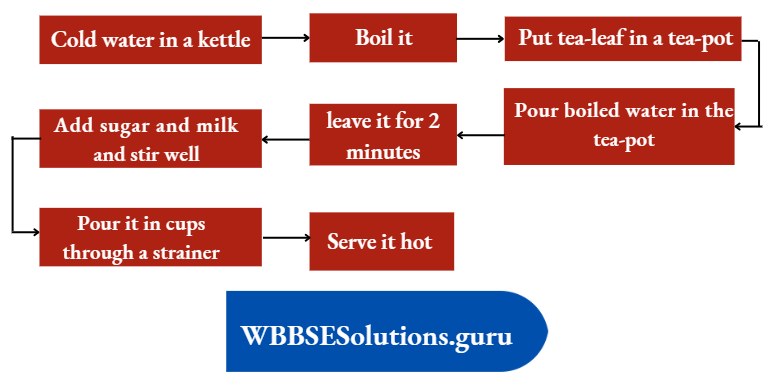
Question 13. Study the chart below for preparation of tea. Then write the process of tea making in a paragraph.
1. Preparation of Tea
Answer:
- To prepare tea, some cold water is first taken in a kettle. It is then boiled on an oven till the vapour comes out. Tea leaves are next put in a tea pot and the boiled water is poured into it.
- It is then left for two minutes for the leaves to soak. Sugar and milk are now added to it and the whole mixture is stirred with a tea spoon. The tea is now ready. It is poured into cups through a strainer and served hot.
2. Preparation of Orange Juice
[Points: Plucking of oranges-sorting-cleaning-crushing to extract the juice mixing water and syrup pouring into sterilised bottle-sealing and labelling despatching to shops for sale. ]
- First oranges are plucked from the garden and fresh ones are sorted out. The oranges are then cleaned thoroughly with water. They are next crushed in mixer to extract juice from them. Water and syrup in proper quantities and a little preservative are now added to the juice.
- The juice is then mixed thoroughly. The orange juice is poured into sterilised bottles. These are then sealed and labeled. The bottles are sent to shops for sale.
Question 14. Write a paragraph on the processing of guava jelly with the help of the following flow-chart:
[Outlines: Collecting ripe guavas-sorting and cleaning-cutting into small pieces-boiled, crushed-seeds separated-adding sugar, syrup and preservative-boiled again to make it thick- cooling and bottling in sterilised bottles-sealed and labeled-ready for sale. ]
Answer:
- First, ripe guavas are collected from the garden. These are then sorted out and the rotten ones are removed. The guavas are now cleaned with water and cut into small pieces. These are then boiled in water and crushed to form a pulp.
- The pulp is next passed through a sieve to remove the seeds. Sugar, syrup, and some preservative are then added to the pulp, and the mixture is boiled again till it becomes thick. It is next allowed to cool and we get guava jelly. This is now filled in sterilized bottles which are sealed and labeled. They are now ready for sale.
Bringing out a School Magazine
[Outlines: Manuscripts are collected from students and teachers → screened with additions, alterations, and omissions→ manuscripts sent to the press-proof correction → sent for final printing → printed in book form and distributed. ]
- First manuscripts are collected from students and teachers on different subjects. These are then thoroughly screened. Additions, alterations, and omissions are made in the manuscripts where necessary.
- These manuscripts are now ready for printing. They are then sent to press. The press sends proofs that are to be checked and corrected thoroughly. When the final proofs are ready, the whole lot is sent for printing. The whole printed matter is then sent to the binder for binding in book form. The magazine is now ready for distribution.

Question 15. Read the above chart for paper making process. Then write a passage on paper making.
Answer:
- We use lots of paper in our daily life. It is manufactured in a big way to meet our demand. Paper is generally made from four basic raw materials. These are wood, bamboo, rags, and grass.
- First, they are chopped into pieces, soaked in water, and made into pulp with the help of a machine. This is now mixed with adequate quantity of lime for whitening. This pulp is then boiled thoroughly and allowed to pass through wire meshes. We get wet paper at this stage. This wet paper is then passed over heated rollers for drying and pressed into thin sheets. The paper is wound in rolls and sent to market.
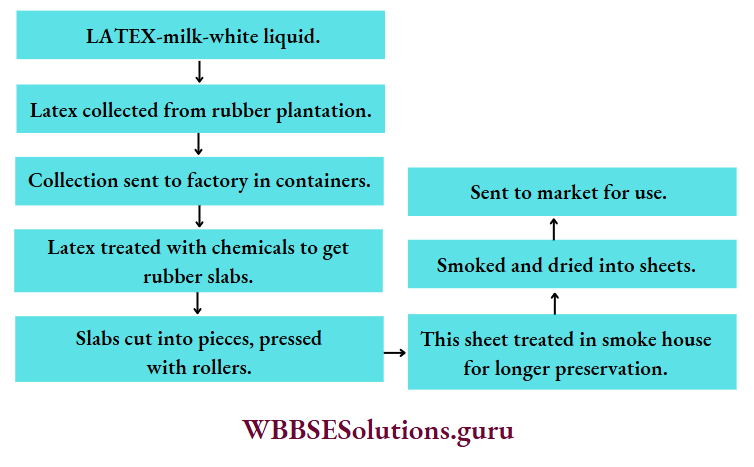
Question 16. Study the following chart carefully and then write a paragraph in about 120 words on the processing of solid rubber from rubber plants.
Start like this: Rubber is a very useful material.
Rubber Processing
Answer:
- Rubber is a very useful material. It is produced from the milk-white liquid called latex obtained from rubber plants. Latex is first collected from rubber plantations.
- The collection is then sent to factories in containers. The thick latex is now mixed with chemicals. It is turned into rubber slabs. The slabs are cut into pieces and pressed with rollers.
- Thus sheets of rubber are obtained. The rubber sheets are next sent to smokehouse for treatment. This treatment enables the rubber to be preserved for a long period of time. The treated rubber turns into dry sheets of rubber. It is then packed and sent to market for sale.
Production of Steel
[Points Iron ore mixed with lime and coke taken to blast-furnace-melted under high-temperature pig iron-melting for purification-add carbon-steel. ]
- Steel is produced from iron ores. First, the ore is collected from mines. It is then mixed with limestone and coke and taken to the blast furnace where it is heated to a very high temperature. It melts and pig iron is thus produced. It is then purified by adding carbon to it and melting it further. Steel is obtained as the final product.
Preparation of Phenol
[Points: Mixing crushed resin with boiled castor oil-cooling-mixing caustic soda solution- stirring solution frequently-pouring creosote oil leaving it for ten minutes-adding carbolic acid and potassium permanganate-pouring water-constant stirring-pouring into another pot after 24 hours.]
- Crushed resin mixed with castor oil is first boiled in a pot. After mixing it thoroughly it is allowed to cool. Caustic soda solution is then added to it and the whole solution is stirred frequently.
- Some creosote oil is next poured into it and it is left as such for ten minutes. Later, carbolic acid, potassium permanganate, and some water are poured into it and the whole mixture stirred constantly for thorough mixing. It is next kept for 24 hours and we get Phenol. It is then filled in bottles for sale.
Making of Batik Work
[Points: Cut cloth to desired size draw design on it with pencil-melt wax-dip cloth in fast color-allow it to dry-paint melted wax on parts which should keep fast colour-allow it to dry-remove wax by bending cloth/ using hot iron-batik printed cloth is now ready to use. ]
- To make a batik work, first, a piece of cloth is taken. It is next cut to the desired size. The design is then drawn on it with a pencil. Some wax is now melted in a pot.
- The cloth is next dipped in fast color and allowed to dry. The melted wax is then painted on parts of the cloth which should keep the fast colour and it is allowed to dry. The wax is then removed by bending the cloth or using a hot iron. We now get batik printed cloth ready for use.
Question 17. Study the flowchart and describe how Mango Pickle is prepared.
[Points: Buying (mangoes)→ sorting, removing rotten ones→ cleaning→ cutting into pieces – drying mixing (salt, spices, mustard oil, chilly, etc.) → keeping on a flat pot in the sun → pouring into jars, preserved.]
Answer:
- To prepare mango pickle, first good quality green mangoes are bought from the market. Then these mangoes are to be sorted and the rotten ones removed. The selected mangoes are then cleaned with water and cut into small pieces.
- They are then dried in the sun. Salt, spice, chilly, mustard oil are then added to them. These pieces of mangoes are now left in the sun on a flat pot for a few days. When absolutely dry and ready, they are poured into jars. They are now preserved for consumption.
Question 18. Find below a chart that shows how Mango Juice is processed. Write a paragraph in 100 words about it following the chart.
[Points: (Harvesting and delivering→ sorting→ cleaning crushing → mixing with water → syrup → putting into boxes → despatching)]
- Mangoes are harvested in gardens and sent to factories. They are then first sorted out and the rotten or defective ones are removed. The mangoes are then cleaned and washed in water thoroughly.
- Next, they are crushed by hand or machines. Water and syrup are then added in required quantities along with some preservative. The preservative helps in keeping the mango paste intact for a long time without getting decomposed. The material is then bottled in jars, sealed and labelled. The jars are packed into boxes and sent to market for sale.
Question 19. Read the flowchart and describe how clothes are washed and made ready for wear.
[Points: (Mixing detergent powder with water→ putting dirty clothes into mixture→ left for 15 to 20 minutes → scrabbing → rinsing → drying → pressing→ ready for wear.)]
Washing of Clothes
- Some quantity of water is first taken in a bucket and detergent powder is added to it. The water is then stirred thoroughly till a rich lather is produced. The clothes are now soaked into the mixture and left there for about fifteen to twenty minutes.
- They are then thoroughly scrubbed till’ dirt comes out. The clothes are now washed with clean water and rinsed. After drying the clothes in the open sun, they are pressed neatly. The clothes are now ready for wear.
Making of Bread
[Points: (Wheat grown in fields sold to flour mills → taken to factory → mixed with water, salt, yeast’divider’ cuts dough into loaves → doughs made to swell→ baked in ovens → sliced and wrapped by machines sold in shops.)]
- The basic ingredient needed for making bread is flour. It is produced in flour mills from wheat which is grown in fields. For the preparation of bread, flour is first mixed with water.
- Salt and yeast are then added to it and the matter mixed thoroughly to make a dough. A ‘divider’ is now used to cut the dough into loaves which are then baked in ovens. The dough swells and turns into a bread. The bread is then sliced, wrapped by machines, and sold in shops.
Preparation of Omelette
[Points: (Egg, onion, ginger, chilli→ onion, chili, ginger cut into pieces egg broken → poured into a pot→ onion, chili, a bit of salt and turmeric mixed→ the mixture stirred → a little mustard oil poured into a frying pan mixture poured into hot oil→ spread all over gently→ rolled and served with sauce.)]
- Take an egg, some onions, chilies, and ginger. Take a little ghee or butter also. Cut the onions, chilies, and ginger into small pieces. Break the egg into a small pot and add chili, onion and ginger pieces, and a bit of salt into it.
- Stir the mixture thoroughly. Take a pan and heat the butter or ghee on it. When it is properly heated, pour the mixture of egg on it. Spread the mixture gently on the pan and fry it for a minute or so. Make a roll and fry it thoroughly by turning. The omelet is now ready for serving with sauce.
Preparation of Coffee
[Points: (Kettle filled with water boiled in a stove→ pot made ready with coffee powder one teaspoon for each cup boiling water poured into pot → mixture stirred → sugar and milk added stirred → ready to serve. )]
- To prepare coffee, water is first boiled in a kettle by putting it on a stove. Pots are made ready with coffee powder-one teaspoonful for each cup. The boiling water is next poured into the pots, and sugar and milk are then added to it. The whole mixture is stirred thoroughly with a spoon. The coffee is now ready for serving.
Preparation of Lemon Squash
[Points: (Lemons collected→ scrubbed→ the rind (outer hård skin) scrapped → boiled with water-cooled squeezed for juice → citric acid and sugar mixed bottled → sent for sole. )]
- For the preparation of lemon squash, a sufficient number of lemons are collected first and these are cleaned by scrubbing. The rind (hard skin) of the lemon is then scrapped off and the lemons are boiled in water and allowed to cool.
- The juice is then squeezed out and after careful straining it is mixed with citric acid and sugar in proper proportion. The squash is now ready for consumption. It is next poured into sterilized bottles and labelled nicely. These are then sent to market for sale.
Preparation of Chowmein
[Points: (Noodles bought boiled with little water→ water drained→ onion, garlic, chili, ginger, beans, cabbages chopped → fried in a shallow pan over little oil boiled noodles added → salt, sauce to taste → served hot. )]
- Get some chow noodles from the market and break them into pieces. Put the noodles into a pan and boil them in water to soften the pieces. Next, drain out the water.
- Now sliced pieces of onion, garlic, chili, ginger, beans, and chopped cabbage are fried in a frying pan over little oil. The noodles are then added to the mass with a little salt in it. Fry them for about ten minutes and the chowmein is now ready. Spread a little sauce over the preparation in plates and serve them hot.
Preparation of Tomato Jelly
[Points (Tomatoes bought from market-sorting and removing rotten ones-cleaning → smashing extracting juice→→ boiled for 30 minutes→ adding sugar, chilli and preservative →→ jelly prepared)]
- First tomatoes are bought from the market. They are then sorted out and the rotten ones are removed. The tomatoes are next cleaned thoroughly with water and smashed in mixers to extract juice.
- The juice is now boiled for thirty minutes with the addition of sugar, chili, and a little preservative in it. The boiling continues till a pulp is formed. This is then allowed to cool and we get tomato jelly. It is now poured into bottles. After sealing and labelling, the bottles are sent to market for sale.
Preparation of Rehydration Mixture
[Points: (Clean hands, pots, teaspoon, tablespoon, cùps → pour 1litre boiled but cold water in a pot add 2 tablespoonfuls of sugar or honey, 1⁄2 teaspoonful salt, 1⁄2 cup orange juice, 1⁄2 teaspoonful/salt, 4 teaspoonful sodibicarb→ stir well → ready.)]
- To make the mixture, at first both the hands and other pots, tablespoons, teaspoons, and cups are to be washed and cleaned thoroughly. Then 1 liter of water is taken in a pot and boiled.
- It is then allowed to cool. 2 tablespoonfuls of sugar or honey and 1⁄2 teaspoonful of salt are now added to it and the mixture is stirred thoroughly. Next, 1⁄2 cup of orange juice and 1⁄4 teaspoonful of soda bicarb are added to the mixture and it is stirred constantly for thorough mixing. The mixture is now ready for use.
Preparation of Apple Jelly
[Points:( Buying apples → sorting and removing rotten ones → cleaning→ cutting into pieces → boiling in a container → turning into thick liquid substance → adding sugar → mixing chemicals for preservation → pouring into sterilized bottles → Sealing → sent to market. )]
- First, ripe apples are bought from market. These are then sorted out and the defective ones removed. The apples are now cleaned with water and cut into small pieces.
- These are then boiled in water in a container and crushed to form a pulp. Sugar, syrup, and some preservatives are then added to the pulp, and the mixture is boiled again till it becomes thick. It is next allowed to cool and we get apple jelly. This is now filled in sterilised bottles which are sealed and labelled. They are then sent to market for sale.
How the Postal System works
[Points: (Letters dropped into post-box→ collected and delivered at the post office → sorted the post office → sorted out → despatched→ delivered. )]
- The postal system works in a chain of events. First, letters are dropped into post-boxes at different spots. These are collected at fixed hours and taken to the post office. They are now sorted out according to destinations and dispatched to the respective post offices. The letters are then delivered to the addressees by postmen.
Formation of Rain
[Points (Clouds carry water vapour → cool air condenses the vapor into drops. drops combine together→ bigger drops formed → raindrops are too heavy to float → fall down in the form of rain )]
- When sun rays fall on the seas, rivers, lakes, etc., the water gets heated and turns into vapour. The hot vapor, being lighter than air, rises up and comes in contact with cool air high in the sky.
- The higher it goes, the cooler it becomes. When it becomes very cold, it condenses into droplets of water and forms clouds. Finer droplets combine together to form bigger drops. Gradually they become too heavy to float and fall on the earth in the form of rain.
Processing of Newspaper Publication
[Points: (Collection of news and pictures by press reporters and photographers → sorting → editing type setting in machines/computers → insertion of paper rolls→ printing of news → folding and cutting →newspaper ready → distribution → home delivery.)]
- Production of newspapers is a rather simple process. First, news and pictures collected by the press reporters and press photographers are taken to the editor where they are edited.
- Then types are set in machines or computers and the text composed. Paper rolls are then inserted in the printing machine. The printing machine is next operated and the news is printed on the paper. The newspapers are then folded and cut. These are now ready for distribution. The vendors or hawkers deliver them to the readers at home.
Preparation of Mustard Oil
[Points: (Seeds collected and dried→ dried seeds put into the hawler or crusher for crushing→ little water added oil cakes separated→ oil collected in containers → sealed→ ready for use )]
- Mustard seeds are first collected from the field and dried in bright sunshine for several days. The dried seeds are next put into the hawler or crusher and crushed with addition of a little water to extract oil. It is then strained to separate the oil cakes from the mustard oil which is collected in containers. The containers are next sealed and sent to market with oil ready for use.
Soap Making
[Points: (Coconut oil + caustic soda + water heated (half an hour) → allowed to cool → common salt added to be kept in that condition for twelves hours→ cut to pieces → ready for use )]
- Collect some coconut oil and caustic soda in a big pan. Mix them thoroughly with addition of water. Place the mixture on a big oven and heat it for half an hour. Stir the mixture thoroughly while heating.
- Then allow the mixture to cool down for some time. Add some common salt to keep the mixture in that condition for twelve hours. It solidifies. Cut the material to pieces. The pieces are now ready for use as soaps.
Question 20. Read the notice and write it in the form of a passage in not more than 100 words.
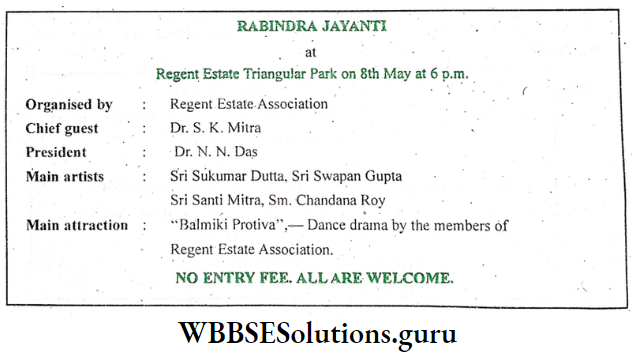
Answer:
- Rabindra Jayanti will be celebrated by Regent Estate Association this year at the Regent Estate Triangular Park at 6 p.m. on 8th May. Dr. S. K. Mitra, the renowned poet, has kindly consented to be the chief guest and Dr. N. N. Das will preside over the meeting.
- A cultural program has also been arranged with eminent artists like Sri Sukumar Dutta, Sri Swapan Gupta, Sri Santi Mitra and Sm. Chandana Roy. Besides, the main attraction of the evening would be the dance drama “Balmiki Protiva” to be staged by the members of Regent Estate Association.
- There is no entry fee and all are welcome.
Question 21. Read the notice. Write it in the form of a passage within 100 words.

Answer:
An annual excursion has been organized by Pragati Sangha. The travel will be by a luxury coach and it includes visits to Bolpur, Bakreswar, Tarapith, and Massanjore. The bus will start from the Sangha premises at 6 a.m. on 14th January and will return on the 17th afternoon. The cost for the whole tour would be Rs. 450.00 per head, all-inclusive. You are requested to book your scat Carly, latest by 10th January.
Question 22. Read the above advertisement and write a paragraph from the information given.
Answer:
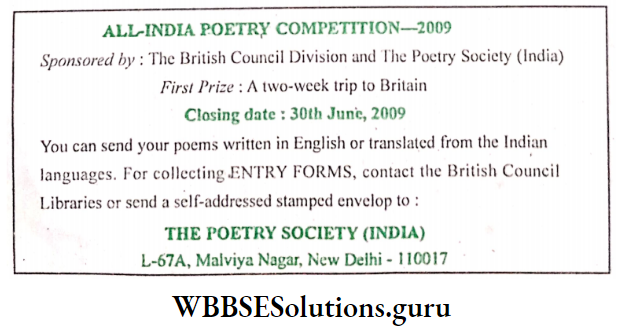
- The All India Poetry Competition-2009 will be held under the sponsorship of the British Council Division and The Poetry Society (India). The entry is open to persons who can send poems written by them in English or translated in English from any Indian language.
- The competition carries a first prize of a two-week trip to Britain. Entry forms can be had from the British Council Libraries or by sending a self-addressed stamped envelope to “The Poetry Society (India), L-67A, Malviya Nagar, New Delhi-110017.” The entry closes on 30th June 2009.