
Arithmetic Chapter 1 Ratios And Proportion Examples
Example 1. If a: b = 2:3 and b: c = 4: 5, then find the value a: b: c.
Solution:
Given That :
a : b = 2 : 3
b: c = 4: 5
a: b: c = ?
⇒ a : b = 2 : 3
Now Multiply the a : b with 4 we get,
⇒ (2 x 4) : (3 x 4)
∴ a : b = 8 : 12
⇒ b : c = 4 : 5
Now Multiply the b : c with 3 we get,
⇒ b : c = (4 x 3) : (5 x 3)
⇒ b : c = 12 : 15
∴ a : b : c = 8 : 12 : 15
The value a: b: c is 8 : 12 : 15

Example 2. Find the compound ratio of x2: yz, y2: zx, and z2: xy.
Solution: The compound ratio of x2 = yz, y2 = zx and z2: xy
From The Above Given Equation
We Consider That L . H .S = R . H . S
= x2 x y2 x z2 : yz x zx x xy
= x2y2z2 : x2y2z2
= 1:1
∴ The compound ratio of x2 = yz, y2 = zx and z2: xy is 1:1
Read and Learn More WBBSE Solutions For Class 8 Maths
Example 3. Find the mean proportional of a2 and b2c2.
Solution: The mean proportional of a2 and b2c2 =
± \(\sqrt{a^2 \times b^2 c^2}\)
= ± abc.
The mean proportional of a2 and b2c2 = ± abc.
| WBBSE Class 8 English Functional Grammar | WBBSE Class 8 English Reading Skills |
| WBBSE Solutions For Class 8 English | WBBSE Solutions For Class 8 Maths |
Example 4. If (3+\(\frac{4}{x}\)) : (5+\(\frac{2}{x}\)) = 1, then find the value of x.
Solution:
Given That : (3+\(\frac{4}{x}\)) : (5+\(\frac{2}{x}\)) = 1
⇒ (3+\(\frac{4}{x}\)) : (5+\(\frac{2}{x}\)) = 1
⇒ \(\frac{3+\frac{4}{x}}{5+\frac{2}{x}}=1\)
⇒ \(3+\frac{4}{x}=5+\frac{2}{x}\)
By taking the all ‘X‘ terms in on one side and Numericals to Other Side. We get,
⇒ \(\frac{4}{x}-\frac{2}{x}=5-3\)
⇒ \(\frac{2}{x}=2\)
⇒ 2x = 2
⇒ \(x=\frac{2}{2}=1\)
∴ The Value of the ‘ X ‘ is : 1
Example 5. What is the value of \(\sqrt{6 \cdot 76}-\sqrt{5 \cdot 76}+\sqrt{42 \cdot 25}\).
Solution:
Given That: \(\sqrt{6 \cdot 76}-\sqrt{5 \cdot 76}+\sqrt{42 \cdot 25}\)
⇒ \(\sqrt{6 \cdot 76}-\sqrt{5 \cdot 76}+\sqrt{42 \cdot 25}\)
By Taking the Determination to the Equation We Get,
= 2.6 – 2.4 + 6.5 = 0.2 + 6.5 = 6:7.
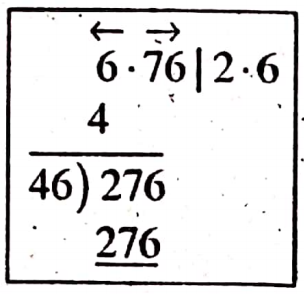
The value of \(\sqrt{6 \cdot 76}-\sqrt{5 \cdot 76}+\sqrt{42 \cdot 25}\) is 6:7
Example 6. Find the approximate value of 7 hour 12 min 40 sec. in minutes.
Solution:
First We convert sec into minutes
40 sec = \(\frac{40}{60}\) min
= \(\frac{2}{3}\) min.
= 0.66 min.
40 sec = 1 min. (approximate)
∴ 7 hour 12 min 40 sec = 7 hour + (12 + 1) min.
⇒ 7 hour 13 min.
∴ 7 hour 12 min 40 sec = 7 hour 13 min.
Example 7. Find the square root of 3\(\frac{814}{1225}\).
Solution: \(\sqrt{3 \frac{814}{1225}}=\sqrt{\frac{4489}{1225}}=\frac{67}{35}=1 \frac{32}{35}\)
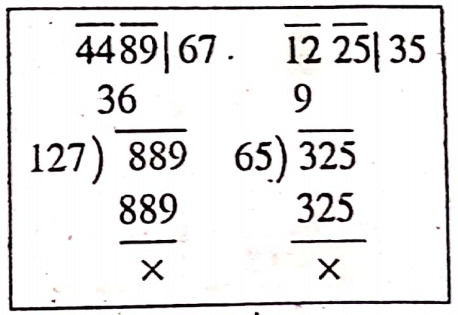
Example 8. If the length of a square becomes double, then what will be changed its areas?
Solution:
we know that all sides in a square are equal.
⇒ Let the length of each side of a square be x units.
Area is x2 sq.m.
If length of each side becomes double, then area is (2x)2 or 4x2 sq.unit.
∴ The area will be \(\frac{4 x^2}{x^2}\) or 4 times of original areas.
Example 9. If 8 men can do a piece of work in 15 days, then how many days can 12 men do that works?
Solution: Let 12 men can do the work in x days. [x > 0]
In the mathematical language the problem is:
Men
8
12
Time taken (day)
15
x
It is the case of inverse proportion.
So the proportion is
12: 8 : : 15: x
⇒ x = \(\frac{8 \times 15}{12}\)
⇒ x = 10
∴ 12 men can do a piece of work in 10 days,
Example 10. A train 200 meter long passes a tree in 12 sec. Find the speed of the train.
Solution: In passing the tree, the train must travel its own length i.e. 200 m.
The problem in mathematical language is:
Time taken (sec)
12
3600
Distance covered (meter)
200
?
According to the properties of ratio proportion we get,
12 : 3600 : : 200 : Distance covered in 1 hour.
∴ Distance covered in 1 hour = \(\frac{3600 \times 200}{12}\) meter 60000 meter = 60 km.
∴ Speed of the train is 60 km/hr.
Example 11. A train running at \(\frac{4}{7}\) of its own speed reached a place in 14 hours. In what time could it reach these running at its own speed?
Solution: Let speed of the train is x km/hr.
If the speed of the train is (x x \(\frac{4}{7}\)) km/hr or \(\frac{4x}{7}\) km/hr, then the train travels at a distance in 14 hours is (14 x \(\frac{4 x}{7}\)) km or 8x km.
The required time to cover a distance of 8x km with speed x km/hr is \(\frac{8x}{x}\) hour or 8 hours.
∴ The required time is 8 hours.
In 8 hours time could it reach these running at its own speed
Example 12. There is a path of 3 m width all around outside the square shaped park. The perimeter of the park including the path is 484 m. Calculate the area of the path.
Solution: The perimeter of the square park including the path is 484 m.
∴ The length of each side of the park including the path is \(\frac{484}{4}\) m or 121 m.
As the path is 3m width.
So length of each side of the park is (121 – 2 x 3) m or 115 m.

Area of the square park is (115)2 sq.m. = 13225 sq.m.
Area of the park including the path is (121)2 sq.m. = 14641 sq.m.
∴ The area of the path = (14641 – 13225). sq.m. = 1416 sq.m
Example 13. Choose the correct answer.
1. The compound ratio of 2: 3, 4: 5, and 7: 8 is
- 15: 7
- 7: 15
- 8: 15
- 3: 5
Solution: The compound ratio of 2: 3, 4: 5, and 7: 8 is (2 x 4 x 7): (3 x 5 x 8) = 56: 120 = 7: 15
∴ So the correct answer is 2. 7: 15
The compound ratio is 2. 7: 15
2. The approximate value of \(\frac{22}{7}\) to 3 places of decimals is
- 3·142
- 3.141
- 3.145
- 3.143
Solution: \(\frac{22}{7}\) = 3.1428…… ≈ 3.143
∴ The correct answer is 4. 3.143
3. If Anita takes 25 minutes to travel 2.5 km Anita’s speed is
- 4 km/hr.
- 5 km/hr.
- 4.5 km/hr.
- 6 km/hr.
Solution: In the mathematical language the problem is:
Time taken (min.)
25
60
Distance covered (km.)
2.5
?
According to the properties of the ratio proportion we get 25: 60 : : 2.5: Required distance.
Required distance is \(\frac{60 \times 2 \cdot 5}{25}=\frac{60 \times 25}{25 \times 10} \mathrm{~km}\) = 6 km
Speed is 6 km/hr.
∴ So the correct answer is 4. 6 km/hr
Anita’s speed is 4. 6 km/hr
Example 14. Write ‘True’ or ‘False’:
1. If the ratio of measurements of angles of a triangle is 1:2:3 then the triangle is a acute angled triangle.
Solution: The sum of the measurement of three angles of the triangle is 180°.
Let the measurements of three angles are x°, 2x°, and 3x°. [x is common multiple and x > 0]
x° + 2x° + 3x°= 180°
⇒ 6°x° = 180°⇒ x° = 30°
∴ The angles are 30°, 30° x 2 or 60° and 30° x 3 or 90°
So the triangle is right angled triangle.
∴ So the statement is false.
2. The difference between 1 and the approximate value of 0.9 to the integer is zero.
Solution: The approximate value of 0.9 to the integer is 1.
1 – 1 = 0
∴ So the statement is true.
Example 15. Fill in the blanks:
1. A ______ is a method to compare two quantities of the same kind having same unit.
Answer: Ratio.
2. 1 square metre = _______ square cm.
Answer: 1 square metre = 1 m x 1 m = 100 cm x 100 = 10000 sq.cm.