
Geometry Chapter 1 Revision
Trapezium: A trapezium is a quadrilateral that has only one pair of opposite sides are parallel.

∴ ABCD is a trapezium whose AB || BC.

Parallelogram: A parallelogram is a quadrilateral whose both pairs of opposite sides are parallel with each other.
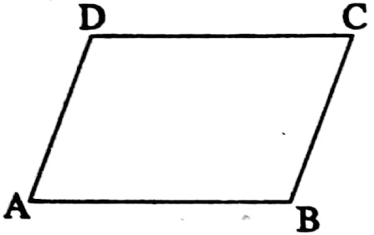
∴ ABCD is a parallelogram whose AB || DC and AD || BC.
Read and Learn More WBBSE Solutions For Class 8 Maths
Rhombus: Rhombus is a parallelogram in which one pair of adjacent sides are equal in length.
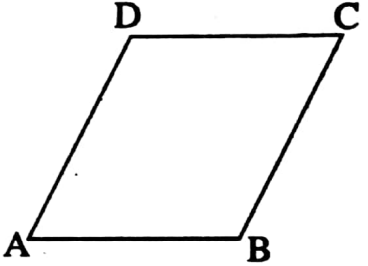
∴ ABCD is Rhombus whose AB = BC = CD = DA.
Rectangle: Rectangle is a parallelogram whose one angle is right angle.
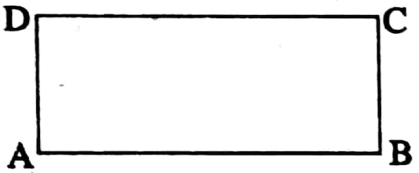
∴ ABCD is rectangle whose AB || DC, AD || BC and ∠BAD 90°
Square: Square is a rectangle in which one pair of adjacent sides are equal in length.
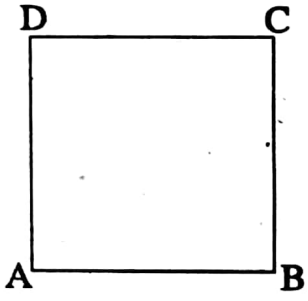
∴ ABCD is a square whose AB = BC = CD = DA and ∠BAD = 90°
Properties:
Trapezium: Only one pair of opposite sides are parallel.
| WBBSE Class 8 English Functional Grammar | WBBSE Class 8 English Reading Skills |
| WBBSE Solutions For Class 8 English | WBBSE Solutions For Class 8 Maths |
Parallelogram:
- Length of opposite sides are equal.
- Measurement of opposite angles are equal.
- Diagonals bisect each other.
Rhombus:
- Length of all sides are equal.
- Measurement of opposite angles are equal.
- Diagonals bisect each other perpendicularly.
Rectangle:
- Length of opposite sides are equal.
- Length of diagonals are equal.
- Diagonals bisect each other.
Square:
- Length of all sides are equal.
- Measurement of each angle is 90°.
- Length of diagonals are equal.
- Diagonal bisect each other perpendicularly.
Geometry Chapter 1 Revision Examples
Example 1. Draw a parallelogram ABCD where AB = 4 cm, BC = 6 cm, and ∠ABC = 45°.
Solution:

I drew a parallelogram ABCD where AB = DC = 4 cm, BC = AD = 6 cm and ∠ABC = 45°
Example 2. Draw a rectangle ABCD where AB = 3.5 cm, BC = 4.6 cm.
Solution:
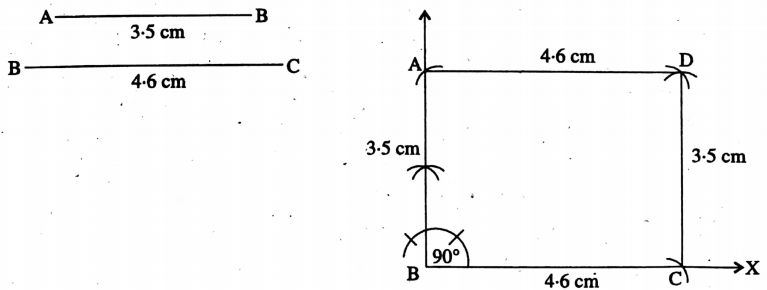
I draw a rectangle ABCD where AB = DC = 3.5 cm, BC = AD = 4.6 cm and ∠ABC = 90°
Example 3. Draw a rhombus PQRS where PR = 8 cm, and QS = 6 cm.
Solution:

⇒ The diagonal of a rhombus bisect each other perpendicularly.
⇒ I drew a rhombus PQRS where diagonal PR = 8 cm and diagonal QS = 6 cm.
Example 4. Draw a square ABCD where length of diagonal is 7 cm.
Solution:
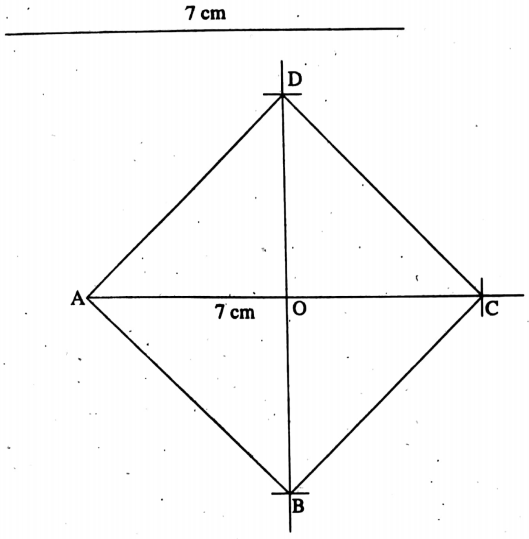
⇒ Diagonals of a square bisect each other perpendicularly.
⇒ I drew a square where AC = BD = 7 cm.