
Geometry Chapter 2 Complementary Angles Supplementary Angles And Adjacent Angles
Complementary angles: If the sum of two angles is equal to 90°. or a Right angle, each angle is called complementary to the other angle.

⇒ ∠AOB + ∠BOC = 90°
⇒ So, ∠AOB and ∠BOC are complementary angles to each other.
Supplementary angles: If the sum of two angles is equal to 180° or straight angle, each angle is called the supplementary to the other angle.

⇒ ∠POQ + ∠QOR = 180°
⇒ So, ∠POQ and ∠QOR are supplementary angles to each other.
Adjacent angles: If two angles in the same plane have the same vertex and a common side and the angles are on two opposite of common sides, they are called Adjacent angles.

⇒ ∠DOE and ∠EOF have the same vertex O and a common side OE and the angles are on two opposite side of OE.
⇒ Hence ∠DOE and ∠EOF are adjacent angles.
Read and Learn More WBBSE Solutions For Class 8 Maths
⇒ Internal bisector of an angle: The line which bisects an angle is called the Internal bisector of the angle.
⇒ External bisector of an angle: The line which is the internal bisector of the adjacent supplementary angle A of an angle is called the External bisector of the angle.

⇒ OP is the internal bisector of the angle ∠AOB and external bisector of the angle ∠BOC.
Geometry Chapter 2 Complementary Angles Supplementary Angles And Adjacent Angles Examples
Example 1. Find the measurements of complementary angles of the following angles. 80°, 90°, 67\(\frac{1}{2}^{\circ}\)
Solution: The measurement of the complementary angle of 80° is (90° – 80°) or 10°.
⇒ The complementary angle of 90° is (90° – 90°) or 0°.
⇒ The complementary angle of 67 \(\frac{1}{2}^{\circ}\) is \(\left(90^{\circ}-67 \frac{1}{2}^{\circ}\right) \text { or } 22 \frac{1}{2}^{\circ}\)
Example 2. Which pairs of angles are complementary?
Solution: 54° + 36° = 90° [Complementary angles]
⇒ 50° + 130° = 180°
⇒ 20.5° + 70.5° = 91°
| WBBSE Class 8 English Functional Grammar | WBBSE Class 8 English Reading Skills |
| WBBSE Solutions For Class 8 English | WBBSE Solutions For Class 8 Maths |
Example 3. Which pair of angles are supplementary?
- 40°, 50°
- 100°, 70°
- 120°, 60°
Solution: 40° + 50° = 90°
⇒ 100° + 70° = 170°
⇒ 120° + 60° = 180° [Supplementary angles]
Example 4. Find the supplementary angle of right angle.
Solution: The supplementary angle of right angle is (180° – 90°) or 90°
Example 5. If one angle of the complementary angle is 4 times the other then find the measurement of smaller angle.
Solution: Let the measurement of smaller angle is x°.
∴ Other angle is 4x°.
4x° + x° = 90°
⇒ 5x° = 90°
⇒ x° = \(\frac{90^{\circ}}{5}\) = 18°
∴ The measurement of smaller angle is 18°.
Example 6. Find the measurement of complementary angle of 35°35′35′′.
Solution: The complementary angle of 35° 35′ 35′′ is (90° – 35°35’35”) = 54°24’25”
90° = \(\begin{gathered}
89^{\circ} 59^{\prime} 60^{\prime \prime} \\
\frac{35^{\circ} 35^{\prime} 35^{\prime \prime}}{54^{\circ} 24^{\prime} 25^{\prime \prime}}
\end{gathered}\)
Example 7. Find the supplementary angle of 25°12′29′′.
Solution: The supplementary angle of 25°12′29′′ is (180° – 25°12′29″) or 154°47′31′′.
180° = \(\begin{gathered}
179^{\circ} 59^{\prime} 60^{\prime \prime} \\
\frac{25^{\circ} 12^{\prime} 29^{\prime \prime}}{154^{\circ} 47^{\prime} 31^{\prime \prime}}
\end{gathered}\)
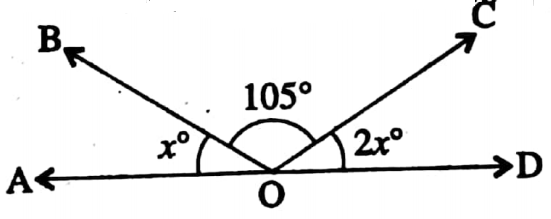
Example 8. In the adjacent angle find the value of x.
Solution: ∠AOD = 180° [Straight angle]
⇒ ∠AOB + ∠BOC+ ∠COD = 180°
⇒ x° + 105° + 2x° = 180°
⇒ 3x° = 180° – 105° = 75°
⇒ x° = \(=\frac{75^{\circ}}{3}=25^{\circ}\)
∴ The value of x is 25°.
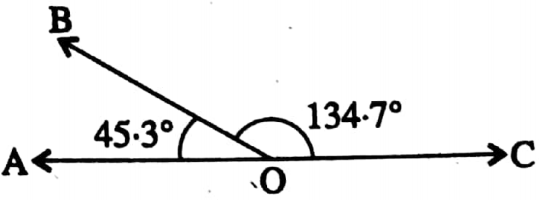
Example 9. The measurement of two adjacent angles are 45.3° and 134.7°. How the external sides of those two angles are situated?
Solution: The sum of two adjacent angles is 45.3° + 134.7° = 180°
So, the external sides of those two angles situated on the same straight line.
Example 10. If ∠A and ∠B are supplementary angles and ∠A – ∠B = 100°, then find ∠A and ∠B.
Solution: ∠A and ∠B are supplementary angles.
\(\begin{aligned}\angle A+\angle B & =180^{\circ} \\
\angle A-\angle B & =100^{\circ} \\
\hline 2 \angle A & =280^{\circ}
\end{aligned}\)
⇒ ∠A = 140°,
∴ ∠B = 180° – 140° = 40°.
Example 11. In the adjacent how are the line segment OA and OE situated?
Solution: ∠AOF = ∠AOB + ∠BOC+ ∠COD + ∠DOE + ∠EOF
= 25° 32° 41° + 40° + 42° = 180° (one straight angle)
∴ OA and OF are on the same straight line.
Example 12. Find the measurements of complementary and supplementary angles of (2x – 15)°.
Solution: The complementary angles of (2x – 15)° is (90 – 2x + 15)° of (105 – 2x)° and supplementary angles is (180 – 2x + 15)° or (195 – 2x)°.
Example 13. Write with explanation whether two acute angles are supplementary to each other or not.
Solution: The value of each acute angle is less than 90°.
⇒ The sum of two acute angles is always less than (90° + 90°) or 180°.
⇒ But the sum of two supplementary angles is 180°.
⇒ So two acute angles are no supplementary angles.
Example 14. Write which pair of angles are adjacent from the following:
Solution: In (1), ∠POQ and ∠QOR have the same vertex O and a common side of OQ and the angles are on two opposite side of OQ.

⇒ So, ∠POQ and ∠QOR are adjacent angles.
⇒ In (2), ∠POQ and ∠POR have the same vertex O and common side of OP.

⇒ But the angles are on the same side of OP.
⇒ So, ∠POQ and ∠POR are not adjacent angles.
⇒ In (3), ∠PTQ and ∠QOR have not the same vertex [T is the vertex of ∠PTQ and O is the vertex of ∠QOR]

∴ ∠PTQ and ∠QOR are not adjacent angles.
Example 15: Choose the correct answer:
1. The measurements of the complementary angle of 70° is
- 110°
- 70°
- 20°
- 35°
Solution: The measurement of the complementary angle of 70° is (90° – 70°) or 20°.
∴ So the correct answer is 3. 20°
The measurements of the complementary angle of 70° is 20°
2. Which pair of angles are complementary?
- 30°, 60°
- 40°, 42°
- 80°, 20°
- 72°, 25°
Solution: 30° + 60° = 90°
∴ 30° and 60° are complementary.
∴ So the correct answer is 1. 30°, 60°
3. Which pair of angles are not supplementary?
- 40°, 140°
- 60°, 120°
- 80°, 100°
- 90°, 75°
Solution: 40°+ 140° = 180° [Supplementary angles]
⇒ 60°+ 120° = 180° [Supplementary angles]
⇒ 80° + 100° = 180° [Supplementary angles]
⇒ 90° + 75° = 165° [are not supplementary angles]
∴ So the correct answer is 4. 90°, 75°
Example 16. Write ‘True’ or ‘False’:
1. Any two adjacent angles are complementary to each other.
Solution: If sum of measurements of two angles is equal to 90°, then each angle is called complementary to the other angle.
As sum of any two adjacent angles may be 90° or may not be 90°.
∴ So the statement is false.
2. The supplementary angle of right angle is right angle.
Solution: The supplementary angle of right angle is (180° – 90°) or 90° which is right angle.
∴ So the statement is true.
Example 17. Fill in the blanks:
1. Two _______ angles are complementary angles.
Solution: Acute
2. The supplementary angle of 0° is _______
Solution: 180°