
Geometry Chapter 3 Concept Of Vertically Opposite Angles
Vertically opposite angles:
If two straight lines cut each other at a point, the angles formed on opposite sides of the common point (vertex) are called vertically opposite angles.

⇒ Two straight lines AB and CD cut each other at O.
⇒ ∠AOC and ∠BOD are two vertically opposite angles.
Read and Learn More WBBSE Solutions For Class 8 Maths
Axioms And Postulates:
⇒ Some of the properties of geometrical figures are self-evident and are accepted without any proof.
⇒ Such self-evident truths are called axioms and the statement, stating these self-evident truths are called postulates.
Theorem: With the help of these axioms and postulates, some other important properties in geometry can easily be proved.
The course of proving such properties is called a theorem.
Postulates:
- Through any two points is a unique line.
- A line segment may be infinitely extended in both sides.
- There exist circles with any center and any radius.
- All right angles are equal in measure.
- One and only one straight line can be drawn passing through a given point and parallel to a given straight line where the point is not on the line [Playfair’s postulate]
Axioms:
- If a ray stands on a straight line, then the sum of the measurement of two adjacent angles so formed is 180°.
- If the sum of the measurement of two adjacent angles is 180°, then the non-common arms of the angles form a straight line.
Theorem 1. If two straight lines intersect each other then the measurement of vertically opposite angles are equal.

Given: AB and CD intersect at O.
As a result two pairs of vertically opposite angles ∠AOD, ∠BOC, and ∠AOC, ∠BOD are formed.
Required to prove: ∠AOD = ∠BOC and ∠AOC = ∠BOD
Proof: AD stands on CD.
∴ ∠AOC + ∠AOD = 180°
⇒ Again OC stands on AB
∴ ∠AOC + ∠BOC = 180°
∴ ∠AOC + ∠AOD = ∠AOC + ∠BOC
⇒ ∠AOD = ∠BOC (Subtracting ∠AOC from both sides)
⇒ Again OB stands on CD
∴ ∠BOC + ∠BOD = 180°
∴ ∠AOC+ ∠BOC = ∠BOC + ∠BOD
⇒ ∠AOC = ∠BOD (Subtracting ∠BOC from both sides)
∴ ∠AOD = ∠BOC and ∠AOC = ∠BOD (Proved)
If two straight lines intersect each other then the measurement of vertically opposite angles are equal.
| WBBSE Class 8 English Functional Grammar | WBBSE Class 8 English Reading Skills |
| WBBSE Solutions For Class 8 English | WBBSE Solutions For Class 8 Maths |
Geometry Chapter 3 Concept Of Vertically Opposite Angles Examples
Example 1. Find the measurement of ∠AOE, ∠BOD, and ∠AOC.

Solution: ∠AOD = ∠BOC (vertically opposite angles)
⇒ ∠AOD = 75°
⇒ i.e. ∠AOE + ∠DOE = 75°
⇒ ∠AOE + 30° = 75°
⇒ ∠AOE = 75° – 30° = 45°
⇒ Again, ∠BOD + ∠BOC = 180° [As BO stands on CD]
⇒ ∠BOD +75° = 180°
⇒ ∠BOD = 180° – 75° = 105°
∴ ∠AOC = ∠BOD (vertically opposite angles) = 105°
The measurement of ∠AOE, ∠BOD, and ∠AOC Are 45°, 105° ,105°
Example 2. Two straight lines PQ and RS intersect at point O; OT is the bisector of ∠POS. If ∠POR = 45°, then find ∠TOS.

Solution: OP stands on RS.
∴ ∠POR + ∠POS = 180°
⇒ 45° + ∠POS = 180°
⇒ ∠POS = 180° – 45° = 135°
OT is the bisector of ∠POS
∴ ∠TOS = \(\frac{1}{2}\)∠POS = \(\frac{1}{2}\) × 135° = 67°\(\frac{1}{2}^{\circ}\)
Example 3. If ∠POR = 2 ∠QOR, then find the value of ∠POS.
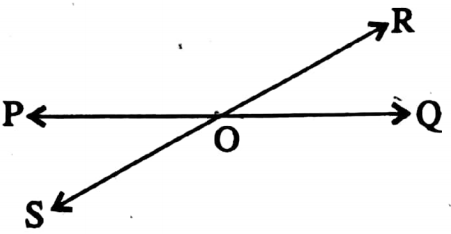
Solution: ∠POR + ∠QOR = 180° [As OR stands on PQ]
2∠QOR + ∠QOR = 180°
⇒ 3 ∠QOR = 180°
⇒ ∠QOR = \(\frac{180^{\circ}}{3}=60^{\circ}\)
⇒ ∠POS = ∠QOR [Vertically opposite angles] = 60°
Example 4. Prove that internal and external bisectors of an angle are perpendicular to each other.
Solution: Let OP and OQ are the internal and external bisector of ∠AOC respectively.

Required to prove: OP and OQ are perpendicular to each other.
Proof: OQ is the external bisector of ∠AOC,
So OQ is the bisector of ∠BOC.
∠POQ = ∠POC + ∠COQ
= \(\frac{1}{2}\)∠AOC + \(\frac{1}{2}\)∠COB
[as OP and OQ are the bisectors of ∠AOC and ∠BOC respectively]
= \(\frac{1}{2}\)(∠AOC + ∠COB) = \(\frac{1}{2}\) × ∠AOB
= \(\frac{1}{2}\) x 180° [one straight angle] = 90°
∴ OP and OQ are perpendicular to each other. (Proved)
Example 5. If two straight lines intersect each other then four angles are formed. Find the sum of the measurement of four angles.
Solution: Let two straight lines AB and CD intersect at point O.
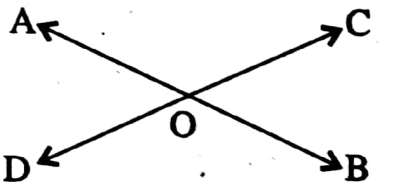
CO is stands on AB.
∴ ∠AOC + ∠COB = 180°
OD is stands on AB.
∴ ∠AOD + ∠BOD = 180°
∴ ∠AOC + ∠COB + ∠AOD + ∠BOD = 180°+ 180° = 360°
The sum of the measurement of four angles 360°.
Example 6. Two straight lines intersect each other at a point and thus four angles are formed. Prove that the bisectors of these angles are two perpendicular straight lines.
Solution: Let AB and CD intersects at point O.
PQ and RS are the bisectors of ∠AOD and ∠AOC respectively.

Required to prove: PQ and RS are perpendicular to each other.
Proof: ∠POR = ∠AOP + ∠AOR
= \(\frac{1}{2}\)∠AOD + ∠AOC
= \(\frac{1}{2}\)(∠AOD + ∠AOC)
= \(\frac{1}{2}\)∠COD = \(\frac{1}{2}\) x 180° = 90°
∴ OP and OR are perpendicular to each other. (Proved)
Example 7. Find the value of x, y, and z.
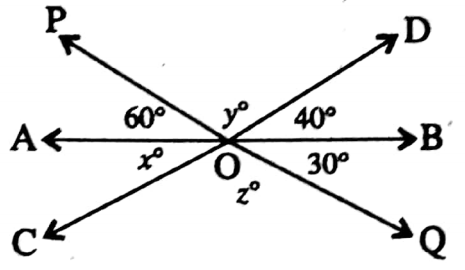
Solution: ∠AOC = ∠BOD (vertically opposite angles) = 40°
∠AOP + ∠POD + ∠BOD = 180°
60° + y° + 40° = 180°
⇒ y° = 180° – 100° = 80°
∠AOC + ∠COQ + ∠BOQ = 180°
40° + z° + 30° = 180°
⇒ z° = 180°-70° = 110°
Example 8. PQ and RS are two straight lines intersecting at a point O. Prove that if the bisector of the ∠POR is produced through O, it will bisects the ∠SOQ.
Solution: Let AO is the bisect ∠POR and let it be produced to B.
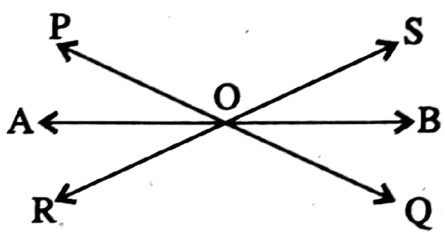
Required to Prove: OB bisects ∠SOQ.
Proof: ∠SOB = ∠AOR [Vertically opposite angles]
∠BOQ = ∠AOP [Vertically opposite angles]
Again, ∠AOR = ∠AOP [AO is the bisector of ∠POR]
∴ ∠SOB = ∠BOQ
∴ OB bisects ∠SOQ (Proved).
Example 9. Prove that the bisectors of a pair of vertically opposite angles lie in the same straight line.
Solution: Let OE and OF are the bisectors of ∠AOC and ∠BOD respectively.
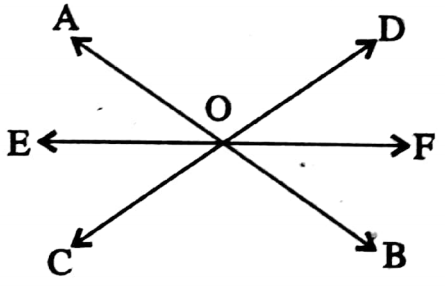
Required to prove: OE and OF lie in the same straight line.
Proof: OE and OF are the bisectors of ∠AOC and ∠BOD respectively.
∴ ∠AOE = ∠COE and ∠DOF = ∠BOF
∠AOD = ∠BOC (Vertically opposite angles)
∠AOE + ∠COE + ∠BOC + ∠BOF + ∠DOF + ∠AOD = 360°
∠COE + ∠COE + ∠BOC + ∠BOF + ∠BOF + ∠BOC = 360°
⇒ 2(∠COE + ∠BOC+ ∠BOF) = 360°
⇒ ∠COE + ∠BOC+ ∠BOF = \(\frac{360^{\circ}}{2}=180^{\circ}\)
i.e. ∠EOF = 180°
i.e. OE and OF lies in the same straight line. (Proved).
Example 10. The straight lines AB and CD intersect at point O; ∠AOD + ∠BOC = 102°, If OP is the bisector of ∠BOD, then find the measurement of ∠BOP.
Solution: ∠AOD = ∠BOC [Vertically opposite angles]
∠AOD + ∠BOC = 102°

∠AOD + ∠AOD = 102°
⇒ 2 ∠AOD = 102°
⇒ ∠AOD = \(\frac{102^{\circ}}{2}=51^{\circ}\)
OD stands on AB
∴ ∠AOD + ∠BOD = 180°
51° + ∠BOD 180°
⇒ ∠BOD = 180° – 51° = 129°
OP is the bisector of ∠BOD
∴ ∠BOP = \(\frac{1}{2}\)∠BOD =\(\frac{1}{2}\) × 129° = 64\(\frac{1}{2}^{\circ}\)
The measurement of ∠BOP = \(\frac{1}{2}\)∠BOD =\(\frac{1}{2}\) × 129° = 64\(\frac{1}{2}^{\circ}\)
Example 11. Choose the correct answer:
1. If ∠I = 35°, then find the value of ∠2 is
- 35°
- 145°
- 70°
- 55°
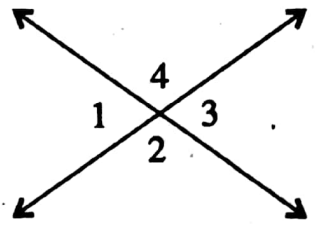
Solution: ∠I + ∠2 = 180°
35° + ∠2 = 180°
⇒ ∠2 = 180° – 35° = 145°
∴ So the correct answer is 2. 145°
The value of ∠2 is 145°
2. If ∠TOS = 20° and ∠ROQ = 60°, then the value of ∠POT is
- 60°
- 120°
- 40°
- 80°
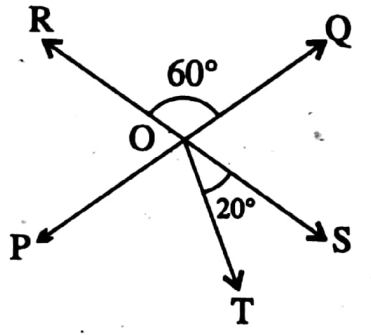
Solution: ∠POS = ∠ROQ [vertically opposite angles]
= 60°
i.e. ∠POT + ∠TOS = 60°
⇒ ∠POT + 20° 60°
⇒ ∠POT = 60° – 20° = 40°
∴ So the correct answer is 3. 40°
The value of ∠POT is 40°
3. If ∠AOC + ∠BOD = 112°, the value of ∠BOC is
- 112°
- 56°
- 68°
- 124°
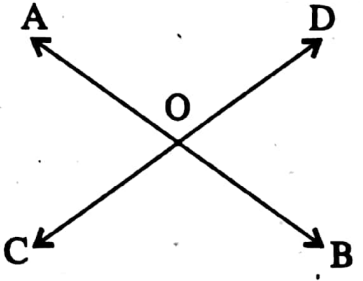
Solution: ∠AOC = ∠BOD
∠AOC + ∠BOD = 112°
∠AOC + ∠AOC = 112°
⇒ 2∠AOC = 112°
⇒ ∠AOC = \(\frac{112^{\circ}}{2}=56^{\circ}\)
⇒ ∠BOC + ∠AOC = 180°
⇒ ∠BOC + 56° 180°
⇒ ∠BOC = 180° – 56° = 124°
∴ So the correct answer is 4. 124°
The value of ∠BOC is 124°
Example 12. Write ‘True’ or ‘False’:
1. The vertically opposite angle of 68° is 112°.
Solution: The vertically opposite angle of 68° is 68°.
So the statement is false.
2. If OP is stands on line AB and ∠AOP = 100°, then the value of ∠BOP is 80°.
Solution: OP is stands on AB
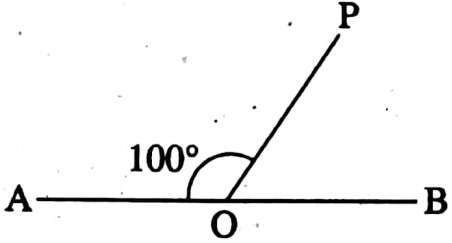
∴ ∠AOP + ∠BOP = 180°
∠AOP +80° = 180°
⇒ ∠AOP = 180° – 80° = 100°
∴ So the statement is true.
Example 13. Fill in the blanks:
1. If a ray stands on a straight line, then the sum of measurement of two ________ angles so formed is 180°.
Solution: Adjacent.
2. The value of right angle is half of ________
Solution: Straight angle.