
Geometry Chapter 6 Verification Of The Relation Between The Angles And Sides Of A Triangle
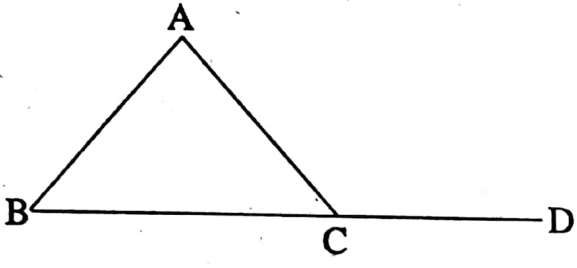
⇒ Exterior angle: The angle formed by extended of one side of an angle through vertex toward opposite direction is called the exterior angle of the given angle.
The exterior angle of ∠ABC is ∠CBD and the exterior angle of ∠CBD is ∠ABC.

ΔABC the BC is extended to D.
Read and Learn More WBBSE Solutions For Class 8 Maths
∠ACD is called exterior angle ∠BAC and ∠ABC are interior opposite angles.

Geometry Chapter 6 Verification Of The Relation Between The Angles And Sides Of A Triangle Theorems
Theorem 1.
⇒ If one side of a triangle is produced then one exterior angle is formed, the measurement of this exterior angle is sum of the measurement of two interior opposite angles.
Given: ABC is a triangle and BC is produced to D. As a result one exterior angle ∠ACD and two interior opposite angles ∠BAC and ∠ABC are produced.
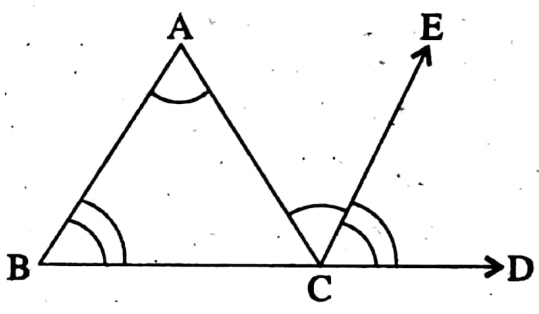
Required to prove: ∠ACD = ∠BAC + ∠ABC.
Construction: CE is drawn parallel to AB.
BA | | CE (by construction) and AC is, transversal.
∴ ∠ACE = ∠BAC [alternate angles]
Again BA || CA and BD is transversal.
∴ ∠ECD = ∠ABC [Corresponding angles]
∠ACE + ∠ECD = ∠BAC + ∠ABC i.e. ∠ACD = ∠BAC + ∠ABC (Proved)
| WBBSE Class 8 English Functional Grammar | WBBSE Class 8 English Reading Skills |
| WBBSE Solutions For Class 8 English | WBBSE Solutions For Class 8 Maths |
Theorem 2.
⇒ The sum of the measurement of three angles of a triangle is two right angles.
Given: ΔABC is any triangle.
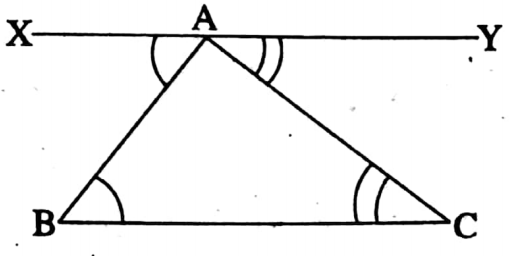
Required to prove: The sum of measurement of three angles of ΔABC is 2 right angles.
i.e. ∠BAC+ ∠ABC + ∠ACB = 180°
Construction: A straight line XY is drawn through A, parallel to BC.
Proof: XY || BC [By construction] and AB is transversal
∴ ∠ABC = ∠XAB [alternate angles]
Again, XY || BC and AC is transversal.
∴ ∠ACB = ∠CAY [alternate angles]
∠ABC +∠ACB = ∠XAB + ∠CAY
∴ ∠ABC + ∠ACB + ∠BAC = ∠XAB + ∠BAC + ∠CAY [By adding BAC on both sides]
ie. ∠BAC + ∠ABC + ∠ACB = ∠XAY
∴ ∠BAC+ ∠ABC + ∠ACB = 180° [one straight angle] (Proved)
Theorem 3.
⇒ If two sides of a triangle are unequal in length the measurement of the angle opposite to the greater side is greater than the measurement of the angle opposite to the smaller side.
Given: In ΔABC, AB > AC.
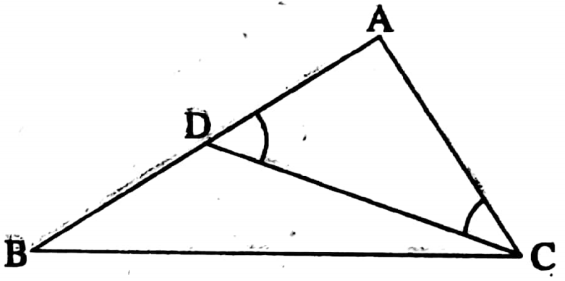
Required to prove: ∠ACB > ∠ABC
Construction: I cut off the line segment AD from the side AB equal of the side AC.
I join two point C and D.
Proof: In ΔADC, AD = AC [By construction]
∴ ∠ADC = ∠ACD
In ΔBCD, the exterior ∠ADC = ∠DBC +∠DCB
∴ ∠ADC > ∠DBC
∴ ∠ACD > ∠DBC ∠ACD + ∠DCB > ∠DBC
i.e. ∠ACB > ∠ABC (Proved).
Theorem 4.
⇒ If the measurement of two angles of a triangle are unequal,, then the length of opposite side of the greater angle is greater than the length of the opposite side of the smaller angle.
Given: In ΔABC, ∠ABC > ∠ACB.
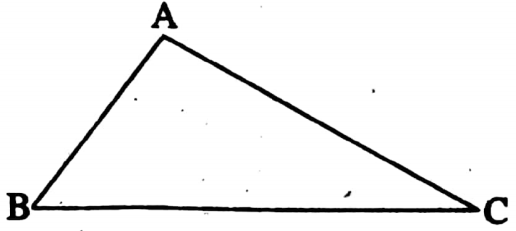
Required to prove: AC > AB
Prove: If AC not equal to greater than AB then either
- AC = AB or
- AC = AB
If AC < AB then ∠ABC < ∠ACB. It cannot be true.
Because it is given ∠ABC > ∠ACB.
Again, if AC = AB then ∠ABC= ∠ACB
It cannot be true because it is given ∠ABC > ∠ACB.
∴ AC > AB (Proved)
Geometry Chapter 6 Verification Of The Relation Between The Angles And Sides Of A Triangle Examples
Example 1. In the adjacent, find the value of x.
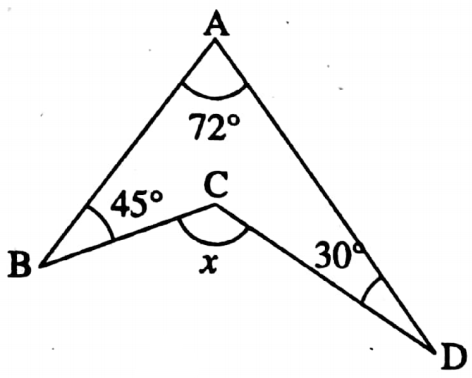
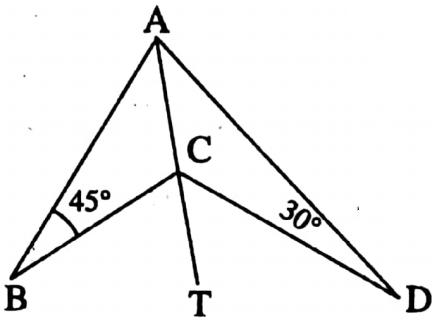
Solution: I joined A, C and AC is produced to T.
In ΔABC,
Exterior ∠BCT = ∠BAC+ ∠ABC
In ΔACD,
Exterior ∠BCT = ∠BAC + ∠ABC
In ΔACD,
Exterior ∠DCT = ∠DAC + ∠ADC
∠BCT + ∠DCT = (∠BAC+ ∠DAC) + ∠ABC + ∠ADC
i.e. ∠BCD = ∠BAD + ∠ABC + ∠ADC
x = 72° + 45° + 30°
⇒ x = 147°.
The value of x = 147°.
Example 2. In the adjacent find the value of ∠A + ∠B + ∠C+ ∠D + ∠E + ∠F.
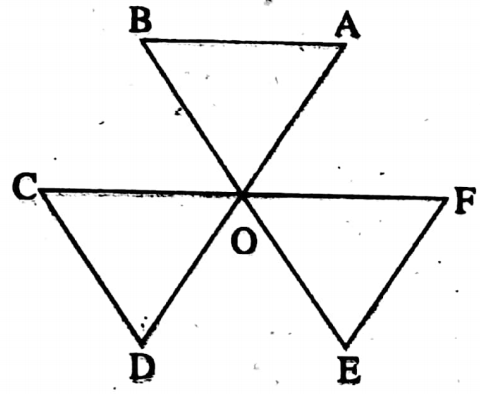
Solution: (∠A + ∠B) + (∠C + ∠D) + (∠E + ∠F)
= ∠BOD + ∠DOF + ∠FOB = -360°
The value of ∠A + ∠B + ∠C+ ∠D + ∠E + ∠F is -360°
Example 3. In ΔABC, BC is produced to D. If ∠ACD = 126° and ∠B = \(\frac{3}{4}\) ∠A then find the value of ∠A.
Solution:
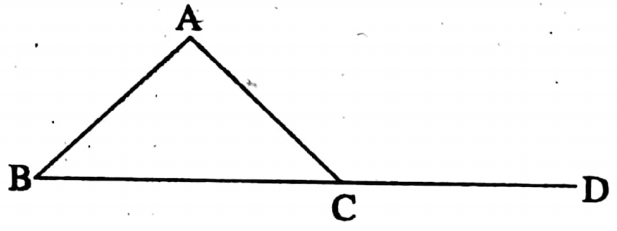
In ΔABC
∠A + ∠B = exterior ∠ACD
∠A + \(\frac{3}{4}\)∠A = 126°
⇒ \(\frac{7 \angle A}{4}\) = 126°
⇒ ∠A = \(\frac{4}{7}\) x 126° = 4 x 18° = 72°
The value of ∠A = 72°
Example 4. If the largest angle of a triangle is an acute angle then find the limit of that angle.
Solution: In ΔABC, ∠A is largest.
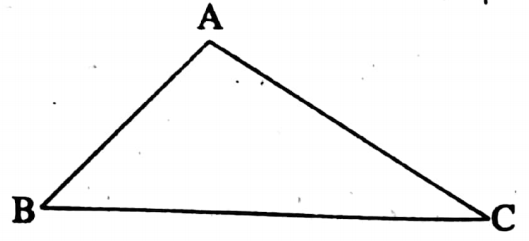
As ∠A is acute angle.
∴ ∠A < 90°.
Again ∠A is largest.
∴ ∠A > ∠B and ∠A > ∠C
∴ ∠A + ∠A > ∠B + ∠C
⇒ 2∠A > ∠B + ∠C
⇒ 2∠A + ∠A > ∠A + ∠B + ∠C
⇒ 3∠A > 180°
⇒ ∠A > \(\frac{180^{\circ}}{3}\)
⇒ ∠A > 60°
⇒ 60° < ∠A
∴ 60° < ∠A < 90°.
The limit of that angle 60° < ∠A < 90°.
Example 5. If O is an interior point of AABC, then find the relation between ∠BOC and ∠BAC.
Solution:
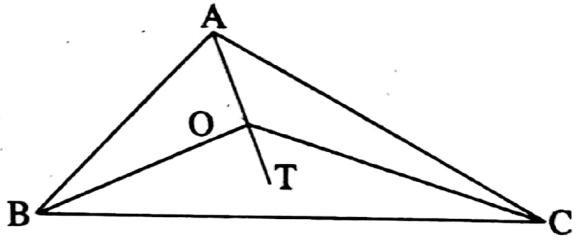
I join A, O, and AO is extended to T.
In ΔAOB, the exterior ∠BOT = ∠BAO + ∠ABO
∴ ∠BOT > ∠BAO
Similarly, In ΔAOC, ∠COT > ∠CAO
∴ ∠BOT + ∠COT > ∠BAO + ∠CAO
i.e. ∠BOC > ∠BAC.
This is the relation.
The relation between ∠BOC and ∠BAC is ∠BOC > ∠BAC.
Example 6. Find the sum of measurement of all angles of a quadrilateral.
Solution:
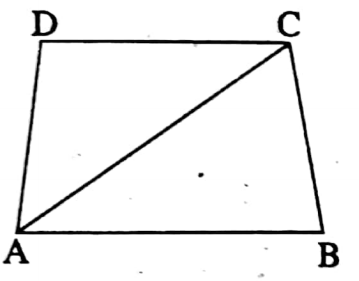
In quadrilateral ABCD, I join A and C.
In ΔABC,
∠BAC + ∠ABC + ∠ACB = 180°
In ΔADC, ∠DAC+ ∠ADC + ∠ACD = 180°
(∠BAC + ∠DAC) + ∠ABC + ∠ADC + (∠ACB + ∠ACD) = 180° + 180°
∴ ∠BAD + ∠ABC + ∠ADC + ∠BCD = 360°
The sum of measurement of all angles of a quadrilateral = 360°
Example 7. In ΔABC, the internal bisectors of ∠ABC and ∠ACB intersect at O, If ∠BOC = 105°, then find the value of ∠BAC.
Solution:
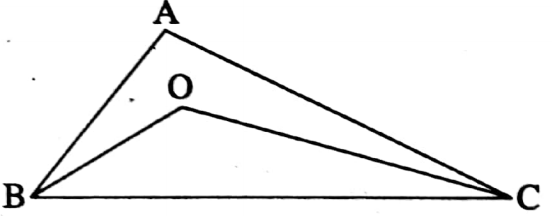
In ΔABC, BO, and CO are the bisectors of ∠ABC and ∠ACB respectively.
∴ ∠OBC = \(\frac{1}{2}\)∠ABC and ∠OCB =\(\frac{1}{2}\)∠ACB
∠OBC + ∠OCB = \(\frac{1}{2}\)(∠ABC + ∠ACB)
180° – ∠BOC = \(\frac{1}{2}\)(180° – ∠BAC)
180° – 105° = 90° – \(\frac{1}{2}\)∠BAC
75° = 90° – \(\frac{1}{2}\)∠BAC
⇒ \(\frac{1}{2}\)∠BAC = 90° – 75° = 15°
⇒ ∠BAC = 15° x 2 = 30°
The value of ∠BAC = 30°
Example 8. In ΔPQR, the internal bisector of ∠PQR and the external bisector of ∠PRQ intersect at T. If ∠QPR = 40° then find the value of ∠QTR.
Solution:
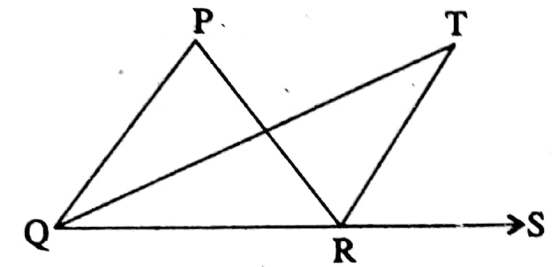
In ΔPQR,
⇒ ∠QTR + ∠TQR = exterior ∠TRS
⇒ ∠QTR = \(\frac{1}{2}\)∠PRS –\(\frac{1}{2}\)∠PQR
⇒ \(\frac{1}{2}\) (∠QPR + ∠PQR) – \(\frac{1}{2}\)∠PQR
= \(\frac{1}{2}\)∠QPR + \(\frac{1}{2}\)∠PQR – \(\frac{1}{2}\)∠QPR = \(\frac{1}{2}\) x 40° = 20°
The value of ∠QTR = 20°
Example 9. In ΔABC, AB = AC and ∠ABC = 2∠BAC. The bisector of ∠ABC meets AC at D. Find the measurement of the angles of the triangle BCD.
Solution:
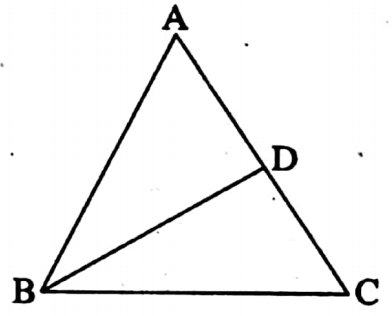
In ΔABC, AB = AC
∴ ∠ABC = ∠ACB
∠ABC + ∠ACB + ∠BAC = 180°
∠ABC + ∠ABC + ∠BAC = 180°
∴ 2∠BAC + 2∠BAC + ∠BAC = 180°
⇒ 5∠BAC = 180°
⇒ ∠BAC = \(\frac{180^{\circ}}{5}=36^{\circ}\)
∴ ∠ABC = ∠ACB = 2 x 36° = 72°
∠DBC = \(\frac{1}{2}\)∠ABC = \(\frac{1}{2}\) x 72° = 36°
In ΔBDC, ∠BDC + ∠DBC + ∠DCB = 180°
∠BDC + 36° + 72° 180°
∠BDC = 180° – 108° = 72°
∴ ∠DBC = 36°, ∠BDC = 72° and ∠DCB = 72°
The measurement of the angles of the triangle BCD = 72°
Example 10. ΔPQR, If ∠P = 80° and ∠Q= 70°, then find the relation between PQ and QR.
Solution:

In ΔPQR, ∠P = 80°, ∠Q = 70°
∴ ∠R = 180° – (80° + 70°) = 30°
As ∠P > ∠R
∴ QR > PQ (This the relation)
The relation between PQ and QR is QR > PQ
Example 11. The hypotenuse of a right-angled triangle is the greatest one – Explain.
Solution:

In ΔABC, ∠ABC = 90°
∴ AC is the hypotenuse.
∠A and ∠C each are acute angles.
∴ ∠ABC > ∠A and ∠ABC > ∠C
As ∠ABC > ∠A, ∴ AC > BC
As ∠ABC > ∠C ∴ AC > AB
∴ AC is the largest side.
Example 12. If the ratio of measurement of angles of a triangle is 4: 5: 9; then write the nature of the triangle.
Solution: Let the measurement of three angles are 4x°, 5x° and 9x°
4x° +5x° + 9x° = 180°
⇒ 18x° = 180°
⇒ x° = 10°
The angles are 4 x 10° or 40°, 5 x 10° or 50° and 9 x 10° or 90°.
∴ The triangle is a right-angled triangle.
Example 13. ΔABC, if the bisector of ∠BAC and a parallel line of AB be drawn through P, the midpoint of AC intersect each other at a point E. Prove that ∠AEC = 90°.
Solution:
Given: In ΔABC, AE is the bisector of ∠BAC and D is the midpoint of AC.
DE || AB, I join E, C.

RTP: ∠AEC = 90°
Proof: AB || DE (Given) and AE is transversal.
∴ ∠BAE = ∠AED [Alternate angles]
Again ∠BAE= ∠DAE [AE is bisector of ∠BAC]
∴ ∠AED = ∠DAE ∴AD = DE
Again AD = DC [given]
∴ DE = DC, ∴ ∠DEC = ∠DCE
∠AED + ∠DEC = ∠DAE + ∠DCE
i.e. ∠AEC = ∠CAE + ∠ACE
In ΔAEC, ∠AEC + ∠CAE + ∠ACE = 180°
∠AEC + ∠AEC = 180°
2∠AEC = 180°
⇒ ∠AEC = \(\frac{180^{\circ}}{2}\)
⇒ ∠AEC = 90° (Proved).
Example 14 The external bisectors of ∠ABC and ∠ACB of ΔABC meet at O. Prove that ∠BOC = 90° – \(\frac{1}{2}\)∠BAC
Solution: Given AB and AC are extended respectively.

BO and CO are the external bisectors of ∠ABC and ∠ACB of ΔABC.
RTP: ∠BOC = 90° – \(\frac{1}{2}\)∠BAC
Proof: BO and CO are the bisectors of ∠OBC
= \(\frac{1}{2}\)∠EBC and ∠OCB = \(\frac{1}{2}\)∠BCF
∠OBC + ∠OCB = \(\frac{1}{2}\)∠EBC + \(\frac{1}{2}\)∠BCF
= \(\frac{1}{2}\)(180° – ∠ABC) + \(\frac{1}{2}\)(180° – ∠ACB)
= 90° – \(\frac{1}{2}\)∠ABC + 90° – \(\frac{1}{2}\)∠ACB = 180° –\(\frac{1}{2}\) (∠ABC + ∠ACB)
= 180° – \(\frac{1}{2}\)(180° – ∠BAC) = 180° – 90° + \(\frac{1}{2}\)∠BAC
= 90° + \(\frac{1}{2}\)∠BAC
In ΔBOC,
∠BOC + ∠OBC + ∠OCB = 180°
∠BOC + 90° + \(\frac{1}{2}\)∠BAC = 180°
⇒ ∠BOC = 180°- 90° – \(\frac{1}{2}\)∠BAC
⇒ ∠BOC = 90° – \(\frac{1}{2}\)∠BAC (Proved)
Example 15. In ΔABC, AD is the bisector of the angle ∠BAC and AP ⊥ BC; if AB > AC then prove that ∠PAD = \(\frac{1}{2}\) (∠ACB – ∠ABC)
Solution:
Given: In ΔABC, AD is the bisector of ∠BAC and AP ⊥ BC.
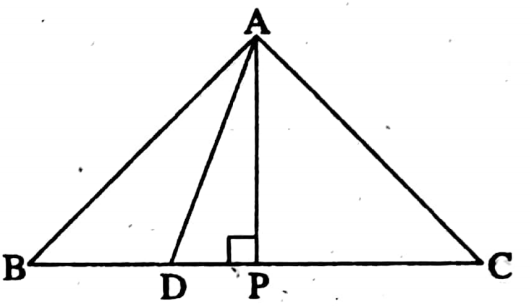
RTP: ∠PAD =\(\frac{1}{2}\) (∠ACB – ∠ABC)
Proof: AP ⊥ BC, ∴ ∠APB = ∠APC = 90°
In ΔABP, ∠APB = 90°,
∴ ∠BAP + ∠ABP = 90°
In ΔAPC, ∠APC = 90°,
∴ ∠PAC + ∠ACP = 90°
∴ ∠PAC + ∠ACP = 90°
∴ ∠PAC + ∠ACP = ∠BAP + ∠ABP
⇒ ∠ACP – ∠ABP = ∠BAP – ∠PAC
= ∠BAD + ∠PAD – ∠PAD
= ∠CAD + ∠PAD – ∠PAC [∠BAD = ∠CAD]
= (∠CAD – ∠PAC) + ∠PAD = ∠PAD + ∠PAD = 2∠PAD
⇒ ∠PAD = \(\frac{1}{2}\)(ACP – ABP)
∴ ∠PAD = \(\frac{1}{2}\) (∠ACB + ∠ABC)(Proved)
Example 16. In ΔABC, the bisectors of ∠ABC and ∠ACB meet at O. If AB > AC then prove that OB > OC.
Solution:
Given: In ΔABC, AB > AC; OB and OC are the bisectors of ∠ABC and ∠ACB respectively.
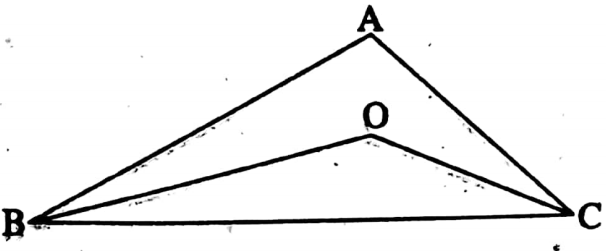
RTP: OB > OC
Proof: AB > AC
∴ ∠ACB > ∠ABC = ∠ACB > \(\frac{1}{2}\)∠ABC
∴ ∠OCB > ∠OBC
∴ OB > OC (Proved)
Example 17. AB is the greatest side and DC is the smallest side. Prove that ∠BCD > ∠BAD.
Solution:
Given: In quadrilateral ABCD, AB and DC are the greatest and smallest side respectively.

RTP: ∠BCD > ∠BAD
Construction: I join A, C.
Proof: In ΔABC, AB > BC [As AB is greatest side]
∴ ∠ACB > ∠BAC
In ΔACD, AD > DC [DC is the smallest side]
∴ ∠ACD > ∠CAD ∠ACB + ∠ACD > ∠BAC + ∠CAD
i.e. ∠BCD > ∠BAD (Proved)
Example 18. Choose the Correction Answer:
1. In ΔABC, AB = AC, BC is produced to D. If ∠ACD = 112° then the value of ∠BAC is
- 44°
- 68°
- 22°
- 34°
Solution:
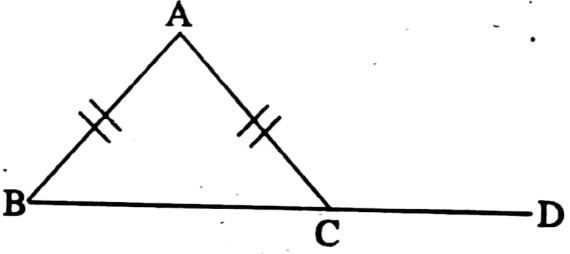
∠ACD + ∠ACB = 180°
112° + ∠ACB = 180°
or, ∠ACB= 180° – 112° = 68°
In ΔABC, AB = AC, ∴ ∠ABC = ∠ACB = 68°
In ΔABC, exterior ∠ACD = ∠BAC + ∠ABC
112° = ∠BAC + 68°
⇒ ∠BAC = 112° – 68° = 44°
∴ So the correct answer is 1. 44°
The value of ∠BAC is 44°
2. In ΔABC, If ∠A = 70° and ∠B = 60°, then the relation between AB and BC is
- AB = BC
- AB > BC
- AB < BC
- None of these
Solution:
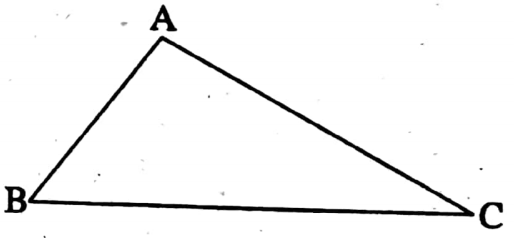
In ΔABC, ∠A + ∠B + ∠C = 180°
70° + 60° + ∠C = 180°
⇒ ∠C = 180° – 130° = 50°
The relation between AB and BC is
As, ∠A > ∠C
∴ BC > AB ⇒ AB > BC
∴ So the correct answer is 3. AB < BC
The relation between AB and BC is AB < BC
3. If the measurement of an angle of a triangle is equal to sum of the other two angles, then the triangle becomes
- Acute angled triangle
- Obtuse angled triangle
- Equilateral triangle
- Right-angled triangle
Solution: In ΔABC, ∠A = ∠B + ∠C
∠A + ∠B + ∠C = 180°
∠A + ∠A = 180°
⇒ 2∠A = 180°
⇒ ∠A = 90°
The triangle is right angled triangle.
∴ So the correct answer is 4. Right angled triangle
Example 19. Write ‘True’ or ‘False’:
1. If the ratio of measurements of three angles of a triangle is 1: 2: 3, then the triangle becomes right angled triangle.
Solution: Let the angles are x°, 2x°, and 3x°.
x + 2x + 3x = 180
⇒ 6x = 180 ⇒ x = 30.
∴ The angles are 30°, 30° x 2 or 60° and 30° x 3 or 90°.
∴ The triangle is right angled triangle.
∴ So the statement is true.
2. If PQ || TS, then the value of x is 80°.
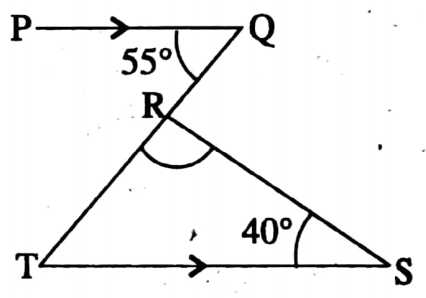
Solution: ∠QTS = ∠PQT [Alternate angle] = 55°
i.e. ∠RTS = 55°
∠TRS + ∠RTS + ∠RST = 180°
x + 55° + 40° = 180°
⇒ x = 180° – 95° = 85°
∴ So the statement is false.
Example 20. Fill in the blanks:
1. In obtuse angled triangle opposite side of _______ is largest.
Answer: Obtuse angle.
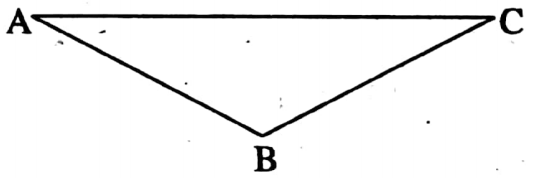
Solution: Let, In ΔABC, ∠B is obtuse angle.
∴ ∠A and ∠C are both acute angle.
∴ ∠B > ∠A and ∠B > ∠C
As ∠B > ∠C then AC > AB
∴ AC is largest.
∴ The obtuse angled triangle opposite side of obtuse angle is largest.
2. In ΔABC, AB = AC; BC is produced to D. If ∠ACD = 105° then the value of ∠BAC
Solution:
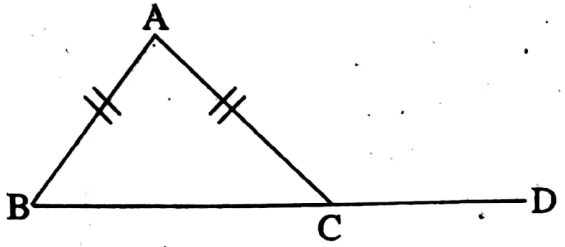
In, ΔABC, ∠ACD = 105°
∠ACB = 180° – ∠ACD = 180° – 105° = 75°
AB = AC
∴ ∠ABC = ∠ACB = 75°
∠BAC + ∠ABC = Exterior ∠ACD
∠BAC + 75° = 105°
⇒ ∠BAC = 105° – 75° = 30°.
The value of ∠BAC = 30°.