
Chapter 1 Sentences
A sentence is a word or a group of words giving a complete sense. (যে শব্দ বা শব্দসমষ্টি একটি পূর্ণ অর্থ প্রকাশ করে তাকে sentence বা বাক্য বলা হয়।)
In the following examples, the groups of words on the left are not, because they do not make complete sense; but those on the right do so, and hence, they are
- Did it – I did it.
- Can do – I can do it.
- In the garden – he is walking in the garden.
- A good boy – he is a good boy.
In writing, the beginning and end of a sentence are indicated respectively by a capital letter and by a full stop, or a note of exclamation or interrogation.
A sentence may consist of one or more words. The one-word is, as a rule, intelligible only in connection with a particular situation. As:
- In exclamations-good! What!
- In imperatives-wait. Stop.
Assertive: these make simple statements (কোনো কিছু সাধারণভাবে ব্যক্ত করা হয়). As :
- I know him.
- He reads in class vii.
- The boys love to play.
Interrogative: these ask questions (প্রশ্ন জিজ্ঞাসা করাহয়). As :
- Why is he here?
- What are you doing?
- Will he come?
Read And Learn More WBBSE Class 9 English Functional Grammar
Imperative: these express commands, requests, etc. (এইসব বাক্যে কোনো আদেশ, উপদেশ, অনুরোধ ইত্যাদি বোঝায়). As :
- Go away from here.
- Don’t do this.
- Please tell me your name.
Optative: these express wishes, prayers, etc. (কোনো ইচ্ছা, প্রার্থনা, আশীর্বাদ প্রভৃতি প্রকাশ করে). As :
- God bless you.
- May he live long.
- Heaven help us.
Exclamatory: these express sudden feelings or emotions (এইসব বাক্য দুঃখ, আনন্দ বা মনের কোনো আকস্মিক আবেগ প্রকাশ করে). As :
- How nice!
- Alas! He is no more.
- What a fool you are!
May be further subdivided into two- (1) affirmative (-) and (2) negative (-).
Affirmative are those that affirm something:
- I know him.
- He reads in class vii.
- Go away from here.
- May he live long?
- How nice!
Negative are those that negate or deny something:
- I do not know him.
- He does not read in class vii.
- Do not go away from here.
- May he not suffer.
- Alas! He is no more.
Some make a different division. They classify Sentences as follows:
Statements which simply affirm or deny something (হ্যাঁ বা না-সূচক সাধারণ বক্তব্য বোঝায়):
- I know him.
- He has not come today.
Questions which ask questions:
- Why is he here?
- Why did you not come yesterday?
Desires which contain some desire, order, or request (, ), etc:
- May he live long?
- Do not go there.
- Please come here.
Exclamations which express a sudden feeling or emotion (প্রকাশ করা হয়) :
- How nice!
- Alas! I am undone.
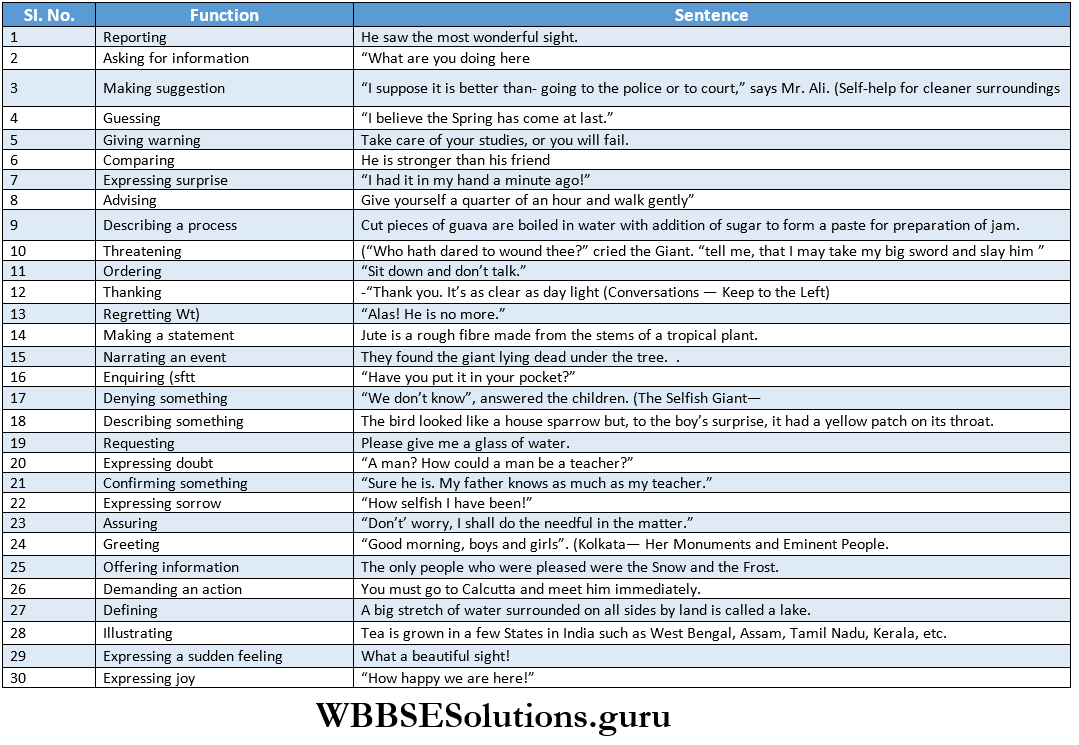
- And language functions
- Convey different messages depending on their functions.
Functions may be broadly listed as:
(বিভিন্ন sentence-এর মাধ্যমে বিভিন্ন প্রকারের বক্তব্য প্রকাশিত হয়। sentence-এর এই বক্তব্যের রূপনানা রকমের হয়। )
- Reporting
- Asking for
- Ordering
- Thanking
- Confirming
- Something
- Expressing
- Sorrow information
- Making suggestion
- Guessing
- Giving warning
- Comparing
- Regretting
- Making statement
- Assuring
- Narrating an event
- Greeting
- Enquiring
- Denying something
- Expressing surprise
- Describing
- Advising
- Describing a process
- Requesting
- Threatening something
- Expressing doubt
- Offering information
- Demanding an action
- Defining
- Illustration
- Expressing a sudden feeling, etc.
- Expressing joy
Look at the following and their functions:
Chapter 1 Sentences The Subject And The Predicate
Every sentence can be divided into two parts, the subject and the predicate:
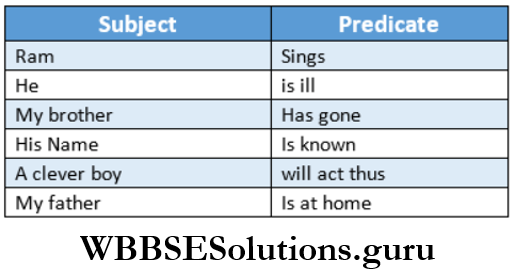
The subject must be a noun or noun-equivalent and is found as an answer to the question what? Or who? Asked before the main verb.
Look at the following:
- Noun: ramen went there. (Who went there ?)
- Pronoun: she is a good girl. (Who is a good girl?)
- Gerund: walking is good exercise. (What is a good exercise ?)
- Infinite to. Tell a lie is a sin. (What is a sin ?)
- Noun clause: why he did this is a puzzle. (What is a puzzle ?)
The subject usually comes at the beginning, but it may come in the middle or at the end of a sentence. Note the following :
- He reads in class 8.
- Though poor, he is honest.
- For a long time, they whispered.
- The best boy amongst them was Sandip.
- The subject is often understood in some, especially in imperative ones.
- Thus, go there = go you there. Sit down = sit you down. In analyzing such, the subject has to be supplied.
Chapter 1 Phrases And Clauses Phrases
- He came to see me.
- This is a chain of gold.
In the above, the groups of words written in italics do not make complete sense.
They do not have any subject or predicate and do not contain any finite verb, expressed or understood, but are used as single parts of speech.
In the first sentence the words ” to see me” act as an adverb to “came”; in the second sentence the words, “of gold” qualify the noun “chain” and thus act as an adjective; in the third sentence the words “on the table” are adverb qualifying “put”.
These groups of words are called phrases.
A phrase is a group of words that does not make complete sense, and does not contain a finite verb, expressed or understood, but is used as a single part of speech.
(যে শব্দ সমষ্টির নিজের কোনো finite verb নেই, এবং যারা পূর্ণ অর্থ প্রকাশ করে না, শুধু একটি single part of speech-এর মতো ব্যবহৃত হয়, তাকে phrase বলে।) agle part.
Phrases are of six kinds:
Noun phrase: It does the work of a noun.
- He likes to play.
- Walking is a good exercise.
In the first sentence, the phrase “to play” is the object of the verb “likes”. In the second sentence, the phrase “to walk” is the subject of the verb “is”. The groups of words here thus do the work of a noun and hence they are noun phrases.
Adjective phrase: It does the work of an adjective.
- Hiren is a man of wealth.
- The boys in the class stood up.
- The book on the table is mine.
The phrase “of wealth” tells us what sort of man ‘Hiren’ is. It qualifies the noun ‘man’ just as an adjective does. It, therefore, does the work of an adjective. Similarly, the phrases “in the class”, and “on the table” are adjectives of ‘boys’ and ‘book’ respectively.
Adverbial phrase: it does the work of an adverb.
- He came to see me.
- He worked with care.
- He fell from the tree.
The italicized phrase “to see me” tells us why ‘he’ came. It, therefore, does the work of an adverb and is an-adverbial phrase. Similarly “with care” and “from the tree” are adverbs qualifying “worked” and “fell” respectively.
Prepositional phrase: it does the work of a preposition.
- He stood in front of me.
- He could not come on account of illness.
- The italicized phrases are prepositions for the objective cases “me” and “illness”.
Conjunctional phrase: it does the work of conjunction.
- Come as soon as you can.
- We went there in order that we might see him.
- The phrase “as soon as” joins the two clauses “come” and “you can”.
The phrases “in order that” joins the two clauses, “we went there” and “we might see him.” They are all conjunctional phrases. Interjectional phrase-does the work of an interjection: what a pity! By Jove! Good heavens!
Chapter 1 Phrases And Clauses Clauses
- I know that he is ill.
- The boy who did it is my brother.
- I went after he had gone.
The groups of words in italics in the above contain subjects (he, who, he respectively) and predicates (is ill, did it, had gone respectively) of their own, but form parts of bigger ., Such groups of words are called clauses.
A clause is a group of words having a subject and a predicate of its own, but forming part of a bigger sentence. (যে শব্দ সমষ্টি এক একটি sentence গঠন করে কারণ এতে subject ও predicate আছে, কিন্তু সেটি বৃহত্তর একটি sentence-এর অংশ মাত্র। )
Chapter 1 Parts Of Speech
Words are generally divided into eight classes or parts of speech according to the work they do in a sentence:
A noun is a word that names any person or thing:
(কোনো ব্যক্তি বা বস্তু বা বিষয়ের নামকে noun বলে।) man, book, gold, india, country, sweetness, honesty, air.
An adjective is a word which adds something to the meaning of a noun: ( যে word দ্বারা noun-এর কোনো গুণ, দোষ, অবস্থা, সংখ্যা, পরিমাণ ইত্যাদি বোঝায় তাকে adjective বলে। )
- He is a good boy.
- This is a dark room.
- Give me a little milk.
- Many men were present.
A pronoun is a word used for a noun or a clause:
(Noun বা clause-এর পরিবর্তে যে word বসে তাকে pronoun বলে।)
- Ram is not here; he is ill.
- He failed, which broke his heart.
A verb is a word used to express action, a state of being, or having something. ( যে word কোনো ব্যক্তি বা বস্তুর কোনো কিছু করা, হওয়া কিংবা থাকা বোঝায় তাকে verb বলে।)
- he walks.
- I go.
- The sun shines.
- The rose smells sweet.
- He is tall.
- I have a car.
An adverb is a word that generally adds something to the meaning of a verb, an adjective, or another adverb:
( যে word কোনো verb, adjective বা অন্য কোনো adverb-এর সম্বন্ধে কিছু বলে কিংবা তাদের অর্থ সীমাবদ্ধ করে তাকে adverb বলে। )
- He walks fast.
- He is very clever.
- He did it quite easily.
A preposition is a word placed before a noun or a pronoun to show its relation to ‘some other word in the sentence:
(যে word noun বা pronoun-এর পূর্বে বসে sentence-এর অন্য কোনো word-এর সাথে এই noun বা pronoun- এর সম্বন্ধ বুঝিয়ে দেয় তাকে preposition বলে।)
- The book is on the table.
- He came to me.
- She is in the garden.
A conjunction is a word that joins words or phrases or clauses:
(যে word অন্য words বা phrases বা clauses কে যুক্ত করে তাকে conjunction বলে।) he said this to Ram and Shyam.
- He sat behind you but in front of me.
- As he was ill, he did not go to school.
An interjection is a word which expresses some sudden feeling or emotion: (যে word মনের আকস্মিক উচ্ছাস বা ভাব প্রকাশ করে তাকে interjection বলে।)
Alas! Hello! Bravo!
Chapter 1 Nouns Classification
Nouns are of five different kinds:
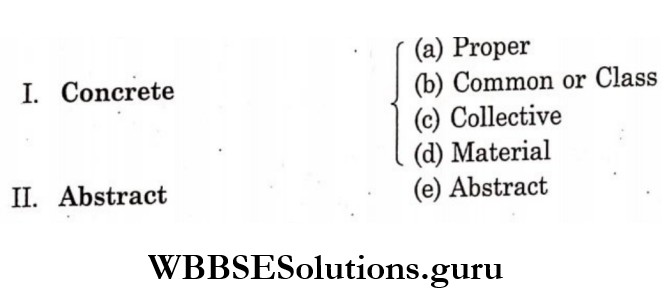
A concrete noun is the name of an object of sense, that is, an object which can be seen, touched, heard, smelt or tasted. ( যা দেখা যায়, স্পর্শ করা যায়, শোনা যায়, খাওয়া যায় অর্থাৎ যা ইন্দ্রিয়গ্রাহ্য তাইই concrete noun.)
Boy, dog, song, flower, milk.
An abstract noun is the name of a quality, action, or state belonging to an object. (যে noun দ্বারা কোনো মানুষ বা জিনিষের গুণ, অবস্থা, প্রকৃতি প্রভৃতি বোঝায়—মানুষ বা জিনিষকে বোঝায় না, তাকে abstract noun বলে।)
Softness, smile, wealth, silence.
A proper noun is the name of one particular person, place, thing, or event (or group of persons or places) as distinct from every other.
(Proper noun দ্বারা একটি নির্দিষ্ট প্রাণী, জায়গা, বস্তু বা ঘটনার নিজস্ব নাম বোঝায়।
- Ramesh -the ganga
- Kolkata -the himalayas
- The french revolution- the ramayana
- the hindus
A common or class noun denotes no one person or thing in particular but is common to any and every person or thing of the same kind.
[Common noun দ্বারা এক জাতীয় প্রাণী বা বস্তুর কোনো নির্দিষ্ট একটিকে না বুঝিয়ে তাদের সকলকেই বোঝায় (common = সাধারণ)। ] Man (not any particular man, but any and every man).
Book (not any particular book like the bible, the Vedas, the koran, etc., But any and every book).
River (not any particular river like the Ganga, or the Jamuna, but any and every river). Country (not any particular country, but any and every country) are common nouns.
Difference between a proper noun and common noun (proper no uncommon noun-এর মধ্যে পার্থক্য)
City বলতে আমরা যে কোনো শহরকেই বোঝাই। কিন্তু kolkata বলতে আমরা কেবলমাত্র kolkata city-কেই বোঝাই। এই ক্ষেত্রে city—common noun; কিন্তু kolkata —
Proper noun : এইরূপ :—
Proper – Common
- The ganga- river
- The gita- book
- India -country
- Indian ocean-ocean
- Monday -day
- B.t. Road- road
There are a few nouns, generally classed as common, which are sometimes called singular nouns because there is only one of each of them known to us
Earth, sun, moon, etc.
When god and lord refer to the almighty, they are proper; but when they refer to the different gods of mythology and temporal lords, they are common.
A collective noun is the name of a group or collection of persons or things taken as a whole.
(যে word দ্বারা একই প্রকারের অনেকগুলি প্রাণী বা জিনিষের সমষ্টি বোঝায়, স্বতন্ত্রভাবে তাদেরকে বোঝায় না তাকে collective noun বলে।)
Thus, in “a flock of sheep” “sheep” is a common noun, because it stands for any and every sheep; but flock is a collective noun, because it stands for all the sheep referred to, taken together, and not any one sheep taken separately. Similarly, in “an army of soldiers”, and “a crowd of people”, army and crowd are collective nouns, as they stand respectively for all the soldiers and people referred to, taken together.
(“Flock of sheep” এই বাক্যাংশে “sheep” কথাটি common noun, কারণ সেটি ভেড়ার সাধারণ নাম ; কিন্তু flock কথাটি collective noun, কারণ তা কতকগুলি ভেড়ার সমষ্টিকে বোঝাচ্ছে। এইরূপ, “crowd of men”, “army of soldiers” crowd army collective nouns, men and soldiers-এর সমষ্টিকে বোঝাচ্ছে।)
A collective noun takes a singular verb when the things and persons are taken collectively, and a plural when they are taken separately.
(Verbটি singular হয়; সকলকে সমষ্টিভাবে না বুঝিয়ে স্বতন্ত্রভাবে বোঝালে verbটি plural হয়।)
- The audience is requested to take their seats.
- The class is large.
But we must be consistent. Thus, we must write :
- The board has agreed to grant bonuses to its (not, their) employees.
- The mob does (not, does) not know their mind.
Chapter 1 Nouns A list of collective words
- An army or regiment of soldiers
- A band of robbers, musicians
- A bouquet of flowers
- A bevy of beauties, women
- A bundle of rags, sticks, and firewood, lies
- A bunch of keys, grapes, flowers a brood of chickens
- A board of directors
- A chain of events, mountains
- A class of students, persons
- A clump of trees.
- A cloud of locusts
- A cluster of grapes, islands, stars
- A consignment of goods
- A course of lectures
- A crew of sailors
- A crowd of people
- A curriculum of studies
- A drove of cattle (cattle being driven), sight-seers
- A fleet of ships
- A flight of birds or steps
- A flock of sheep (generally small animals), geese
- A gang of thieves, robbers
- A galaxy of stars
- A group of islands
- A grove of trees
- A herd of cattle (generally big animals), deer, elephants
- A hive of bees
- A heap or mass of ruins
- A horde or tribe of Arabs
- A litter of pups, pigs
- A pack of hounds, wolves, cards, thieves, liars, lies
- A pair of shoes
- A Parliament of Owls
- A pile of books
- A pride of Lions
- A range of mountains
- A series of events
- A stack of hay, wood
- A shoal of fish
- A shower of rain, arrows
- A swarm of bees or flies.
- A suit of clothes
A material noun denotes the matter or substance of which things are made.
It is also called the mass noun. (যে material বা পদার্থ দ্বারা কোনো জিনিষ গঠিত হয় তাকে material noun বলে।)
Thus, the river is a common noun, but water, of which it is made, is a material noun; sheep is a common noun, but mutton, the flesh of a sheep, is a material noun.
Chapter 1 Nouns Countable And Uncountable Nouns
Nouns can also be classified generally as countable and uncountable: countable nouns stand for something that can be counted (যা এক, দুই করে গণনা করা boy, egg, school, man, tree, house, etc.
Only, countable nouns have plural forms and can be used with the indefinite article an) in the singular or many, few, a few, several, etc.
In the plural: (countable singular noun- এর পূর্বে a, an, এবং plural noun-এর পূর্বে many, few, a few, several ইত্যাদি বসে।) a school, a boy, an umbrella, many cows, a few books.
Uncountable nouns stand for something that cannot be counted though they can be measured (যা এক, দুই করে গণনা করা যায় না কিন্তু যা পরিমাপ করা যায়) :
Water, air, glass, wood, sand, etc.
Such nouns have no plural form and are not used with the indefinite article (a/an). (4 কোনো plural form নেই এবং এদের পূর্বে a বা an বসে না।). They are preceded by much, little, etc.
(এদের পূর্বে much, little ইত্যাদি ব্যবহৃত হয়) to denote amount or quantity: much money, little water.
Some of these can, however, be both countable and uncountable according to the context in which they are used, with a change in their meaning.
কোনো কোনো ক্ষেত্রে এরা countable এবং uncountable উভয়ভাবেই ব্যবহৃত হতে পারে। সেক্ষেত্রে তাদের অর্থ ভিন্ন প্রকারের হয়।)
- Paper =the substance on which we write (uncountable)
- A paper = a newspaper (countable)
- Glass = the material (uncountable)
- A glass = a tumbler (countable)
- Wood = The table is made of wood. (Material, uncountable)-কাঠ
- A wood forest the bungalow is in the middle of a wood. (Countable)
- Copper = metal (uncountable)
- A copper = coin (countable)
Notice how often we put a piece of, a great deal of, a bit of, etc. Before uncountable nouns when we want to “individualize” them. We also use some when we want to indicate an indefinite quantity.
Note the following examples:
- A bit of string (এক টুকরো সুতো) -some string (কিছু সুতো )
- A piece of (bar) soap- some soap
- A piece of work (কাজের অংশ)-some work
- A lump of sugar (সামান্য একটু চিনি)-some sugar
- A piece of advice (সামান্য পরামর্শ)-some advice
- A flash of lightning (বিদ্যুতের খানিক চমক- some lightning
- An act of cruelty-some cruelty
- A piece of news (সংবাদ টুকু)-some news
- A piece of furniture-some furniture
- A piece of luggage-some- luggage
- A piece of music-some music
Chapter 1 Nouns Number
In English, there are two numbers: singular and plural. When one thing is spoken of, the noun is singular, such as a boy, a girl, or a cat. But when more than one thing is spoken of, the noun is plural, such as boys, girls, and cats.
Rules for forming the plural:
Most nouns form their plural by adding s to the singular:
(Singular noun-এর শেষে সাধারণত s যোগ করে plural হয়।)
- Singular – plural
- Girl- girls
- Eye- eyes
- House- houses
- Book- books
- Ant- ants
- Table- tables
- Car- cars
- Chair- chairs
- Cat- cats
- Pen- pens
- Cow- cows
- King- kings
- Dog- dogs
- Tree- trees
- Bird- birds
- Pencil- pencils
- Doll- dolls
- Leg- legs
- River- rivers
- Room- rooms
- Brother- brothers
- Lion- lions
- Sister- sisters
Nouns ending in s, ss, sh, ch (soft), x, and z take es in the plural: (যে সব singular noun-এর শেষে s, ss, sh, x, 2 ও soft ch অর্থাৎ যে ‘ch’ -এর উচ্চারণ ‘চ্’-এর মত থাকে তাদের শেষে es যোগ করে plural হয়।)
- Singular – plural
- Gas- gases
- Box- boxes
- Fox- foxes
- Fish- fishes
- Watch- watches
- Monarch -monarchs
- Branch – branches
- Topaz- topazes
But when ch is pronounced as k, only s is added: ( যদি ch -এর উচ্চারণ ‘ক’-এর মত হয় তবে শুধু s যোগ করে plural হয়।)
- Singular – plural
- Monarch – monarchs
- Stomach -stomachs
Nouns ending in y preceded by a consonant or qu change y into and add es in the plural: (যদি noun-এর শেষে y এবং তার পূর্বে consonant অথবা qu থাকে, তা হলে plural করবার সময় y কে I করে পরে es যোগ করতে হবে।)
- Singular- plural
- Lady-ladies
- City-cities
- Army-armies
- Country-countries
- Copy-copies
- Body- bodies
- Soliloquy (off) soliloquies
- Sky- skies
- Baby- babies
- Fly- flies
But if y is preceded by a vowel, add only যদি y– এর পূর্বে vowel থাকে তবে শুধু s যোগ করে plural হয়।) but safe-safes; strife-strifes; thief- thieves.
Some take both forms: staff-staffs (), staves (sticks); wharf (g)—wharves, wharves; scarf (a)- scarfs, scarves.
Nouns ending in ‘o’ preceded by a consonant generally take es in the plural: (যদি noun-এর শেষে ০ থাকে এবং তার পূর্বে consonant থাকে, তবে সাধারণত es যোগ করে plural হয়। )
- Singular- plural
- Hero -heroes
- Mango -mangoes
- Buffalo- buffaloes
- Potato- Potatoes
- Volcano- volcanoes
- Mosquito- mosquitoes
Exceptions- canto-s, halo-s , piano-s, manifesto-s, photo-s, memento-s, dynamo-s, portico-s.
Nouns ending in ‘o’ preceded by a vowel generally take only s in the plural: (যদি noun-এর শেষে ০ থাকে এবং তার পূর্বে vowel থাকে, তবে সাধারণত s যোগ করে plural হয়।)
- Singular – plural
- Bamboo – bamboos
- Radio -radios
- Cuckoo- cuckoos
- Folio- folios
Some nouns form their plural by change of vowels: (কতকগুলি noun-এর word-এর মধ্যেকার vowel-এর পরিবর্তন করে plural করতে হয়।)
- Singular – plural
- Man- men
- Louse (উকুন)- lice
- Woman- women
- Mouse- mice
- Foot- feet
- Goose (রাজহাঁস)- geese
- Tooth- teeth
Some nouns adden: (কতকগুলি noun-এর শেষে en যোগ করে plural করা হয়। )
- Singular – plural
- Ox – oxen
- Child – children
- Brother- brethren (also brothers)
- Nouns that have no plural forms:
- (এইসব noun-এর কোনো plural form: নাই, এরা সর্বদাই singular রূপে ব্যবহার হয়।)
- Alphabet (বর্ণমালা)
- Expenditure (ব্যয় )
- Furniture (আসবাবপত্র)
- Information (সংবাদ, খবর)
- Luggage (মালপত্র)
- Offspring (child or children)
- Poetry
- Scenery (দৃশ্য)
He has learned the alphabet. He has sold all his furniture or luggage. All his expenditure is shown here. These are my offspring. I got all the information I wanted.
These flowers by the riverside are beautiful scenery. He writes good poetry.
Nouns which have no singular forms: (এইসব noun-এর কোনো singular হয় না, সর্বদাই plural form-এ ব্যবহার হয়। )
- Jeans (জিন কাপড়ের প্যান্টালুন)
- Alms (ভিক্ষা)
- Amends (ক্ষতিপূরণ
- Annals (ইতিবৃত্ত)
- Ashes (ছাই)
- Assets (সম্পত্তি)
- Auspices (প্রসাদ, আনুকূল্য
- Bellows (হাপর )
- Scissors (কাঁচি)
- Shears (কাস্তে)
- Shorts (খাটো প্যান্ট)
- Spectacles (চশমা)
- Thanks (ধন্যবাদ) )
- Wages (বেতন)
- Bowels (অন্ত্র)
- Eaves (ঘরের ছাঁচ
- Billiards (একরকম খেলা) proceeds (আয়)
- Dregs (তলানি)
- Entrails (নাড়িভুঁড়ি)
- Fetters (শৃঙ্খল
- Forceps (চিমটা)
- Measles (হাম)
- Mumps (গালফুলা রোগ) nuptials (বিবাহ)
- Odds (ন্যূনাধিকভাবে তারতম্য) pyjamas (পাজামা)
- Paints (রং)
- Tidings (সংবাদ)
- Tongs (চিম্টা)
- Vitals (জীবনী শক্তি
Nouns which have the same form in both the numbers:
Apparatus, common, corps, deer, innings, means, picé, public, series, sheep, species, swine, and the nouns of number, weight or money such as dozen, score, yoke, stone (weight), hundred weight, when used after a numeral, especially if they join with that numeral to make a compound adjective (as in ‘two-ton lorry’).
The singular meaning is expressed by putting a singular adjective, such as a, an, one, this, that, etc. Before them.
A deer, one sheep, this piece; but, two deer, two-piece.
The words hundred, thousand, lakh (or, lac) million, dozen, score when preceded by a definite numeral (পূর্বে নির্দিষ্ট সংখ্যাবাচক শব্দ থাকলে) or by several or a few are never made plural:
- I want three hundred (or, one hundred) rupees.
- Five thousand (not, thousands) men assembled there.
- He bought one (or two) dozen pencils.
- Draw a cheque for rupees three lacks (or lac). (Not, lakhs or lacs).
- A few hundred people collected there.
- Give me five score eggs.
- Several hundred (or dozen) eggs were damaged.
- Three million (not, millions) tons of rice have been imported this year.
But when these words are not preceded by numerals and used ‘merely to convey the idea of a large number or are preceded by some, many (অনির্দিষ্ট সংখ্যাবাচক শব্দ পূর্বে থাকলে), they are made plural
Some dozens, many dozens, hundreds of people, thousands of ants, scores of animals, many thousands, millions of rupees, lacs, and lacs of rupees, etc.
The plural of compound nouns (except nouns ending in full and fall) is generally formed by adding s to the important word; as:
Governors-general (governors-general is also used); passers-by; brothers-in-law; on-lookers; but mouthfuls, handfuls, pitfalls (5), waterfalls (2).
In nouns ending in ‘man’, the plural is formed by changing man into man when a man is used in the sense of a human being; such as Englishmen, nobleman, or workman.
When, however, the final man does not mean a human being, but is a part of the word itself, the plural is formed by adding s only; as germans, Mussalmans, and Brahmans. “Mankind. The singular number, referred to by it and its, not they and their.”- Usage by f.t. Wood.
- Plurals of letters of the alphabet and of numbers are formed by adding (s): b.a.’S d.d.’ S.
- Cut your t’s and dot your I’s; 3’s, 5’s, etc.
- Some add only s in the plural, leaving the apostrophe for the genitive.
- He hit two 4’s (4s) and two 6’s (6s).
- Three b.a.’S (b.a.s) and two m.a.’S (m.a..s) were selected.
Plurals of abbreviations:
Single letters are doubled:
- Pp. For pages, ll. For lines, mss. For manuscripts.
- Curt forms take s: secs. For sections, etc.
Miscellaneous:
- Singular- plural
- Mr- Messrs
- Mrs madam- mesdames
- Mrs brown – miss brown
- The mrs browns – the miss browns the misses brown
- Madam- ladies
- Man-servant- master brown
- The masters brown the master browns- mr brown
- Messrs Browns- woman-servant lord-justice knight-templar
- The Mr browns- men-servants
- Women-servants- lords-justices
- Knights templars
Foreign plurals:
- Agendum (বিচাৰ্য- agenda
- Singular crisis (সঙ্কটাপন্ন)
- Crises বিষয়) অবস্থা )
- Appendix – appendices
- Analysis (বিশ্লেষণ)
- Radius (ব্যাসার্ধ)
- Radii- analyses
- Erratum (শুদ্ধিপত্র)- errata
- Axis (অক্ষ )- axes
- Bandit (বোম্বেটে) – banditti (or bandits)
- Focus (কেন্দ্র) – foci (or focuses)
- Formula (সূত্র)- formulae
- Basis (ভিত্তি)- bases
- Medium (মাধ্যম)- media
- Memorandum (স্মারকলিপি)- memoranda
- Hypothesis seraph ( প্রথম শ্রেণির স্বৰ্গ-দূত) – hypotheses
- Terminus (শেষপ্রান্ত ) – termini (or terminuses)
- Phenomena- phenomenon
- Seraphim (or seraphs)
- Vertex (শীর্ষ) -vertices
- Oases- oasis (মরুদ্যান)
The tendency of modern English is to reject all foreign forms.
The name of a country, or a thing, though plural in form, is treated as singular; as:
- The united states of America is a rich country;
- The folk tales of Bengal is a nice book.