
Chapter 14 Clauses
As he is ill, he cannot come.
This is the boy who did it.
In the first sentence, each of the parts “As he is ill” and “he cannot come” is a complete sentence, having a subject and a predicate of its own.
Each of these two small sentences again forms part of the big sentence “As he is ill, he cannot come.”
Read And Learn More WBBSE Class 9 English Functional Grammar
Similarly, in the second sentence the two small sentences “Who did it” and “This is the boy” are parts of the big sentence “This is the boy who did it.”
Such small sentences which form part of a big sentence are called Clauses.

Chapter 14 Clauses A Clause Is A Sentence Forming Part Of A Bigger Sentence.
(যে ছোট sentence কোন বৃহত্তর sentence-এর অংশ তাকে Clause বলে।)
In the above examples, “As he is ill”, “he cannot come”, “This is the boy”, and “who did it” are all clauses.
Kinds of Clauses:
Clauses are of three kinds:
- Principal clause.
- Subordinate or Dependent clause.
- Co-ordinate clause.
Principal and Subordinate (Dependent) Clause:
As he is ill, he cannot come.
This is the boy who did it.
In the first sentence, the clause “he cannot come” can stand alone and makes complete sense by itself.
But the clause “As he is ill” cannot stand by itself as a sentence without depending on the clause “he cannot come”. (“He cannot come” clause-
করছে। “As he is ill” এই clause-টি “he cannot come” এই clause-টির উপর নির্ভর না করে সম্পূর্ণ অর্থ প্রকাশ করতে পারে না। )
Similarly, in the second sentence the clause “Who did it” has to depend on the clause “This is the boy” to convey the complete meaning.
A clause that is dependent on another clause is called a subordinate or Dependent Clause.
A clause that stands by itself and on which the Subordinate Clause depends is called the Principal Clause.
In the examples above, “he cannot come” and “This is the boy” are Principal Clauses.
“As he is ill” and “Who did it” are Subordinate or Dependent Clauses.
Note the following examples:
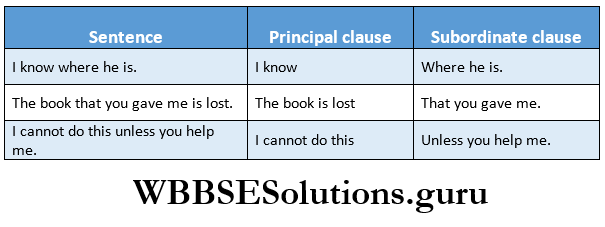
I cannot do this unless you help me. Remember, a finite verb is the main indication of a clause.
Every clause must have a finite verb and the number of finite verbs in a sentence indicates the number of clauses.
(মনে রাখবে, finite verb-ই Clause-এর মূল জিনিস। প্রত্যেক Clause-এই একটি Finite verb থাকতে হবে এবং একটি sentence-এ যতটি Finite verb ততটি Clause থাকে। )
In the above sentences, the forms of the verbs play and sing are guided by the Number and Person of the Subjects boys and Ram, and the tense.
These are called Finite verbs. The word finite means “limited.”
A finite verb is limited by its subject.
It agrees with its subject in number and person and its form changes according to the tense.
[কোন verb যখন subject-এর number, person ও tense (time) দ্বারা সীমাবদ্ধ অর্থাৎ নিয়ন্ত্রিত হয় এবং সম্পূর্ণ অর্থ প্রকাশ করে তাকে Finite verb (Finite = limited বা সীমাবদ্ধ) বলে। সুতরাং যে verb-এর subject থাকে তাইই Finite verb.
- Finite verb ছাড়া কোন sentence গঠিত হতে পারে না।
- Samar likes to read.
- Samar began smiling.
- Going home, he met his brother.
In the above sentences, the verb forms to read, smiling, and going have no subject and their forms do not depend on number, person, and tense.
Such verb forms are called Infinite verbs or Non-finites. (যে verb-এর action বা ক্রিয়া number, person বা tense দ্বারা সীমাবদ্ধ হয় না অর্থাৎ যার কোন subject থাকে না এবং অর্থ স্বয়ংসম্পূর্ণ নয় তাকে Infinite verb বা Non-finite বলে। )
লক্ষ্য করো উপরের sentence গুলিতে likes, began ও met Finite Verbs.
Co-ordinate Clause:
He went home and then left for Delhi.
He is poor but he will help you.
In the first sentence, either of the two clauses “He went home” and “then left for Delhi” can stand by itself as a complete sentence without depending on the other.
They are of equal rank and are connected by the Co-ordinating Conjunction.
In the second sentence, the clauses “He is poor” and “he will help you” do not depend on each other to make complete sense.
They are of equal rank and connected by the Co-ordinating Conjunction but.
Such clauses are called Co-ordinate Clauses.
A Co-ordinate Clause is of the same rank as another and is connected by a Co-ordinating Conjunction with the latter.
Thus, a clause may be co-ordinate with a Main clause, or with a Subordinate clause.
Co-ordinating clauses are connected with each other by coordinating conjunctions such ȧs and, but, yet, or, not only but also, either-or, neither – nor, therefore, etc.
Note the following examples:
He left the place, but I remained there. He is lame and cannot go there alone. Either you must come or I shall go. I cannot come for I am ill.
Read or you will fail.
Subordinate Clauses: These are of three kinds:
- The Noun Clause does the work of a noun.
- The Adjective Clause does the work of an adjective.
- The Adverbial Clause does the work of an adverb.
Chapter 14 Clauses The Noun Clause or Nominal Clause
A noun Clause does the work of a noun and it is usually introduced by the conjunction that, is expressed or understood, or by an interrogative pronoun or an interrogative adverb.
(Noun Clause Noun-এর মতো কাজ করে)
I know that he is ill. They say (that) he is dead. That he is ill is known to all. I know what he wants.
I shall enquire who did it. I asked him if (or whether) he was there. I know why he did it.
The Noun Clause may be :
The subject of a verb :
- That he is ill is known to all.
- When he will come is uncertain.
The Noun clauses “that he is ill” and “when he will come” are subjects to the verbs “is known” and “is” respectively.
The object of a verb
- I know when he will come.
- He said that he would go.
The Noun clauses “when he will come” and “that he would go” are objects to the verbs “know” and “said” respectively.
The object of a preposition (Preposition-4 object ):
It depends on how he behaves.
Here, the Noun clause in italics is used as an object to the preposition “on”.
The complement to a verb:
This is what we expected.
Here, the Noun clause “what we expected” is used as a complement to “is”.
In apposition to a noun or it:
- There is a rumor that he is dead.
- It is true that he has come.
Chapter 14 Clauses The Adjective Clause
Adjective Clause does the work of an adjective in a sentence qualifying a noun or a pronoun. (Adj. Clause Adjective
- I know the boy who did it.
- This is the place where he was born.
- I have lost the book (which) you gave me.
- This is the reason why he failed.
In the above sentences, the clauses in italics qualify the words “boy”, “place”, “book” and “reason” as Adjectives. Hence these are all Adjective Clauses.
Note also that each Subordinate Clause is introduced either by a Relative Pronoun or a Relative Adverb having an antecedent.
If there is no Antecedent, the clause would be a Noun Clause.
I know who did it.
This is where he was born: This is why he failed.
Adjective Clauses are, therefore, termed also as Relative Clauses.
The Adjective Clause is introduced by
- Relative Pronouns-who, which, that, as.
- Relative Adverbs-when, where, how, why, whence, as.
This is the boy who did it. I shall give a prize to one that will be able to complete the work.
I know the time when he comes. He lives at the place where I lived. This is the reason why he failed.
Chapter 14 Clauses The Adverbial Clause
An adverbial Clause does the work of an adverb in a sentence modifying a verb, adjective, or another adverb.
Adverbial Clauses can be introduced by any of the subordinating conjunctions except that used in Apposition:
Adverbial Clauses of Time indicate time and are introduced by when, while, after, before, till, until, since, etc.
Wait until I come. He came when I was there. Strike while the iron is hot. He came after I had left.
Adverbial Clauses of Place indicate place and are introduced by where, whence, wherever, etc.
Stay where you are. Return whence you came.
Adverbial Clauses of Reason or Cause indicate reason or cause and are introduced by because, as, since, that, etc.
He cannot come because he is ill. As he is ill, he cannot come. Since you are ill, you need not come.
I am sorry that you said so.
Adverbial Clauses of Purpose indicate a purpose and are introduced by that, in order that, so that, least, etc.
We read that we may learn. He works hard in order that he may succeed. Walk slowly lest you should fall.
Adverbial Clauses of Result indicate result and are introduced by that, so… that, such…. that:
What have I done that you desert me? I am so tired that I cannot walk.
He is such a fool that I cannot depend on him.
The conjunction is sometimes understood.
He is so weak he cannot walk. You were so late I could not wait.
Adverbial Clauses of Manner indicate results and are introduced by as Travel as you like. It happened as I expected.
Adverbial Clauses of Condition or Supposition indicate condition or supposition and are introduced by if, unless, in case, whether, on condition, provided (that), supposing that, etc.:
If I succeed I shall help you. I shall not go unless you come. I may come in case I have me.
He will come provided he gets leave. I shall try whether I succeed or not (succeed). Sometimes, the introductory conjunction is omitted:
Had I been (= if I had been) rich, I would have helped you.
Were I.(= if I were) present I would have opposed you.
Adverbial Clauses of Concession are introduced by though, although, even if, even, etc.
Though he is poor, he is honest. Even if I fail, I shall not give up hope. Although they were present, they said nothing.
Sometimes adverbial clauses of concession are introduced by pronouns or adverbs combined with ever, viz., whoever, whatever, whichever, however:
However strong you may be, I am not afraid of you. Whatever you may say, I do not believe you. Whoever he may be, he cannot be allowed.
Adverbial Clauses of Comparison or Degree are introduced by so ….. as, such….. as, as… as, then, the:
He is not as tall as his brother. He is as honest as his brother. He is as wise as you. She is taller than you. The more, the merrier.
The Relatives “who” and “which” make adverbial clauses when they signify cause or purpose:
Cause Dutta, who (= because he) had been found guilty, was fined. The picture. which (= because it) was spoiled, and has been thrown away.
Purpose:- I shall send my brother who will (= that he may) do the work. He has sent me a dog which will (= that it may) guard my house.