
Chapter 17 Correlatives
Correlatives are pairs of words that are regularly used together (একত্র ব্যবহৃত হয়).
Here are some of the important Correlatives:
Both – and
- Both Ram and Kali (not, as well) were present there.
- He is both rich and (not, as well as) powerful.
Either— or; neither — nor
- Either he or his brother was there.
- Neither the boy nor his brother was there.
Read And Learn More WBBSE Class 9 English Functional Grammar
As— so
- As you sow, so shall you reap.
- As I am ill, (so) I cannot go
So — that
- He is so ill that he cannot walk.
- I am so poor that I cannot buy I
No sooner — than
- No sooner did I come than they left the place.
- No sooner had he gone than I reached the place
Not only — but also
- Not only he but his brother also were present.
- He is not only rich but also honest.
As — as; so — as
- Come as soon as you can.
- He is not as eager as you are
- Only such boys are wanted as (not, who or that) have passed.
- The defect was such as to cause anxiety.
- The same as

Such ― that
- Such was his misfortune that nobody helped him.
Hardly — when
- Hardly was he gone when they left.
- Hardly had he entered the room when it began to rain
Scarcely— before or when
- Scarcely was he gone before (or when) they left.
- Scarcely had he entered the room before (or when) it began to rain.
Such — as
- Only such boys are wanted as (not, who or that) have passed.
- The defect was such as to cause anxiety.
Such — that
- Such was his misfortune that nobody helped him.
- The defect was such that it caused anxiety
The same — as
- This is the same book as (not, like) that.
- He is the same person as (or, that) I saw yesterday.
- Each member of the Correlatives “both-and”, “either-or”, “neither-nor”, and “not only-but also” should be followed by words of the same class.
- (Correlatives-এর উভয় অংশের পরই একই জাতীয় part of speech বসে।)
Look at the following sentences:
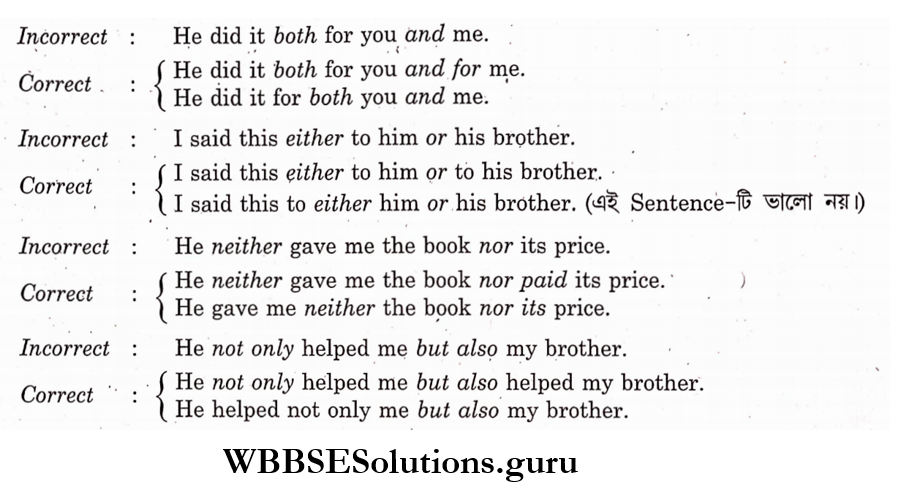
In the first sentence, ‘both’ is followed by a preposition and ‘and’ by a pronoun. This is wrong.
The correct form should be to put Preposition ‘for’ after ‘both’ and ‘and’.
Or, the preposition ‘for’ may be put before ‘both’ and then pronouns ‘you’ and ‘me’ placed after ‘both’ and ‘and’.
In the second sentence, if either is followed by a preposition ‘to’, ‘or’ should also be followed by the preposition, ‘to’.
Or, ‘to’ may be placed before ‘either’, ‘either’ and ‘or’
should be Followed by the same type of Parts-of-Speech (Pronoun and Noun).
In the third sentence, ‘neither’ should be followed by the verb ‘gave’ and ‘nor1 by the verb ‘paid’. Or, the verb ‘gave’ may be put before ‘neither’, and the nouns ‘book’ and ‘price’
placed after ‘neither’ and ‘nor’ respectively.