
Chapter 6 Voice
- The hunter killed the lion.
- The lion was killed by the hunter.
The above two sentences have the same meaning but their forms are different.
In the first sentence, the subject (the hunter) is the doer of the action (killed); that is, the subject is active (2 sentences- subject “hunter”). The verb “killed” is, therefore, said to be in the Active Voice.
Read And Learn More WBBSE Class 9 English Functional Grammar
In the second sentence, the subject (the lion) is acted upon and it is the receiver of the action (was killed); that is, the subject is not active, but passive ( sentence- subject “lion” সক্রিয় বা active নয়। অর্থাৎ lion নিজে কোনো কাজ করেনি। তার উপরেই “হত্যা” কাজটি করা হয়েছে). The verb “was killed” is, therefore, said to be in the Passive Voice.
Voice Definition:
Voice is the form of the verb which shows whether the subject acts or is acted upon.

There are two voices:
1. When the subject of the sentence is the doer or actor, the verb is Active voice: (যখন subject কোনো কাৰ্য্য নিজেই সম্পন্ন করে তখন সেই verb-এর Active Voice বা কর্তৃবাচ্য হয়।) He runs. I did it. He said this.
2. When the subject of the sentence is acted upon, the verb is Passive voice: (যখন subject কাজটি নিজে করে না, তার উপরে কাজটি করা হয়, তখন সেই verb-এর Passive Voice বা কর্মবাচ্য হয়। ) It was done by me. This was said by him.
Rules for changing the Active Voice into Passive:
The object in the Active Voice becomes the subject in the Passive. (Active- Object Passive-Subject )
The subject in the Active Voice becomes the object in the Passive, generally preceded by the preposition by. (Active-এর Subject-টি Passive Voice-এ Object-এ পরিণত হয় এবং তার পূর্বে সাধারণতঃ by বসে।)
The verb is changed into the Past Participle form and is preceded by some form of the verb “to be”.
(Active-এর verbটি Past Participle form-এ পরিবর্তিত করে তার পূর্বে “to be verb-এর উপযুক্ত form বসাতে হয়। Tense Active Verb-এর tense অনুযায়ী হয়।
Note the following example:
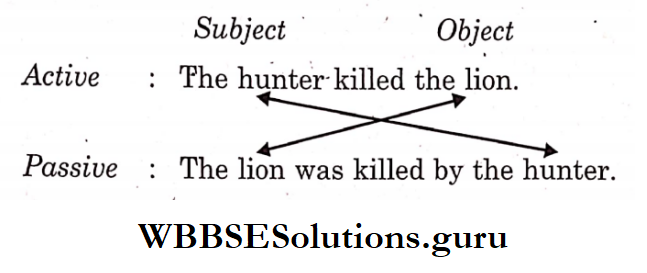
Here the subject (hunter) in the Active Voice has become an object in the Passive Voice, and the object (lion) in the Active Voice has become a subject in the Passive Voice.
Similarly:
- Active: I call him.
- Passive: He is called by me.
- Active: I shall write a letter.
- Passive: A letter will be written by me.
- Active: Rani reads a book.
- Passive: A book is read by Rani.
- Active: He did the job.
- Passive: The job was done by him.
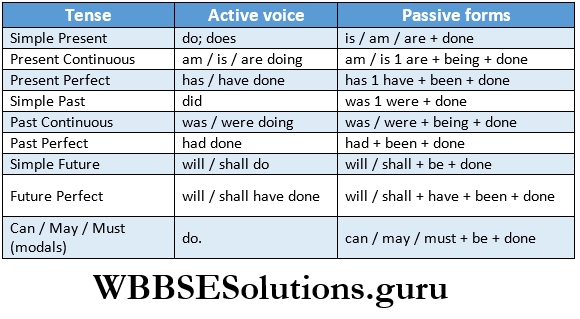
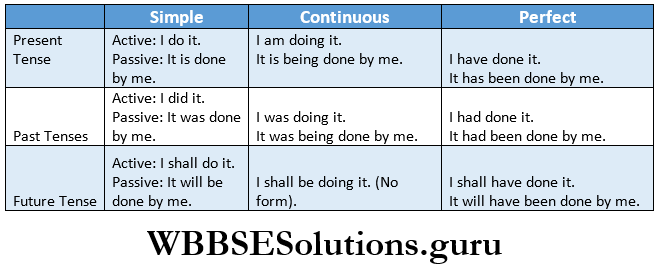
Study the following table which shows forms of the verb “to do” in different tenses in the Active and Passive Voice.
(নীচের ছকটিতে Active ও Passive Voice-এ tense অনুযায়ী “to do” verb-এর বিভিন্ন আবশ্যকীয় form দেখানো হয়েছে) :
Chapter 6 Voice Simple Present
Active – Passive
- Children like sweets – Sweets are liked by children.
- He sells fish in the market. – Fish is sold by him in the market.
- She loves me. – I am loved by her.
- I help him. – He is helped by me.
Chapter 6 Voice Present Continuous
Active – Passive
- I am reading a book. – A book is being read by me.
- The fisherman is catching fish. – Fish is being caught by the fisherman.
- They are drawing pictures. – Pictures are being drawn by them.
- She is cooking rice in the kitchen. – Rice is being cooked by her in the kitchen.
- They are helping me. -I am being helped by them.
Chapter 6 Voice Present Perfect
Active – Passive
- I have read the book. – A book is being read by me.
- The girls have sent the flowers. – The flowers have been sent by the girls.
- Partha has written these letters.- These letters have been written by Partha.
- They have brought the statue from Kolkata. – The statue has been brought by them from Kolkata.
Chapter 6 Voice Simple Past
Active – Passive
- He did it. – It was done by him.
- I saw a tiger.- A tiger was seen by me.
- They bought toys- Toys were bought by them
- She helped me – I was helped by her
- He stole my book – My book was stolen by him
Chapter 6 Voice Past Continuous
Active – Passive
- I was doing the work – The work was being done by me.
- He was reading a book – A book was being read by him
- They were calling the boys – The boys were being called by them.
- Sandip was writing a letter. – A letter was written by Sandip.
- Were the boys throwing stones? – were stones being thrown by the boys?
Chapter 6 Voice Past Perfect
Active-passive
- They had done the work. – The work had been done by them,
- We won the match. – The match had been won by us.
- She had sewn the cloth. – The cloth had been sewn by her.
- Had you lent the book? – Had the book been lent by you?
Chapter 6 Voice Simple Future
Active – Passive
- shall do it. – It will be done by me.
- He will do the work. – The work will be done by him.
- I shall buy a house. – A house will be bought by me.
- He will not hurt you. – You will not be hurt by him.
- Shall we help her? – Will she be helped by us?
Chapter 6 Voice Future Perfects
Active – Passive
- Mr. Roy will have taught this class. – This class will have been taught by Mr. Roy.
- I shall have written the letter. – The letter will have been written by me.
- She will have drawn the picture. – The picture will have been drawn by her.
Chapter 6 Voice Passive Verbs With Modals
Active – Passive
- He can do the work.- The work can be done by him.
- You must take this medicine.- This medicine must be taken by you.
- We may help you. – You may be helped by us.
- The boy should read the book. – The book should be read by the boy.
- He might take your help- Your help might be taken by him
Chapter 6 Voice Interrogative Sentences
Active – passive
- Do you Known Him? – Is he known to you?
- Did you read the book?- Is this wanted by him?
- Have you done the work? – Was the book. read by you?
- Was he taking tea? – Has the work been done by you?
- Are you reading the book? – Was tea being taken by him?
- Where did you see him? – Is the book being read by you?
- Who will do the work? – Where was he seen by you?
- What did they do? – By whom will the work be done?
- Why have you bought this – What was done by them?
Note that who in the active becomes by whom in the passive.
For Interrogative sentences beginning with auxiliary verbs like Do, Does, Did, etc. the following steps may be followed to convert them to Passive ones :
- Step 1: Change the sentence into Assertive.
- Step 2: Change it into Passive.
- Step 3: Change it into an Interrogative one.
Sentence: Do you Know him? – Did you read the book?
- Step 1: Assertive: You know him. – You read the book
- Step 2: Passive: He is known to you: The book was read by you.
- Step 3: Interrogative: Is he known to you? Was the book read by you?
You know him. He is known to you. Is he known to you?
Did you read the book? You read the book. The book was read by you. Was the book read by you?
- Only Transitive verbs (i.e., verbs taking an object to complete a sense) can be used in the Passive Voice. Since Intransitive verbs do not have objects, they cannot be used in the passive form. But there are some exceptions, see Art: 118.
- Though, theoretically, all transitive verbs can be made passive, sometimes in practice the passive form is not used. As:
- “We had a nice dinner yesterday” would not be used in the passive as “A nice dinner was had by us yesterday.”
- The doer of the action of a passive verb (i.e., object) may sometimes be preceded by some prepositions other than by: (অনেক সময় passive voice-এ object-এর পূর্বে by না বসে অন্য preposition বসে।)
Active – Passive
- It is said he will come – Men say he will come
- He is expected soon. – we expect him soon
- My book has been lost. – I have lost my look
- The house was blown down. – the storm
- The lion is called the king of beasts. – people call the lion the king of beasts.
- The shed was burnt to ashes. – Fire burnt the shed to ashes
In the Passive Voice, often the object is understood. In changing such sentences into the Active Voice, the Object has to be mentally supplied and then formed into the Subject.
In changing the voice of Complex sentences the voices of both the Principal and Subordinate clauses should be changed.
The Introductory also may be sometimes used. (Complex Sentence-voice Principal Subordinate- clause- এরই voice পরিবর্তন করতে হয়। )
Active – Passive
I know that he did the work. – It is known to me that the work was done by him. or, That the work was done by him is known to me.
Passive
We must endure what we cannot What cannot be cured must be endured. cure.
Sentence: It is said that they know it.
Change of voice: Everybody says that it is known by (or to) them.
An Intransitive Verb may be changed into the Passive:
- The battle was fought at this place.
- The race you speak of was run yesterday.
When it takes a cognate object in the Active Voice:
- The battle was fought at this place.
- The race you speak of was run yesterday.
When it is a Prepositional or Group Verb:
Active – Passive
- They laugh at us. – We are laughed at by them.
- He dispensed with my services. – My services were dispensed with by him.
Objects that cannot be used as Subjects in the Passive:
- The Reflexive object. Thus, “He killed himself” cannot be changed into “Himself was killed by him”. The Passive would be “He was killed by himself”.
- The Factitive object. Thus, “They made him king” becomes “He was made king by them” in the passive.
If the Active Verb is in the Imperative mood, i.e., if it expresses orders, requests, advice, etc. the word ‘let’ is usually placed at the beginning in the Passive Voice.
There are other ways also. (আদেশ, অনুরোধ, উপদেশ ইত্যাদি বোঝালে, Passive voice-এ Sentence-টি সাধারণত Let দিয়ে আরম্ভ হয়। এটা ছাড়া কোনো কোনো ক্ষেত্রে অন্য উপায়ে নতুন words সংযোজন করেও passive করা হয়।)
- You (or, Visitors) are requested to keep off the grass. (Smith)
- You are requested to enter by this door.
- The medicine should be taken regularly.
Passive Infinitives are done by retaining the ‘to’ followed by ‘be’ and the past participle form of the verb. Active to + do
Active – passive
- I am to buy a book. – A book is to be bought by me
- I have to do the work. – The Work Has to be done by me
- It is time to post the letters today – The letter is to be posted by you today.
- He has no money to spend – There is no money to be spent by him.
Some transitive verbs are active in form but passive in sense; they are called quasi-passive verbs.
This book reads well (= is well when it is read). It tastes sweet (= is sweet when it is tasted). The rose smells sweet (= is sweet when it is smelt). The house is building (= is being built). The book is printing (= is being printed). The cows are milking.(= are being milked).
If the Active Verb is in the Imperative mood, i.e., if it expresses orders, requests, advice, etc. the word ‘let’ is usually placed at the beginning in the Passive Voice. There are other ways also.
(আদেশ, অনুরোধ, উপদেশ ইত্যাদি বোঝালে, Passive voice-এ Sentence-টি সাধারণত Let দিয়ে আরম্ভ হয়। এটা ছাড়া কোনো কোনো ক্ষেত্রে অন্য উপায়ে নতুন words সংযোজন করেও passive করা হয়।)
Chapter 6 Voice Miscellaneous Examples
Nothing can be gained without labor. Why was he refused admittance? Indiscipline should not be encouraged. French is spoken in Quebeck.
One should keep one’s promise. Someone has stolen my pen. Circumstances obliged me to go. We can gain nothing without labor.
Why did they refuse him admittance? We should not encourage indiscipline. People in Quebeck speak French.
In the above examples, the agent by has been omitted in the Passive constructions. ( লক্ষ্য কর, Passive voice-এ কাজ যার দ্বারা সম্পাদিত হয় অর্থাৎ agent-এর কোনো উল্লেখ করা হয়নি।)
Generally, when we want to place emphasis on the performer or doer of the action, we use the active voice; but when we want to place emphasis on the action, or on the receiver of the action, we use the passive voice.
The verb construction called the “passive voice” is used in specific situations. They are the following:
When it is not necessary to say who performed the action উল্লেখের প্রয়োজন যেখানে নেই):
- The appointment letter was issued today.
- Rice is grown in India.
- It is made in Russia
When it is preferable not to mention the performer or doer (কাজটি কে করেছে তা উল্লেখ না করা যেখানে সমীচীন মনে করা হয়):
- He was told that his English was not good.
- A notice was passed on the gate.
- I was informed of it earlier.
When we wish to emphasise the receiver of the action rather than the performer or doer (যখন কর্তার চাইতে ক্রিয়ার প্রাপককে প্রাধান্য বেশি দেওয়া হয়):
- A man was knocked down by a lorry
- He is said to have earned a lot of money.
- He was congratulated on his success.
In situation of social and historical significance (উল্লেখযোগ্য সামাজিক বা ঐতিহাসিক ঘটনার উল্লেখ করতে):
- America was discovered by Columbus.
- The battle was fought at Plassey.
- An atomic bomb was dropped on Hiroshima.
- In invitations, requests, and announcements:
- Passengers are requested not to smoke in the bus.
- You are invited to attend the party.
- The flight will be delayed by half an hour.
In newspaper reports (সংবাদপত্রে ঘটনার বিবরণ দিতে):
- Kolkata was lashed by a thunderstorm last night.
- The Prime Minister was cornered in the Parliament.
- The goal was scored in the 14th minute of the first half.
To describe a mechanical process and in giving scientific descriptions ( প্রক্রিয়া এবং বৈজ্ঞানিক বিবরণ বোঝাতে):
- Iron ore is mixed with coke and limestone to produce pig iron.
- The mixture is collected in a bottle.
Question 1. In the 14th minute, Subhas was fouled by Anjan near the penalty box. From the free kick, the first goal for Aryans was scored by Rabi.
Answer: In the 14th minute, Anjan fouled Subhas near the penalty box. From the free kick, Rabi scored the first goal for the Aryans.
Question 2. One terrorist was killed and two others were injured by the police in Punjab yesterday. The injured were taken to a hospital and were later arrested by the police.
Answer: Yesterday in the Punjab the police killed one terrorist and wounded two others. The police took the injured to a hospital and later arrested them.
Question 3. In the final W. Germany was defeated by Argentina 3-2. The spectators were thrilled by the skillful ball-play of the players.
Answer: In the final Argentina defeated W. Germany 3-2. The players thrilled the spectators with their skillful ballplay.
Question 4. A 6-year child was knocked down by a passing vehicle. A young boy was driving it. He was chased by a big crowd and was later arrested by the police.
Answer: A passing vehicle knocked down a 6-year-old child. The car was being driven by a young boy. A big crowd chased him and later the police arrested him.