Chapter 8 Adverbs And Adverbials
Definition: An Adverb is a word which generally qualifies a verb, an adjective, or another adverb; but it also qualifies a sentence or any part of speech except a Noun and a Pronoun.
- Verb: He walks slowly.
- Adjective: This is a very beautiful picture.
- Adverb: This can be done more easily.
- Participle: It is a very charming scene.
Read And Learn More WBBSE Class 9 English Functional Grammar
- Preposition: He came right through the field. I arrived long before the time.
- Conjunction: I hate him simply because he is a liar. He came just after I had left.
- Sentence: Unfortunately I failed. Evidently, you are wrong.
Classification of Adverbs:
Adverbs are broadly divided into three classes according to their uses
Simple or Independent Adverbs are those that merely qualify some word or phrase or sentence.
He reads well. He can run fast. He stood just in front of me. Unfortunately failed.
Relative or Conjunctive Adverbs are those that not only qualify a word but also connect two clauses. When the antecedent is expressed, the adverb is Relative; but when it is not expressed, it is Conjunctive.
- I know why he did it.-Here the why is Conjunctive.
- I know the reason why he did it.-Here the why is Relative.
Interrogative Adverbs are those that are used in asking questions, both direct and indirect.
- Why are you sorry? How did you do it? Tell me when we will come.
- Do you know where he lives? Where does he live?
Simple Adverbs are subdivided into many classes according to their meanings:
Adverbs of Time or Frequency show when a thing happens.
Rise early in the morning. I am very busy now. We shall be there soon. Ranjan was asleep when Atul came in.
Then, when, always, before, daily, ever, never, ago, already, immediately, today, yesterday, etc. are some more examples of Adverbs of Time.
Adverbs of Place show where a thing happens. (ঘটনার স্থান নির্দেশ করে)
Look there. We searched far and near. The car is waiting outside. Where, above, after, hence, etc. are some more examples of Adverbs of Place.
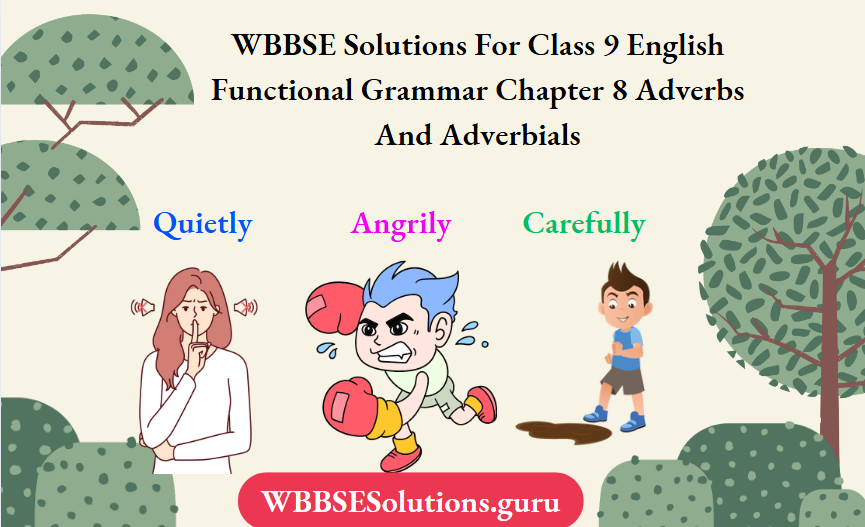
Adverbs of Manner or Quality show how a thing is done.
They played well. Don’t talk aloud. He was highly praised. Walk slowly.
Badly, ill, thus, wisely, quickly, how, etc. are a few more examples of Adverbs of Manner or Quality.
This is the largest class of adverbs and in it are included nearly all those derived from adjectives and ending in “-ly,” like: carefully, narrowly, dutifully, peacefully, etc.
Adverbs of Quantity or Degree or Number show how much or to what extent a thing happens. (সংখ্যা বা পরিমাপ বোঝায়
- I have enough. Don’t talk much. They came here only once.
Almost, half, hardly, very, much, little, rather, quite, etc. are a few more examples of Adverbs of Degree or Number.
Adverbs of Cause and Effect show why a thing is done, and its effect. (6 ফল বোঝায়)
- He was hungry. Therefore, I gave him some food.
- The man stole some money. Consequently, he was arrested.
Why, accordingly, hence (for that reason), etc. are also examples of Adverbs of Cause or Effect.
Adverbs of Order show the order in which a thing is done. He came last. Come first tomorrow.
First, secondly, lastly, etc. are some examples of Adverbs. of Order.
Adverbs of Affirmation or Negation express affirmation or negation. ( বোঝায় Yes, I can do it. Surely, we are all happy. I am not at all happy. You need not worry now.
No, not, certainly, perhaps, indeed, probably, possibly, truly, really, etc. are a few more examples of Adverbs of Negation or Affirmation.
Adverbs are compared like Adjectives with -er and -est, more and most, or irregularly:
- Wisely more – wisely- most wisely
- Soon sooner – soonest
- Fast – faster-fastest
- Rapidly more rapidly- most rapidly
- Forth-further – furthest
- Well-better-best
- Little less least
- Much more – most
Since both adjectives and adverbs have the characteristic of comparison you will have to consider the function to distinguish between the two.
Adjectives will make comparisons about Nouns; adverbs will make comparisons about verbs, adjectives, and other adverbs.
Adverbs often end in “-ly”:
Examples:
He worked rapidly, ate hungrily, and slept soundly. Note that all words that end in “ly” are not adverbs. Some are adjectives. Check their functions.
Examples:
He was a friendly man who had a burly physique.
Here friendly tells about the man (noun) and burly tells what kind of physique (noun). So, both are adjectives here.
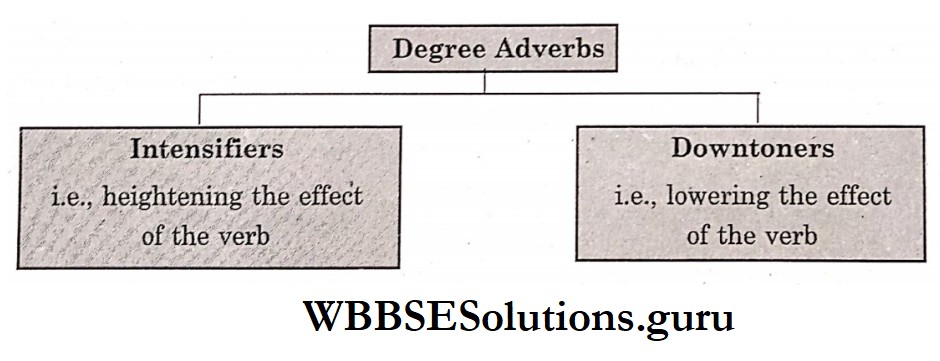
Degree Adverbs can be classified as follows:
Adverbial Phrases are two or more words having the force of an Adverb:
Now and then, by and by, off and on, up and down, in time, in short, in vain, heart and soul, bag and baggage, by no means, etc.
General rules for the position of Adverbs:
The Adverb usually follows an Intransitive verb. (সাধারণতঃ অকর্মক ক্রিয়ার পরে বসে)ঃ They live here. He came early.
Exceptions: But adverbs of time/frequency such as always, seldom, never, ever, sometimes, frequently, etc. are placed before all verbs other than the verb to be:
- He frequently told me this.
- He always supports me.
- They seldom do it.
- I never (or often) go there.
- He sometimes talks too much.
- But, He is always cheerful. I am often busy. You are never late.
The Adverb usually follows the Object. (Object-4):
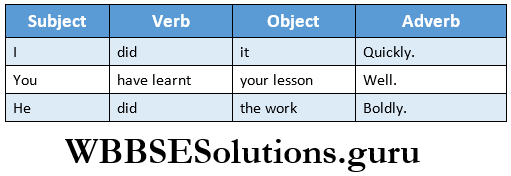
Nothing must be put between the verb and the object.
Exceptions: But for the sake of emphasis the adverb sometimes changes its position.
- Slowly and silently he entered the room.
- Cheerfully he gave me the news
- I certainly believe that whatever you say are all true.
- We all admire you very much.
- The bus almost crushed the scooter.
The Adverb usually comes between the Auxiliary and the Principal Verb. (Auxiliary Verb Principal Verb এর মধ্যে):
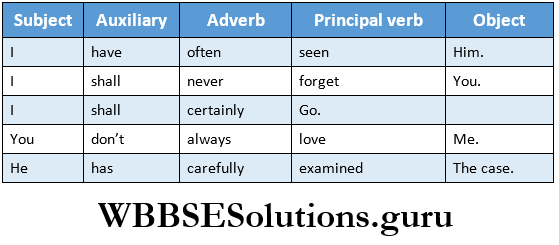
The Adverb precedes the Adjective it qualifies. (Adjective-4):
- I am rather sorry for you.
- We are very happy.
But enough, when an Adverb, always follows the word it qualifies:
- I am strong enough to work.
- He was wise enough to accept the offer.
As an Adjective, however, enough may be placed either before or after the Noun it qualifies. I have enough strength to go there. I have strength enough to go there.
An Adverb is placed first in a sentence:
- To qualify the whole sentence.
- For the sake of emphasis.
Examples:
- Luckily he did not die. Fortunately, he was present there.
- Down went the Royal George.
Word order of Adverbs of Manner, Place, and Time:
Though absolute rules cannot be made in these cases, the tables below indicate the normal order:
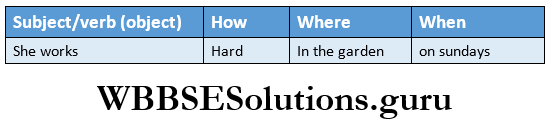
But when the verb is a verb of movement like come, go, jump, run, etc., we are usually most interested in where someone is going. So the word order is:

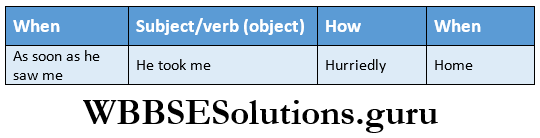
When there are a number of long adverbial phrases or we want to emphasize the time, we can put the time adverbial (when) at the beginning of the sentence: