
Chapter 9 Prepositions
A preposition is a word placed before a noun or a noun-equivalent to show its relation to some other word in the sentence
- He came to me.
- Put it on the table.
Prepositions may also govern other parts of speech used as nouns:
- From here, before now, for good, in short, about to go.
Prepositions may govern phrases and clauses as well:
- It depends on how you do your duty.
- I shall go to where you have come from.
- I am ignorant of how to do it.
Prepositions sometimes follow the words they govern when the object is an interrogative or relative pronoun understood; particularly the relative that is never governed by a preposition preceding it:
What is this for? Where do you come from? This is the boy that I spoke of. This is the e-boy that I spoke of. This is the boy (whom) I spoke to.
Read And Learn More WBBSE Class 9 English Functional Grammar
Phrase Prepositions or Prepositional Phrases are phrases used as a preposition-on account of, instead of, in spite of, by means of, owing to, by dint of, in accordance with.
He could not come on account of illness. In spite of hard labor, he failed in the examination. Instead of coming here, he went home.
Uses of a few Prepositions:

At is often followed by an article to form a phrase:

In
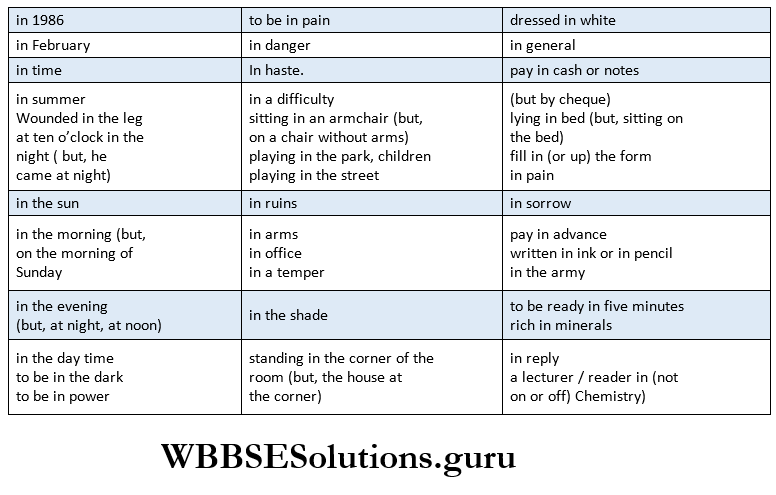
On

By
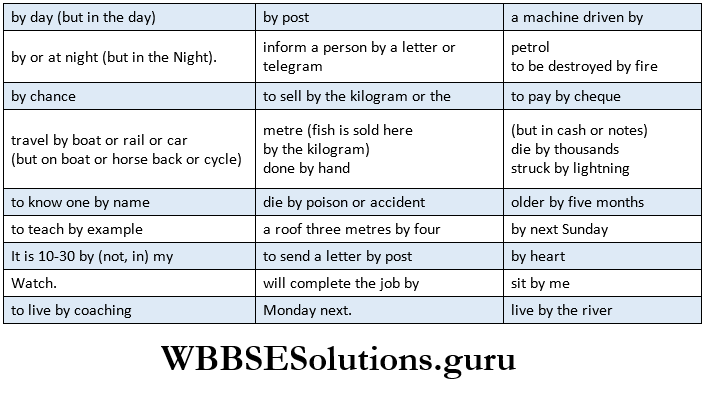
Of

To

For

Chapter 9 Prepositions Differences In The Use Of A Few Important Prepositions
At, In Both are used to denote time and place.
Expression of time:
At refers to a certain moment or point in time:
- He will come at 4 p.m.
- We got up at dawn and had breakfast at 8 o’clock.
- Take the medicine at bedtime.
Similarly:
- At noon, at sunset, at midnight, at dinner time, at the beginning
At is also used for festivals which mark a point of time in the year:
- We have a holiday at Christmas / Dewali.
In refers to a space or period of time (RT)
- He will come in an hour / in a few minutes.”
- He ran the distance in three hours.
Similarly:
In the summer, in September, in the year 1998, in the morning, in the evening. I shall see you at 3 o’clock in the afternoon. Cricket is played in the winter.
Expression of place:
At refers to a small place, town, or village; in refers to a large place (a country, a district, or a large city) (At ছোট স্থানের পূর্বে, in বড় স্থানের পূর্বে বসে) :
- He lives in Serampur.
- He lives in Kolkata (or in London).
- He lives in the U.S.A.
- He lives in Jangipur in the district of Murshidabad.
- He has a shop at Bally in Howrah.
- The train arrives in Delhi at 5 o’clock.
For houses and places of residence:
- It is used to denote a kind of house or residence.
- In a bungalow, in a flat, in a hotel, etc
- He lives in a flat.
At is used to denote a specific one (a):
- at 12, Chowringhee Road
- at the Oberoi Grand
It is used to refer to names of streets and roads:
- in Rash Behari Avenue
- in Chowringhee Road
He lives at 25, Rash Behari Avenue in Kolkata, but he lives in Rash Behari Avenue. He lives in a hotel on Rash Behari Avenue.
By, with: By relates to the doer or agent; with relates to the instrument or the thing with which something is done; as : [By যে কাজ করে (agent বা doer) তাকে নির্দেশ করে ; with যা দ্বারা কিছু করা হয় তা নির্দেশ করে।]
- He was struck by Ram with a stick.
- The letter was written by him with a pen.
Among, between: Between generally relates to two persons or things; Among relates to more than two [ সাধারণতঃ দু’য়ের মধ্যে অর্থে between ও দু’য়ের অধিকের মধ্যে অর্থে among ব্যবহৃত হয়।]
- There was a quarrel between the two brothers.
- There was a quarrel among the boys.
For, since, from: For refers to a space of time; since and from refer to a point of time.
But while since refers only to a past point, from refers to a point of time in all tenses. As:
[ হতে অর্থে (তিনি তিন দিন হতে পীড়িত, আমি সোমবার হতে আসব) এই তিনটি শব্দই ব্যবহৃত হয়। কিন্তু
- For space of time (সময়ের ব্যপ্তি) বোঝায়।
- Since– past point of time
- From – past, present ও future তিন রকম point of time-ই বোঝায়। ]
- He has been here for a week.
- I have not seen you for many days.
- It is many days since I saw you last (since the point of time that I saw you last). He has been here since Monday last.
- He began English at the age of ten (past).
- He begins English today (present).
- He will begin English tomorrow (future).
In, into: In refers to position or rest inside something; into refers to motion or change of state [কোনো কিছুর মধ্যে বা ভিতরে থাকা বোঝালে in এবং বাইরে থেকে ভেতরে গতি বা অবস্থা বা আকারের পরিবর্তন বোঝালে into হয়।] as:
- There is no milk in the pot.
- There was nobody in the room.
- The girls ran into the hall.
- The Ganga flows into the Bay of Bengal.
- The ice melted into the water.
Besides, besides:
- Beside is only a preposition and means near-Sit beside me.
- wide of – Your remark is beside the point. Besides is
- a preposition meaning in addition to. I have none to help me besides you.
- an adverb = also, moreover. It is late; besides, I am tired.
- Beside oneself means becoming out of control
- because of a particular feeling or emotion: He was beside himself with joy when he heard the news.
After, in, within, at, by After refers to a past space of time, while in refers to a future space of time (“পরে” অর্থে “after” অতীতকাল নির্দেশ করে, এবং “in” ভবিষ্যৎ কাল নির্দেশ P).
Thus we cannot say, ‘He will come after a few days’, or ‘He died in a few days’.
The correct sentences will be, ‘He will come in a few days and ‘He died after a few days respectively.
To denote the point of time, after is used with all tenses; such as ‘He will come or comes or came after 5 o’clock’.
Within also refers to a space of future time; but whereas in denotes at the end of, within denotes some time before the end of.
I shall go in a week after the week has ended. I shall go within a week before a week has ended নীচের sentence গুলি লক্ষ্য কর:
- He will come in a week —এক সপ্তাহ পরে আসবেন।
- He will come within a week এক সপ্তাহের মধ্যে আসবেন।
- He came after a week —এক সপ্তাহ পরে এসেছিলেন।
- He will finish the work in a month – এক মাস পরে করবেন।
- He finished the work after a month—এক মাস পরে করেছিলেন।
At refers to a definite point of time; as ‘He came at noon’.
By refers to a point of future time and means ‘sometime before that’: as “You must be back by 5 o’clock”.
We reached the place at the same time = We took the same period of time (say, 5 hours) to reach the place; we might have started and arrived at the destination at different hours.
We reached the place at the same time say, 5 o’clock; we might have started at different hours.
He reached the place within the same time = say, 5 hours; it may be, one took 3 hours, another 4 hours, etc.
Over, above: Over is generally used for a point generally higher; above is used for a point directly higher (অপেক্ষাকৃত উচ্চ স্থানে অর্থে over, কিন্তু ঠিক উপরে অর্থে above ব্যবহৃত হয়).
As
- On our way to Kolkata, our plane flew over the Middle East.
- My neighbors above my flat disturb me very often.
From, of:
- Wine is made from grapes.
- Steel is made from iron ores.
Here the material has lost its original composition in the process of manufacture.
- The table is made of wood.
- The bridge is made of steel.
Here the material remains unchanged in the process of manufacture.
Chapter 9 Prepositions Appropriate Prepositions
Certain words take particular prepositions after them. This is a matter of idioms.
In a few cases, the usage varies. Still, students should carefully note the generally accepted usage.
A few examples are given below:
Abide by with (a person), in, at (a place)-I shall abide by your decision. Abide (dwell, 2) with me, Lord. I shall not abide long in Kolkata, or at Bankura.
Abound in (used before both the container and the contained), with (used before the contained only)-Wild animals abound in Indian forests. Indian forests abound with wild animals (or, in good timber).
Abreast of, with (RCA)- Read newspapers to keep abreast of or with the latest developments.
Absent from (a place) -He was absent from the meeting.
Absolve (one) from (blame), of (sin) -I absolve you from blame. The priest absolved him of sin. (POD & COD).
Absorbed in He is absorbed in thought (deeply engaged)
Abstain from -I shall abstain from smoking.
Abut on The buidling abuts on the temple (একই সীমায় মেশা)
Accede to-I cannot accede (agree) to your request.
Access to We have free access to him (right of approaching, নিকটে যাবার অধিকার).
Accessible to-He is accessible to all.
Acceptable to-Your offer is acceptable to me.
Acclimatize to ( নুতন, স্থান বা পরিবেশে মানিয়ে G) They will need some time to get acclimatized to the new surroundings.
Accommodate (one) with (a loan), (oneself) to (circumstances) He accom- mandated (সাহায্য করেছিল) me with a loan. We should accommodate ( খাওয়া, মানিয়ে নেওয়া) ourselves to circumstances.
Accompanied by (a person) with (a thing)-I was accompanied there by my friend. He is suffering from a fever accompanied (combined, R) with a headache. Accomplished in The girl is accomplished in dancing.
Accord to, with- They accorded (gave, a grand reception to the leader. Your story accords (agrees, সঙ্গতিপূর্ণ) with his.
According to; (In) Accordance with- According to (or, In accordance with) your orders I went there (অনুসারে, অনুযায়ী).
Account (verb) for; Accountable (responsible) to (a person) for (an action)-I have to account for ( (3) this money. We are accountable (responsible,) to God for our deeds. Modern usage confines abound in and abound with to the two distinct senses of “be rich in” and “be infested with” respectively; vide POD.
Accrue (fall) to (one), from (a thing)-Great benefit will accrue ( জমবে ) to the country from the measure.
Accused of -He was accused of theft.
Accustomed to -I am accustomed (used) to such a life.
Acquainted with -I am acquainted with him.
Acquiesce in-He’acquiesced in (agreed to, a) the proposal.
Acquit (one) of I acquit (A) you of the charge.
Adapted to (one’s ability); for (a purpose), from (the original) This work is not adapted to (fit for, 1) my abilities.
This story is adapted for school boys from a story of Rabindranath (R). Add to (s)-Add this to that. Addicted to -He is addicted to wine. Addition to; (In) Addition to-There has been an addition to (সংযোজন, অতিরিক্ত C) their family.
During my leave period, he will look after my jobs in addition to (for) his own duties. Adept in He is adept (proficient) in music.
Adequate This amount is adequate to (sufficient) our wants.
Adhere to I still adhere (stick, CT) to my plan.
Adjacent to His house is adjacent close, to mine.
Adjourned to, for-The meeting was adjourned (put off, মুলতুবী রাখা হল) to Sunday next (or, for a week) ‘afraid to wake him.’
Admit of (excuse, -Your conduct admits of no excuse
Admit (one) to, into (a place, class, etc.)- He was admitted into the room. He was admitted to class 8.
(To take) Advantage of, (to gain) Advantage over-He took advantage of ( সুযোগ নিল) my absence to steal my book. He gained an advantage f over me in the race.
Advantageous to-The new rule is advantageous to us. Adverse to Your plan is adverse against to our interests.
Affection for, towards (POD); Affectionate to, towards- He has affection for or towards me. He is affectionate to or towards me.
The affinity between (two things), of (one thing) for (another), too, for There is an affinity between the two languages.
The affinity of milk to water poses a problem. I feel a strong affinity to or for him.
Affix to, on (COD)-Affix this stamp to or on the letter (attach).
Afflicted with (a disease), at-He is afflicted with (suffering from gout. She is affiliated with the death of her son.
Afraid of-I am afraid of him. He is afraid of doing this.
Alliance or Allied with, Allied to-
Agog (refer) with-The boys were agog with excitement at the start of the match.
Agree with (a person), on (a point), to (a proposal)-I agree with you on this point.
“I agree with what you say” (POD). I agree with your proposal. Agreeable (পছন্দমতো, সম্মত) to — The climate of this place is agreeable to me.
Are you agreeable to my proposal? Ahead of -He reached here much ahead of the scheduled time. The boy soon got ahead of the others in the long run.
Aim at ( তাক করা, লক্ষ্য করা ) He aimed at the flying bird.
Akin to -My feeling for him is akin to pity.
Alarmed at, by, -We are alarmed at (or by) the news. He is alarmed for my safety.
Alien (foreign, বিদেশি, স্বভাব বিরোধী) to; Alienated from-Such rudeness is alien to his nature. He has been alienated (separated) from his friend.
Alight from (a vehicle), at, on -He alighted from the car at the park. The bird alighted on the housetop. Align with The people aligned with (extended close cooperation.
The police fight the dacoits. Alive to, with I am alive to (conscious of, my danger. “The river is alive with boats.” (POD).
Allegiance to You must show allegiance (loyalty,) to your leader.
England has formed an alliance with [or, is allied with (united with, fare- France. The thing is allied to (of the same nature as that.
Allocate to The money was allocated to the club for social work. Allot to Fifty shares were allotted to (assigned,) me.
Allude to-He alluded to the story in the speech.
Aloof from Keep aloof (away, from such friends.
Alternate with; Alternative to-Light alternates with darkness (পর্যায়ক্রমে C). This question is an alternative to that.
Amateur at (অপটু, অপেশাদার) – He is an amateur at painting.
Amazed at-I am amazed (overwhelmed with wonder, বিস্মিত, হতচকিত) at your conduct.
Ambition for; Ambitious of-I have no ambition for fame. I am not ambitious of fame. Amenable to ( বশ্য, মেনে চলতে ইচ্ছুক ) He is not amenable to reason.
Amount to (মোট পরিমাণ দাঁড়ায়) – What does the total amount to?
Amused at, by, with (POD)-I am amused (কৌতুক বোধ করছি) at or by or with your story.
The analogy to or with (something), between (two things) (s): Analogous with-The teacher explained the mechanism of the human heart by drawing an analogy to or with the pump.
“The teacher drew an analogy between the human heart and a pump.”
The mechanism of the nervous system of the body is in a way analogous with the mechanism of a telephone exchange.
Also from (POD). “But to is getting the upper hand.”-(MEU).
Angry with (a person) for (having done something), at, about (a thing) (4, অসন্তুষ্ট)— He is angry with me for my having done this. He is angry at or about my failure.
Annex to- Annex this slip to the letter (add, সংযোজিত করা).
Annoyed (displeased) with (a person) for (doing something), at (a thing)-
He was annoyed with me for my going there. He was annoyed at my conduct.
Answer (verb) to, for (one’s conduct)- Answer to (reply or respond to, tes the roll-call. This place answers to (agrees with) the description given in the book. You must answer for (explain, Re (C) your conduct.
Answer (noun) to (not of), (In) Answer to (a)-The answer to the question is very simple. I said this in answer to his query. Answerable to (somebody) for (something) (দায়ী, কৈফিয়ৎ দিতে বাধ্য) — You are answerable to the teacher for your conduct.
Antecedent (adj.) to, (noun) of-Happenings antecedent to (4) his disappearance are being examined. The antecedents (b) of the person are not known to me.
Antidote (af) to-What is the antidote (medicine to counteract) to this poison? (Also against, for) (POD & COD). Antipathy to, against (COD)-I have an antipathy (strong dislike) to smoking, but not against or against him.
Anxious about, for I am anxious (uneasy) about the result. I am anxious for (earnestly desire) the prize.
The answer is also transitive: ‘Answer me.’ 2Also approve your action (without of).
Apathy towards -He has great apathy towards his studies. Apologise to (a person) for (rudeness)- You must apologize (ক্ষমা চাওয়া ) to him for your conduct.
Appeal to (a person) for (redress) against (a decision) করা)– I appealed to him for help.
I shall appeal against your decision. Append to-A certificate from the Headmaster is appended to the application.
Appendix to (অতিরিক্ত যুক্ত অংশ) — Please look at the appendix to the main.
Appetite for-I have no appetite (hunger) for food. Applicable to -Is the rule applicable to your case?
Apply to (a person) for (a post)-I applied to him for the post. Appoint to (a post) -He was appointed to the post.
Opposition to (WOOD)-This clause is in opposition to or with that clause.
Apprehensive-I am apprehensive (fearful) of failure. Appraised We were duly appraised (informed) of the event.
Appropriate to (উপযুক্ত, যথাযোগ্য) – Your remark is not appropriate to (fitting) the occasion.
Approve- approve of your action. -He is apt (clever) in mathematics, or at (quick) figures. (COD has only after the word).
Aptitude for (R)-I have no aptitude (talent) for music.
Argue with (a person), about or over (something), against or for (something) (কোনো কিছুর পক্ষে বা বিপক্ষে যুক্তি দেখিয়ে af 1)-I do not want to argue with you about (or over) the decision.
He argued against (or for) the bill. Arrive at (সিদ্ধান্তে আসা ) — Ultimately they arrived at a conclusion.
Ascribe-Don’t ascribe any motive to my action.
Ashamed -I am ashamed of your conduct.
Ask (a thing) of (a person)-He asked for a loan from me.
Ask (a person) for (a thing)-He asked me for a loan.
Ask about, after He asked about, or after you.
Aspire after or to (POD)-I do not aspire after or to a high post (desire something high).
Aspirant to (উচ্চাকাঙ্ক্ষী, উচ্চপদপ্রার্থী) – My friend is an aspirant to the post of the Principal.
Aspiration for, after-I have no aspiration for (or after) riches.
Assent I assented (consented) to the proposal.
Assign He assigned the task to me.
Assist in -I assisted him in his duties. Associated with (a person) in (a business)- He was associated with you in the plot.
Assure (one) of-He assured me of his help.
Astonished at-I was astonished at your courage.
Atone for ( প্রায়শ্চিত্ত করা, অনুতপ্ত হওয়া) – You must atone for (make amends) your sin.
Attach to Attach this slip to (not with) the letter. I do not attach any importance to what he says.
Attachment for (fest)-I have an attachment for the children of the school.
Attacked by (a person), with (fever) – He was attacked by robbers on the way.
He has been attacked with a fever. Attain to -He attained to (reached, মনোযোগ সহকারে শোনা ) greatness by dint of perseverance. (Also without to).
Attend to, upon, at-Attend (listen) to your teacher. I attended upon (served, or looked after সেবা করেছিলাম) the patient.
We attended at the station for him (also without at). Attended by (a person), with (a thing)- He was attended by his servants. The task is attended with difficulty. Attribute (a loss) to (a person)- He attributed the loss to me (held me responsible for it).
Attune-Their minds were attuned to the music.
Authority for, on, of, with, over, to What is your authority for such a statement? He is an authority (expert) on politics.
I say this on the authority of the Oxford English Dictionary. He has no authority (personal influence) over his brother.
Only the Secretary has authority to make payments.
1 According to McMordie “We ask a thing from a person.
Ask of is an old form, no longer in use.” But this form is given in POD & COD.
Avail (take advantage of সুযোগ নেওয়া (oneself) of; Available to-I availed me of his help. His help was available to me.
Available to (somebody) for (a purpose)-The records are available to the auditors for scrutiny.
Avenge on He will avenge (for) himself on you.
Bar to There is no bar (obstacle) to his trying for the post.
Bare of-The field is bare of (without) grass.
Based on what he says is based on truth.
Beg (a thing) of (a person) — He begged the favor of me. I beg of you to keep quiet.
Beg (a person) for (a thing) -He begged me for the favor.
Beg for (a thing) from (a person)-He begged for help from me.
Behave towards (আচরণ করা) – Behave kindly towards the poor. 2Believe in-I do not believe (have faith, বিশ্বাস করা) in his honesty. To insist on from as the only right preposition.
Belong to (কারও অধিকারভুক্ত হওয়া) – This book belongs to me.
Beneficial to-Exercise is beneficial to health.
Benton-He is bent on going (determined to go, দৃঢ় প্রতিজ্ঞ) there.
Bequeath to He bequeathed (left by will, উইল দ্বারা দান করা) his all to me.
Bereft (deprived) of-Bereft of children, he lives a lonely life.
Beset with-He is beset (surrounded) with dangers.
Bestow May God bestow (give, t) His blessings on you.
Beware of Beware (take heed, of the enemy.
Bias against, towards-I have no bias (prejudice) against him (or towards anything particular).
Blessed with, in (অধিকারী হওয়া, পাওয়া) – He is blessed with (i.e., possesses) good health. He is blessed (i.e., happy) in his children.
Blind of, in (an eye), to (consequences)- He is blind of or in both the eyes. He is blind to his son’s faults.
Blush (লজ্জায় লাল হওয়া) to sight or word, with or for joy or shame, for another (COD) He blushed with shame at his own mistake. I shall never give you cause to blush for me.
Boast of Do not boast of your wealth.
The border on Your conduct borders on cruelty (সীমান্তবর্তী হওয়া).
Born of, in -He was born of poor parents. He was born in poverty.
Borrow of or from-I borrowed the amount of or from him.
Bound for (home), by (contract), in (honor) He is bound for (on the way to) England.
I was bound by contract to pay the money. I am bound in honor to help you.
Bow to – You should bow to (নতজানু হয়ে শ্রদ্ধা ) your superiors. I had to bow to circumstances (অবস্থার কাছে নতি স্বীকার করা).
Brood on or over (COD)-Do not brood (think sorrowfully) so much on or over your misfortune, (চিন্তা করে মন খারাপ করা):
Burdened with He is burdened with a big family. Burst into (tears), out (laughing) He burst into tears at the sad news He burst out laughing at my story.
Busy at, in, with, about-He is busy at his desk. He is busy doing his work (also, without in). He is busy with his lessons. He is always busy with nothing.
Buy (a thing) of (a person), but from (a shop) -I bought this thing of him (but bought this from his shop).
Callous to He is callous to (indifferent my suffering.
Capable of; Capacity for He is not capable of hard work. He has no capacity for hard work.
Care for, about (COD); (take) Care of He does not care (verb) for me or for wealth, or about the result (has no interest in it). He has no care for me. Take care of (your health Careful), Careless, of or about- He is careful (or careless) about his health.
Cater for, to (usually in the sense of pondering, evil inclinations)- The dispensary was set up to cater to the needs of the local people. Some newspapers cater to low tastes.
Cause of (a preceding event), for (ground or justification for)-What is the cause of your failure? There is no cause for anxiety.
Cautious of; Caution against-He is cautious of giving (careful that he may not give) offense. Take proper caution against malaria.
He cautioned me against thieves. Certain of; Certainty of, about, (POD)-I am certain (C) of it. There is no certainty of or about it.
Certificate of I want a certificate of character.
Certify to (one’s character)-I certify (প্রশংসাপত্র দেওয়া) to his honesty.
Characterized by; Charac- touristic of-His plans are characterized by boldness.
Boldness is the characteristic of his plans. Charge (noun) against (a person), of (a thing) What is the charge (RS) against him? He took charge of the affair.
Charge (verb) (a person) with (a fault), on (a person) He was charged with theft. The theft was charged to him.
Charge (a payment) to (a person)-Give him one kilogram of sugar and charge the price to me (দাম ফেলা ). Cheat) of, out of (POD)-He was cheated of or out of his dues.
Claim upon or against (a person), too, for (a thing)-I have no claim upon or against him.
I have no claim to this money. His claim for damage was accepted.
Clamour for The people are clamoring (constata) for more freedom.
Clear of (blame)-Keep clear of (free from, তফাতে থাকা) wicked friends.
Cling (stick,) to-He clung to me through my troubles.
Close to (adj.) His house is close to mine (near, সন্নিকটে)
Close with (verb) -He closed with (accepted) the offer.
Clothed with (shame), in (dress) Clothed with shame she left the place. She was clothed in white.
A clue to Find out the clue to the mystery.
Coincide with Your story coincides (agrees) with his.
Collide with-The lorry collided with the car.
(In) Collusion with (গোপনে ষড়যন্ত্র করে) – He acted in collusion with others to deceive me.
Collaborate (সহযোগিতাসহ কাজ করা) with (a person), in or on (something); (In) Collaboration with -The people collaborated with the police in rounding up the dacoits.
Collaborate on a biography with a friend. The relief work was carried out by the villagers in collaboration with government officials.
Combine with; (In) Combination with-Hydrogen combines with Oxygen to form water.
Yellow color in combination with blue produces the green color. Commence on, with-The examination commences on the 5th instant. He commenced his speech with a short prayer.
Commensurate with-His pay is not commensurate with (not in the right proportion) his qualifications. (HORNBY gives to also).
Comment on, upon (মন্তব্য করা, মন্তব্য)- Comment upon this passage. Do not make any comment on this issue.
Commit to Commit the passage to memory (মুখস্থ করো).
Common to This angle is common. to both triangles. Communicate (a thing) to (a person), with (a person) on (a thing)
Communicate (give) the information to him. I shall communicate (write letters, লেখালেখি করা) with him on this
matter.
Compare with (like things), to (unlike things)-Compare Akbar with Aurangzeb. Anger is compared (likened) to fire.
Compatible with -You should drive the car at a speed compatible with (suited to, ) safety.
Compensate (n person) for (his loss), with (a substitute)-I compensated him for (to make good) his loss. (But, we compensate a loss.) I compensated for the loss with a similar thing.
Competent for -You are not competent for the post.
Compete with, for He competed with me for the post (প্রতিদ্বন্দ্বিতা করা ) Complacent about You should not be complacent (আত্মপ্রসাদে মগ্ন ) about your examination result.
Complain to (a person) against (another), of (a thing)-He complained to me against you, or of your conduct. He complained of a headache.
Comply with; (In) Compliance with He complied with (agreed) my request. In compliance with your instructions,) the work was done.
Composed of What is water composed (made) of?
Compromise (আপসে মীমাংসা করা) with (a person or party), on (an issue)-I cannot compromise with persons holding opposite views. There cannot be any compromise on this issue.
Concean from-I concealed (kept secret) this from him.
Conceive of I cannot conceive (think) of such cruelty.
Concentrate (stat) on, upon-You should concentrate on or upon your studies.
Concerned in (a plot), at, about (feel anxiety), for (=anxious for a person’s welfare), with (having to do with).
Five men were concerned (mixed up, in the plot. I am concerned at your failure. I am much concerned (a) about the result.
I am much concerned for you (তোমার সম্পর্কে আগ্রহী). I am not concerned with this matter.
Conclusion of, to, from -There was great applause at the conclusion of the concert.
This is the conclusion of the story. You can draw some conclusions (to infer, from the evidence. Concur with (a person) in (his decision) or on (a point)-I concur with you in your decision (or on this point).
Condemn to, for-He was condemned (sentenced, 2) to death for murder.
Condole with (a person) on (his loss)-We condoled (sympathized) with him on his loss ( সহানুভূতি প্রকাশ করলাম ).
Conducive to-Early rising is conducive to health (helpful). Confer on, with (a person) about (a matter)-I shall confer (give, 27 4) a prize on the boy. I shall confer with (consult, at) him about your prayer.
Confess to (a sin); Confession of (weakness) I confess (at) to this weakness. It is a confession of weakness.
Confide in, to-Confide in (trust) me. Confide (tell in confidence, your secret to me.
Confidence in-I have full confidence in your ability.
Confident of He is confident (hopeful) of success.
Confined in (a room), to (bed)-He is confined in jail. He is confined to bed by gout.
Conform with (4) (a person) on (views) to(a rule); (In) Conformity with-I conform (agree) with you on this point.
Conform to (follow) (or Act in conformity with) our rules. Confront with-He was confronted with a very difficult situation.
Confuse with -Don’t confuse mix-up liberty with license.
Congenial to-This climate is congenial to my health (favorable).
Congratulate (one) on (one’s success)-I congratulate (অভিনন্দিত করা ) you on your success.
Often confounded with comprise. Note that comprise is transitive, meaning ‘consist of”, ‘containing, and requires no preposition after it.
Write “The family comprises ten members’ or “The family is composed of ten members.’ See also under consist.
Confess is also used as a transitive verb, when to is not required.
Connected, or Connection with; Connection between (two); (In) Connection with-I am connected with that paper.
He has no connection) with me. There is no connection, between the two. He came here in connection with an official inquiry.
Connive at; (With the) Connivance of, (In) Connivance with He connived at (overlook,) our faults.
The plot was hatched with the connivance of (or in connivance with) (tacit permission of, পরোক্ষ প্রশ্রয়ে ) the authority..
Conscious of I am conscious. of (aware) my weakness.
Consequent on (or upon) or, (In) Consequence of (P) the failure of the bank many people have lost their all.
Consent (I) (verb) to, (noun) to, for He consented to my proposal. I gave my consent to the proposal. He gave his consent for the marriage to take place.
Consideration (বিবেচনা ) for, (In) Consideration of -Show some consideration for his youth. In consideration of his youth, he is let off this time.
Consist of, in-My family consists of (contains) six members. True happiness consists in (is) contentment. Consistent) with (agreeing to)- Your action is not consistent with your principles.
Conspicuous for, by -He was conspicuous (remarkable) for his memory. He is conspicuous by absence (to attract notice, বিশেষ উল্লেখযোগ্য).
Conspire with (others), to (do something), against (somebody)-His enemies conspired with his partners to ruin him. They conspired against the leader.
Consult with (a person) on or about (a thing)-I consulted with him (also, consulted him) on or about that matter.
Contact with -I have no contact with him.
Contemporary (noun) of, (adj.) with (of the same time)-Akbar was a contemporary of, or was contemporary with Elizabeth.
Contempt for, of-I have great contempt for him. He was guilty of contempt of court.
Contend with or against (a foe or difficulties), for (a thing)-He had to contend (compete, প্রতিদ্বন্দ্বিতা করা) for the prize with or against a strong rival.
Contented with-He is contented with a little.
Contiguous to-His house is contiguous (close,) to mine.
Contingent on or upon-The success of the mission is contingent on or upon (dependant,) the reception it gets from the public.
Contrast (noun) to, between; (In) Contrast with -Your action is a contrast to (or, is in contrast with) your profession. There is a great contrast between the two.
Contrast with (verb) -Contrast (compare, g) Akbar with Aurangzeb.
Contrasted with you, your brother is poor.
Contrary to-You acted contrary to orders. (opposite). Not to be confounded with comprise, which does not require of. See under compose.
Contribute to Contribute (pay, ART ) something to this fund. Control of, over-He has no control of or over himself.
Converge on -People converged (থেকে একই স্থান অভিমুখে আসা ) on the parade ground. Conversant with -I am conversant (well-acquainted, বিশেষ অবগত) with the history of the case.
Converse with (a person) on, about (a subject) (COD)-I shall converse with him on or about the matter (talk, বলা ) Converted to, into-He was converted to Christianity.
My joy was converted into sorrow (changed). Convict He was convicted of theft (punished, দণ্ডিত হয়েছিল).
Convince of -I am convinced (satisfied with your honesty.
Cooperate with (a person), in (a task)-I hope you will cooperate with me in this mission.
Cope with I cannot cope with (manage) so much work.
Correspond with (a person). about (a thing), to, with-I shall correspond with (write to) him about the matter. “The wings of a bird correspond to the arms of a man’. Your report corresponds (agrees) with his.
Count for, upon-Our advice counts for nothing (i.e., is of no effect) with him.
I count (depend on fat), upon your help. Counter (Adj., adv.), to (verb) with-They acted counter (af) to the leader’s wishes. They countered our proposal with one of their own.
Covetous of-He is covetous (greedy, ) of wealth.
Dawn The truth, at last, dawned on (became clear to) me. Deaf of an, in one, ear, to (not listen to) He is deaf of an (or in one) ear. He is deaf to entreaty.
Deal in (trade-in, t) goods; with a person (behave, ব্যবহার বা বোঝাপড়া করা); with a subject (write or talk about it, আলোচনা করা); by or with a person (treat in a specified way)-He deals in rice but does not deal honestly with his customers. He deals with the subject in his new book. He dealt cruelly by or with me.
Deal out-He dealt out equal justice to all.
Debar from-He was debarred from (prevented) voting. Decide upon, or against-I have not decided upon my plan of action.
The case was decided against him. Dedicate to -1)-He dedicated the book to his mother.
Deduce from-I deduced (inferred) the truth from his remarks. Defend from, against-I shall defend you from your enemy. I shall defend you against all attacks.
Deficient in-He is deficient in (weak; 5) learning.
Defer The discussion was deferred (put off, মুলতবি রাখা হল) to the next meeting. (In) Deference to (SUM(ATT) — The women wore veils in deference to the customs of the country.
Delegate The power was delegated ) to the
entrusted, subordinates.
Deliberate upon (discuss) -We deliberated long upon (considered) the matter ‘(আলোচনা করলাম ).
Delete from-His name was deleted (struck out) from the list. Delight in Delighted at, with (আনন্দিত হওয়া)- He finds delight in books. He is delighted at or with the result. The child is delighted with his toys.
Disgusted with, at, by (COD) (R)-I am disgusted with, or by, or at his conduct. He was disgusted with me, Disliked to, for, (POD & COD) I dislike (or for) the boy. I cannot shake off my dislike of him.
Dispense with -I dispensed with (do without) his services. Displease with (a person) at or by (his conduct) (POD)-I am displeased with him at or by his conduct.
Dispose of (finish, Let us dispose of our work. Dispute with (a person) about, on (a matter) (COD)-I had a dispute with (তর্ক করেছিলাম) him about (or on) that matter.
Disqualified for (a post), from (competing)-He is over-age and is disqualified for (or from appearing at) the examination. Dissent from-I dissent from your views (differ,ভিন্নমত হওয়া).
Dissimilar to This thing is dissimilar to that. Dissuade from-I dissuaded him from taking up the venture. Distaste for-He has a distaste (aversion) for publicity.
Distinct from-“These families are distinct from one another.” Distinguish between, from, by Distinguish between the two. I distinguished you from him by your dress (পার্থক্য করা বা বোঝা).
Distract from-The loud music distracted (মনঃসংযোগের বিঘ্ন ঘটাল) me from study.
COD writes differ with, and from also in this sense. But MEU prefers this sense. That difference can be followed only by from and not by to is a superstition.”-MEU.
“Different from, to, then, all used by good writers past and present; than chiefly where a prep, is inconvenient.”-COD.
Distrust of There is reason for your distrust of him.
Divert from, to-The noise diverted (drew away, অন্যদিকে ঘুড়িয়ে দেওয়া) my attention from the book to the crowd.
Divest of He was divested of all power (all power was taken away from him.) Divide into (parts), between, or among-It was divided into several parts.
Divide the money between the two (or among the four) men present. Domineer over-He domineers (rules, 1) over the whole class.
Doubt about, of; Doubtful of There is no doubt about or of his honesty.
I am doubtful of his honesty. Dubious of or about-I feel dubious of his sincerity. He feels dubious (a) about what to do next.
No money is due to me (payable) from him.
Dull of (hearing), at (work)-He is dull of hearing (কানে খাটো). He is dull (কাঁচা) at Physics.
Dwell in (a place), upon (a subject)-He dwells in this house.
He dwelt long upon (discuss,) the subject. Eager for, after, about (COD)-He is eager for (or after) fame, or about the
result.
Easy He is easy to access
Efface from (মুছে যাওয়া) – Exposure to sun and rain has effaced the inscription from the plaque.
In the course of time, his memory effaced from my mind. Egress from-The plan shows sufficient egress from the stadium.
Eject from-Lava ejected from the volcano destroyed the village.
Elicit from -I elicited (drew out) the information from him.
Eligible for He is eligible for the post (qualified).
Eliminate from-He was eliminated from the tournament.
Emanate from -Real strength emanates from learning.
The embargo on -The Government decided to lay an embargo on trade with enemy countries.
Embark at (a port), for (a destination), on or in (a vessel), on (a task).-We have to embark (জাহাজে ওঠা) at Bombay for London on or in the ship.
The students embarked on a drive for a donation of blood.
Emerge from, into-The tiger emerged (came out) from the jungle into the open field.
Emigrate from, to-He emigrated-Smoke is emitted from the chimney.
Enamoured of (very fond of, 4)-He is enamored of this place. Encroach on (one’s rights, territory, etc., or abs. (COD)-Do not encroach on my land or right (enter without right, অনধিকার প্রবেশ করা).
Encumber (one) with (something,-You should not be encumbered with unnecessary luggage when traveling.
End in-Vice must end in (result) misery.
Endowed with-He is endowed with (possesses,) talents.
Engaged with (a person) on or in (some work); to-I was engaged in conversation with him. He is engaged in books (or, in work.) My daughter is engaged (betrothed) to his son.
Engrossed in-He was deeply engrossed in his studies.
Enraged with, at “He is enraged with you for speaking against him.
The bear is enraged at his keeper”-Mc Mordie. Enter into (something) with (somebody), upon (a career), for (an examination or contest)-He entered into conversation with me. He has entered upon his new duties.
I have entered the examination. Have you entered (a) for the long jump? Entertained by (a person) with (music) at (a party)-We were entertained (বিনোদিত) by him with music at the party.
Entitled to He is entitled to a reward for honesty. Entrust with, to entrusted the thing to him. I entrusted him with the thing.
I entrusted him with (দায়িত্ব অর্পণ করা ) the job. Envy of (person); of, at (advantages) (POD): Envious of-I have no envy (jealousy) of him. I have no envy of his success. I am not envious of his success. ( ঈর্ষান্বিত নই).
Equal in (rank) with (a person) to (a task); Equally with-I am equal in rank with you.
I am not equal to (able to do) the task. He is to blame equally with his brother.
Equip (somebody) with (something) for (a purpose) They equipped the boys with food and clothes for the journey. The equivalent to-One dollar is equivalent (সমান) to rupees forty-five in Indian currency.
Erase from -The marks will have to be erased from the painting.
Err in The hunter erred in his calculations of the distance
Escape from There is no escape from death.
Essential to Health is essential to success in life (অত্যাবশ্যক).
Evict from The tenants were evicted. (Foto) from the house for not paying the rent.
Exact from-He exacted (drew out, 4) promise from me. “Excel in He excels in painting (score Conte হওয়া).
Exception to; (with the) Exception of I take exception (object, f) to your remark.
There is no exception to the rule. All were present with the exception of Ram.
Exchange for, with -I often exchange ideas with him. What will you give me in exchange for this (পরিবর্তে নেওয়া বা দেওয়া)?
Exclude from; Exclusive of excluded (kept out of, Minors are from the list of voters.
The price of the thing is Rs. 100, exclusive of railway freight.
When enter means to go into some specific place, no preposition is used; it takes a direct object (e.g. enter, a room, enter a town).
In older English enter into was often used for this purpose but it is now obsolete”-F. T. Wood. COD has “excel-surpass (others in quality, in doing): be pre-eminent (in, at thing, in quality, in doing).”
Excuse from, for-I excuse you from attendance. What is your excuse for failure? Exempt from ( অব্যাহতি দেওয়া) – He was exempted from the fine.
Expect -I did not expect this from or of him (POD). Expel from-The man was expelled from the club.
Expert, in-He is an expert at the flute.
He is an expert in drawing. Expose to-Don’t expose it (keep it open, no) to the sun.
External to-These are considerations external to the main topic.
Extort from ( বলপূর্বক আদায় করা ) He tried to extort money from his friends.
Extract (verb) from, (noun) of, from-Oil is extracted from cotton seed. The extract of the fruit tastes sweet. This is an extract from the poem ‘Paradise Lost.’
Exult over (a person) at, in (his misfortune) He exulted over (rejoice exceedingly, আনন্দোচ্ছাস করা) me at or in my misfortune.
Faith in, with -Have faith in God. He broke faith in me. Faithful The dog is faithful to its master.
False to-I cannot be false (unfaithful) to my friend. Familiar with, to-I am familiar (intimate) with him. His face is familiar (well-known) to me.
Fatal to (destructive, -This mistake is fatal to his prospects.
Favor (verb) with -Will you favor us with an interview?
(In) Favor of He spoke in favor of my son.
Favorable to, for -His report is favorable to me. This time is favorable for the attack.
(The) A favorite of; (a) Favourite with or of (COD)-He is the favorite of (or a favorite with or of) his master.
Fear of; (v.) for-He is in fear of (or, fears for) his life.
Fearful, Fearless, of-He is fearful, or fearless, of danger.
Feed (intr.) on; (trans.) with-Cows feed on ( খেয়ে জীবন ধারণ করে) grass.
Feed the cow with grass.
Feel for (a person) in (his trouble)-I feel for you (s) in your trouble.
Fight for (the poor) with or against (the rich) He always fought for the poor with or against the rich.
Fire at, into, upon (COD)-He fired at the bird. The police fired into or upon the mob.
Fired with (zeal)-Fired with zeal, he set about his task.
Fit for, out, up You are not fit for the post.
The ship was fitted out (equipped, আবশ্যকীয় জিনিস দ্বারা সজ্জিত ) for the voyage. He is fitting up his house for the guests.
Fix, in, on, to (COD); up-The idea became fixed in his mind. He fixed his eyes on me.
Fix this stamp to the envelope. The date of the meeting has been fixed up (স্থির হয়েছে).
Fond of; Fondness for-He is fond of sweets. He has a great fondness for sweets.
Foreign to Rudeness is foreign to his nature (বিদেশিয়, স্বভাববিরুদ্ধ).
Forgetful of He began to work forgetful of everything else.
Free (adj.) from danger, of (tax), of (money); (verb) from, of He is now free from danger, The goods arrived free of tax.
He is free of his money (lavish). This medicine freed me from or of pain.
Glance at (an object), over (a subject)-He just glanced (looked for an instant, ক্ষণিকের জন্য দৃষ্টি দিল) at me and then went on with his work. Please glance (C) over this letter.
Glory in I glory (take pride) in your success ( গর্ব করা).
Good for (nothing), at (cricket)-He is good for nothing. He is good at cricket.
Grab at ( আঁকড়ে ধরা) – He grabbed at his collars (take roughly).
He grabbed at the opportunity and lost no time to secure the job.
Grateful too, for I am grateful (po) to him. for his help.
Greedy of, after (riches): Greed for (riches) He is not greedy of or after riches. He has no greed for riches.
Grieve at, for, about, over-I am grieved at or for or about the loss.
I grieve for him; he has lost his son. He grieved over his dead friend (McMordie).
Grumble at, over, about-He grumbles at, or about his lot (complains). There is no use grumbling over the past.
Guard from, against, over-He guarded me from (or against) their attack.
You must guard against such mistakes. He stood guard over the prisoner.
Guess He guessed the truth. (Also without at).
Guilty of-He is guilty of theft.
Hail from-He hails (come, Rajasthan) from Hang to, on, from-Hang (3) it to or on or from a hook, or from the ceiling, or to or on the wall (POD).
Hanker after I do not hanker ( 1) after wealth.
Harp (verb) on-He always harps on (talks repeatedly, ক্রমাগত একই বিষয়ে বলা) his misfortunes.
Hatred of, for (a person), of (a thing)- I have no hatred of or for him, or of that thing.
Hear of or about, from-I heard of or about you from him. (Pay) Heed to-Pay heed and listen to what I say.
Heedless of I shall go, heedless (without caring of effect.
Heir of (a person), to (a property)-He is the heir of his uncle.
He is heir to his uncle’s property (gunfire). Hesitate at-He hesitates at nothing.
Hide (a thing) from (a person)-I hide nothing from you.
Hinder from; Hindrance to He was hindered from going. There is no hindrance to his going. POD gives of, for after greedy, and of after greed.
Hinge upon-The whole case hinges (depends upon this point. Hint at-I hinted at the coming trouble.
The hope of, for; Hopeful or Hopeless of-I have no hope (n.) of or for success.
I hope for success. I am hopeful (or, hopeless) of success. Hostile to He is hostile (opposed) to my plan.
Hunt after, for, out-Don’t hunt after or for pleasure. They hunted out the tiger.
Hurtful (injurious) Smoking is hurtful to health.
Identical with Your opinion is identical. with the same as, mine. Ignorant of -He is ignorant of the fact.
Ill with, of (fever), (go ill) with-He is ill with (or of) fever.
It will go ill with you if you oppose me (তোমার ভালো হবে 1). Immaterial to This point is immaterial to our case.
Immersed in (plunged)- He is immersed in debt.
Immune from, against, to (COD)-He is immune (secure, )from or against or to infection.
Impart to Impart (give) the knowledge of the thing to him.
Impatient of, at, for He is impatient (intolerant) of (also at-COD under at) delay (অসহ্য বলে অধীর ). I am impatient for payment (eager to get, G অধীর ).
Impediment to-Such obsolete systems are great impediments to
progress.
Impervious (T) to-He is impervious to all arguments. These shoes are impervious to water.
Implicated in- He is implicated (involved, Pay) in the plot.
Import into (a country) from (another) Watches are imported into India from Switzerland.
Impose on The task was imposed on him (put). He tried to impose upon me (deceive).
Impress (a thing) upon (one’s mind), (a person or thing) with (6) a mark-I impressed the lesson upon him.
I impressed him with the idea.
Impute to-Do does not impute (ascribe) motives to him. Inaccessible to―This place is inaccessible to outsiders.
Inadequate to, for-Our preparations were inadequate for the task. The quantity of food was inadequate for such a large number of people.
Incapable of He is incapable of doing such a thing (not incapable to do).
An incentive to -This reward will be an incentive to (serve to bring forth) greater exertion (উদ্দীপক).
Incidental to All expenses incidental to (liable to occur) the meeting will be borne by the committee.
Inclination to, for-He has no inclination to (or for) study. Include in; Inclusive of -My name is included in the list. The price is Rs. 100, inclusive of railway freight.
Incompatible with -Such an action is incompatible with (not in harmony, ) his temperament.
Incongruous with-The account she gave at the trial is incongruous ( বেমানান with her earlier statement.
Inconsiderate of -You should not be inconsiderate of (সহানুভূতিহীন) the feelings of others.
Inconsistent with, in Your actions were inconsistent with your preachings.
He was inconsistent in his performance.
Inculcate (an idea) upon, in (one) (COD)-He inculcated the idea upon or in my Influence with, over (a person), upon (his decision)-I have no influence with or over him. His speech had a great influence on my mind. Influenced by (2)-His decision was influenced by my advice.
Inform against (a person), of (a thing)-He informed (complained to) the police against me.
I informed him of it. mind (impressed, সংস্কার জন্মিয়ে দেওয়া) . Infuse (ভিতরে ঢুকানো) into — He infused
Incumbent upon (somebody) to (do something)-It is incumbent upon you to warn the students of the evils of drinking.
Indebted to, for-I am indebted to you for my success. (put) a new spirit into us.
Inherent in This right is inherent in us.
Initiated into (taken in as a member of a secret group, )-He was initiated into our party.
Independent of He is independent Injurious (4) to-Smoking is injurious of my help.
Indignant with (a person) at (his conduct)- He is indignant (angry) with me at my conduct.
Indispensable: Your help, is indispensable to me (absolutely necessary, অত্যাবশ্যক).
Indulge in, with (a thing given); Indulgent to – Do not indulge (আসক্ত হওয়া, প্রশ্রয় CTG) in wine. You indulge him with your support. He is indulgent to his son.
Infected with This house is infected with smallpox (সংক্রামিত) to health.
Innocent of -I am innocent of the charge.
Inquire of (a person) about, into (a matter)-I inquired of (asked, cefterhim about the matter. He shall inquire into the matter.
Jeer at-Do not jeer at (make fun of, করা) him.
Join (a thing) to (another); (one) with or to (another); with (one) in (a thing or game) Join this angle to that. The two families were joined with or to each other by marriage. England joined with France to fight against Germany.
Join with you in your opposition to the bill. I shall join in your game (also without in).
Judge by Do not judge a thing by its appearance.
Jump at (an offer), to (a conclusion), with (joy) He jumped at (readily accepted) the offer. Do not jump to (form hastily, off) a conclusion. He jumped with joy to see me.
Junior to— He is junior ( অপেক্ষাকৃত কনিষ্ঠ ) to me in service.
Justification of, for-What is the justification (ন্যায়সংগত যুক্তি) of or for his conduct? Key to What is the key to the mystery?
Labor at (a work) under (a difficulty), for (a cause)-He labored at his work under great difficulties. He labored hard for the public good.
Lack of; Lacking in (a thing)-I have no lack of friends. He is not lacking in politeness, Investigate is a transitive verb and therefore takes a direct object. The police are investigating the matter
(not investigating into or about).
Lame of, in (one leg)-He is lame of or in one leg (COD.)
Lament for or over There is no use lamenting for (অনুশোচনা করা) or over the past (also without for or over). Laugh at—Do not laugh at ( বিদ্রূপের হাসি হাসা) the dwarf.
Lavish (adj.) of (money), in (expenditure); Lavish (v.) (favor) upon-He is lavish of money, or in his expenditure. He lavished ( মুক্ত হস্তে দিল) favours upon me.
Lean against, on, upon, to-He leaned against (at) the wall for support. He leaned on (3) his stick. I lean upon (depend, f) you for ‘help.
He leaned toward my opinion. Level (verb) (a gun) at, against (an object) (POD), (a house) with or. to (the ground) The hunter leveled the gun at or against the tiger.
The storm leveled the house with or to the ground ( ভূমিস্যাৎ করল). Level (adj.) with-This surface is in level with that.
Liable to (harm), for (an action)-He is liable to (likely to get) punishment for neglect of duty. Libel on-The play is a libel (Rope) on human nature (COD). Likeness to -I knew him by his likeness to his father.
Liking for -He has a liking for me. Limited to)-Invitation was limited to members only.
Listen to, in (to), for-Listen to what he says. Did you listen in to the Prime Minister last night? Please listen carefully to the telephone bell while I am in the kitchen.
Live in, at (a place) on, (a food), by (means), for (an ideal), within, beyond (one’s means)-He lives in Kolkata, or at Ranaghat. He lives on milk only.
Live by honest means and for a high ideal. He lives within or beyond his means. Long for, after-Everybody longs (desires eagerly,) for, or after happiness.
Lost in (thought), to (sense of shame)-He is lost (deeply absorbed, in thought. He is lost to (has nothing of, অনুভবের শক্তি হারিয়েছে) all sense of shame.
Loyal to-He is loyal to his master. Mad with, on or about, or for or after He is mad with anger. He is almost mad on or about or for or after the thing (COD).
Martyr to—He died a martyr to liberty.
Marry (one person) to (another)—Ram was married to Sita.
Match (noun) for ; (verb) with—He is no match for me. This color matches with (agrees with, that.
Meddle with, in—Do not meddle with his machine, or (interfere) in my affairs
Meditate upon—He meditated upon (thought deeply over) the folly of his action.
2Meet with (an accident)—He.has met with an accident.
Menace to The careless driver is a menace to the other road users.
Merge with, into—Smaller states merged with the bigger ones.
‘Twilight merged into darkness.’
Martyr to-He died a martyr to liberty.
Marry (one person) to (another)-Ram was married to Sita.
Match (noun) for; (verb) with-He is no match for me. This color matches with (agrees with) that.
Meddle with, in-Do not meddle with (অনর্থক নাড়াচাড়া করা) his machine, or (interfere) in my affairs.
Meditate upon (He meditated upon (thought deeply over) the folly of his action.
Meet with (an accident)-He has met with an accident.
Menace to The careless driver is a menace. to the other road users.’ Merge, into-Smaller states merged with the bigger ones. “Twilight merged into darkness.’
But when meditate means “to have in mind to do or make,” it does not require any preposition: He meditates resignation. Generally, we meditate upon a past action but meditate on a future one. 2But, we meet a person.
Mindful of-Be mindful of your duties.
Mix in (society), with (a person), up, in -I shall not mix (C) with you.
He mixes in high life. He is mixed up (involved) in or with that plot. Mourn for (the dead)-We all mourn (C +) for him.
Moved by (entreaty), to (tears), at (a sight), with (pity)-He was moved by her entreaty. He was moved to tears (or with pity) at the sight of her misery.
Murmur at, against-They murmur (complain in low tones, অসন্তোষ প্রকাশ P) at their low, wages.
People are murmuring against the new tax. Muse on He mused (thought deeply, চিন্তা 4) long on life’s changes. Natural to-Such kindness is natural to (ates) him.
The necessity for, of, to-What is the necessity for this book? The General felt the necessity of surrender (or surrendering). This is a necessity to me.
Necessary for, to Industry is necessary for or to success. 1(In) Need of; (any or no) Need for-I am in need of money.
Have you any (or no) need for money now? Neglect of, in; Neglectful of; Negligent of, in (a)-He was fined for neglect of duty, or for neglect in doing his duty.
You are neglectful or negligent of duty. You are negligent in your work. #Negotiate with (somebody), on (an issue)- We decided to negotiate (আলাপ-আলোচনা 4) with him on our wage revision.
The COD gives only after need.
Object to I object to that remark (fe করা).
Objection to, against (a proposal), against (a person) I have no objection to or against the proposal (or, against him.) Oblige (a person) with or by (doing) He obliged me with a loan, or by giving me a loan.
Obliged to (a person), for (a thing)—I am obliged (P, ) to you for your kindness.
Oblivious of, to (POD)-He sat quietly oblivious (সবকিছু ভুলে গিয়ে) of or to his surroundings.
Obsessed by or with-He was obsessed (কোনো বদ্ধমূল ধারণার বশবর্তী হওয়া) with or by the idea.
Obstacle to (4)-Poverty is often an obstacle to higher studies. Occupied with (a business), in (doing a thing) He is occupied with his books. He is occupied with writing a letter.
Occur to-The idea never occurred to ( হয়নি) me.
Offend against (a rule); Offended with (a person), at (an action); Offensive to-You has offended against (violated) good manners. I am offended (displeased,) with you at your conduct.
The smell of this acid is offensive to me. Officiate for, in-He officiated for me in that post.
Open Your plan is open to objection (আপত্তি করা যেতে পারে). “Opportunity for (action), of (doing)-He had no opportunity for going there. This is your opportunity for action.
But negotiate a treaty, an agreement, terms, etc. 3 COD & POD allow “opportunity to do” also.”
Opposed to I am opposed to the proposal.
Opposite to -His house is opposite to mine.
Opposition to-He offered strong opposition to the bill.
Opt for (something), out of (something)-I opted (সিদ্ধান্ত গ্রহণ করলাম) for mathematics as my additional subject. He opted out of (chose to take no part in) the committee.
Originate with or from (a person), in or from (a thing) (COD)-The idea originated with or from him. The fire originated) in or from the
kitchen.
Oust from-He was ousted from society.
(To be) Overcome with, by (emotion), etc., (COD) He was overcome (fo G) with fatigue, or by my. entreaties.
Overwhelmed with, at-He is overwhelmed (fog) with grief at his brother’s death.
Owe to I owe (be indebted for) my all to him.
Parallel to-The straight line is parallel to that.
Parody on or of (a poem)-This is a parody on (or of) a poem of Milton (a composition in imitation of another to make others laugh at him. বিদ্রুপাত্মক নকল).
A part from, with (say good-bye to), with (give up) (COD)-It is painful for a mother to part (GG) from or with her son. I cannot part with (দিতে পারি না ) this book.
Partake of Let us partake of some food (take a share, ভাগ নেওয়া). Also without at in this sense.
Partial to; Partiality for -He is partial to his friend. He has no partiality for his friend.
Particular about -He is very particular about his health. Party to-I am not a party to this decision.
Passion for. (strong enthusiasm)-He has a passion for music. Patient under (difficulties), of (suffering); Patience with He is patient of his sufferings.
Be patient under difficulties. He lost all patience with me. (At) Peace with I want to live at peace with you.
Peculiar to That style of play is peculiar to him.
Penetrate through, into, to (COD) (The enemy penetrated through our lines into or to the village. Penitent for He is penitent for his faults (অনুতপ্ত).
Permit of Your conduct permits no excuse.
Perplex with My mind is now perplexed with doubts and fears. Persevere in-He persevered in his attempts (বারবার চেষ্টা করা). Persist in He persisted in disturbing me ( লেগে থাকা )
Pertain to The building and the land pertaining to it were sold off. Pertinent Points pertinent to the subject only will be discussed here. Pine (আকুলভাবে আকাঙ্খা করা ) for — The exiles pined for their native country.
Pity for-Have pity for the poor. Play at (a game), on (an instrument), with They are playing at cricket1. He is playing on a harp. I shall not play with you. He played with (treated insincerely) my feelings.
Plead with (a person) for or against (something) He pleaded with me for justice (or, against the wrong done to him.) Pleased with (somebody/something), about (one’s conduct), at (before a gerund)- I am pleased with him or about his conduct.
I am pleased at finding him here. I am very pleased with her exam. results.
Plunged in (thought), into (water)-I found him plunged (engrossed, f) in thought.
He plunged (dived) into the ” river.
Point out, at, to point out the mistakes here. He pointed his gun at me. His speech pointed to some of our defects.
Polite in, to-He is polite in his manners (or to strangers). Ponder on, over-Ponder (best) well on, or over my advice.
Poor in (spirit)-Don’t be poor in spirit. Popular with, for He is popular with all for his goodness (জনপ্রিয়). Possessed by, or with (the devil, an idea)
(POD), of (wealth)-He is possessed with or by the idea and cannot give it up. He behaved as if he were possessed by or with the devil ( পাওয়া). He returned possessed (অধিকারী) of vast wealth.
Precaution against-Take precautions against the cold.
Prefer (one) to another; Preferable to-I prefer (like better) health to wealth. Health is preferable to wealth.
Preference to, over-(COD), for (a thing)- I give him preference to or over his brother. I have no preference for any of the candidates.”
Prejudice against; Prejudicial to-I have no prejudice (bias, বিরুদ্ধে সংস্কার) against intercaste marriage. Smoking is prejudicial (harmful) to health (ক্ষতিকর).
Prelude to The song is a prelude (fast) to the main function.
Pre-occupied with-He was preoccupied with his own problems. Prepare for (COD), against (danger); Preparatory to-He is preparing for the examination.
Prepare against the coming danger. He is packing up in preparation for departure.
Present (a thing) to (a person), (a person) with (a thing)-I presented the book to my sister. I presented my sister with the book.
Preside at, over-He pressed at the table (or, over the meeting).
Pretend to I do not pretend to be high birth.
Pretext for; (on or under the) Pretext of This is nothing but a pretext for avoiding responsibility.
He went inside the house on (or under) the pretext of inspecting the installations.
Prevail on, with, over or against-I
pervailed on (persuaded, af) him to go home. My argument did not prevail (prove effective, (কার্যকরী হওয়া) with him.
I prevailed over (or, against) (overcame) all difficulties. Prevent (one) from (going)-I prevented him from going.
Previous to Previous to (before) that, he was a clerk.
Prey to (greed)-noun. He is prey to greed (শিকার).
Prey upon-verb. Anxiety preyed upon (exert wasteful influence upon) my mind (ক্ষয় করা).
Pride in; Pride (oneself) on; Proud of He takes pride in or prides himself on, his rank. He is proud of his rank.
Prior to Prior to (before, 4) that, he was a clerk.
Proceed with (a thing already begun), to (a new thing); from (the source); against-He did not look at me, but proceeded with his work (কাজ করে যেতে 2). He bade me goodbye and proceeded to work.
Light and heat proceed from the sun. I shall proceed against you in a court (নালিশ করব. Proficient in, at (POD)-He is proficient (strong, ) in or at music. Profit by, on-We profit by experience.
He made a profit on the sale of the goods. Profitable to This transaction is profitable to me.
Profuse in The garden is profuse in roses.
Prohibit from-I prohibited (st) him from going.
Prompt in (answer) — He is prompt in his answers. He is prompt
Promote to-He has been promoted to a higher post (পদোন্নতি হয়েছে).
Prone to — He is prone to (খারাপ দিকে প্রবল ঝোঁক থাকা) idleness.
Proof against-He is proof against temptation (প্রলোভনের অতীত). Proportionate to Punishment should be proportionate to the offense.
Protect from or against; Protection against-I shall protect you from or against dangers.
Take proper protection against the cold. Provide against (the evil day), for (children), (one) with (a thing)-You must provide against ( পূর্বে ব্যবস্থা করা evil days or for your children.
I provide (supply) him with food. (or, I provide food to or for him.) Pry into (inspecting closely – I do not like prying on your secrets.
The purge of or from-The club was purged of or from bad people.
Pursuant; Pursuance of— Pursuant to (or, In pursuance of) (following) your orders, I wer+ there yesterday.
Qualified for He is qualified for the post. Quest for Quest of-The quest for knowledge is an endless one. He went off in quest of food.
Quick at, of He is quick at figures, or of understanding (চটপটে )
Quarrel with (a person), about, for, over (a thing)-They quarrelled with one another about or for or over the house.
Ready at, for (departure), in (answers) The clerk is ready (quick) at figures. We are ready for departure.
He is ready with his answers. Reason for, with, about-What is your reason for doing it? Don’t reason (argue,) with me about that
matter.
Rebel against -The soldiers rebelled against the king.
Recommend to, for (something)-I recommended) him to my friend for the job.
Reconciled with, to (enemy), to (an unpleasant situation)-He is reconciled (reunited, f) with or to his friend. He has become reconciled to his lot.
Recover from-He has recovered from is illness (সেরে ওঠা).
Reduced to (poverty)-He has been reduced to poverty.
Refer to, for-Refer the matter to him for inquiry (বিচারার্থে পাঠানো). Reference to This has a reference to your letter dated 5th April.
Reflect, upon-Your rude behavior reflects only on (or upon) your nature.
Refrain from-I refrain (hold oneself back) from making any remark now (R হওয়া). Regard (noun) for-I have no regard (respect) for him.
In (or With) Regard to-In (or With) regard to that matter, I have nothing to say ( সম্বন্ধে ).
Regardful or Regardless of He is regardful (or regardless) of the feelings of others (সতর্কদৃষ্টি বা উদাসীন ) He opposed me regardless of the
consequences.
Rejoice in, at “No one rejoiced at (or in) success more than she.” McMordie.
Relation of (one) to (another); between (the two)-What is the relation of the moon to the tides? What relation is he to you? What is the relation between the moon and the tides?
Related to (a family); Relations with-I am related to him. This letter relates (R) to that. My relations with him are good.
Relevant to-Your remark is not relevant (pertinent) to the point. Relieve of, from-This will relieve you of or from pain.
Rely on -You may rely on my word.
Remarkable for-He is remarkable (noted, for his strength.
Remedy for (COD) (cure )-There is no remedy for this disease. (Nesfield has a ‘remedy for or against snakebite’.)
Remind (one) of (a thing)-I reminded ( করিয়ে দেওয়া) him of his promise.
Render Render the passage in English.
Repent of Repentance for-I repent of my rudeness. I feel repentance for my rudeness. 2 Replace (one thing), with (another)— Replace this old chair with (or, with) a new one -COD.
Reply I have sent a reply to his inquiry. Repose (confidence) in (a person), in, on (a bed) on (a pillow)-Repose (place, confidence in God. He reposed (lay) in or on the bed for some time. He reposed his head on a pillow (রাখল ).
Require (a thing) of (a person)-I required a loan of him.
Requisite (m) for Sincerity and hard work are the chief requisites for success.
Resign (oneself) to-I resigned myself to fate (আত্মসমর্পণ করা).
Resistance to-The soldiers offered resistance to the enemy attack.
Resolve into (factors), upon (determined, -Resolve (analyze) the expression into factors. He is resolved upon going away.
Resort to We must resort to (use, 23 force to put them down. People resort (come) to the temple from everywhere.
Respect for I have great respect for him. Nesfield has ‘rejoice at the success of another’, but in one’s own success’. But COD does not make any such distinction.
But we ‘substitute one thing for another.’ See under substitute. “When replace is active it has for its object the name of the thing that is replaced and is followed by with…
When the verb is passive with the thing that is replaced, as its subject, by is used…..
But in a passive sentence where it is necessary to use to denote an agent, with must be used before the name of the thing that is substituted.” Current Eng.
Usage by F. T. Wood. But COD has to fill up the place of (by, with).’
(In) Respect of He is senior to me in respect of service. : (With) Respect to-We had a talk with respect to (about, ) that matter. Respectful to He is respectful to his elders.
Respite from I need some respite from the heavy work.
Respond to Respond to the roll call.
Responsible to (an authority) for (one’s action)-I am responsible to the Board for my action.
Rest with, upon-It rests (depends) with you to grant my prayer. I rest upon (rely on, f) your promise.
Restore to-Restore (give back) his property to him. Restrain from-He was restrained from taking a hasty decision. Restrict to)-Admission was restricted to students only.
Result (noun) of (a test); (verb) from (a cause), in (a consequence)-The result of the examination is out.
Misery results from vice. Vice results in misery. Retire from (business), into (loneliness), to (bed), on (pension)-He retired from service on a pension.
He retired into loneliness in his old age. Let us retire to bed.
Revenge on, for He took revenge (or He revenged himself) on me for opposing him.
Revert to-After much discussion, we reverted to (প্রত্যাবর্তন করা) the original proposal.
Reward (a man) with (something) for (service) He rewarded me with the
post for my help to his boy ( পুরস্কৃত করা ).
Rich in India is rich in minerals. Rid of Get rid of your bad habit ( করা).
Rob (a man) of (his money)-The man robbed me of my all.
Row (a) (verb) with (a person), over or about (something)-He is always rowing with his friends over or about trifling matters.
Rude to (someone), about (something), of (one) Don’t be rude to anybody.
He was rude about his objections to the proposal. It was rude of you to interrupt the lady when she was speaking.
Sacred to (a God)-This temple is sacred (e) to Lord Bishnu.
Sad at He was sad about leaving school. Saddle (somebody) with (something)-I was saddled with (put under responsibility,) the heavy tasks.
Safe, Save from-He is safe from danger. I saved him from the danger. Sanguine of (success)-I am sanguine (hopeful) of success.
Satisfied with, (the truth)-I am satisfied with him (or his conduct). I am satisfied of the truth of what you say.
Satisfaction in, at, with-I find satisfaction in helping the poor. Great was his satisfaction at or with my result.
Satisfactory to (a person), for (a purpose)-I hope this arrangement will be satisfactory to you.
His results are quite satisfactory for securing admission to the college.
The two phrases do not mean the same thing. In respect of = in point of some quality, and is preceded by an adjective.
With respect to about, and qualifies some noun or verb. “We cannot write ‘We had a talk in respect of that.” or “He is senior to me with respect to service.”
Saturated with-His clothes were saturated with rainwater. (সম্পূর্ণ রূপে ভিজে গেল) Search (C) for; (In) Search of We searched for it there. They are in search of him. Our search for the thing was of no avail.
Secede from-A a group of people who seceded from the party.
Seclude from-He lives a life secluded from society. Secure against (attack), from (harm) The town is secure against attacks. His money is secure from robbers in a bank.
Seek for, after (a thing), of, or from (a person) (POD)-We sought for it there (also, without for). We all seek happiness. We sought help from him.
Senior to He is senior to me in service.
Sensible of; Sensitive to I am sensible of (aware,) the risk I run. He is very sensitive to cold (ঠাণ্ডায় কাহিল হয়). Sentence to, for He was sentenced to death for murder.
The sequel to, The Division of the Land, was a sequel to the agreement. The famine was a sequel to the flood.
Shame at, for I feel shame at or for your conduct.
Short of (fund)-I am short of funds. Shrink from-He shrank from going there (পশ্চাদপদ হওয়া).
Sick (ill, tired, disgusted) of, for (a thing)- I am “sick of a fever” (COD).
I am sick of this idle life. I am sick for my home (অত্যন্ত আকুল). Side with He sided with me.
Silent about, on (a thing)-He is silent about or on that point. Similar to The thing is similar to that (সদৃশ),
Similarity of (one thing) with (another), between (two things)-Point out the similarity of this thing with that (or, between the two things).
Simultaneously with-The members of the opposition raised their hands simultaneously with the members of the ruling party on this issue.
Sin against-You have sinned against God, and must suffer.
Sink in (mud), into (the sea), upon (the ground), under (a burden)-He sank in mud up to the knees.
The ship sank into the sea. He sank to the ground quite exhausted. The horse sank under the heavy load put upon it.
(The) Slave of -He is the slave of his passions.
Slave to He is a slave to his passions. Slow of (speech), at, in (doing a thing) He is slow of speech or at or in making up his mind.
Slur on, over This, will put a slur (blame, ) on his name.
He slurred over his son’s faults (passed lightly over, দোষ লঘু ভাবা).
The smell of (wine) (verb)-This glass smells of wine.
Smile at He smiled at (greeted with a smile) me. He smiled (laughed) at your threat (উপহাসের হাসি হাসল)..
Smile upon)-Fortune smiled upon (favored) him at last.
Sneer at-Don’t sneer (smile to show disrespect) at me
Snatch at A drowning man snatches at a straw (ধরতে চেষ্টা করা)
Sorry, for I am sorry for my mistake.
Speak with, to, about, for, of, on-I do not speak with him.
I spoke to him about the matter. His conduct speaks well for him. He speaks highly of you. He spoke on the subject.
Specific for, against -What is the specific for this poison? There is no specific against cancer.
Spite (hatred and anger) against-He has a spite against me.
The stain upon, with, in-Your action is a stain (blot, spot) upon your character. The cloth was stained with ink. Stain the glass in blue.
Stand on, by, in, too, for, at-He stood on the ground by what he said; in the street; at attention; on ceremony; on his rights; on the balcony. It stands to reason. I shall stand for my friends who stood by me through all difficulties.
Stare at (a person)-He stared at me (4 দৃষ্টিতে তাকাল).
Start for, from (a place), at-He started from home for Kolkata. He started at (was startled by) my sudden entrance (the চমকে উঠলেন).
Startled at (surprised) (হঠাৎ চমকিত হলেন)- He was startled at the sight.
Stick at (nothing), to (a thing)-He sticks at nothing (will use every means, কিছুতেই পশ্চাদপদ নয়) to gain his point.
Stick to your point (লেগে থাকা ) . Stoop to-I cannot stoop to (lower me, নিজেকে ছোটো করা) such means.
Strange to This name is strange to me (অপরিচিত).
Stripped of He was stripped of all powers.
Subject (noun) of, for ; (verb and adj.)to -What is the subject of or for inquiry? We were subjected to great hardships. We are subject to death.
Submit to (বশ্যতা স্বীকার করা ) — The rebels submitted to the king (gave in).
Subordinate to-He is subordinate (lower in position) to me in service.
Subscribe to (a fund) I shall subscribe to the fund. He subscribes to that paper. I don’t subscribe to your views.
Subsequent to This happened subsequent to (after, ) my departure. Subsist on (a food)-We subsist on rice (live by eating).
Substitute (one thing) for (another)— Substitute single words for the following phrases.
Succeed to (a property), in (an object)-He succeeded to (inherited, eat) his father’s estates. Jahangir succeeded to (came after, ef 2) Akbar (also, without to). He succeeded in his object.
Succumb to The pedestrian succumbed (C) to the injuries.
Suffer from (fever), for (one’s misdeeds)-I am suffering from malaria. You must suffer for your misdeeds.
Suitable for, to (one), to (an occasion) This house is not suitable for or to me. The speech was not suitable for the occasion.
Suited to, the for-Your remark is not suited to the occasion. He was not suited for the post.
Superior to—He is superior (অপেক্ষাকৃত শ্রেষ্ঠ to me in all respects.
Supplement to-This volume is a supplement to that.
Supply (a person) with (a thing), (a thing) to (a person) He supplied us with food. He supplied food to us.
Sure I am sure of success.
Surety for I stand surety for him.
Surprised at, by-I am surprised at or by his conduct (বিস্মিত).
Susceptible, of-He is susceptible to cold. The statement is not susceptible to proof.
Suspect of I suspect him of treachery. Suspicious of I am suspicious of his motive.
1Sympathy. for, with I have no sympathy for or with him. Sympathise with, in-I sympathize with you in your misery.
Talk with, to, of, about, over “I was talking to or with Jones about or of or over it” (POD).
Tamper with Take care that the records are not tampered with (to make unauthorised changes, অবৈধভাবে হস্তক্ষেপ করা).
Tantamount to His request was tantamount (equal in effect to, 4) to a command.
Taste of -experience (noun and verb): I have had some taste of misery.
Thou shalt soon taste of death. To have the flavor of This dish tastes of garlic.
Taste for-He has no taste for music.
Testify to-He testified to my honesty (bore witness, সাক্ষ্য দিয়েছিল).
Testimony to; Testimony of The incident stands as testimony to his honesty.
He was presented with a gift in testimony of the appreciation of his long service.
Thankful too, for-I am thankful to you for. your help.
Think of, about-What do you think of or about him? He thinks of going away.
Think over Think carefully over his advice.
Thirst for, after-We all thirst for or after happiness.
Tide over-He has tided over (overcome, P) the difficulty.
Tired of (waiting), by (a walk) or with (exertions)-I am tired of waiting,or by the long walk, or with (P) exertions.
Tolerant of We must be tolerant of opposition (সহিষ্ণু).
Touch at (a place), upon (a subject), with (pity) This train does not touch at that station.
He touched upon (referred to,) the subject in his speech. He was touched (moved, fab) with pity at my misery.
Toy (verb) with-He toyed with the idea of (think not very seriously about, খেলোভাবে চিন্তা করা ) setting up a factory.
Trade in-He trades in tea.
Treat with (a person), of (a subject), (one) to a (dinner) He treated ( well with me.
This book treats of (discusses) music. He treated us to (gave us) a dinner.
Tremble with (fear)-The child trembled with fear.
Tribute to They paid tribute to the departed soul.
Triumph over-He triumphed over his troubles (won, জয়লাভ করল).
True to-Be true to your word.
Trust (a thing) to (a person); (a person) with (a thing); Trust to (one’s judgment), in (God)-You may trust (entrust) the work to me, or trust me with the work.
I cannot trust to (rely on) his judgment. Trust in God.
“The exception was sometimes taken to following sympathy with for instead of with is groundless.”-
Tyrannise over-He tyrannized over (oppressed) the people. Unaware of I was totally unaware of the incident.
Uncalled for The statement was uncalled for (neither desirable nor necessary, অযাচিত).
Uncared for-The child was left uncared for (অযত্নে পালিত).
Uneasy about-I am uneasy about the effect of his action.
Unequal to He is unequal to the task.
Union, (In) Unison, with-I seek union with Ram with whom I quarreled. They act in unison with one another.
Unite with I am now united with him.
United (married) to-She is united in marriage to an engineer.
Urge upon-We urged the point upon his consideration. (The) Use of; (any or no) Use for; (to be of) Use to (one) for-What is the use of this (or, of my going there)? Have you any use for it? I have no use for it.
This book is of great use to me for success in the examination. (To be) Used to-He is used to such hardships.
Useful to (a person) for (a purpose)-This book is useful to students for success in the examination. Vain of (dress)-She is vain of her dress (অহংকারী).
Vary from; (at) Variance with Your story varies (differs, 2) from his. Your story is at variance with his. Versed in-He is well versed (learned) in politics.
Vest (a power) in (a person), (a person) with (a power) That power was vested in me. I was vested with that power.
Vexed with (a person), for, at (a thing)-. He is vexed with me for opposing him. He is the opposition.
Victim of -He was a victim of the earthquake disaster.
Victim to (folly)-He died a victim of his own folly.
Vie with, in They vied (competed) with one another in their eagerness to honor me. (In) View of; (with a) View to-In view of (considering, b) what you say, I pardon you this time.
He came here with a view to getting (in order to secure) my approval.
Vital to Rest and care are now vital to his health (স্বাস্থ্যের পক্ষে অত্যাবশ্যক). Void of (sense)-Your remark is void of (without) any meaning.
Vouch for Can you vouch for (express confidence, প্রত্যয় সহকারে বলা ) his honesty?
Vulnerable to-He is vulnerable (not protected against attack, 3) to
criticism.
Wait for (a person), at (a place) upon (attend on)-We waited for you at the corner.
I waited upon (attended, ) the guest.
Want of (noun); Wanting in-I have no want of money now. He is wanting in common sense.
Warn (a person) of (danger), against (a person or a thing or a doing). (COD) I warned him of his danger.
warned him against his neighbor (or gambling).
Weak of (understanding) in (mind)-He is weak in mind and of intelligence.
Weary (adj.) of, (verb) with-I am weary (P) of their constant quarrel. I do not want to weary him with further requests.
Wink at (দেখে না দেখা) – Do not wink at (ignore) your son’s faults.
Wish for I do not wish for riches (করা).
Witness against, for, to, of-The doctor will act as a witness against (for) the defense. His clothes are a witness to his poverty. This man is a living witness to my loyalty.
Wonder at-We wondered at his ignorance.
Worthy of (favor) -He is worthy of praise.
Yearn for, to-We yearned for a glimpse of the popular leaders. He yearned to return to his home.
Yield to-The rebels yielded to the king (surrendered, করল). বশ্যতা স্বীকার
Zealous for, in-He is zealous (eager) for freedom. Be zealous for a good cause.
Zest for I have no zest (enthusiasm, Gel, ) for the work now.
Chapter 9 Prepositions Examples Worked Out
Fill in the blanks with ‘by’ or ‘with’:
1. One cannot compare a lion with a snake.
2. The pirates refused to stand by their captain.
3. The injured boy had to walk with a crutch
4. You must be here at 6 p.m. if you want to meet her.
5. You can leave the umbrella with me.
6. The house was struck by lightning.
Fill in the blanks with “beside” or “besides”
1. Please sit beside me.
2. Besides you, Ranjan will also come today.
3. Who besides you will help me?
4. Don’t go beside the river.
Fill in the blanks with “over” or “above”:
1. Keep it over there.
2. The airplanes are flying over the cloud.
3. His brother lives above my flat.
4. Look above and pray to God.
5. The bird flew over the tree.
Fill in the blanks with suitable prepositions :
1. You must abide by my decision
2. I acquit you of the charge
3. He was charged with theft.
4. I enquired him about the matter.
5. He was entrusted with the work.
6. You shall have to answer me for your conduct.
7. Why do you stare at him?
8. Why do you stare me in the face?
9. I differ from you on that point.
10. The accident resulted in his carelessness and may result in his death.
11. He has great affection for me.
12. She complained about her father and her brother.
13. No money is due to him by me.
14. I am innocent of the crime.
15. He prefers me to you.
16. This place is familiar to me.
17. He was invited to the meeting.
18. He dealt with roughly me.
19. He reminded me of the matter.
20. He is ill with a fever.
21. We waited for you at the station.
22. I do not like the taste of this fruit.
23. He has a taste for reading.
24. She is dull of hearing.
25. You are blind to your friend’s faults.
26. His conduct is worthy of praise.
27. In view of what he says, he may be pardoned this time.
28. I have no regard for the man.
29. With regard to that you need not be anxious.
30. He is proud of his riches.
31. She takes pride in her ornaments.
32. He supplied me with everything.
33. He supplied everything to me.
34. Your remark is devoid of any sense.
35. I despair of success.
36. He was appointed to that post.
37. He is true to his word.
38. She was ignorant of the fact.
39. He repented of his past conduct.
40. Have to trust me.
41. I tried to get rid of the man.
42. He is obliged to you for your support.
43. I asked him the thing.
44. Everybody hankers after happiness.
45. He informed me of the matter.
46. She is fond of me.
47. I am responsible for my work.
48. Bina is affectionate to me.
49. He robbed me of my money.
50. She has no sympathy for me.
51. Curd is made of milk.
52. The bag is made of leather.
Fill in the blanks with suitable prepositions :
1. I did not expect such a treatment on your hands.
2. The train stops at all stations.
3. If you pay, you must pay by cheque and not cash.
4. Tibet lies north of India.
5. The report must be completed the next week.
6. The hunter shot the lion —an arrow.
7. It has been raining the last week.
8. I am the dark matter.
9. You have to pay me —— in advance.
10. I have been ill since last Monday.
11. He came for a week.
12. He came here by rail.
13. The train is running on time.
14. He said this on oath.
15. I am the know of the thing.
16. He came on foot.
17. He is at school.
18. Do not go out in the sun.
19. We live with rice.
20. He came to power very soon.
21. I did this to you.
22. The food is not to my taste.
23.1 met him on the way.
24. Send the news by wire.
Fill in the blanks in the following with suitable articles and prepositions.
1. He was a round little man with a red face and a whole box of tools dials and wires. He smiled at her and gave her an apple.
2. Bose was born in 1858 in a village in Bengal. After studying Physics at Calcutta University he went to England for further studies. He graduated from Cambridge, then returned to India and was appointed Professor of Physics at Presidency College, Calcutta.
3. There was a knock on the door. I opened it and found a small dark man in a blue overcoat and wollen cap. He said he was an employee gas company and had come to read the meter.
4. A cat was brought to a house infested with mice. mice, at a meeting, decided to fasten a bell to the cat’s neck. But who was to carry the bell?
5. Every afternoon the children came and played with the Giant. But the little boy was never seen again. The Giant was kind to all the children, yet he longed for his little friend and often spoke to him.
6. We value trees not only their usefulness but also their beauty. They have way refreshing eyes and bring peace of mind.
7. Sunday last my father was going to his car at his friend’s house when he met an accident. He was immediately rushed to the hospital. He was confined to bed for nearly three months. Finding myself short of money, I wrote to my uncle for help.
8. land we live in is called Bharat or India. She is a great and beautiful country north we have the Himalayas, the highest mountains in the world.
9. In East Asia is a group of islands. These form land Japan. The people of Japan are called Japanese. Japanese are very fond of flowers. Most houses in Japan are made of wood.
10. An old beggar woman was sitting in the front big house. She was in a very- wretched condition. a young man came out with house books under his arm.
11. In the central parts of Africa there is a class of strange people called Pygmies. Pygmies live hunting and fishing. They have great skill with bow and arrow.