
Lesson 11 A Shipwrecked Sailor Word Meanings
Section: 1:(On September 30, 1659………..desolate island.)
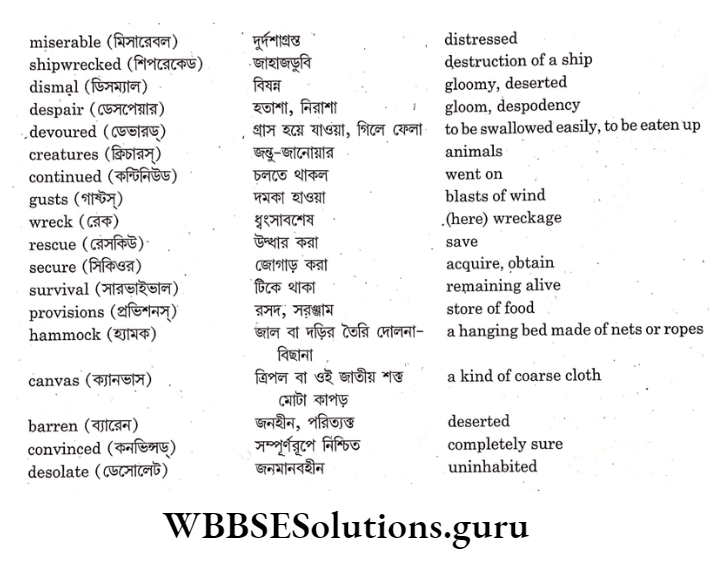

Section:2:(I searched long……….Knife for everyday)
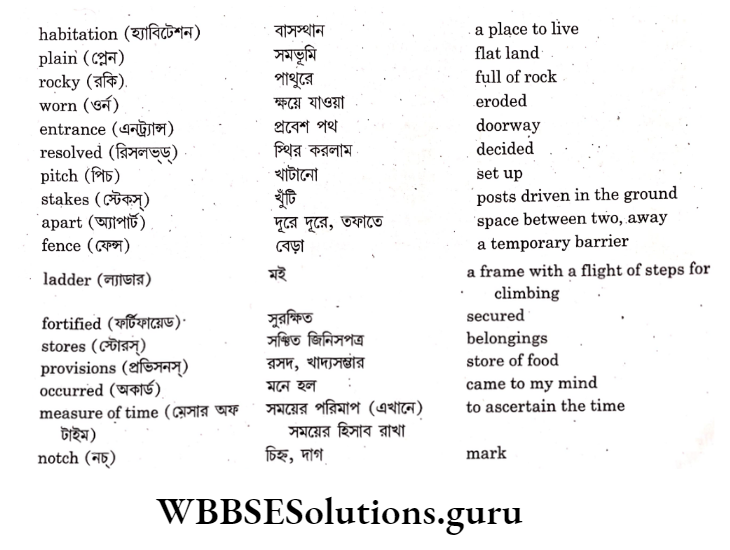
Section:3:(After a long spell of rain…………………the day before.)
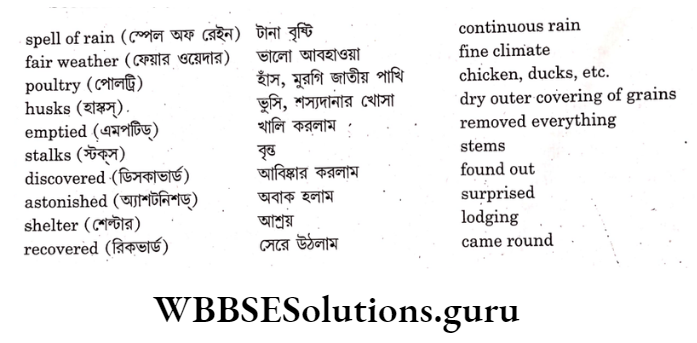
Section:4:(On 15th of July……………..days on this island)
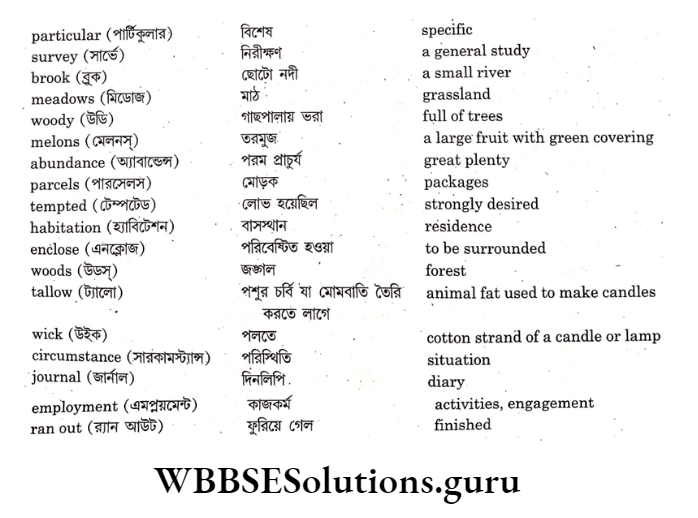
Summary: This is the story of Robinson Crusoe, a sailor, who was caught.. a violent storm and was shipwrecked.
He landed on a desolate island and tried to adjust himself to utter loneliness on the island being sure that he will have to live there for the rest of his life.
Read And Learn More WBBSE Class 9 English Reading Skill
He collected some wood, cable, strings, nails, food, gun, etc., and some tent materials from the wrecked ship. He built a tent with fencing all around to have a safe habitation.
He collected juicy fruits, and freshwater from the nearby flat green area beside a small river, and made a lamp using a tallow, clay pot, and a wick.
He started counting his days by marking a notch every day on a post with a knife.
Looking forward to getting rescued someday by a passing vessel, he spent a whole year on the unknown, desolate island.
Lesson 11 A Shipwrecked Sailor Textual Questions With Answers
Tick the correct answer from the given alternatives
Question 1. Robinson Crusoe was shipwrecked in-
- 1659
- 1559
- 1359
- 1959
Answer: 1. 1659
Question 2. Robinson Crusoe used canvas to make a-
- Bed
- Sail
- Tent
- Curtain
Answer: 3. Tent
Question 3. The distance between the stakes robinson crusoe drove into the ground was-
- Five inches
- Seven inches
- Four inches
- Six inches
Answer: 4. Four inches
Question 4. Crusoe saw some fair weather in the month of
- December
- November
- September
- October
Answer: 2. November
Question 5. The journey homeward with the fruit parcel took Crusoe-
- Five days
- Ten days
- Three days
- Four days
Answer: Three days
Answer the following questions within fifteen words:
Question 1. What name did Crusoe give to the dismal island?
Answer: Crusoe named the dismal island where he got shelter after the shipwreck the Island
of Despair.
Question 2. Where did he pitch the tent?
Answer: He pitched the tent on a flat green land, just before a hollow of a rising hill.
Question 3. How did Crusoe go over the fence?
Answer: Crusoe used a short ladder to go over the fence.
Question 4. Why did he keep a journal?
Answer: He kept a journal to keep records of his everyday activities and engagements.
Answer the following questions within twenty-five words:
Question 1. What were the items Robinson Crusoe’ collected from the wrecked ship?
Answer: From the wrecked ship Robinson Crusoe collected some wood, cable, string, a knife, nails, and a gun. He also collected a hammock, some canvas, some ink, paper, and some money too.
Question 2. How did Crusoe keep track of the number of days he spent on the island?
Answer: Crusoe used to keep track of the number of days he spent on the island by cutting a mark every day on a large post with his knife.
Question 3. In what way did Crusoe make himself a lamp?
Answer: Crusoe collected a little tallow and a small clay dish to which he added a wick. In this way, he made a lamp for himself.
Underline the adverbs and state their kinds
Question 1. It is too hot today.
Answer: too-Adverb of Degree; today-Adverb of Time.
Question 2. The girl seldom visits my house.
Answer: seldom-Adverb of Frequency.
Question 3. He searched everywhere for the book.
Answer: everywhere-Adverb of place.
Question 4. The boy runs fast.
Answer: fast-Adverb of Manner.
Underline the clauses in the following sentences and state what kind of clauses they are:
Question 1. She asked me what my name was.
Answer:
- what my name was Subordinate Noun clause.
- She asked me-Principal clause
Question 2. He is a friend who has always helped me.
Answer:
- He is a friend-Principal clause.
- who has always helped me-Subordinate the Adjective (or, Relative) clause?
Question 3. Please enter the room when you are asked to.
Answer:
- Please enter the room-Principal clause.
- when you are asked to-Subordinate Adverbial clause.
Question 4. That he will win is known to us.
Answer:
- (It) is known to us-Principal clause.
- That he will win-Subordinate Noun clause.
Identify the following sentences as simple, complex, and compound
Question 1. They predicted that it would rain.
Answer: Complex sentence.
Question 2. The weather was fine, and the children went out to play.
Answer: Simple sentence
Question 3. Ravi woke up early but he could not reach school on time.
Answer: Compound sentence.
Question 4. After finishing his work, my father returned home.
Answer: Simple sentence
Do as directed:
Question 1. Tatar hoped to do well in the examination. (change into a complex sentence)
Answer: From the wrecked ship Robinson Crusoe collected some wood, cable, string, a knife, nails, and a gun. He also collected a hammock, some canvas, some ink, paper, and some money too.
Question 2. The Headmistress arrived and the meeting began. (change into a complex sentence)
Answer: Crusoe used to keep track of the number of days he spent on the island by cutting a mark every day on a large post with his knife.
Question 3. Ayesha was surprised when she heard the news. (change into a simple sentence)
Answer: Crusoe collected a little tallow and a small clay dish in which he added a wick. In this way, he made a lamp for himself.
You must work hard to be successful in life. (change into a compound sentence)
Underline the adverbs and state their kinds:
Question 1. It is too hot today.
Answer: too-Adverb of Degree; today-Adverb of Time.
Question 2. The girl seldom visits my house.
Answer: seldom-Adverb of Frequency.Answer: seldom-Adverb of Frequency.
Question 3. He searched everywhere for the book.
Answer: everywhere-Adverb of place.
Question 4. The boy runs fast.
Answer: fast-Adverb of Manner.
Underline the clauses in the following sentences and state what kind of clauses they are:
Question 1. She asked me what my name was.
Answer:
- She asked me-Principal clause
- what my name was-Subordinate Noun clause.
Question 2. He is a friend who has always helped me.
Answer:
- He is a friend-Principal clause.
- who has always helped me-Subordinate the Adjective (or, Relative) clause?
Question 3. Please enter the room when you are asked to.
Answer:
- Please enter the room-Principal clause.
- when you are asked to-Subordinate Adverbial clause.
Question 4. That he will win is known to us.
Answer:
- (It) is known to us-Principal clause.
- That he will win-Subordinate Noun clause.
Identify the following sentences as simple, complex, and compound:
Question 1. They predicted that it would rain.
Answer: Complex sentence.
Question 2. The weather was fine, the children went out to play.
Answer: Simple sentence
Question 3. Ravi woke up early but he could not reach school on time.
Answer: Compound sentence.
Questions 4. After finishing his work, my father returned home.
Answer: Simple sentence
Do as directed:
Question 1. Tatar hoped to do well in the examination. (change into a complex sentence)
Answer: Tatar hoped that he would do well in the examination.
Question 2. The Headmistress arrived and the meeting began. (change into a complex sentence)
Answer: When the Headmistress arrived, the meeting began.
Question 3. Ayesha was surprised when she heard the news. (change into a simple sentence)
Answer: Hearing the news Ayesha was surprised.
Question 4. You must work hard to be successful in life. (change into a compound sentence)
Answer: You must work hard, otherwise you will not be successful in life.
Lesson 11 A Shipwrecked Sailor Examples Worked Out
1. On September 30, 1659, I, miserable Robinson Crusoe, being shipwrecked during a violent storm, came on shore on this dismal island.
I call it the Island of Despair. I was almost dead and the rest of my ship’s company was drowned.
I had neither food, house nor clothes. I feared I would be devoured by wild beasts. When night came, I slept in a tree for fear of wild creatures. It rained all night.
The rain continued through the next day with gusts of wind. Only a wreck of my ship was to be seen at low water.
I swam to the wreck to rescue and secure for my survival some food and other provisions.
I was able to collect some wood, cable, string, a knife, nails, and a gun.
I also collected a hammock and some canvas with which I made a tent. I got some ink and paper.
I also found some money, but they were useless to me on this barren island. I was some hundred leagues out of the ordinary course of the trade of mankind.
I was convinced I had to spend the rest of my life alone on this wild, desolate island.
Read the above text and answer the following questions.
Tick the correct answer from the given alternatives:
Question 1. The reason for the shipwreck robinson crusoe suffered from was-
- A flood
- A violent storm
- An earthquake
- A naval war
Answer: 2. A violent storm
Question 2. Robinson feared that he would-
- Be eaten up by wild beasts
- Die of hunger
- Die under sea-waves
- Die falling
Answer: 1. Be eaten up by wild beasts
Question 3. After being shipwrecked, Robinson came to a-
- Crowded island
- Deserted island
- Marshy island
- Busy sea shore
Answer: 2. Deserted island
Question 4. In the shipwreck everybody on the ship other than Robinson-
- Was drowned
- Suffered general injury
- Was almost dead
- Continued to stay On board the ship
Answer: 1. Was drowned
Question 5. On the first night, Robinson slept-
- In a cot
- On a tree
- In a cave
- On the wrecked ship
Answer: 2. On a tree
Question 6. Robinson swam to the wreck to-
- Salvage some of his belongings and food
- Find his fellow passengers
- See the condition of the ship
- Stay on the wrecked ship
Answer: 1. Salvage some of his belongings and food
Question 7. The wreck of the ship could be seen-
- In the morning
- In the daytime
- At low water
- At night
Answer: 3. At low water
Question 8. In the barren land, the thing that was useless to Robinson was-
- Wood
- Canvas
- Gun
- Money
Answer: 4. Money
Answer the following questions within fifteen words:
Question 1. When did the shipwreck occur?
Answer: The shipwreck occurred on September 30, 1659.
Question 2. What happened to the ship after it had faced the violent storm?
Answer: After it had faced the violent storm the ship was sunk with all its cargo and men excepting Robinson Crusoe.
Question 3. What did Crusoe have with him when he came on the shore of the dismal island?
Answer: Crusoe had neither food, house nor clothes with him when he came on the shore of the dismal island.
Question 4. Where did Crusoe sleep at night and why?
Answer: Crusoe feared that he would be eaten up by wild beasts and so to avoid them he slept on a tree.
Question 5. Why did he swim to the wrecked ship?
Answer: Crusoe swam to the wreck ship to retrieve some food and other provisions for his survival.
Question 6. How did he make a tent?
Answer: He made a tent with a hammock and some canvas that he had collected from the wreck of the ship.
Question 7. What was he convinced of?
Answer: He was convinced of spending the rest of his life alone on the wild, desolate island.
Answer the following questions within twenty-five words :
Question 1. What happened to Robinson Crusoe during the sea voyage?”
Answer: During the sea voyage, Crusoe’s ship was caught in a violent storm suffering a total shipwreck. Somehow he managed to reach a dismal island all alone and he was almost dead.
Question 2. Why did he call the island the Island of Despair?
Answer: After the shipwreck, he somehow reached the shore of the deserted island all alone. He had no food, shelter, or and clothes no proper environment for living. Finding no hope, he called the island the Island of Despair.
Question 3. Why was the money useless to him?
Answer: Crusoe landed in a barren land without any ordinary course of the trade of mankind. There was nothing to purchase there. So the money was useless to him.
2. On the 15th of July I took a more particular survey of the island. Around two miles up, I found a brook with pleasant meadows by its bank, plain, smooth, and covered by grass.
In a woody part, I found melons in great abundance and grape trees. The grapes were ripe and rich.
Further into the land, I found a great number of cocoa, orange, and lemon trees.
I carried great parcels of fruit homeward and the journey took me three days.
I was tempted to transfer my habitation to this valley of fruits. I did not, because I still hoped to be rescued by some passing ship on the sea.
I did not want to enclose myself in hills and woods. I stayed in view of the sea. Ten months had passed since I had set foot on this island.
Previously I had no lamp after dark. I collected a little tallow and a small clay dish. To this, I added a wick. I had thus made myself a lamp.
I now began to seriously consider the circumstance I was reduced to. I decided to describe my state of affairs in writing.
I began to keep a journal of every day’s employment. I could not include all particulars because gradually I ran out of ink.
I found, by the notches I cast on the post, it was September 30th again. I had spent three hundred and sixty-five days on this island.
Read the above text and answer the following questions.
Tick the correct answer from the given alternatives:
Question 1. After surveying the island Robinson found-
- A small hill two miles up
- A small village one mile away
- A brook two miles up
- A brook five miles away
Answer: 3. A brook two miles up
Question 2. In a woody part of the island, he found
- Melons and grape trees
- Cocoa
- Orange trees
- Lemon trees
Answer: 1. Melons and grape trees
Question 3. On his journey back home, he carried great parcels of—
- Corns
- Fruits
- Wood
- Flowers
Answer: 2. Fruits
Question 4. Robinson was tempted to shift his habitation-
- To the hills
- To the valley of fruits
- Near the brook
- Far away from the sea
Answer: 2. To the valley of fruits
Question 5. Finally, he began to live in the-
- Valley of fruits
- Woods
- View of the sea
- Hills
Answer: 3. Woods
Question 6. To prepare a lamp, he used-
- Oil
- Kerosine
- Animal fat
- Candlestick
Answer: 3. Animal fat
Question 7. To record his daily activities and engagements, he began to keep a-
- Journal
- Notebook
- Sheet of paper
- Wall calendar
Answer: 1. Journal
Answer the following questions within fifteen words:
Question 1. When did Crusoe take a survey of the island?
Answer: Crusoe took a more particular survey of the island on the 15th of July.
Question 2. Give a description of the brook and its surroundings.
Answer: The brook was two miles up from the seashore with pleasant meadows by its bank, plain, smooth, and covered by grass.
Question 3. Name the fruits that were found on the island.
Answer: Fruits like melon, grapes, oranges, and lemons were found on the island.
Question 4. How long did Robinson take to reach home?
Answer: Robinson took three days to reach home after completing his survey of the island and going around the fruit orchids.
Question 5. What things were collected by Robinson to make a lamp?
Answer: Robinson collected a little tallow, a small clay dish, and a wick to make a lamp.
Question 6. Where did Robinson keep the record of his activities on the island?
Answer: Robinson kept a record of his activities on the island in a journal.
Question 7. Why could not Crusoe write all particulars in his journal?
Answer: Crusoe could not write all particulars in the journal because gradually he ran out of ink.
Question 8. How did he know that his one-year stay on the island had been completed?
Answer: Looking at the notches he had cast on the post, he concluded that it was September 30th again and his one-year stay on the island had been completed.
Answer the following questions within twenty-five words:
Question 1. What did Crusoe find in his more particular survey of the island?
Answer: During his survey of the island Crusoe found a brook with pleasant meadows by its bank, plain, smooth, and covered by grass. He also found melons and grapes in a woody part. Further into the land, he found a great number of cocoa, orange, and lemon trees.
Question 2. Why did he not ultimately transfer his habitation?
Answer: Crusoe did not transfer his habitation because the disliked enclosing himself in hills and woods. Besides, he still hoped to be rescued by some passing ship on the sea. So he wanted to stay close to the sea.