
WBBSE Chapter 6 The Second World War And Its Aftermath Syllabus
Fascism and Nazism versus Democratic ideals; Outbreak of the Second World War; Locating the main theatres of conflict chronologically with the aid of maps; Discussion on the course of the Second World War using timelines; Struggle between Soviet Russia and Germany.
USA and the Second World War; the impact of Second World War on contemporary World history; Technological changes in war weaponry; Second World War as a truly “global” war; The qualitative and quantitative changes in the destructiveness of war; Aggressive Nationalism versus Internationalism.
Did you know? : Anglo-French policy of appeasement; Rome-Berlin-Tokyo axis; Battle of Leningard; The Pearl harbour incident; Hiroshima-Nagasaki.(Contemporary paintings, newspaper reports and cartoons, maps, photographs etc.
WBBSE Solutions For Class 9 Fundamentals Of History
Maps of Europe (in 1939 and 1945), Map on the Second World War locating areas of expansion and its years and dates; Timeline of relevant issues; Comparative diagrams and statistical data related to the expansion and impact of the two World Wars).
WBBSE Chapter 6 The Second World War And Its Aftermath Synopsis
1. Democracy versus Dictatorship :
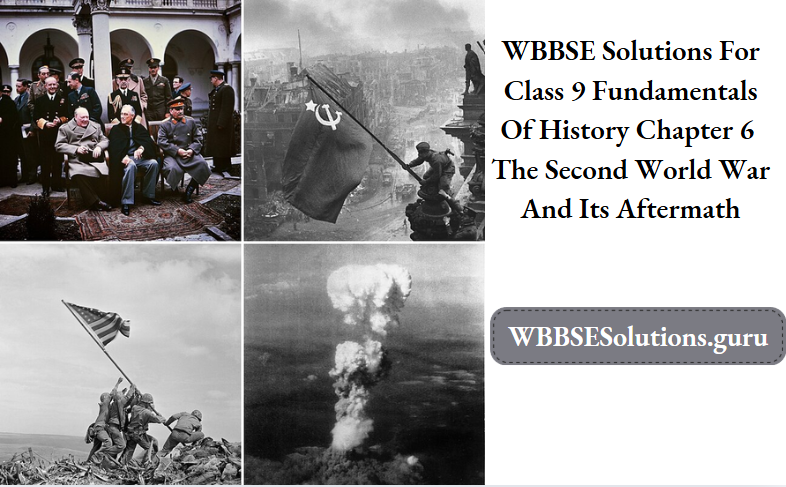
The Second World War that took place between 1939 and 1945 was in many ways a continuation, after an uneasy 20 years hiatus, of the disputes left unsettled by First World War.
It was a global war that involved the majority of the countries of the world -including the great powers -leading to the formation of two opposing military alliances, namely the Axis Powers and the Allied Powers.
It was also a fight between two political ideologies -Dictatorship and Democracy. The principal belligerents were Germany, Italy and Japan forming the Axis Powers and England, Soviet Union, United States of America, France and China forming the Allied Powers.
2. Causes of Second World War :
The immediate cause of the outbreak of the Second World War was Germany’s attack on Poland on 1st September 1939 and the subsequent declaration of the war against Germany by Britain and France.
Despite the pacifist attempts that were made after the First World War, its aftermath caused revanchist nationalism in many European states and it was most significantly observed in the case of Germany.
The humiliating Treaty of Versailles that tried to undermine her military power and cripple her economy made her look forward for an opportunity to avenge her defeat. Hence it is said that ‘The Treaty of Versailles sowed the seeds of the Second World War’.
The Weimar Republic that was formed in Germany after the First World War was weak and it failed to resolve the issues that arose, like the heavy burden of compensation that was imposed upon Germany by the Treaty of Versailles.
As a result inflation, unemployment problems, and heavy taxation became the pressing issues of the hour. It was at this time, Hitler with his fine oratory and shrewd political skill exploited the discontent of his countrymen.
Another crucial event of the period was the Great Depression of 1929 which largely contributed to the rise of Nazism under Adolf Hitler in Germany.
Italy who was on the winning side during the First World War was unable to reap many advantages from it and in the period between 1922 to 1925.
The Fascist movement led by Benito Mussolini in Italy abolished democracy, socialism, and liberalism and followed an aggressive expansionist policy with the aim of making Italy a world power.
In the meantime, Hitler became the Chancellor of Germany in 1933 abolished democracy and adopted radical and racially motivated movements in order to reverse the order of the world.
He secured Germany economically and politically and rejected the Treaty of Versailles (1919). He reorganized the German army, violated the conditions of the Treaty of Versailles, embarked upon an aggressive policy towards the neighbouring countries, broke treaties and promises, annexed Austria, annexed Czechoslovakia and went ahead to form the Rome-Berlin-Tokyo Axis in order to disturb the Balance of Power.
The Western democracies like Britain and France were alarmed by the rise of communism and its influence in Eastern Europe and followed a policy of Appeasement.
They remained inactive even at the time when Germany, Italy, and Japan the Axis powers violated the Treaty of Versailles or on important events like German militarization, the annexation of Austria and seizing of the Rhineland by Hitler.
They wanted to avert another war by taking such a stance and even went to the extent of signing the Munich Agreement. Similar policies were adopted against Japan’s occupation of Manchuria and Italy’s annexation of Abyssinia.
3. The outbreak of the Second World War :
The Second World War ensued with the attack of Germany on Poland.
Initially, Germany was gaining success but the turn of events started with Germany’s disastrous Russian campaign which marked the ‘Beginning of the end’ for Nazi Germany.
At the beginning of the war USA maintained a neutral position, But the rise of Fascism and Nazism, the growing influence of Japan the failure of the Disarmament Conference alarmed USA.
The USA amended its Neutrality Policy in 1939 and adopted the ‘Cash and Carry’ policy to help the Allies.
In the meantime, the US President Franklin D. Roosevelt further adopted the Good Neighbour policy, signed a defence treaty with Canada, made military training compulsory for American youths (age 21 to 31) and built military garrisons on Bermuda and Newfoundland. In 1941 the US Senate passed the ‘Lend -Lease Act’ which turned America into the ‘Arsenal of Democracy’.
USA also declared a ‘Shoot -at -Sight’ order on German submarines and warships as German submarines attacked her merchant navy. Thus it was an undeclared war like situation between USA and Germany by the end of 1941.
4. Collapse of the Axis powers :
However, it was Japan’s attack on the US naval base in Pearl Harbour on 7th December 1941 that made USA give up her position of isolation and she declared war on Japan on 8th December 1941. America’s entry into the war on the side of the Allies changed the fate of the war and the win for the Allies became easier.
The fall of Italy deteriorated the condition of the Axis Powers which suffered more after the Operation Overlord in June 1944.
The combined attack by the Red Army and the Anglo-French military force cornered Germany from both the Eastern and the Western Fronts.
With the suicide of Hitler on April 1945, Germany had no other option but to sign the Instrument of Surrender on May 7th 1945.
The Allies now wanted Japan to surrender but Japan paid no heed to that and consequently faced the severe and devastating impact of the atomic bombs that were dropped by USA on her cities of Hiroshima and Nagasaki.
This forced Japan to surrender and sign the Instrument of Surrender on 2nd September 1945, marking the end of the Second World War.
At the end of the war millions of people died, millions became homeless, the European economy declined and the war saw the use of many deadly weapons including the atomic bombs which were extremely destructive.
It was one of the deadliest wars that was ever fought in the world. Soviet Union also was heavily affected by the war.
5. Impact of the Second World War:
The end of the war saw the beginning of a new era -the gradual decline of the European colonial empires and rise of two Super Powers- the Soviet Union and the United States of America. The ideological conflicts between Communist Soviet Union and the Capitalist USA ushered in the period of Cold War.
European politics was then led by the two, one of whom had never been considered as a European nation though it was within Europe itself, and the other who is not even a country of Europe.
Europe got divided into two Blocs – the US-led Western Bloc and a Soviet-led Eastern Bloc. Some nations stayed out of the Cold War through the Non-Aligned Movement.
As a result of the war the Allies formed the United Nations Organization on October 1945 with the view of settling global issues through peaceful negotiations.
The end of the war also increased the rate of colonization from the great powers and Vietnam and others became independent over countries like India, Sri Lanka, and Indonesia, over the years.
WBBSE Chapter 6 The Second World War And Its Aftermath Important Words With Their Meanings
1. Appeasement
The action or process of appeasing.
2. Pact
A formal agreement between individuals or parties.
3. Neutrality
Impartiality.
4. Aggressive
Ready or likely to attack or confront, characterized by or resulting from aggression.
5. Indemnity
Security or protection against a loss or other financial burden.
6. Qualitative
Relating to, measuring, or measured by the quality of something rather than its quantity.
7. Quantitative
Relating to, measuring or measured by the quantity of something rather than its quality.
8. Destructive
Causing great or irreparable damage.
9. Nuclear weapons
A bomb or missile that uses nuclear energy to cause an explosion.
10. Deliverance
The action of being rescued or set free.
WBBSE Chapter 6 The Second World War And Its Aftermath Names Of Some Important Person
| 1. Adolf Hitler | The Dictator or Nazi Leader of Germany |
| 2. Benito Mussolini | The Dictator or Fascist Leader of Italy |
| 3. General Franco | The Military Dictator of Spain |
| 4. Neville Chamberlain | Prime Minister of England |
| 5. Winston Churchill | Prime Minister of England |
| 6. Clement Attlee | Prime Minister of England |
| 7. Edouard Daladier | Prime Minister of France |
| 8. Paul Reynaud | Prime Minister of France |
| 9. Philippe Petain | Prime Minister of France |
| 10. Charles de Gaulle | Provisional President of France, architect of France’s Fifth Republic |
| 11. Haile Selassie | Emperor of Ethiopia |
| 12. Hideki Tojo | Prime Minister of Japan |
| 13. Franklin D. Roosevelt | President of USA |
| 14. Harry S. Truman | President of USA |
| 15. Dwight D. Eisenhower | Allied Supreme Commander and later President of USA |
| 16. George Marshall | US Secretary of State |
| 17. J. R. Oppenheimer | Father of the atomic bombs |
| 18. Douglas MacArthur | US Military General |
| 19. Hirohito | Emperor of Japan |
| 20. Joseph Stalin | General Secretary of the Communist Party of the Soviet Union and the premier of the Soviet Union. |
WBBSE Chapter 6 The Second World War And Its Aftermath Some Important Facts
1. Molotov Cocktail
A breakable glass bottle containing a flammable substance such as Petrol, alcohol, napalm-like mixture, with some motor oil added with usually a source of ignition such as a burning cloth wick held in place by the bottle’s stopper is called a ” Molotov Cocktail “.
The name “Molotov Cocktail” was coined by the Finnish during the Winter War.
The name was a derogatory reference to the Soviet Foreign Minister Vyacheslav Molotov who was one of the architects of the Molotov-Ribbentrop Pact signed between Russia and Germany in the year 1939.
The ” Molotov Cocktail ” (often referred to as the Petrol Bomb ) was widely used by both the Allied and the Axis powers mainly against tanks of each side.
It came to be known as a crude but very effective weapon during the 2nd World War.
2. Dunkirk Evacuation –
Operation Dynamo also known as the “Dunkirk Evacuation” and the “Miracle of Dunkirk” was the evacuation of Allied soldiers from the beaches and harbours of Dunkirk, North of France between 26th May and 4th June 1940.
During the six-week Battle of France, a large number of Belgian, British and French troops were cut off and surrounded by the German Troops on the beaches of Dunkirk.
3. Kamikaze – the Divine Wind
In the closing stages of the Pacific Campaign during the 2nd World War the Japanese unleashed the Kamikaze or Suicide attacks on US and Allied Naval forces.
Kamikaze aircrafts were pilot-guided explosive missiles and the pilots would attempt to crash their aircraft deliberately into Allied ships, especially aircraft carriers.
Japan was suffering from a diminishing capacity of war and they were losing pilots faster than they could replace. This led to the Kamikaze attacks as Allied forces advanced towards the Japanese mainland.
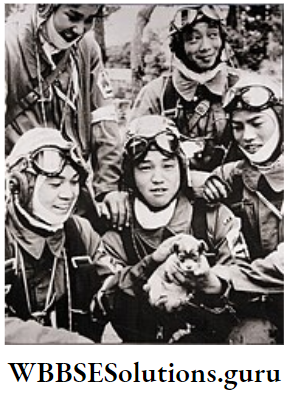
About 3,800 Kamikaze pilots died during the war with more than 7,000 naval personnel dead from such attacks. Over an eight-day period, 3,38,226 soldiers were rescued by a hastily assembled fleet of over 800 vessels.
Little ships of Dunkirk, a flotilla of hundreds of merchant marine boats, fishing boats, pleasure crafts, yachts, and lifeboats came to the rescue.
British Prime Minister Winston Churchill called this incident a “colossal military disaster” and “a miracle of deliverance”
4. Chindits
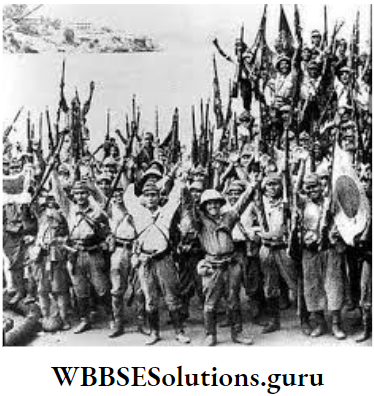
The Long Range Penetration Group, special operations units of the British and Indian Armies were nicknamed the Chindits. The Chindits were the creation of Brigadier Orde Charles Windgate.
They saw action during the Burma Campaign of the 2nd World War during 1943-44.
The Chindits performed long-range penetration raids behind enemy lines attacking Japanese troops, facilities and lines of communication.
They had to march through extremely difficult terrain and were often weakened by malaria and dysentery.
There is much debate as to the high casualty rate compared to the military value of the achievements of the Chindits.
5. SAS ( Special Air Service )
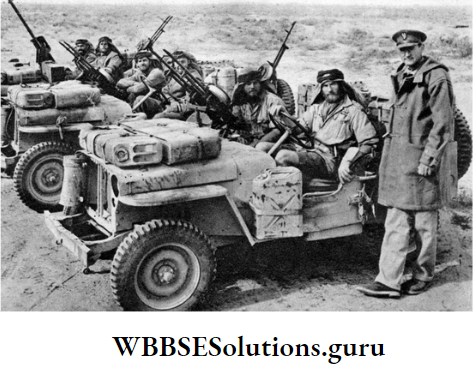
The Special Air Service was a British Army Commando unit formed by David Stirling in 1941 originally known as the “L Detachment”.
The unit achieved great success in operating behind enemy lines during the North Africa Campaign against the Germans and the Italians.
Assisted by the Long Range Desert Groups they created havoc amongst the Germans and were successful in attacking and destroying several German aircraft, men and machinery.
They also fought in Italy and carried out operations supporting the Allied advance into France, Belgium, the Netherlands and eventually into
Germany on the Western front. The success of the SAS led other countries in the world to create such Special forces and the SAS still counts as one of most efficient Special forces in the world.
WBBSE Chapter 6 The Second World War And Its Aftermath Fill In The Blanks
Question 1. Immediately after the First World War, it appeared that an age of _________ had dawned
- Democracy
- Socialism
- Capitalism
- Communism.
Answer: 1. Democracy
Question 2. In 1920 most of the European nations except _______ were democratic
- England
- Russia
- Belgium
- France
Answer: 2. Russia
Question 3. _________ was one of the features of Fascism.
- Liberalism
- Democracy
- Nationalism
- Equality
Answer: 3. Nationalism
Question 4. The German invasion of _______ marked the beginning of the Second World War.
- Austria
- Russia
- France
- Poland
Answer: 4. Poland
Question 5. ________ the US President, mentioned in his ‘Fourteen Point Principle’ the right to self-rule.
- Woodrow Wilson
- H.C Hoover
- F.D Roosevelt
- Richard Nixon
Answer: 1. Woodrow Wilson
Question 6. The New Deal Policy was announced by the US President ________.
- Woodrow Wilson
- H.C Hoover
- F.D Roosevelt
- Richard Nixon
Answer: 3. F.D Roosevelt
Question 7. Italy joined Germany and Japan on ________, 1937 and the Rome-Berlin —Tokyo-Axis was formed
- 6th November
- 7th November
- 8th November
- 9th November
Answer: 1. 6th November
Question 8. Adolf Hitler invaded Denmark and Norway in ________.
- 1939
- 1940
- 1941
- 1942
Answer: 2. 1940
Question 9. Adolf Hitler made a simultaneous attack on Holland, Belgium and Luxemburg on ________.
- 1940
- 1941
- 1942
- 1943
Answer: 1. 1940
Question 10. Winston Churchill signed the Anglo-Soviet Agreement on ________.
- 1937
- 1939
- 1941
- 1943
Answer: 3. 1941
Question 11. The ‘Scorched Earth Policy’ was adopted by _________.
- Italy
- Hungary
- Germany
- Russia
Answer: 4. Russia
Question 12. ________ attacked the US naval base in Pearl Harbour on 7th December 1941.
- Japan
- Hungary
- Italy
- Germany.
Answer: 1. Japan
Question 13. The atomic bomb dropped at Nagasaki killed _____ civilians.
- 20,000
- 30,000
- 40,000
- 50,000
Answer: 3. 40,000
Question 14. The Second World War continued for a period of _______ years.
- 3
- 4
- 5
- 6
Answer: 4. 6
Question 15. The ideological conflict between the capitalist power USA and the Socialist power USSR is known as the ______.
- Phony War
- Blitzkrieg
- Cold War
- World War
Answer: 3. Cold War
Question 16. The Second World War officially ended on _______.
- 8th May 1945
- 18th May 1945
- 25th May 1945
- 31st May 1945
Answer: 1. 8th May 1945
Question 17. ________ pointed out that ‘the Second World War was a good war’.
- Eric Hobsbawm
- E. H. Carr
- A.J.P. Taylor
- David Thomson
Answer: 3. A.J.P. Taylor
Question 18. In 1934, Adolf Hitler took the title of _________.
- Kaiser
- II Duce
- Fuhrer
- Czar
Answer: 3. Fuhrer
Question 19. Hideki Tojo was the Prime Minister of _________.
- Poland
- Hungary
- Czechoslovakia
- Japan
Answer: 4. Japan
Question 20. Maginot Line was built in _________.
- Spain
- France
- Japan
- Poland
Answer: 2. France
Question 21. Haile Selassie was the emperor of _________.
- Spain
- Ethiopia
- Syria
- Poland
Answer: 2. Ethiopia
Question 22. The atom bomb named _________ was dropped at Nagasaki.
- Little Girl
- Little Boy
- Fat Man
- Fat Woman
Answer: 3. Fat Man
Question 23. The atom bomb named _________ was dropped at Hiroshima
- Little Girl
- Little Boy
- Fat Man
- Fat Woman
Answer: 2. Little Boy
Question 24. Albert Einstein was a _______.
- Christian
- Zoroastrian
- Jew
- Muslim
Answer: 3. Jew
Question 25. The Munich Pact was signed between the leaders of ________ nations.
- 2
- 4
- 6
- 8
Answer: 2. 4
WBBSE Chapter 6 The Second World War And Its Aftermath Identify Which Of The Following Is “True” Or “False”
Question 1. The Second World War broke out on 1st September 1939.
Answer: True
Question 2. Around 50 million people died and nearly 40 million people were wounded in the Second World War.
Answer: True
Question 3. In 1920, Russia was the only democratic state in Europe.
Answer: False
Question 4. The Treaty of Versailles is regarded as one of the reasons for the Second World War.
Answer: True
Question 5. Democracy never allowed any mutual regard and compromise.
Answer: False
Question 6. Aggressive nationalism is one of the features of Fascism.
Answer: True
Question 7. Appeasement was a form of foreign policy that tried to avoid war.
Answer: True
Question 8. In 1939, Hitler occupied the whole of Czechoslovakia.
Answer: True
Question 9. In 1930, the Munich Pact was signed.
Answer: False
Question 10. Adolf Hitler was the ‘Father of Nazism’
Answer: True
Question 11. Benito Mussolini was the ‘Father of Fascism’.
Answer: True
Question 12. Daladier was the Foreign Secretary of Italy.
Answer: False
Question 13. The Anglo-French policy of appeasement failed to prevent war.
Answer: True
Question 14. E.H. Carr called the Treaty of Versailles a ‘dictated peace’.
Answer: True
Question 15. Kaiser William II was known as the third Bismarck of Germany.
Answer: False
Question 16. Woodrow Wilson mentioned the right to self¬rule in his ‘Fourteen Points Principle’.
Answer: True
Question 17. The Allies signed the Munich Agreement in matters regarding Czechoslovakia.
Answer: True
Question 18. In 1939, the Rome-Berlin-Tokyo axis was formed.
Answer: False
Question 19. On November 25th 1936, Germany and Japan concluded the Anti-Comintern Pact.
Answer: True
Question 20. The first instance of Anglo-French appeasement was the Anschluss.
Answer: True
Question 21. Neville Chamberlain was the Prime Minister of Britain.
Answer: True
Question 22. Hitler signed the ‘Ten-Year Non-Agression Pact’ with Italy.
Answer: False
Question 23. Russia occupied Finland on 30th November 1939.
Answer: True
Question 24. Hitler attacked Holland, Belgium and Luxemburg on 10th May 1940.
Answer: True
Question 25. Paul Reynaud was the Prime Minister of France.
Answer: True
Question 26. Japan attacked Manchuria in 1929.
Answer: False
Question 27. Hitler followed the policy of Pan-Germanism.
Answer: True
Question 28. One of the central principles of Fascism was economic self-sufficiency.
Answer: True
Question 29. The government of Marshal Petain was known as the Vichy Government.
Answer: True
Question 30. On 15th August 1943, nearly a thousand Luftwaffe launched a series of raids on England.
Answer: True
Question 31. The Anglo-Soviet Treaty was signed in 1939.
Answer: False
Question 32. Hitler called his invasion of Russia, ‘Operation Sea Lion’.
Answer: False
Question 33. The ‘Lend-Lease Act’ was passed by the U.S. Senate.
Answer: True
Question 34. From 1st October 1941 to 1st July 1942 USA sent 400 aeroplanes to Russia.
Answer: True
Question 35. The Russian Red Army was led by Martial Voroshilov during the Second World War.
Answer: True
Question 36. In 1941, Pearl Harbour was attacked by Russia.
Answer: False
Question 37. USA entered the Second World War in 1941.
Answer: True
Question 38. Hideki Tojo was the Prime Minister of Japan.
Answer: True
Question 39. The Anglo-American force landed on the coast of Normandy on the ‘D-Day’.
Answer: True
Question 40. In August 1945, Mussolini was shot and killed.
Answer: False
Question 41. Hitler married Eva Braun.
Answer: True
Question 42. Only 36 hours after his wedding Hitler committed suicide.
Answer: True
Question 43. The USA dropped an atomic bomb on Hiroshima.
Answer: True
Question 44. The Battle of Leningrad is also known as the Seize of Leningrad.
Answer: True
Question 45. Pearl Harbour was in Japan.
Answer: False
Question 46. The Second World War is regarded as a really ‘global war’.
Answer: True
Question 47. The United Nations Organization helped in the growth of internationalism.
Answer: True
Question 48. The growth of international terrorism in the present world is a danger to the spirit of internationalism.
Answer: True
Question 49. The colonial empires of Britain and France disappeared after the Second World War.
Answer: True
Question 50. Japan surrendered on 2nd September 1945.
Answer: True
WBBSE Chapter 6 The Second World War And Its Aftermath Match Column A With Column B
Question 1.
| 1. A | B |
| (1) Stalin | (a) Germany |
| (2) Daladier | (b) Italy |
| (3) Mussolini | (c) Russia |
| (4) Hitler | (d) France |
Answer: (1) c, (2) d, (3) b, (4) a
Question 2.
| 2. A | B |
| (1) Abraham Lincoln | (a) Religious reformer |
| (2) Swami Vivekananda | (b) Jewish Scientist |
| (3) Albert Einstein | (c) Fascist Leader |
| (4) Benito Mussolini | (d) President of USA |
Answer: (1) d, (2) a, (3) b, (4) c
Question 3.
| 3. A | B |
| (1) Charles de Gaulle | (a) Japan |
| (2) Hideki Tojo | (b) USA |
| (3) F.D.Roosevelt | (c) England |
| (4) Winston Churchill | (d) France |
Answer: (1) d, (2) a, (3) b, (4) c
Question 4.
| 4. A | B |
| (1) Italy | (a) Imperialism |
| (2) Russia | (b) Fascism |
| (3) Germany | (c) Socialism |
| (4) Japan | (d) Nazism |
Answer: (1) b, (2) c, (3) d, (4) a
Question 5.
| 5. A | B |
| (1) Franz Joseph I | (a) Emperor of Ethiopia |
| (2) MehmedV | (b) Czar of Bulgaria |
| (3) Haile Selassie | (c) Emperor of Austria |
| (4) Ferdinand I | (d) Sultan of Turkey |
Answer: (1) c, (2) d, (3) a, (4) b
Question 6.
| 6. A | B |
| (1) Neville Chamberlin | (a) Russia |
| (2) Harry S. Truman | (b) France |
| (3) Edouard Daladier | (c) England |
| (4) Marshal Voroshilov | (d) USA |
Answer: (1) c, (2) d, (3) b, (4) a
Question 7.
| 7. A | B |
| (1) Cash and Carry | (a) Germany |
| (2) Vichy Government | (b) Russia |
| (3) Scorched Earth Policy | (c) USA |
| (4) Reich | (d) France |
Answer: (1) c, (2) d, (3) b, (4) a
Question 8.
| 8. A | B |
| (1) Anton Drexler | (a) Democratic Party |
| (2) Franklin D. Roosevelt | (b) German Socialist party |
| (3) Winston Churchill | (c) Nationalist Party |
| (4) General Franco | (d) Conservative party |
Answer: (1) b, (2) a, (3) d, (4) c
Question 9.
| 9. A | B |
| (1) 1919 | (a) Disarmament Conference |
| (2) 1933 | (b) Atom Bomb Dropped |
| (3) 1945 | (c) Pearl Harbour Incident |
| (4) 1941 | (d) Paris Peace Conference |
Answer: (1) d, (2) a, (3) b, (4) c
Question 10.
| 10. A | B |
| (1) Hirohito | (a) Hitler’s wife |
| (2) Eva Braun | (b) Chancellor of Austria |
| (3) Arthur Seyss | (c) Supreme Allied Commander |
| (4) General Eisenhower | (d) Empoeorof Japan |
Answer: (1) d, (2) a, (3) b, (4) c
Question 11.
| 11. A | B |
| (1) Truman Doctrine | (a) 1945 |
| (2) Battle of Midday | (b) 1947 |
| (3) Potsdam Conference | (c) 1944 |
| (4) Deliverance Day | (d) 1942 |
Answer: (1) b, (2) d, (3) a, (4) c
Question 12.
| 12. A | B |
| (1) Kamikaze | (a) Mass murder of Jewish people |
| (2) Holocaust Organization | (b) International Peace |
| (3) UNO | (c) World Health Organization |
| (4) WHO | (d) Japanese aircraft |
Answer: (1) d, (2) a, (3) b, (4) c
Question 13.
| 13. A | B |
| (1) 1940 | (a) Atom bomb dropped |
| (2) 1943 | (b) Deliverance Day |
| (3) 1944 | (c) Italy invaded by Allied Powers |
| (4) 1945 | (d) Germany occupied France |
Answer: (1) d, (2) c, (3) b, (4) a
Question 14.
| 14. A | B |
| (1) 1939 | (a) Battle of Dunkirk |
| (2) 1940 | (b) US army landed in North Africa |
| (3) 1941 | (c) Outbreak of Second World War |
| (4) 1942 | (d) Pearl Harbour Incident |
Answer: (1) c, (2) a, (3) d, (4) b
Question 15.
| 15. A | B |
| (1) Operation Torch | (a) Russia |
| (2) Operation Barbarossa | (b) USA |
| (3) Operation Overlord | (c) England |
| (4) Operation Sea Lion | (d) Normandy |
Answer: (1) b, (2) a, (3) d, (4) c
Question 16.
| 16. A | B |
| (1) 1937 | (a) Battle of Madagascar |
| (2) 1942 | (b) Battle of Normandy |
| (3) 1938 | (c) Rome Berlin Tokyo Axis |
| (4) 1944 | d) Munich Pact |
Answer: (1) c, (2) a, (3) d, (4) b
Question 17.
| 17. A | B |
| (1) Dictated Peace | (a) Winston Churchill |
| (2) Arsenal of Democracy | (b) E.H. Carr |
| (3) A miracle of Deliverance | (c) Prof. W. Knapp |
| (4) A day of supreme folly for Japan | (d) F.D. Roosevelt |
Answer: (1) b, (2) d, (3) a, (4) c
Question 18.
| 18. A | B |
| (1) General Franco | (a) Germany |
| (2) Marshal Zhukov | (b) France |
| (3) Paul Reynaud | (c) Spain |
| (4) Von Paulus | (d) Russia |
Answer: (1) c, (2) d, (3) b, (4) a
Question 19.
| 19. A | B |
| (1) Fat Man | (a) India |
| (2) First World | (b) Hiroshima |
| (3) Third World | (c) Nagasaki |
| (4) Little Boy | (d) USA |
Answer: (1) c, (2) d, (3) a, (4) b
Question 20.
| 20. A | B |
| (1) Jawaharal Nehru | (a) First atom bomb |
| (2) Robert Oppenheimer | (b) Fourteen Point Programme |
| (3) Woodrow Wilson | (c) Propaganda Minister of Hitler |
| (4) Josef Goebbels | (d) First Prime Minister of India |
Answer: (1) d, (2) a, (3) b, (4) c
WBBSE Chapter 6 The Second World War And Its Aftermath Select The Correct Option Of The Following Statements
Question 1. The Second World War is called a global war.
- Most of the countries in the world were involved in this war.
- It brought about a qualitative change like the war.
- The involvement of Japan in the war made it a global war.
Answer: 1. Most of the countries in the world were involved in this war.
Question 2. Germany invaded Poland on 1st September 1939.
- It was an expansionist policy of Adolf Hitler.
- It was the immediate cause of the Second World War.
- It was a sign of the autarchy of Germany.
Answer: 2. It was the immediate cause of the Second World War.
Question 3. After the First World War, it seemed an age of democracy had dawned in Europe.
- It was because the European nations rejected Communism.
- It was because democracy envisaged the extension of voting rights.
- It was because all the states in Europe were moving towards parliamentary politics.
Answer: 3. It was because all the states in Europe were moving towards parliamentary politics.
Question 4. Twenty years after the First World War most European states were under dictatorship.
- Democracy wanted to strengthen the power of the parliament which was opposed by the people.
- The democratic concept of ‘mutual regard and compromise’ was rejected by the mass
- The rise of extremely charismatic dictators paved the way for the growth of dictatorial rule in Europe.
Answer: 2. The democratic concept of ‘mutual regard and compromise’ was rejected by the mass
Question 5. Mussolini annexed and occupied Abyssinia.
- The people of Abyssinia welcomed Fascist rule.
- Mussolini made special deals with England and France and won a victory in the Second Italo-Ethiopian War.
- It was Mussolini’s protest against the economic sanctions imposed upon her by the League of Nations.
Answer: 2. Mussolini made special deals with England and France and won a victory in the Second Italo-Ethiopian War.
Question 6. Adolf Hitler and Benito Mussolini supported General Franco in the Spanish Civil War.
- Both of them found a Fascist Comrade in General Franco.
- Both of them followed a policy of ‘Appeasement’ with Spain.
- Both of them ignored Britain and France in this way.
Answer: 2. Both of them found a Fascist Comrade in General Franco.
Question 7. Both the Western democracies and the Nazi groups were not in favour of Russia.
- They were against Russia because of her absence from the League of Nations.
- They were against the different political ideology that Russia nurtured called Socialism.
- They were against the Russian Red Army.
Answer: 2. They were against the different political ideology that Russia nurtured called Socialism.
Question 8. The Treaty of Versailles helped in the emergence of the Nazi Party under Adolf Hitler in Germany.
- The Treaty of Versailles reduced the military strength of Germany.
- The Treaty of Versailles was humiliating for Germany.
- The Nazi Party under Hitler vented their anger against the Treaty of Versailles and disregarded the clauses of the treaty one by one.
Answer: 3. The Nazi Party under Hitler vented their anger against the Treaty of Versailles and disregarded the clauses of the treaty one by one.
Question 9. Britain and France adopted a policy of appeasement with Germany.
- Britain and France became weak after the First World War and were not in a position to check the growing power of Germany under Hitler.
- They adopted this policy to avoid a big confrontation.
- They were inspired by the Nazi rule of Adolf Hitler in Germany.
Answer: 1. They adopted this policy to avoid a big confrontation.
Question 10. The Rome-Berlin-Tokyo Axis was formed in 1937.
- The main purpose of the pact was to thwart Russia and Communism.
- They formed this axis to disregard the Treaty of Versailles.
- They formed the axis to sever their connection with the League of Nations.
Answer: 1. The main purpose of the pact was to thwart Russia and Communism.
Question 11. The Anglo-Soviet Agreement was signed in 1941.
- Winston Churchill signed this agreement to avoid any Russo-German alliance.
- By the treaty, it was decided that both England and Russia would Jointly resist Germany.
- By the Treaty Winston Churchill agreed to send warplanes to Russia.
Answer: 2. By the treaty it was decided that both England and Russia would Jointly resist Germany.
Question 12. The ‘Lend-Lease Act was passed by the U.S. Senate.
- By this Act, the USA allowed England to supply food and weapons to her colonies.
- The Act allowed the USA to establish its supremacy in Europe.
- It was a program under which the United States supplied food, oil and other materials to England, France, Soviet Union and other Allied Nations between 1941 to 1945.
Answer: 3. It was a program under which the United States supplied food, oil and other materials to England, France, the Soviet Union and other Allied Nations between 1941 to 1945.
Question 13. The Battle of Stalingrad is a memorable chapter in the history of the Second World War.
- It was the first major German loss during the Second World War.
- The Nazis had great success and captured about 800,000 square kilometres of Russian territory.
- Hitler launched this attack on Russia to destroy her.
Answer: 1. It was the first major German loss during the Second World War.
Question 14. The USA joined the Second World War in 1941.
- The USA joined the war on the side of the Allied due to the repeated insistence of England and France.
- Japan’s bombing of Pearl Harbour prompted her to join the war.
- The interest of the USA in the Far East made her join the war.
Answer: 2. Japan’s bombing of Pearl Harbour prompted her to join the war.
Question 15. The USA dropped atomic bombs on the Japanese cities of Hiroshima and Nagasaki.
- In this way, USA took her revenge for the Pearl Harbour Incident,
- As Japan paid no heed to the Allies’ demand for surrender, the USA dropped atomic bombs in two of her cities.
- In this way, the USA showed its military strength to the rest of the world.
Answer: 2. As Japan paid no heed to the Allies’ demand for surrender, the USA dropped atomic bombs in two of her cities.
Question 16. The Cold War began after the end of the Second World War.
- It saw the division of the world into three categories First World, Second World and Third World.
- It heralded technological and tactical changes in the warfare.
- The ideological conflict between the capitalist USA and communist Russia marked the beginning of the Cold War.
Answer: 3. The ideological conflict between the capitalist USA and communist Russia marked the beginning of the Cold War.
Question 17. 6th June 1944 is regarded as the D-Day.
- On this day the Allies utilized more than 5,000 ships and landing craft to land more than 150,000 troops on five beaches in Normandy.
- It was on this day Mussolini was shot and killed.
- This day ended the Second World War.
Answer: 1. On this day the Allies utilized more than 5,000 ships and landing craft to land more than 150,000 troops on five beaches in Normandy.
Question 18. India, Pakistan, Algeria, and Nigeria emerged as independent countries.
- The Cold War led to the emergence of these independent nations.
- The destruction of the war made European countries like England and France very weak.
- After the Second World War, the colonial empires of Britain and France disappeared.
Answer: 3. After the Second World War the colonial empires of Britain and France disappeared.
Question 19. After 1945 it was clear that the two superpowers would enjoy a great influence on global matters.
- Europe was destined for some years of poverty.
- The Second World War resulted in the emergence of the USA and USSR as major world powers.
- After 1945 the world was relieved from the evils of Fascism.
Answer: 3. The Second World War resulted in the emergence of the USA and USSR as major world powers.
Question 20. The United Nations Organization was formed on 24th October 1945.
- It was formed to end the Second World War.
- It was formed to act as a bulwark against any further progress of aggressive nationalism
- It was formed by world leaders to solve global problems peacefully through negotiations.
Answer: 2. It was formed by world leaders to solve global problems peacefully through negotiations.