
WBBSE Chapter 7 The League Of Nations And The United Nations Organisation Syllabus
Formation and structure of the League of Nations. Nature and structure of the United Nations Organisation; UN Charter.
WBBSE Chapter 7 The League Of Nations And The United Nations Organisation Synopsis
1. Formation of the League of Nations :
The atrocities and devastation of the First World War left an indelible mark on the minds of the common people as well as the leaders of the world who started finding ways to establish peace in the world even before the First World War ended.
US President Woodrow Wilson mentioned the League of Nations in his ‘ Fourteen Points Programme (8th January 1918) and took the initiative of establishing an international organization that would undertake the responsibility of resolving all international disputes peacefully and ensuring global security.
WBBSE Solutions For Class 9 Fundamentals Of History
The League Covenant was officially adopted in 1919 and the first session of the League took place on 10th January 1920. The League of Nations had its headquarters in Geneva.
2. The structure of the League of Nations:
The League of Nations operated through different departments.
The League Assembly
The League Council
A Secretariat
A Permanent Court of International Justice
An International Labour Organization
3. Failure of the League of Nations :
Initially, the League of Nations was able to solve the international issues that arose soon after the First World War but gradually it became weak.
The absence of the USA as a member of the League, her lack of an army, navy or air force, the selfishness of the Big Powers, the rise of dictatorship in the 1930s and certain other factors contributed to the failure of the League of Nations.
Though the League had successfully executed its duties in the social and humanitarian fields for the development of the people across the world it utterly failed to perform its primary duty—of preventing a war and maintaining global peace and security.
The outbreak of the Second World War in 1939 openly showcased the failure of the League Of Nations.
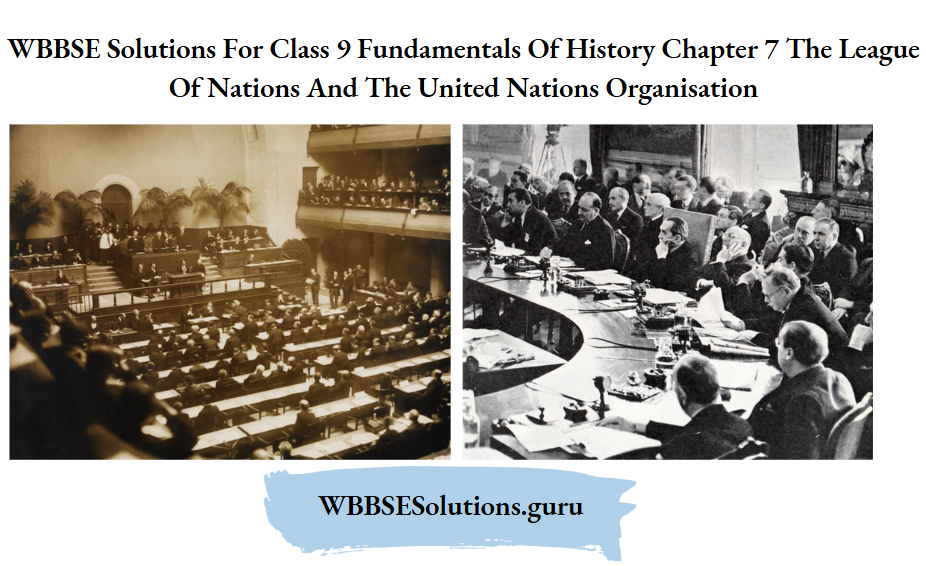
4. Formation of the UNO:
The horrors of the Second World War (1939-45) surpassed the First World War (1914-18) by leaps and bounds and once again the people as well as the leaders felt the need to establish an international peace organization.
Thus on 24th October 1945 at the behest of the USA, the Soviet Union and England formed the United Nations Organization which has its headquarters at New York.
5. Basic Principles of UNO:
According to the UN Charter, the fundamental duties of the organization are –
To remove all possibilities of war and establish peace and security in the world; to reassert faith in the dignity of people and human rights; use of international types of machinery for the social, economic, scientific and cultural development of human beings; to reaffirm in the equal rights of nations and foster proper coordination by the UN among all the member- states who are willing to fulfil these objectives.
6. The structure of UNO:
The United Nations Organization executes its functions through six principal organs.
They are—
The General Assembly
The Security Council
The Economic and Social Council heads 13 organizations like FAO, IMF, WHO etc.
The Trusteeship Council
The International Court of Justice
The Secretariat.
The UNO started with a total number of 51 members in 1945 and today its membership is at 193.
7. The UNO Charter:
The Preamble of the UN Charter depicts its true spirit. The Preamble reads as follows:
We The Peoples Of The United Nations determined
1. To save succeeding generations from the scourge of war, which twice in our lifetime has brought untold sorrow to mankind, and
2. To regain faith in fundamental human rights, in the dignity and worth of the human person, in the equal rights of men and women and of nations large and small, and
3. To establish conditions under which justice and respect for the obligations arising from treaties and other sources of international law can be maintained, and to promote social progress and better standards of life in larger freedom,
And For These Ends
- To practice tolerance and live together in peace with one another as good neighbours, and
- To unite our strength to maintain intematioiiaJ-peace and security, and
- To ensure, by the acceptance of principles and the institution of methods, that armed force shall not be used, save in the common interest, and
- To employ international machinery for the promotion of the economic and social advancement of all peoples,
Have Resolved To Combine Our Efforts To Accomplish These Aims
Accordingly, our respective Governments, through representatives assembled in the city of San Francisco, who have exhibited their full powers found to be in good and due form, have agreed to the present Charter of the United Nations and do hereby establish an international organization to be known as the United Nations.
WBBSE Chapter 7 The League Of Nations And The United Nations Organisation Important Words With Their Meanings
1. Assembly
A group of people gathered together in one place for a common purpose
2. Convened
Come or bring together for a meeting or activity
3. Dispute
A disagreement or argument
4. Recommendation
A suggestion or proposal as to the best course of action, especially one put forward by an authoritative body
5. Covenant
An agreement
6. Global
Worldwide
7. Veto
A constitutional right to reject a decision
8. Violate
Break or fail to comply with ( a rule or formal agreement)
9. Armaments
Military weapons and equipment
10. Preamble
An introductory part of a statute or deed, stating its purpose, aim and jurisdiction.
WBBSE Chapter 7 The League Of Nations And The United Nations Organisation Names of some Important Persons
| Woodrow Wilson | President of USA |
| Franklin D. Roosevelt | President of USA |
| Winston Churchill | Prime Minister of England |
| Trygve Lie | First Secretary-General of U.N.O |
| Antonio Guterres | Present Secretary-General of U.N.O |
| Guy Ryder | Executive Director of ILO |
| Dr. Tedros Adhanom Ghebreyesus | Director-General of WHO |
| Dr. Poonam Khetrapal Singh | Regional Director of the WHO South-East Asia Region |
| Audrey Azoulay | Director-General of UNESCO |
| Kristalina Georgieva | Managing Director and Chairwoman of IMF. |
WBBSE Chapter 7 The League Of Nations And The United Nations Organisation Chronological Table
| Dotes | Events |
| 1. 1919 | (1)Paris Peace Conference (2) League Covenant adopted |
| 2. 1920 | The First Session of the League of Nations took place |
| 3. 1922 | The Permanent Court of International Justice opened |
| 4. 1939 | Beginning of the Second World War |
| 5. 1941 | Atlantic Charter signed |
| 6. 1942 | Washington Declaration |
| 7. 1943 | Moscow Declaration, Tehran Conference |
| 8. 1945 | (1) End of the Second World War (2) Yalta Conference (3) San Francisco Conference (4) Formation of United Nations Organization. |
WBBSE Chapter 7 The League Of Nations And The United Nations Organisation Some Important Facts
1. Names Of The Secretary Generals Of the U.N.O.
| Antonio Guterres | 1st January 2017-till date |
| Ban Ki-Moon | 1st January 2007 to December 2016 |
| Kofi Annan | 1st January 1997 to December 2006 |
| Boutros Boutros-Ghali | 1st January 1992 to December 1996 |
| Javier Perez de Cuellar | 1st January 1982 to December 1991 |
| Kurt Waldheim | 1st January 1972 to December 1981 |
| U. Thant | 1st January 1961 to December 1971 |
| Dag Hammarskjold | 10th April 1953 to December 1960 |
| Trygve Lie | 1st February 1946 to 1952 |
2. According to UNESCO, there are 38 World Heritage Sites in India. The city of Jaipur has been declared as a World Heritage Site by UNESCO in 2019
3. At present (2020) the World Health Organization is working hard to fight against the Coronavirus Disease ( COVID-19)
4. The United Nations quoted on 5th August 2020 –
1. “From the League of Nations to the UN, 100 years of international cooperation have brought nations closer in the collective effort to promote peace.
2. From 3rd to 9th August 2020 centenary flags floated above the Mont-Blanc Bridge to celebrate 100 years of Multilateralism in Geneva.
WBBSE Chapter 7 The League Of Nations And The United Nations Organisation Fill In The Blanks
Question 1. The League of Nations was formed after the ________ World War.
- First
- Second
- Third
- Fourth
Answer: 1. First
Question 2. The League of Nations was entrusted with the task of implementing ________.
- Wars
- Peace
- Laws
- Treaties.
Answer: 2. Peace
Question 3. _________ was called the ‘Father of the League of Nations’.
- Clemenceau
- Lloyd George
- Woodrow Wilson
- Winston Churchill
Answer: 3. Woodrow Wilson
Question 4. _________ is known as the Foundation Day of the League of Nations.
- 10th January 1920
- 12th January 1920
- 15th January 1920
- 20th January 1920.
Answer: 1. 10th January 1920
Question 5. The League Covenant was officially adopted at the ________.
- Potsdam Conference
- Yalta Conference
- San Francisco Conference
- Paris Peace Conference
Answer: 4. Paris Peace Conference
Question 6. In 1920, the League of Nations had ___________ members in its first session.
- 40
- 45
- 48
- 50
Answer: 1. 40
Question 7. _________ was not a member of the League of Nations.
- Germany
- Italy
- USA
- Soviet Union
Answer: 3. USA
Question 8. The Allied States who signed the peace Covenant were considered _______ Members.
- Non-Original
- Legal
- United
- Founding
Answer: 4. Founding
Question 9. The League Council had sessions at least ________ a year.
- Once
- Twice
- Thrice
- Four times
Answer: 3. Thrice
Question 10. The League Assembly met _________ a year.
- Once
- Twice
- Thrice
- Four times
Answer: 1. Once
Question 11. _______ fundamental Principles are mentioned in Article 2 of the U.N. Charter.
- 5
- 6
- 7
- 8
Answer: 3. 7
Question 12. The 51 countries which first signed the Charter of the United Nations are called the ________ Members.
- Security
- Original
- Legal
- Charter
Answer: 4. Charter
Question 13. The Secretariat of the United Nations comprises of _________ employees.
- 1000
- 10,000
- 12,000
- 15,000
Answer: 2. 10,000
Question 14. The headquarters of UNICEF is in ________.
- London
- Paris
- New York
- Vienna
Answer: 3. New York
Question 15. The UN Charter was amended in _______.
- 1950
- 1951
- 1952
- 1954
Answer: 1. 1950
Question 16. The UNO was founded in ________.
- 1919
- 1930
- 1945
- 1947
Answer: 3. 1945
Question 17. The number of principal organs of the United Nations is_______.
- 4
- 6
- 8
- 10
Answer: 2. 6
Question 18. Trygve Lie belonged to the country of _______.
- Italy
- China
- Seoul
- Norway
Answer: 4. Norway
Question 19. Woodrow Wilson belonged to _________.
- USA
- England
- France
- Soviet Union
Answer: 1. USA
Question 20. The Atlantic Charter was released in _____.
- 1939
- 1940
- 1941
- 1942
Answer: 3. 1941
WBBSE Chapter 7 The League Of Nations And The United Nations Organisation Identify Which Of The Following Is “True” Or “False”:
Question 1. The League of Nations functioned through an Assembly, a Council and a permanent Secretariat.
Answer: True
Question 2. The League Covenant contained 26 Articles specifying its objects, structure, etc.
Answer: True
Question 3. The League of Nations was born out of the deep desire for peace.
Answer: True
Question 4. The Foundation Day of the League was 1“ April 1920
Answer: False
Question 5. Woodrow Wilson’s famous ‘Fourteen Points Programme’ mentioned about the League of Nations.
Answer: True
Question 6. The League Covenant consists of 40 paragraphs.
Answer: False
Question 7. The primary aim of the League was to resolve all international disputes peacefully.
Answer: True
Question 8. The League of Nations pledged to look after the social and economic welfare of the people.
Answer: True
Question 9. The defeated states who joined the League of Nations were called Non-Original members.
Answer: True
Question 10. The League of Nations headquarters was in New York.
Answer: False
Question 11. The League Assembly was formed with representatives of the States which signed the Covenant.
Answer: True
Question 12. The League Assembly handled the functions of the League.
Answer: False
Question 13. The USA declined to join the League of Nations.
Answer: True
Question 14. The temporary members of the League Council were elected by the League Assembly.
Answer: True
Question 15. The League Council had sessions only twice a year.
Answer: False
Question 16. A few welfare organizations functioned under the League.
Answer: True
Question 17. The League Council discussed and resolved global problems unanimously.
Answer: True
Question 18. The duties of the International Labour Organization were to improve the condition of women only.
Answer: False
Question 19. Each member State of the League of Nations belonged to the International Labour Organization.
Answer: True
Question 20. The Minorities Committee was one of the organizations under the League.
Answer: True
Question 21. The United Nations Organization was formed mainly due to the initiatives of England, the USA and the USSR.
Answer: True
Question 22. Article 1 of the Charter of the UN mentions four fundamental purposes.
Answer: True
Question 23. All Member states were not given equal sovereign status by the UN.
Answer: False
Question 24. All the 51 countries that signed the Charter of the United Nations are called Charter Members.
Answer: True
Question 25. The United Nations-run its activities through 9 principal organizations.
Answer: False
Question 26. The vital organization of the United Nations is the Security Council.
Answer: True
Question 27. The Security Council consisted of 15 members.
Answer: True
Question 28. The International Court of Justice was established at The Hague.
Answer: True
Question 29. The Secretariat is an important organization of the United Nations.
Answer: True
Question 30. The headquarters of the United Nations are in New York.
Answer: True
WBBSE Chapter 7 The League Of Nations And The United Nations Organisation Match Column A with Column B
Question 1.
| 1. A | B |
| (1) Fourteen Points Programme | (a) 1945 |
| (2) League of Nations | (b) 1919 |
| (3) United Nations Organization | (c) 1918 |
| (4) Berlin Peace Conference | (d) 1920 |
Answer: (1) c, (2) d, (3) a, (4) b
Question 2.
| 2. A | B |
| (1) Woodrow Wilson | (a) England |
| (2) Lloyd George | (b) Italy |
| (3) Vittorio Orlando | (c) France |
| (4) Georges Clemenceau | (d) USA |
Answer: (1) d, (2) a, (3) b, (4) c
Question 3.
| 3. A | B |
| (1) Postdam Conference | (a) Soviet Union |
| (2) San Francisco Conference | (b) Austria |
| (3) Yalta Conference | (c) Germany |
| (4) Vienna Conference | (d) USA |
Answer: (1) c, (2) d, (3) a, (4) b
Question 4.
| 4. A | B |
| (1) Geneva Conference | (a) 1943 |
| (2) Yalta Conference | (b) 1941 |
| (3) Atlantic Charter | (c) 1954 |
| (4) Tehran Conference | (d) 1945 |
Answer: (1) c, (2) d, (3) b, (4) a
Question 5.
| 5. A | B |
| (1) United Nations Organization | (a) ILO |
| (2) World Health Organization | (b) UNO |
| (3) International Labour Organization | (c) IMF |
| (4) International Monetary Fund | (d) WHO |
Answer: (1) b, (2) d, (3) a, (4) c
Question 6.
| 6. A | B |
| (1) UNO | (a) Geneva |
| (2) International Court of Justice | (b) New York |
| (3) League of Nations | (c) Newfoundland |
| (4) Atlantic Charter | (d) Hague |
Answer: (1) b, (2) d, (3) a, (4) c
Question 7.
| 7. A | B |
| (1) IMF | (a) Montreal |
| (2) ILO | (b) Rome |
| (3) FAO | (c) Washington |
| (4) ICAO | (d) Geneva |
Answer: (1) c, (2) d, (3) b, (4) a
Question 8.
| 8. A | B |
| (1) Trygve Lie | (a) Korea |
| (2) U. Thant | (b) Ghana |
| (3) Kofi Annan | (c) Norway |
| (4) Ban ki-Moon | (d) Myanmar |
Answer: (1) c, (2) d, (3) b, (4) a
Question 9.
| 9. A | B |
| (1) WHO | (a) 1946 |
| (2) UNESCO | (b) 1943 |
| (3) UNICEF | (c) 1945 |
| (4) UNRRA | (d) 1948 |
Answer: (1) d, (2) c, (3) a, (4) b
Question 10.
| 10. A | B |
| (1) Sir Eric Drummond | (a) Father of League of Nations |
| (2) Lord Byron | (b) Secretary General of the United Nations |
| (3) Trygve Lie | (c) Secretary General of League of Nations |
| (4) Woodrow Wilson | (d) English poet. |
Answer: (1) c, (2) d, (3) b, (4) a
WBBSE Chapter 7 The League Of Nations And The United Nations Organisation Select The Correct Option Of The Following Statements :
Question 1. Woodrow Wilson’s recommendation of the League of Nations at the Paris Peace Conference was unanimously accepted.
- It was because the USA played a significant role in the First World War.
- The politicians and statesmen who participated in the First World War wanted to set up an organization to settle disputes peacefully.
- It was formed to cripple Germany and maintain the balance of power in Europe.
Answer: 3. It was formed to cripple Germany and maintain the balance of power in Europe.
Question 2. The USA did not join the League of Nations.
- The USA was against the idea of peace as it would hamper her interests.
- The USA did not join the League of Nations for its headquarters were in Geneva
- The US Senate prevented her from joining the League of Nations.
Answer: 3. The US Senate prevented her from joining the League of Nations.
Question 3. Woodrow Wilson was called the ‘Father of the League of Nations
- His Fourteen Points Programme mentioned the League of Nations which he presented at the Paris Peace Conference.
- A committee was formed under Woodrow Wilson which drafted the League Covenant that was officially adopted at the Paris Peace Conference in 1919.
- Woodrow Wilson inculcated in the minds of the nations who met at the Paris Peace Conference the fear of war.
Answer: 3. Woodrow Wilson inculcated in the minds of the nations who met at the Paris Peace Conference the fear of war.
Question 4. The League of Nations pledged to perform social and economic welfare activities.
- It worked for deprived nationalities, women children and workers.
- It established the International Monetary Fund
- It established the Food and Agricultural Organization.
Answer: 3. It established the Food and Agricultural Organization.
Question 5. The League Assembly was the League organization with the highest authority.
- It was important for it to perform welfare functions.
- It was important because it was formed with the Founding Members of the League.
- It had the power to make decisions on world peace, security, political matters and problems related to minorities.
Answer: 3. It had the power to make decisions on world peace, security, political matters and problems related to minorities.
Question 6. The League of Nations failed.
- The rise of Hitler was responsible for the failure of the League.
- The sectarian and selfish attitude of the big powers led to the failure of the League.
- The absence of the USSR in the League was the reason for its failure.
Answer: 3. The sectarian and selfish attitude of the big powers led to the failure of the League.
Question 7. The United Nations Organization was founded on 24,h October 1945.
- It was formed to reconstruct Europe.
- It was formed for the people’s demand for peace and security.
- It was formed for the politicians who wanted to form a new international organization.
Answer: 2. It was formed for the people’s demand for peace and security.
Question 8. The Security Council is the vital organization of the United Nations.
- It is the executive committee of the United Nations.
- It looks after the economic and social matters.
- It looks after the underdeveloped countries.
Answer: 1. It is the executive committee of the United Nations.
Question 9. The trusteeship system was established in Cameroon, Somaliland, Tanganyika and some other countries.
- They are permanent members of the United Nations.
- The Trusteeship Council aimed to look after underdeveloped countries.
- It was done to promote international cooperation.
Answer: 2. The Trusteeship Council aimed to look after underdeveloped countries.
Question 10. The International Court of Justice which is situated at the Hague is extremely important.
- The members of the UNO are bound to follow the decisions of the International Court of Justice.
- It is comprised of 15 extremely capable judges.
- The International Court of Justice maintains international security.
Answer: 1. The members of the UNO are bound to follow the decisions of the International Court of Justice.