
Algebra Chapter 1 Laws Of Indices
If a certain real number x is multiplied m times in succession (where m is a positive integer) then the continued product so obtained is called the mth power of x and is written by xm.
Then x = x x x x x x …………. to m factors.
Here x is called the base of xm and m is called the index or exponent of xm.
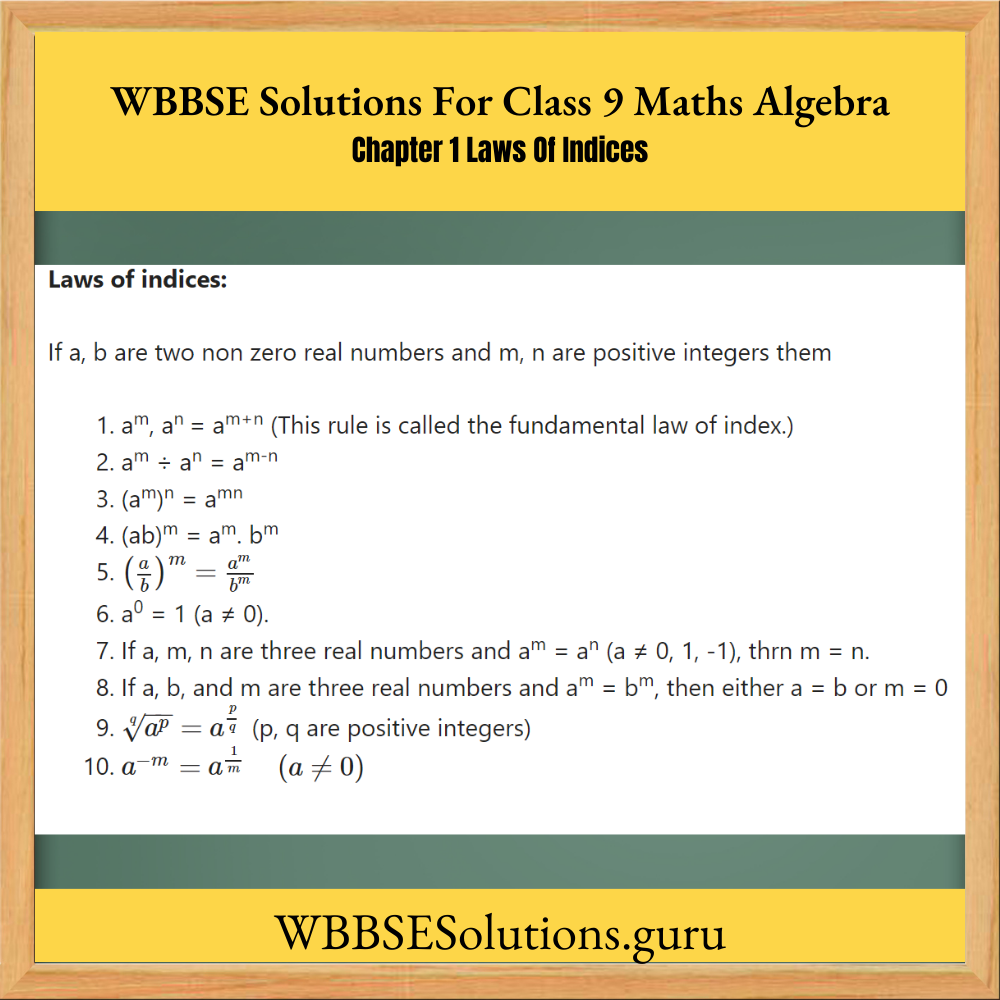
Laws of indices:
If a, b are two non zero real numbers and m, n are positive integers them
- am, an = am+n (This rule is called the fundamental law of index.)
- am ÷ an = am-n
- (am)n = amn
- (ab)m = am. bm
- \(\left(\frac{a}{b}\right)^m=\frac{a^m}{b^m}\)
- a0 = 1 (a ≠ 0).
- If a, m, n are three real numbers and am = an (a ≠ 0, 1, -1), thrn m = n.
- If a, b, and m are three real numbers and am = bm, then either a = b or m = 0
- \(\sqrt[q]{a^p}=a^{\frac{p}{q}}\) (p, q are positive integers)
- \(a^{-m}=a^{\frac{1}{m}} \quad(a \neq 0)\)
Read and Learn More WBBSE Solutions For Class 9 Maths
Algebra Chapter 1 Laws Of Indices True Or False
Example 1. In xm, x is called index and m is called the basc.
Solution: The statement is False.
Example 2. \(\left(\frac{a}{b}\right)^2=\left(\frac{b}{a}\right)^{-2}\)
Solution: The statement is True.
Example 3. x0 = 1 for any real number x.
Solution: The statement is False.
Example 4. If ax = ay then x = y for any real number a.
Solution: The statement is False.
Example 5. \(a^{\frac{m}{n}}=\sqrt[n]{a^m}\)
Solution: The statement is True.
Example 6. If ax = k then a = k-x
Solution: The statement is False.
Example 7. If 3x = 2x then x = 0
Solution: The statement is True.
Example 8. \(a^{-\frac{p}{q}}=\sqrt[q]{a^p}\) (p, q are positive integers a ≠ 0)
Solution: The statement is True.
Example 9. \((-27)^{\frac{1}{3}}=-3\)
Solution: The statement is True.
Example 10. If m, n, and p are positive integers, then am. an. ap = am+n+p.
Solution: The statement is True.
Algebra Chapter 1 Laws Of Indices Fill In The Blanks
Example 1. Value of \((81)^{\frac{3}{4}}\) is ________
Solution: 27.
Example 2. Value of p0 (p ≠ 0) is ________
Solution: 1
Example 3. \(\sqrt[3]{\left(\frac{1}{64}\right)^2}\) = ___________
Solution: \(\frac{1}{2}\)
Example 4. If (27)x = (81)x then x: y
Solution: 4:3.
Example 5. If x = 5 and y = 3 then \((x+y)^{\frac{x}{y}}\) is ___________
Solution: 32.
Example 6. If a ≠ b ≠ 0, and ax = bx then x ________
Solution: 0.
Example 7. If 4x = 83 then x = ________
Solution: \(\frac{9}{2}\)
Example 8. \(2^{\frac{1}{2}}\times 2^{-\frac{1}{2}} \times(64)^{\frac{1}{6}}\) = ________
Solution: 1
Example 9. √√2 = ________
Solution: \(2^{\frac{1}{4}}\)
Example 10. \(x^{a-b} \times x^{b-c} \times x^{c-a}\) = _______
Solution: 1.
Algebra Chapter 1 Laws Of Indices Short Answer Type Questions
Example 1. If (55+0.01)2– (520-0.01)2 = 5x then find the value of x.
Solution: 4.55.0.01 = 5x [(a + b)2 – (a – b)2 = 4.ab]
⇒ or, \(\frac{4 \times 5}{100}=5^x\)
⇒ or, 55-2 = 5x
⇒ or, x=3
The value of x is 3
Example 2. If 3 x 27x = 9x+4 then find the value of x.
Solution: 3 x (33)x = (32)x+4
or, 31+3x = 32x+8
∴ 1+3x= 2x + 8
or, x = 7.
The value of x is 7.
Example 3. Which is greater \(3^{3^3} \text { or, }\left(3^3\right)^3 \text { ? }\)
Solution: \(3^{3^3}=3^{27}, \quad\left(3^3\right)^3=3^9, 27>9\)
∴ \(3^{3^3}>\left(3^3\right)^3\)
Example 4. \((\sqrt[5]{8})^{\frac{5}{2}} \times(16)^{-\frac{3}{8}}\) = ?
Solution: = \(\left(8^{\frac{1}{5}}\right)^{\frac{5}{2}} \times\left(2^4\right)^{-\frac{3}{8}}\)
= \(8^{\frac{1}{5} \times \frac{8}{2}} \times 2^{4 \times\left(-\frac{3}{8}\right)}\)
= \(\left(2^3\right)^{\frac{1}{2}} \times 2^{-\frac{3}{2}}=2^{\frac{2}{2}+\left(-\frac{3}{2}\right)}=2^0=1\)
\((\sqrt[5]{8})^{\frac{5}{2}} \times(16)^{-\frac{3}{8}}\) = \(\left(2^3\right)^{\frac{1}{2}} \times 2^{-\frac{3}{2}}=2^{\frac{2}{2}+\left(-\frac{3}{2}\right)}=2^0=1\)
Example 5. Simplify \(\sqrt[5]{x^8 \cdot \sqrt{x^6 \cdot \sqrt{x^4}}}\)
Solution: \(\sqrt[5]{x^8 \sqrt{x^6 x^{-\frac{4^2}{2}}}}\)
= \(\sqrt[5]{x^8 \sqrt{x^{6-2}}}=\sqrt[5]{x^8 \sqrt{x^4}}\)
= \(\sqrt[5]{x^8 x^{\frac{24}{2}}}\)
= \(\sqrt[5]{x^{8+2}}=x^{\frac{10}{5}}=x^2\)
\(\sqrt[5]{x^8 \cdot \sqrt{x^6 \cdot \sqrt{x^4}}}\) = \(\sqrt[5]{x^{8+2}}=x^{\frac{10}{5}}=x^2\)
Example 6. Simplify \(\left\{(81)^{-\frac{3}{4}} \times \frac{16^{\frac{1}{4}}}{6^{-2}} \times\left(\frac{1}{27}\right)^{\frac{4}{3}}\right\}^{\frac{1}{3}}\)
Solution: =\(\left\{3 \times\left(-\frac{3}{4}\right) \times \frac{2^{4 \times \frac{1}{4}}}{3^{-2} \times 2^{-2}} \times\left(3^{-3}\right)^{-\frac{4}{3}}\right\}^{\frac{1}{3}}\)
=\(\left\{3^{-3} \times \frac{2^1}{2^{-2} \times 3^{-2}} \times 3^{-3 \times\left(-\frac{4}{3}\right)}\right\}^{\frac{1}{3}}\)
= \(\left\{3^{-3+4+2} \times 2^{1+2}\right\}^{\frac{1}{3}}\)
= \(\left(3^3 \times 2^3\right)^{\frac{1}{3}}=6^{3 \times \frac{1}{3}}=6\)
Example 7. If \(x^{p^q}=\left(x^p\right)^q\), find p in terms of q, (x ≠ 0, 1, −1)
Solution: \(x^{p^q}=x^{p q}\)
⇒ or, \(xp^q=p q \quad(x \neq 0,1,-1)\)
⇒ or, \(\frac{p^q}{p^1}=q\)
⇒ or, \(p^{q-1}=q\)
∴ \(p=q-1 \sqrt{q}\)
Example 8. Arrange in the ascending order of magnitude, 263, 345, 527, 618
Solution: 263 = (27)9 = (128)9
⇒ 345 = (35)9 = (243)9
⇒ 527 = (53)9 = 1259
⇒ 618 = (62)9 = (36)9
[Note: You have to find out the H.C.F. of 63, 45, 27, 18 which is 9]
⇒ Since 36125 < 128 < 243
⇒ Hence 618 < 527 < 263 < 345
Example 9. If \(x^{x \cdot \sqrt{x}}=(x \sqrt{x})^x\), find the value of x.
Solution: \((x \sqrt{x})^x=(x \sqrt{x})^x\)
⇒ or, \(x^{\sqrt{x}}=x \sqrt{x}\)
⇒ Now, \(x \sqrt{x}=x^{1+\frac{1}{2}}=x^{\frac{3}{2}}\)
∴ \(\sqrt{x}=\frac{3}{2}, \quad x=\frac{9}{4}\)
The value of x \(\sqrt{x}=\frac{3}{2}, \quad x=\frac{9}{4}\)