
Arithmetic Chapter 1 Real Numbers
⇔ Natural Numbers: 1, 2, 3, 4, 5,………………… 125, ………….. are counting numbers or natural numbers such that 1 is the first natural number and there is no last natural number.
⇒The natural number is denoted by N and is written as
⇒ N = (1, 2, 3, 4, ……………..,125,………………….).
⇔ Whole numbers: The numbers 0, 1, 2, 3,……………, 125,……… are called whole numbers.
⇒ The whole numbers is denoted by W and is written as
⇒ W = (0, 1, 2, 3, 125,…..)
⇔ Integers: The numbers……., -4, -3, -2, -1, 0, 1, 2, 3…….are called Integers.
⇒ The integers is denoted by Z and is written as Z = (…….., -3, -2, -1, 0, 1, 2, 3,………..)
WBBSE Solutions For Class 9 Maths
⇒ The integers greater than 0, i.e. 1, 2, 3,……. are called Positive Integers and the integers less than 0, i.e.-1,2,3,….. are called Negative Integers.
⇒ 0 (Zero) is an integer that is neither positive nor negative.
⇔ Rational Numbers: The numbers which can be expressed in the form of \(\frac{p}{q}\) where p and q are integers and q 0 are called Rational Numbers. eg: 6, \(\frac{3}{4}\), 0, \(\frac{5}{6}\) etc.
⇒ [All integers are Rational Numbers.]
⇔ Irrational Numbers: The numbers which can not be expressed in the form of \(\frac{p}{q}\) where p and q are integers and q #0 are called Irrational Numbers. e.g. √3, π etc.
Some important points:
- If two rational numbers x and y such that x < y there is a rational number \(\frac{x+y}{2} \text { i.e. } x<\frac{x+y}{2}<y\)
- If x and y are two rational numbers and x < y then, n rational numbers between x and y are (x + d), (x + 2d), (x + 3d),….. (x + nd), where d = \(d=\frac{y-x}{n+1}\)
- If the rational numbers of the form \(\frac{p}{q}\) be expressed into decimals, it will be terminating decimal numbers, where q has prime factors 2 and 5 only.
- If the rational numbers of the form \(\frac{p}{q}\) be expressed into recurring decimals where q has prime factors other than 2 and 5.
- If rational numbers are expanded into decimals it will be terminating are recurring and the fraction whose decimal form is terminating or recurring will be rational.
Arithmetic Chapter 1 Real Numbers True Or False
Example 1. The sum of two rational numbers is always rational.
Solution: The statement is true.
⇒ [e.g. [\(\frac{5}{7}\) + \(\frac{2}{3}\) = \(\frac{29}{21}\)]
Example 2. The sum of two irrational numbers is always irrational.
Solution: The statement is false.
⇒ [6.8. (2+√3)+(4-√3)=6]
Example 3. The product of two rational numbers is rational.
Solution: \(\frac{3}{4}\) x \(\frac{5}{6}\) = \(\frac{5}{6}\) [rational number]
∴ The statement is true.
Example 4. The product of two irrational numbers is always rational.
Solution: √3 × √5 = √15 [irrational number]
⇒ (3+√5)(3-√5)=(3)2-(√5)2
= 9 – 54 [rational number]
∴ The statement is false.
Example 5. Each rational number is real number.
Solution: \(\frac{3}{5}\), 0, √9, –\(\frac{4}{7}\) all are real number.
∴ So the statement is true.
Example 6. Each real number is irrational.
Solution: Clearly the statement is False.
Arithmetic Chapter 1 Real Numbers Fill In The Blanks
Example 1. The division of two integers is not always ______
Solution: Integer.
Example 2. The value of (2 + √3)(2 – √3) is ______
Solution: 1
(2 + √3)(2 -√3) = 22 – (√3)2 = 4 – 3 = 1
Example 3. The difference between 1 and 0.9 is ________
Solution: 0
1 – 0.9 = 1 – \(\frac{9}{9}\) = 1 – 1 = 0
Example 4. We will get _______ decimal if \(\frac{7}{20}\) are expanded into decimal.
Solution: Terminating.
20 = 22 x 5
20 has no prime factors except 2 and 5.
∴ The decimal form of \(\frac{7}{20}\) will be terminating.
Arithmetic Chapter 1 Real Numbers Short Answer Type Questions
Example 1. Give an example where sum of two irrational numbers is a rational number.
Solution:
- √5, -√5 √5 + (-√5) = 0 [rational number]
- 7 + √5; 7 – √5 (7 + √5) + (7 – √5) = 14 [rational number]
Example 2. Give an example where subtraction of two irrational number is a rational number.
Solution:
- √7, √7 ⇒ √7-√7=0 [rational number]
- (5+√3), (2+√3) ⇒ (5+√3)-(2+√3) = 5 + √3 – 2 – √3 = 3 [rational number]
Example 3. Write a rational number between \(\frac{1}{7}\) and \(\frac{2}{7}\)
Solution: A rational number between \(\frac{1}{7}\) and \(\frac{2}{7}\) is \(\frac{\frac{1}{7}+\frac{2}{7}}{2}\) = \(\frac{3}{7 \times 2}=\frac{3}{14}\)
Example 4. Determine a irrational number between \(\frac{1}{7}\) and \(\frac{2}{7}\).
Solution: \(\frac{1}{7}\) = 0.1428571428571……..= 0.142857
⇒ \(\frac{2}{7}\) = 0.285714285714……= 0.285714
⇒ The irrational number lying between \(\frac{1}{7}\) and \(\frac{2}{7}\) will be non-terminating and non-recurring.
∴ One required irrational number is 0.15015001500015………..
Example 5. Express 0.0123 in the form of \(\frac{p}{q}\) where p and q are integers and q ≠ 0.
Solution: 0.0123 = \(\frac{0123-12}{9000}=\frac{111}{9000}=\frac{37}{3000}\)
Example 6. Write four rational numbers between 2 and 3.
Solution: If x and y are two rational numbers and x < y then, n rational numbers between x and y are (x + d), (x + 2d), (x + 3d)………..(x+nd.), where \(d=\frac{y-x}{x+1}\)
⇒ Here, x = 2, y = 3 and n = 4
⇒ d = \(\frac{3-2}{4+1}=\frac{1}{5}\)
∴ The four rational numbers are
⇒ \(\left(2+\frac{1}{5}\right)\left(2+\frac{2}{5}\right)\left(2+\frac{3}{5}\right),\left(2+\frac{4}{5}\right)\)
i.e. \(\frac{11}{5}, \frac{12}{5}, \frac{13}{5} \text { and } \frac{14}{5}\)
Example 7. Write four irrational numbers between \(\frac{2}{3}\) and \(\frac{5}{3}\)
Solution: \(\frac{2}{3}\) = 0·666…………..0.6
⇒ \(\frac{5}{3}\) = 1.666…………. = 1.6
⇒ The irrational number between \(\frac{2}{3}\) and \(\frac{5}{3}\) will be non-terminating and non-recurring.
∴ Four irrational numbers between \(\frac{2}{3}\) and \(\frac{5}{3}\) are 0.707007000700007……….
⇒ 0.72572557255572………, 0.81481448144481…………., 0.93293229322293……….
Example 8. Place the rational numbers on a Number line.
- –\(\frac{3}{4}\)
- \(\frac{13}{5}\)
Solution:
1.

⇒ At first, 9 take OA’ = 1 unit on the left side of the point ‘0’, OA’ is divided into 4 equal parts.
⇒ OR = –\(\frac{3}{4}\) unit.
2.
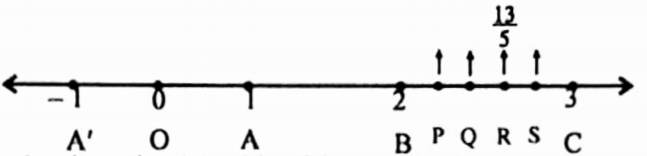
At first, 9 take OA 1 unit on the right side of the point ‘O’,
∴ OB = 2 units and OC = 3 units.
⇒ BC is divided into 5 equal parts BR = \(\frac{3}{5}\) unit.
∴ OR = OB + BR = = (2 + \(\frac{3}{5}\)) units = \(\frac{13}{5}\) units.
Example 9. Write two rational numbers between 0.2101 and 0.2
Solution: 0.2 = 0.2222………..
⇒ The two rational numbers between 0.2101 and 0.2 are 0.211 and 0.212
Example 10. Express each of the following numbers in the form of \(\frac{p}{q}\) where p and q are integers and q 0.
- 0.2345
- 12.0366
Solution:
- 0.2345 = \(\frac{2345-234}{9000}=\frac{2111}{9000}\)
- 12.0306 = \(\frac{120306-1203}{9900}=\frac{119103}{9900}=\frac{39701}{3300}\)