WBBSE Class 10 Maths Statistics Chapter 1 Mean Median Ogive Mode Multiple Choice Questions

WBBSE Class 10 Maths Statistics Chapter 1 Mean Median Ogive Mode Multiple Choice Questions

Example 1. The median of a given frequency distribution is found graphically with the help of

  1. Frequency curve
  2. Frequency polygon
  3. Histogram
  4. Ogive

Solution: The correct answer is 4. Ogive

Read And Learn Also WBBSE Class 10 Maths Multiple Choice Questions

Example 2. If the mean of numbers 6, 7, x, 8, y, 14 is 9, then

  1. x + y = 21
  2. x + y = 19
  3. x – y = 21
  4. x – y = 19

Solution: The mean of numbers 6, 7, x, 8, y, and 14 is

⇒  \(\frac{6+7+x+8+y+14}{6}=\frac{35+x+y}{6}\)

According to quéstion, \(\frac{35+x+y}{6}=9\)

∴ The correct answer is 2. x + y = 19

WBBSE Class 10 Maths Statistics Chapter 1 Mean Median Ogive Mode Multiple Choice Questions

Example 3. If 35 is removed from the data 30, 34, 35, 36, 37, 38, 39, 40 then the median increases by

  1. 2
  2. 1.5
  3. 1
  4. 0.5

Solution: Total number of terms of 30, 34, 35, 36, 37, 38, 39, and 40 is 8

Here n = 8 (i.e. n is even)

∴ median = \(\frac{1}{2}\) [(\(\frac{8}{3}\))th term + (\(\frac{1}{2}\) + 1)th term]

= \(\frac{1}{2}\) [4 th term + 5th term]

= \(\frac{36+37}{2}=\frac{73}{2}=36 \cdot 5\)

If 35 is removed from the given data then, n = 7 [i.e. n is odd]

∴ median = \(\frac{7+1}{2}\) th term = 4th term = 37

∴ The median increases by (37 – 36.5) or 0.5

∴ The correct answer is 4. 0.5

Class 10 Statistics Chapter 1 Mcqs With Answers

Example 4. If the mode of data 16, 15, 17, 16, 15, x, 19, 17, 14 is 15, then the value of x is

  1. 15
  2. 16
  3. 17
  4. 19

Solution: In the given data 15 and 17 each occurs 2 times.

As the mode of given data is 15

∴ The value of x is 15

∴ The correct answer is 1. 15

Example 5. If the median of arranging the ascending order of data 8, 9, 12, 17, x + 2, x + 4, 30, 31, 34, 39, is 15 then the value of x is

  1. 22
  2. 21
  3. 20
  4. 24

Solution: In the given data, n = 10 [i.e. n is even]

∴ median = \(\frac{1}{2}\left[\left(\frac{10}{2}\right) \text { th term }+\left(\frac{10}{2}+1\right) \text { th term }\right]\)

= \(\frac{1}{2}[5 \text { th term }+6 \text { th term }]\)

= \(\frac{x+2+x+4}{2}=\frac{2 x+6}{2}=x+3\)

as per question, x + 3 = 24 ⇒ x = 21

∴ The correct answer is 2. 21

WBBSE Notes For Class 10 Geography And EnvironmentWBBSE Notes For Class 10 History And Environment
WBBSE Solutions For Class 10 Life ScienceWBBSE Class 10 Life Science Multiple Choice Questions
WBBSE Solutions for Class 10 MathsWBBSE Class 10 Maths Multiple Choice Questions
WBBSE Notes For Class 10 Physical Science And Environment


Measures Of Central Tendency Mcqs Class 10

Example 6. Three values of a variable are 12, 6, and 8, and their frequency are (m – 1), m, and (m + 2) respectively, If arithmetic is 8.2 then the value of m is

  1. 2
  2. 3
  3. 4
  4. 5

Solution:

WBBSE Class 10 Maths Statistics Chapter 1 Mean Median Ogive Mode Three values of a variableAnd Frequency

⇒  \({Mean}(\overline{\mathrm{X}})=\frac{\sum f_i x_i}{\sum f_i}=\frac{26 m+4}{3 m+1}\)

⇒  \(\frac{26 m+4}{3 m+1}=8 \cdot 2\)

⇒ 26m + 4 = 24.6 m + 8.2

⇒ 1.4 m = 4.2 ⇒ m = 3

∴ The correct answer is 2. 3

Class 10 Maths Chapter 1 Statistics Solutions

Example 7. If the mode of data 64, 60, 48, x, 43, 48, 43, 34 is 43, then the value of (x + 3) is

  1. 44
  2. 45
  3. 46
  4. 48

Solution: In the given data 43 and 48 each occurs two times.

As mode is 43, So the value of x is 43

∴ The value of (x + 3) is (43 + 3) or 46

∴ The correct answer is 3. 46

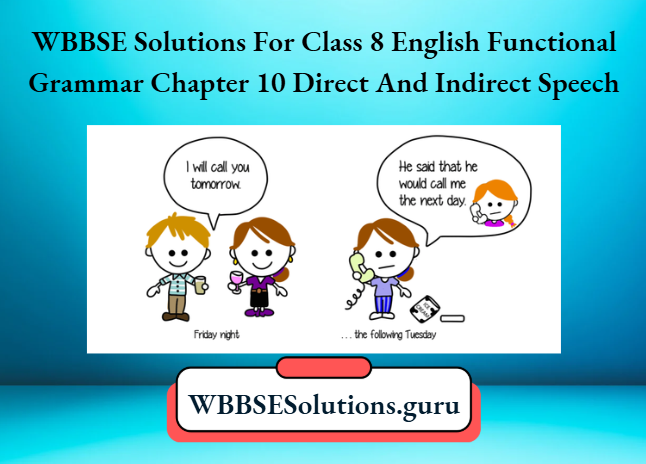
WBBSE Solutions For Class 8 English Functional Grammar Chapter 10 Direct And Indirect Speech

WBBSE Chapter 10 Direct And Indirect Speech

Ram says, “He will come.”
Ram says that he will come.

প্রথম বাক্যে রামের উক্তি অবিকল উদ্ধৃত করা হয়েছে, কিন্তু দ্বিতীয় বাক্যে রামের কথার মর্ম বক্তা নিজের ভাষায় প্রকাশ করেছে। এইরূপ

বক্তার উক্তি অবিকল উদ্ধৃত করা হলে তাকে Direct Speech বা Direct Narration বলে।

বক্তার উক্তির মর্ম প্রকাশ করা হলে তাকে Indirect Speech বা Indirect Narration বলে।

Read And Learn More WBBSE Class 8 English Functional Grammar

যে উক্তিটি অবিকল উদ্ধৃত করা হয় (এখানে He will come) তাকে Reported Speech বলে, এবং যে verb (এখানে says) এই উক্তিটিকে সূচনা করে তাকে Reporting Verb বলে।

নীচের Sentence-গুলি লক্ষ্য করো :
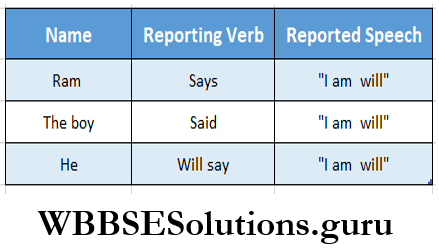
WBBSE Solutions For Class 8 English Functional Grammar Chapter 10 Direct And Indirect Speech Reporting And Reported Speech

1. Ram says, “I am ill.”-Direct speech
Ram says that he is ill.-Indirect speech

2. The boy said, “I am ill.”-Direct speech
The boy said that he was ill.-Indirect speech

3. He will say, “I am ill”.-Direct speech
He will say that he is ill.-Indirect speech.
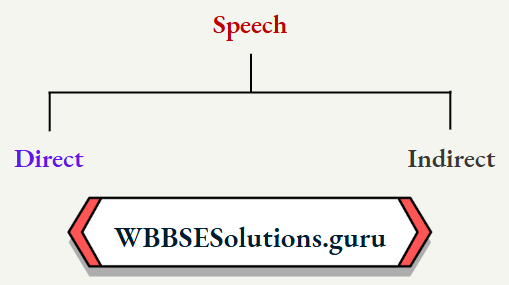
WBBSE Solutions For Class 8 English Functional Grammar Chapter 10 Direct And Indirect Speech Direct And Indirect Speech

মনে রেখো :

Direct:

  1. Direct speech -এ Reported speech-f inverted comma (“— ”)-র মধ্যে রাখতে হয়।
  2. Direct speech-এ Reporting verb- একটি comma বসে।
  3. Reported speech capital letter হয়।’

Indirect:

  1. Indirect speech-এ inverted comma
  2. Sentence-এ সামান্য কিছু পরিবর্তন আসে।

Direct Speech-কে Indirect করার নিয়ম :

Statement or Assertive Sentence:

1. Indirect Speech-এ Reporting Verb- that :
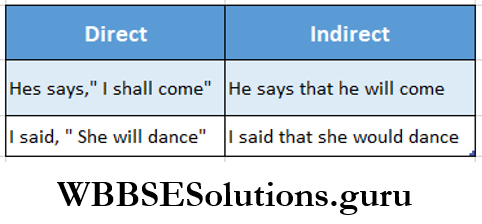
WBBSE Solutions For Class 8 English Functional Grammar Chapte 10 Direct And Indirect Speech Statement of Assertive Sentence Of Indirect Speech And Reporting Verb

2. Reporting Verb- Present,Future Tense, Indirect- Reported Speech-এর Verb-টির Tense-এর কোনো পরিবর্তন হয় না :
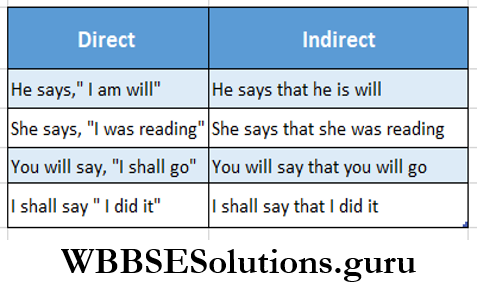
WBBSE Solutions For Class 8 English Functional Grammar Chapter 10Direct And Indirect Speech Statement of Assertive Reporting Verb And Present And Future Tense

3. Reporting Verb Past Tense-এ Indirect-এ Reported Speech-এ Verb-be অনুরূপ Past tense-এ পরিবর্তিত হয় :

WBBSE Solutions For Class 8 English Functional Grammar Chapter 10 Direct And Indirect Speech Statement of Assertive Reporting Verb And Past Tense

নীচের Chart-টি লক্ষ্য করো :

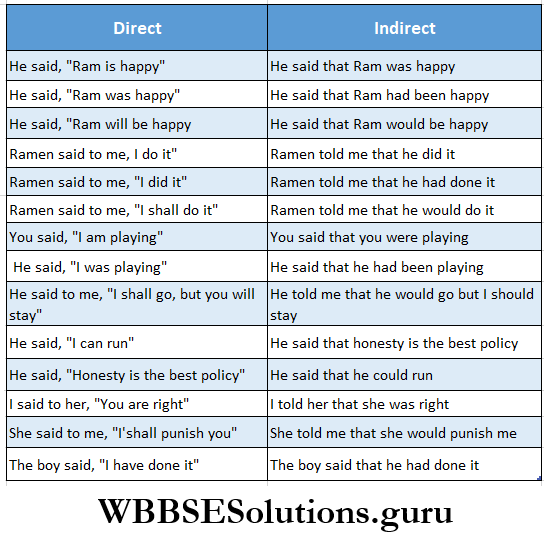
WBBSE Solutions For Class 8 English Functional Grammar Chapter 10 Direct And Indirect Speech Verb Direct Speech And Indirect Speech

Note :

  • লক্ষ্য করো Reported Speech-এর Pronoun- ও Indirect-এ পরিবর্তিত হচ্ছে। প্রথম উদাহরণে I কথাটি Satish-কে বোঝায় বলে Indirect-এ তা he হয়েছে। চতুর্থ উদাহরণে I কথাটি you-কে বোঝায় বলে Indirect-এ তা you হয়েছে। অন্যান্য উদাহরণগুলিও লক্ষ্য করো, দেখতে পাবে বক্তার অথবা যাকে বলা হয় তার person অনুসারে Reported Speech-এর Pronoun-এর Person পরিবর্তিত হয়।

অনেক সময় Indirect narration-এ পরিবর্তিত করবার পর Pronoun-গুলি ঠিক কাকে বোঝাচ্ছে এ ব্যাপারে ভ্রান্তি হয়। সেক্ষেত্রে Pronoun-এর পাশে bracket-এ ব্যক্তির নাম বসান বাঞ্ছনীয়।

WBBSE Solutions For Class 8 English Functional Grammar Chapter 10 Direct And Indirect Speech Verb Direct And Indirect

  • আরও লক্ষ্য করো Direct Speech-এর shall Indirect Speech-এ will ( বা তার past form ‘would’)-এ পরিবর্তিত হয়েছে। তার কারণ “শুধু ভবিষ্যৎ” বোঝাতে I এর পর shall বসে বটে, কিন্তু you ও he (she, it, etc.)-এর পর will হয়। সুতরাং person-এর পরিবর্তন অনুসারে shall বা will-এরও পরিবর্তন হবে।
  •  উপরের (c) chart-এর তৃতীয়, চতুর্থ ও সপ্তম উদাহরণে লক্ষ্য করো Direct-এ Reporting Verb-টি said ; কিন্তু Indirect- এ তা told করা হয়েছে। That-এর পূর্বে ‘said to me’, ‘said to her’ ইত্যাদি ভাল ইংরাজি নয়— ‘told me,’ ‘told her’ এরূপ হবে।
  • Reporting Verb-এর কোনো পরিবর্তন হয় না।

4. কিন্তু Reported Speech-টি যদি কোনো চিরন্তন সত্য (universal truth) বা নিত্যকার অভ্যাস (habitual action) বোঝায় তবে Reporting Verb-টি Past Tense হলেও Indirect – এ ঐ Reported Speech-এর

Verb-টির Tense-এর কোনো পরিবর্তন হয় না :
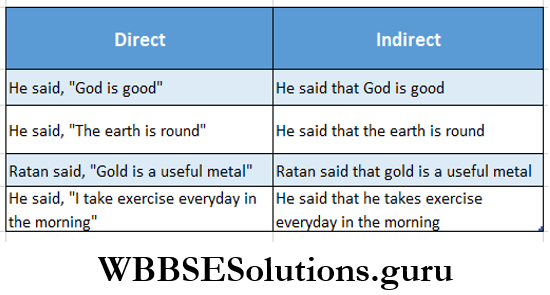
WBBSE Solutions For Class 8 English Functional Grammar Chapter 10 Direct And Indirect Speech Verb Direct Speech And Indirect Speech.

WBBSE Chapter 10 Direct And Indirect Speech Examples Worked Out table

Question 1.
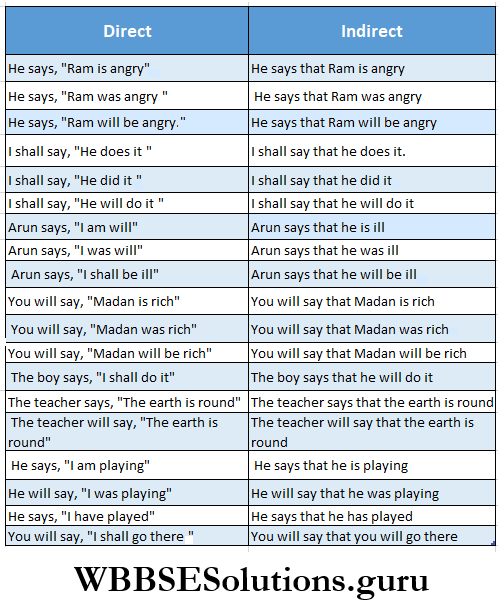
WBBSE Solutions For Class 8 English Functional Grammar Chapter 10 Direct And Indirect Speech Examples Worked Out

Question 2.

WBBSE Solutions For Class 8 English Functional Grammar Chapter 10 Direct And Indirect Speech Examples Worked Out.

WBBSE Chapter 10 Direct And Indirect Speech Exercise

Change the following sentences into Indirect form. One is done for you;

The girl says, “I am well”. The girl says that she is well.

The girl will say”I am well.” He says, “I am reading.” The girl said, “I am well.” You said, “Amar is hungry.” You say, “Amar is hungry.” You said, “Mr. Bose will talk.” I said to him, “You are wrong.” He said to him, “I shall run.” You will say, “I am tired.”

You said, “I am tired.” You said, “I take exercise everyday.” I shall say, “I shall go there.” You will say, “I shall go there.” Ramala says, “I was reading a book.” Ramala said, “I am reading a book.”

She said, “I can sing.” He says, “I went there.” He said, “I went there.” She said, “I know her.” The girl says, “I am ill.” The boy said, “I did it.” I said to him, “I shall follow you.” The girls say, “We are happy.” He said, “We worked out the sum.”

Rani said to Babu, “God is good.” He said to me, “You are wrong.” They said, “We are doing our work.” She said to me, “I have seen it.”

Arati said to me, “I shall go out but you will stay.” I said to her, “I like tea.” The boy said, “The earth moves round the sun.” You said, “We are helping him.” You said, “I saw the boy,”

Interrogative Sentences (প্রশ্নবোধক বাক্য):

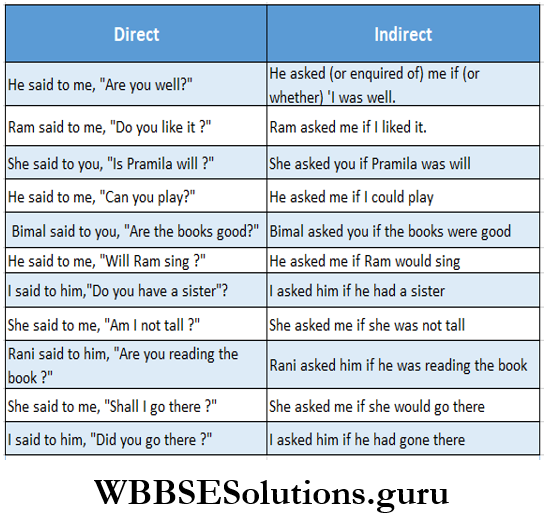
যদি Reported Speech টি প্রশ্নবোধক বাক্য হয় তবে

1. Reporting Verb- ask enquire

2. যদি প্রশ্নটির উত্তর “হ্যাঁ” বা “না” দিয়ে করা চলে তবে ask বা enquire-এর পর whether বা if বসবে। কিন্তু যদি প্রশ্নটি interrogative pronoun বা adjective বা adverb (যেমন whis, which, what, why, when, where, how, etc.) দ্বারা শুরু হয় তা হলে ask বা enquire-এর পরে কিছুই বসবে না।

3. Indirect-এ Reported Speech-টির Interrogative form থাকে না- সাধারণ statement-এর form হয়, অর্থাৎ Assertive Sentence-এ পরিণত হয়। Interrogative sentence-এ সাধারণত Verb-এর পরে Subject বসে, কিন্তু এখন এটা Assertive sentence হয়ে যাওয়ায় Subject-এর পর Verb বসবে।

4. Indirect Speech-এ Reporting Verb-এর পরে that ব্যবহার করবে না।

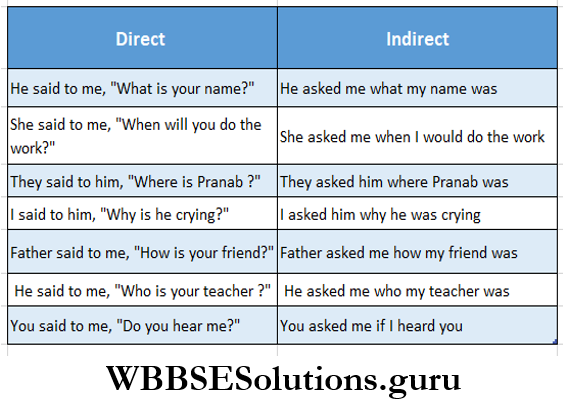
WBBSE Solutions For Class 8 English Functional Grammar Chapter 10 Direct And Indirect Speech Indirect Speech And Reporting Verb

WBBSE Solutions For Class 8 English Functional Grammar Chapter 10 Direct And Indirect Speech And Reporting Verb.

লক্ষ্য করো : Indirect Speech-এ বাক্যের শেষে কোনো জিজ্ঞাসাবোধক চিহ্ন “ (?)” ব্যবহৃত হয় না।
WBBSE Solutions For Class 8 English Functional Grammar Chapter 10 Direct And Indirect Speech

WBBSE Chapter 10 Direct And Indirect Speech Examples Worked Out

Question 1.
WBBSE Solutions For Class 8 English Functional Grammar Chapter 10 Direct And Indirect Speech Examples Worked Out...

Question 2.

WBBSE Solutions For Class 8 English Functional Grammar Chapter 10 Direct And Indirect Speech Examples Worked Out..

WBBSE Chapter 10 Direct And Indirect Speech Exercise

Change into Indirect form. One is done for you.

I said to him, “Are you happy?”.→ I asked him if he was happy.

She said to me, “When will you come. ?” I said to him, “Why are you so angry?” He says to me, “Have you seen my brother ?” He said, “Where are you going?” The teacher said to me, “Have you

done the work?” I said to him, “What are you doing?” He said, “Is there any hope for me?” She says to me, “Are you angry with me?” The boy said, “Why did you not call me ?” She said to me, “Will you go to Calcutta?”

Arup said to me, “How is your father ?” They said to me, “Will you come to our house?” I said to her, “May I come into your room ?” I said to him, “Do you know his name ?”

WBBSE Class 8 English Functional GrammarWBBSE Class 8 English Reading Skills
WBBSE Solutions For Class 8 EnglishWBBSE Solutions For Class 8 Maths


Imperative Sentences (আদেশ বা অনুরোধজ্ঞাপক বাক্য) (Request, order, advise, suggestion):

এইরকম বাক্যকে Indirect করবার সময়-

1. Reporting Speech-Reporting Verb- request, order, advise, beg, command, entreat বা tell ইত্যাদিতে পরিবর্তিত করবে।

2. Reported Speech-এর Verb-টির পূর্বে “to” বসবে।

WBBSE Solutions For Class 8 English Functional Grammar Chapter 10 Direct And Indirect Speech Imperative Sentences To Direct And Indirect

অনেক সময় request, order, advise, let, command ইত্যাদি কোন্ Verb-টি ব্যবহার করতে হবে তা সঠিকভাবে স্থির করতে না পারলে “tell” ব্যবহার করাই ভাল।

Imperative Sentences with ‘Let’:

Reported Speech অনেক সময় Let’ দিয়ে আরম্ভ হয়।

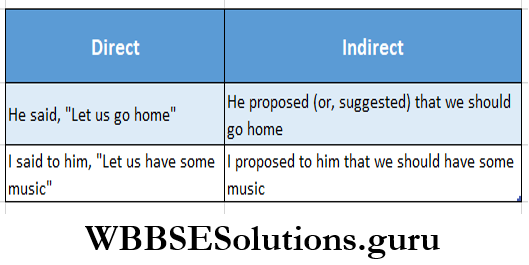
1. Ler’ দ্বারা কোনো suggestion বা proposal (প্রস্তাব) বোঝালে Reporting Verb-কে propose’ বা ‘suggest’ ইত্যাদিতে পরিবর্তিত করে ‘Let’-এর স্থানে should বসাতে হয়। যথা:
WBBSE Solutions For Class 8 English Functional Grammar Chapter 10 Direct And Indirect Speech Imperative Sentences Let Direct And Indirect

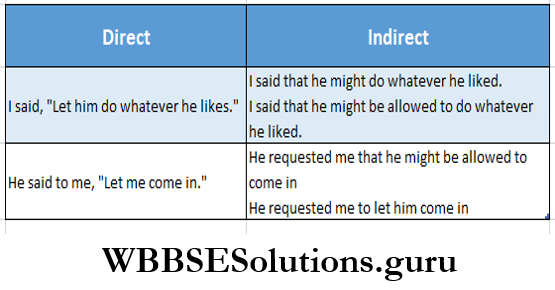
2. কিন্তু ‘Ler দ্বারা কোনো proposal বা suggestion (প্রস্তাব) না বোঝালে অর্থানুসারে let-এর পরিবর্তে ‘might’, ‘might be allowed’ বা ‘to let’ ইত্যাদি verb ব্যবহৃত হয়। যথা
WBBSE Solutions For Class 8 English Functional Grammar Chapter 10 Direct And Indirect Speech Imperative Sentences To Let Direct And Indirect

WBBSE Chapter 10 Direct And Indirect Speech Examples Worked Out
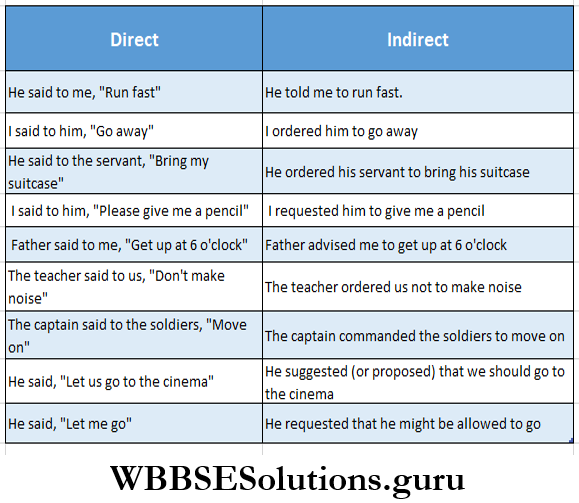
WBBSE Solutions For Class 8 English Functional Grammar Chapter 10 Direct And Indirect Speech Examples Worked Out Direct And Indirect

WBBSE Chapter 10 Direct And Indirect Speech Exercise 

Change into Indirect Speech. One is done for you.

He said to me, “Go there.” → He ordered me to go there.

She said to him, “Come to my house.” I said to her, “Do not do it.” They said to me, “Try to do it.” The teacher said to him, “Obey your parents.” She said to me, “Come to me and I shall help you.” She said to me, “Do as ‘I tell you.”

He said to me, “Excuse me, please.” He said to me, “Sit down.” She said to me, “Do not go there.” The man said to me, “Please help me.” He said to me, “Let me try.” Ram said to his friends, “Let us do it.” He said to me, “Let us eat.” I said, “Let the boy go.”

Optative Sentences (ইচ্ছা বা প্রার্থনাসূচক বাক্য):

এই রকম বাক্যকে Indirect করবার সময়

1. Reporting Verb-টি অর্থানুযায়ী wish, pray, bless ইত্যাদিতে পরিবর্তিত করবে এবং তার পরে that বসাবে।

2. Optative Sentence-টিকে Assertive Sentence বা Statement-এ পরিবর্তিত করবে।
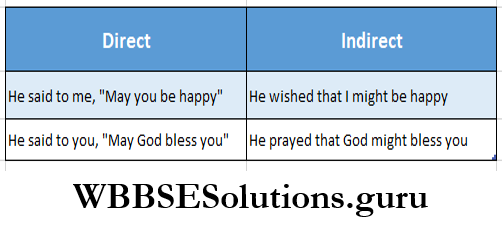
WBBSE Solutions For Class 8 English Functional Grammar Chapter 10 Direct And Indirect Speech Optative Sentencess

Exclamatory Sentences (বিস্ময়, উচ্ছ্বাস ইত্যাদি জ্ঞাপক বাক্য):

এই রকম বাক্যকে Indirect করতে হলে

1. Reporting Verb-টিকে পরিবর্তন করে মনের আকস্মিক ভাব প্রকাশক একটি verb (exclaim, ery out, pray, wish ইত্যাদি) ব্যবহার করতে হয়। প্রয়োজন হলে অর্থানুযায়ী নতুন কোনো word বা phrase-ও যোগ করতে হয়।

2. Interjection-টি বাদ দিয়ে Exclamatory Sentence-টিকে Assertive Sentence-এ পরিবর্তিত করতে হয়।

WBBSE Solutions For Class 8 English Functional Grammar Chapter 10 Direct And Indirect Speech Exclamatory Sentencess

অনেক সময় what, how এবং who—এই wordগুলি exclamatory sentence-এ ব্যবহৃত হয়ে আতিশয্য (excess) বা অভাব (absence) বোঝায়। Indirect narration করবার সময় তাদের পরিবর্তে অর্থানুযায়ী greal, greatly, very, very much, none বা ঐজাতীয় word ব্যবহার করতে হয়। যথা

WBBSE Solutions For Class 8 English Functional Grammar Chapter 10 Direct And Indirect Speech Exclamatory Sentencess.

WBBSE Chapter 10 Direct And Indirect Speech Exercise

Change into Indirect Speech. One is done for you.

She said, “How beautiful it is!” → She exclaimed with joy that it was very beautiful.

I said, “What a sight!” I said, “Alas! she is ill.” They said, “Hurrah! we have done it.” He said to her, “May you live long.” You said, “Good morning, my friend.”

He said to us, “May you all succeed.” The old man said, “How happy I am !” The boy said, “Alas! I have no money with me.” He said, “What a fun!”

Words indicating Time and Place:

Reported Speech-এ নিকটে বোঝায় (স্থানবাচক ও কালবাচক) এইরূপ word-গুলি Indirect Speech-এ সাধারণত দূরত্ববোধক অনুরূপ word-এ পরিবর্তিত করতে হয় :

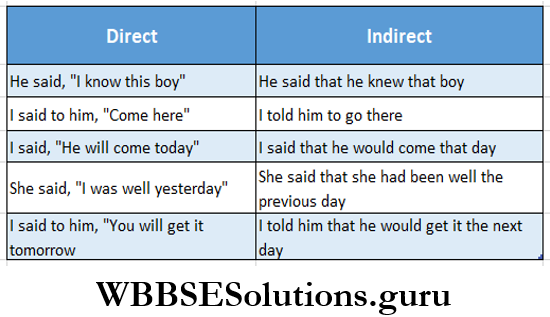
WBBSE Solutions For Class 8 English Functional Grammar Chapter 10 Direct And Indirect Speech Words Indicating Time And Place

WBBSE Solutions For Class 8 English Functional Grammar Chapter 10 Direct And Indirect Speech Words Indicating Time And Place.

কিন্তু this, here ইত্যাদি word-গুলি যদি বক্তার সম্মুখস্থ কোনো কিছুকে নির্দেশ করে তা হলে Indirect করবার সময় তাদের কোনো পরিবর্তন হয় না। যথা :
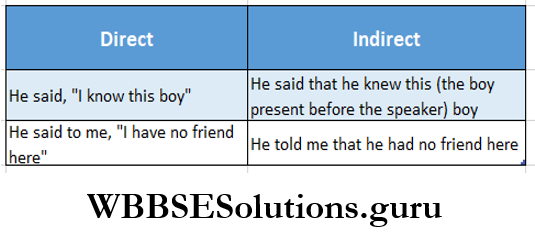
WBBSE Solutions For Class 8 English Functional Grammar Chapter 10 Direct And Indirect Speech Words Indicating Time And Place..

মনে রেখো : ‘It’ কখনো ‘that’ হয় না। , ‘It’ সর্বদাই অপরিবর্তিত থাকে।

WBBSE Chapter 10 Direct And Indirect Speech Exercise

Change into Indirect Speech. One is done for you.

He said to you, “I am busy now.” He told you that he was busy then.

He said to me, “Come again tomorrow.” The girls said, “We shall finish the work today.” He said to me, “Why do you treat me thus ?” I said to him, “We shall be happy here.”

She said, “I have no hope here.” She said, “I saw you yesterday.”

Narration change of passages:

একই passage-এ একই ধরনের একাধিক sentence থাকলে Indirect করবার সময় reporting verb-টি একবারই থাকে এবং sentence-গুলি সাধারণত and, but ইত্যাদি Conjunction দ্বারা যুক্ত হয়। যথা :

Direct : Ram said to me, “What is your name? What do you want ?”

Indirect : Ram asked me what my name was and what I wanted.

Direct : She said, “Ram is a good student. He is very poor.”

Indirect : She said that Ram was a good student but he was very poor.

কোনো-কোনো সময় Direct Narration এ Reported Speech-এর মধ্যে বিভিন্ন প্রকারের sentence থাকে, কোনেটি Assertive, কোনোটি

Interrogative, কোনোটি Imperative, অথবা কোনোটি Exclamatory। এইরূপ speech-কে Indirect করবার সময় পূর্বোক্ত নিয়ম অনুসারে বিভিন্ন প্রকারের verb ব্যবহার করতে হয়। যথা :

Direct : The teacher said, “Stand up, Nabin. Why have you not prepared your lesson ? I shall write to your father.”

Indirect: The teacher ordered Nabin to stand up and asked him why he (Nabin) had not prepared his lesson. He also told him that he would write to his (Nabin’s) father.

Reporting Dialogues and Conversations:

আমাদের প্রাত্যহিক জীবনে আমরা প্রায়ই dialogue, গল্প বা ঘটনা report করে থাকি। এই reporting বক্তা নিজে, শ্রোতা বা অন্য যে কোনো তৃতীয় ব্যক্তি করতে পারে। নীচের উদাহরণটি দেখো :

Anil: Yesterday I told Ramen that my sister would go to Bombay. (Anil) এইবার দেখো Ramen কীভাবে Anil-এর বক্তব্যটিকে নিজের ভাষায় report করছে।

Ramen: Yesterday Anil told me that his sister would go to Bombay. (Ramen). প্রথম Report এবং দ্বিতীয় report-এ Noun / Pronoun-এর পরিবর্তন দেখো) :

I           –      Changes  – To –  Anil

Ramen  –      Changes –  To – me

My        –       Changes – To – hIs

এইবার তৃতীয় কোনো ব্যক্তি উপরের report-টিকে নিজের ভাষায় কীভাবে বলবে তা দেখো

Gopal:  Yesterday Anil told Ramen that his sister would go to Bombay.

দ্বিতীয় report-এর সাথে তৃতীয় report-এর পার্থক্য লক্ষ্য করো :

Me – Changes – To – Ramen

এইরূপ আরও কিছু উদাহরণ দেখো :

Conversation Mr. Dutta had with Arati and Anjali last week.

Mr. Dutta: I am your friend’s uncle.
Arati and Anjali: We are your neighbours

এইবার উপরের dialogue-টি তিনভাবে reporting করা হচ্ছে।

1. As reported by Mr. Dutta:

I told Arati and Anjali last week that I was their friend’s uncle. They told me that they were my neighbours.

2. As reported by Arati and Anjali. :

Last week Mr. Dutta told us that he was our friend’s uncle. We told him that we were his neigh- bours.

3. As reported by Shyamali-(a third person):

Last week Mr. Dutta told Arati and Anjali that he was their friend’s uncle. Arati and Anjali said that they were his neighbours.
উপরের report গুলিতে Pronoun-গুলির পরিবর্তন লক্ষ্য করো।

Modification of Tense:

Reporting-এর ক্ষেত্রেও verb-এর পরিবর্তন হয়।

1. Present Continuous Tense Past Continuous Tense:

Pubali and Dipali (at 9 a.m. Yesterday): We are painting pictures.
Ruma:  I am reading a book.

Reported by a third person:

Yesterday at 9 a.m. Pubali and Dipali told Ruma that they were painting pictures. Ruma told them that she was reading a book.

2. Will+verb (simple future) usually changes into would + verb.

Teacher: I will teach you English in the morning.
Student: I will work hard to learn it.

Reported by a third person:

The teacher told the student that he would teach the student English in the morning. The student replied that he would work hard to learn it.

3. Simple Past Tense reporting-এর ক্ষেত্রে Past Perfect Tense- এ রূপান্তরিত হয়।:

Teacher: Akbar built Fatehpur Sikri.
Student: Shahjahan built the Taj Mahal.

Reported by a third person:

The teacher told the student that Akbar had built Fatehpur Sikri. The student told him that Shahjahan had built the Taj Maha

Reporting-এর ক্ষেত্রে নিম্নলিখিত পরিবর্তনগুলি করা হয় :

Can – Changes – To – Could

May – Changes –  To – Might

As reported by a third person: Ten years ago Mr. Sen told Malabika that he could do it in half an hour. Malabika told him that she could dance for two hours.

WBBSE Chapter 10 Direct And Indirect Speech Exercise

1. Change the following from Direct to Indirect Speech:

Rita says, “You are tall.” He said to me, “Go away.” He said to me. “What do you want?” I said to him, “Don’t shout.” He said to her, “When will you play?” They said to me, “Are you sick?” You said, “I have a bag.”

She said to him, “Please go there.” I said to him, “You are wrong.” She says, “I shall go to your house.” They said to her, “You have done a great wrong.”

The teacher said to the girl, “Why do you cry?” I said to him, “When will you come ?” The boy said, “I swim in the pond everyday.”

She said to him, “Can you do this sum?” The boy said to me, “Help me.” He will say, “I have seen the picture.” The lady said, “Let us read the book again.”

Father said to me, “Do not go there.” You said to them, “Have you done the work ?” The boy said, “Alas! she is no more.” She said to me, “May I come in ?” Salil said, “What a fool I am.”

The teacher said, “Let him go there.” I said to her, “Make no noise.” I said to her, “Go to school at once.” He said to the members, “Obey the. chair.”

The girl said, “I am reading a book now.” She said to him, “Is there no hope for me?” The boy said, “We went to the fair yesterday.” She said to me, “I was drawing a picture.”

He said, “The sun rises in the east.” I said, “The sky is blue.” You said to your mother, “I shall obey you.” He said to you, “I shall go there tomorrow.” You will say, “I am busy.” He said to me, “Come again tomorrow.” The girls said to me, “We shall finish the work today.”

The police said to the boy, “Who is your master?” The son said to his mother. “Please give me a rupee.” She asked me, “When will you come to our house?” The teacher said to me, “Never go there.”

2. Report the following dialogues. One is done for you:

1. The wolf asked, “What are you carrying in the basket ?” “Food for my grandmother”, said the girl. “Where does your grandmother live ?” asked the wolf.

Answer: The wolf asked the girl what she was carrying in the basket. The girl replied that it was food for her grandmother. The wolf then asked her where her grandmother lives.

2.

Rama : Did you see my white dog?
Chameli : Yes, it was playing in the field.
Rama: But, where has it gone now?
Chameli: I cannot tell you that.

3.

Bina: Hallo! What a good news. I am really glad to hear that you have got first division.

Lekha: Thank you very much.

WBBSE Solutions For Class 8 English Functional Grammar Chapter 9 Modals 

WBBSE Chapter 9 Modals

ইংরাজি ভাষায় কিছু কিছু words আছে যাদের আমরা বিভিন্নভাবে বক্তব্য প্রকাশের জন্য main verb-এর সহায়ক হিসাবে ব্যবহার করি। এইসব word-গুলিকে modals বা modal auxiliaries বলা হয়।

নীচে এই modal – গুলি লক্ষ্য করো :

can, could, may, might, shall, should, will, would, ought, must, need

Modal-এর বিশেষ ত্ব :

1. এরা কখনও main verb হিসাবে ব্যবহার হতে পারে না, কিন্তু কোনো কোনো ক্ষেত্রে এরা একা-ও বসতে পারে।

May I come in, sir? Yes, you may.

Can I have it? Yes, you can.

Will he come here? Yes he will.

Must you play? Yes, I must.

Read And Learn More WBBSE Class 8 English Functional Grammar

2. এইসব modal-এর শেষে কখনও ‘s’ or ‘ing’ বসে না।

He can do it. The girl may go there.

এদের ব্যবহারের আরও কিছু নিয়ম-কানুন তোমরা পরে জানবে। নীচে কয়েকটি modals-এর ব্যবহার সম্বন্ধে আলোচনা করা হল।

WBBSE Solutions For Class 8 English Functional Grammar Chapter 9 Modals

WBBSE Chapter 9 Modals May

WBBSE Solutions For Class 8 English Functional Grammar Chapter 9 Modals Modals May

WBBSE Class 8 English Functional GrammarWBBSE Class 8 English Reading Skills
WBBSE Solutions For Class 8 EnglishWBBSE Solutions For Class 8 Maths


WBBSE Chapter 9 Modals Can

WBBSE Solutions For Class 8 English Functional Grammar Chapter 9 Modals Can

WBBSE Chapter 9 Modals Must

WBBSE Solutions For Class 8 English Functional Grammar Chapter 9 Modals Modals Must

WBBSE Chapter 9 Modals Could

WBBSE Solutions For Class 8 English Functional Grammar Chapter 9 Modals Modals Could

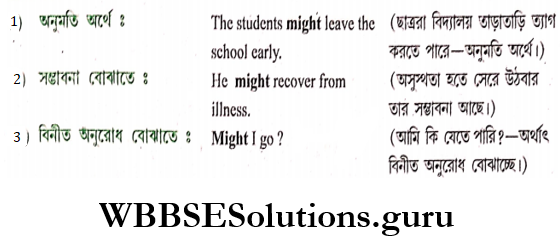
WBBSE Chapter 9 Modals Might

WBBSE Solutions For Class 8 English Functional Grammar Chapter 9 Modals Modals Might

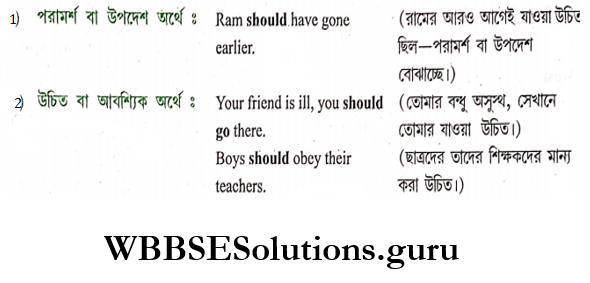
WBBSE Chapter 9 Modals Should

WBBSE Solutions For Class 8 English Functional Grammar Chapter 9 Modals Modals Should

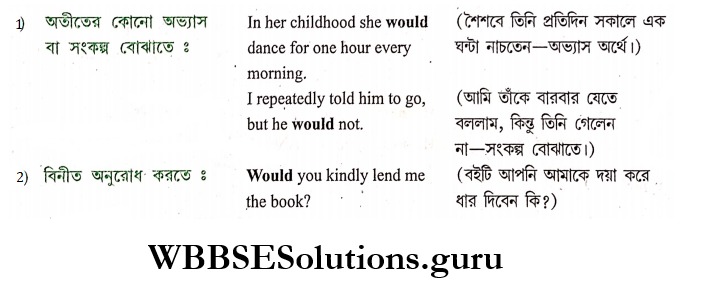
WBBSE Chapter 9 Modals Would

WBBSE Solutions For Class 8 English Functional Grammar Chapter 9 Modals Modals Would

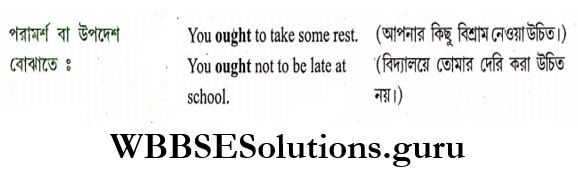
WBBSE Chapter 9 Modals Ought To

WBBSE Solutions For Class 8 English Functional Grammar Chapter 9 Modals Modals Ought To

WBBSE Chapter 9 Modals Need

WBBSE Solutions For Class 8 English Functional Grammar Chapter 9 Modals Modals Need

WBBSE Chapter 9 Modals Making Requests (অনুরোধ করা)

অনুরোধ করতে বা শিষ্টাচার প্রকাশ করতে ইংরাজিতে প্রায়ই Modals-এর সাহায্যে Sentence গঠিত হয়। নীচের উদাহরণগুলি লক্ষ্য করো :

Can you lend me your book?

Would you pass me the paper, please?

Could you post this letter for me?

May I request you to come tomorrow?

Would you mind telling me his address?

WBBSE Solutions For Class 8 English Functional Grammar Chapter 6 Verbs And Tense

WBBSE Chapter 6 Verbs And Tense

তোমরা পূর্বে শিখেছ Tense প্রধানত তিনটি। যথাঃ

  1. Present (বর্তমান)
  2. Past(অতীত) ও
  3. Future (ভবিষ্যৎ)

Read And Learn More WBBSE Class 8 English Functional Grammar

এই প্রত্যেকটি মূল Tense- এর আবার চারটি করে বিশেষ ৰূপ (form) আছে। যথা :

  1. Indefinite
  2. Continuous / Progressive
  3. Perfect
  4. Perfect Continuous

WBBSE Chapter 6 Verbs And Tense Present Indefinite Tense

1. কোনো কার্য হয় বা হয়ে থাকে বোঝাতে, বা যা নিত্য সত্য (universal truth) বা অভ্যাসগত কাজ তা বোঝাতে verb-এর এই tense হয়। যথা :

  • He sleeps— সে ঘুমোয়।
  • I work আমি কাজ করি।
  • He reads a book— সে বই পড়ে।
  • You do this work—তুমি এই কাজটি করো।
  • The sun rises in the east — সূৰ্য্য পূর্ব দিকে উঠে। The earth is round—পৃথিবী গোলাকার।
  • He takes exercise everyday in the morning — সে প্রতিদিন সকালে ব্যায়াম করে।

Note : Subject (কর্তা) Third Person, Singular হলে মূল verb-এর সাথে ‘s’ বা ‘es’ যোগ হয় ।

2. কখনো কখনো অতীত ঘটনা অধিকতর সরল বর্ণনার জন্য Present Indefinite Tense-এ ব্যবহৃত হয়। যথা :

  • নেপোলিয়ন নিজেকে সম্রাট বলে ঘোষণা করলেন – Napoleon proclaims (also, proclaimed himself Emperor.
  • এর পর অশোক বৌদ্ধধর্ম গ্রহণ করলেন – Ashoka adopts (also adopted) Buddhism after this.
  • মদিনাবাসী মহম্মদকে বরণ করল – Madina welcomes (also welcomed ) Mohammad.

3. নিকট ভবিষ্যৎকাল বোঝাতে ক্ষেত্র বিশেষে এই Tense ব্যবহৃত হয়। যথা :

  • আমি আজ রাত্রে মুম্বাই রওনা দেব – I leave for Mumbai tonight.
  • তার অফিস আগামীকাল বন্ধ হবে — His office closes tomorrow.

WBBSE Chapter 6 Verbs And Tense Present Continuous / Progressive Tense

Verb Structure: am/is/are+(verb +ing)

  • কোনো কাজ বর্তমানে চলছে এবং এখনো শেষ হয়নি বোঝালে verb-এর এই tense হয়। যথা :I am going — আমি যাচ্ছি। – We are going—আমরা যাচ্ছি।
  • You are going—তুমি যাচ্ছ। – You are going—তোমরা যাচ্ছ।
  • He is going — সে যাচ্ছে। – They are going—তারা যাচ্ছে।
  • We are reading now – আমরা এখন পড়ছি।
  • He is writing a letter সে চিঠি লিখছে।
  • The boy is singing –বালকটি গান করছে।
  • The lamp is burning — বাতিটি জ্বলছে।
  • The child is crying শিশুটি কাঁদছে।
  • The girl is not going to school – বালিকাটি স্কুলে যাচ্ছে না।

Note :

  1. সাধারণত বাংলায় ক্রিয়ার (verb) পর-ইতেছি, -ইতেছ, –ইতেছে থাকলে ইংরাজিতে verb-এর এই tense হয়।
  2. এই tense-এ verb-এর শেষে ing যোগ করতে হয় এবং এর পূর্বে কর্তা (subject) । হলে am এবং কর্তা Third Person, Singular (অর্থাৎ he, she, it ইত্যাদি) হলে is এবং অন্যান্য স্থলে are বসাতে হয়।
  3. Verb-এর শেষে যদি ‘e’ থাকে তবে – ing’ যোগ করবার সময় ‘e’ টি তুলে দিতে হবে। যথাঃ
    • He is coming. The sun is rising.
  4. See, want, hope, hear; feel, wish প্রভৃতি কতকগুলি ‘verb’ যা দ্বারা কোনো feeling বা emotion’ বোঝায় তারা কখনো Continuous Tense-এ ব্যবহৃত হয় না। কাজটি বর্তমানে চলছে বোঝালেও Indefinite Tense -ই ব্যবহৃত হয়। যথা :
    • We see you are seeng নয়) . – আমরা তোমাকে দেখছি।
    • The boy wants it (is wanting নয় ). – বালকটি এটা চাচ্ছে। We hear it (are hearing নয়) . – আমরা এটা শুনছি।
    • She feels unwell (is feeling নয়) . – সে অসুস্থ বোধ করছে।
    • I hope to get a prize (am hoping নয় ) – আমি আশা করছি একটি পুরস্কার পাব।

WBBSE Chapter 6 Verbs And Tense Present Perfect Tense

Verb Structure : has / have + verb (Past Participle form )

কাজটি এইমাত্র শেষ হয়েছে, বা পূর্বে শেষ হলেও ফল এখনও চলছে এরূপ বোঝালে verb-এর এই tense হয়। যথা :

  • I have done it আমি এটা করেছি। – We have done it আমরা এটা করেছি।
  • You have done it.—তুমি এটা করেছ। – You have done it—তোমরা এটা করেছ।
  • He has done it. – সে এটা করেছে। – They have done it.—তারা এটা করেছে।
  • He has gone away — সে চলে গেছে।
  • I have called him আমি তাকে ডেকেছি।

Note:

1. সাধারণত বাংলার ক্রিয়াপদের (Verb) পর-ইয়াছ, ইয়াছে, ইয়াছি থাকলে ইংরাজিতে verb-এর এই tense হয়।

কিন্তু যদি কাজটি অতীত কালে সম্পন্ন হয়ে থাকে এবং সেই কালটি নির্দেশ করা হয়, তা হলে বাংলায় ক্রিয়ার পর “ইয়াছ”, “ইয়াছে”, “ইয়াছি” থাকলেও ইংরাজিতে তার Past Tense হয়, Present Perfect Tense নয়। যেমন :

  1. I saw (have seen নয়) him yesterday – আমি তাকে কাল দেখেছি।
  2. He went (has gone নয়) to Delhi in January  – জানুয়ারি মাসে তিনি দিল্লি গিয়েছেন।
  3. The dog died (has died নয়) on Sunday last – কুকুরটি গত রবিবার মারা গিয়েছে।
  4. I received (have received নয়) your letter yesterday – আমি গতকাল তোমার চিঠি পেয়েছি।

অতীতকালের উল্লেখ থাকলে এই tense হয় না।

2. এই tense-এ মূল verb-টির Past Participle form-এর পূর্বে has অথবা have বসাতে হয়। কর্তা (subject) Third Person ও Singular হলে has এবং অন্যান্য সমস্ত ক্ষেত্রে have বসে।

WBBSE Chapter 6  Verbs And Tense Present Perfect Continuous Tense

Verb Structure : has / have been + ( verb + ing)

নীচের dialogue-গুলি পড়ো :

1.

Sumona : How long have you been waiting?

সুमनI+ : তুমি কতক্ষণ যাবৎ অপেক্ষা করছ?

Neela: I have been waiting for two hours

নীলা : আমি দুই ঘন্টা যাবৎ অপেক্ষা করছি।

2.

Teacher : How long has Sandip been studying?

শিক্ষক :কতক্ষণ যাবৎ সন্দীপ পড়াশুনা করছে ?

Student: He has been studying since 6 a.m.

ছাত্র : সে সকাল ৬টা থেকে পড়াশুনা করছে।

এইরূপ কোনো কাজ পূর্বে আরম্ভ হয়ে বর্তমান সময় পর্যন্ত চলছে, বোঝালে verb-এর এই tense হয়। নীচে আরও কতকগুলি উদাহরণ দেওয়া হল :

  • I have been doing this for two years — দুই বছর ধরে আমি এটা করছি।
  • He has been living here for a long time – সে অনেকদিন যাবৎ এখানে বাস করছে।
  • You have been suffering from cold since Friday last— তুমি গত শুক্রবার থেকে সর্দিকাশিতে ভুগছ।
  • I have been teaching him since February last — আমি গত ফেব্রুয়ারি মাস থেকে তাকে পড়াচ্ছি।

Note :

  1. এই tense-এ মূল verb-এর শেষে ing যোগ করে তার পূর্বে Third Person Singular Number এ has been এবং অন্যান্য সমস্ত ক্ষেত্রে have been বসাতে হয়।
  2. যাতে space of time অর্থাৎ কোনো নির্দিষ্ট কাল ধরে কাজটি হয়েছে বোঝায়, তার পূর্বে for এবং যাতে past point of time অর্থাৎ অতীত কালের কোনো নির্দিষ্ট সময় থেকে বর্তমান কাল পর্যন্ত বোঝায় তার পূর্বে since বসে।

WBBSE Solutions For Class 8 English Functional Grammar Chapter 6 Verbs And Tense

WBBSE Chapter 6 Verbs And Tense Past Indefinite Tense

অতীত কালে কোনো কাজ হত বা হয়েছিল বোঝালে ইংরাজিতে verb-এর এই tense হয়। যথা :

  • I did it. — আমি এটা করেছিলাম।
  • Ram went home — রাম বাড়ি গিয়েছিল।
  • He gave me a book — সে আমাকে একটি বই দিয়েছিল।
  • I saw a tiger — আমি একটি বাঘ দেখেছিলাম।

Note : ‘যদি কোনো কাজ অতীত কালে সম্পন্ন হয়ে থাকে এবং সেই কালটি নির্দেশ করা হয়, তা হলে বাংলার ক্রিয়ার পর “ইয়াছে”, “ইয়াছি” থাকলেও ইংরাজিতে তার Past Indefinite Tense হয়। যথা :

  • He came (has come নয়) here yesterday — সে কাল এখানে এসেছে।
  • We saw (have seen নয়) the picture last Monday — গত সোমবার আমরা সিনেমাটি দেখেছি।

উপরে “yesterday” “ last Monday” দ্বারা অতীত কালের নির্দিষ্ট সময় নির্দেশ করা না থাকলে ‘He has come’ ও ‘We have seen’ হতে পারত।

WBBSE Class 8 English Functional GrammarWBBSE Class 8 English Reading Skills
WBBSE Solutions For Class 8 EnglishWBBSE Solutions For Class 8 Maths


WBBSE Chapter 6 Verbs And Tense Past Continuous/Progressive Tense

Verb Structure: was / were + ( verb + ing).

কোনো কাজ অতীত কালে চলছিল বোঝানে ইংরাজিতে (verb)-এর এই tense হয়। যথা:

I was reading  – আমি পড়ছিলাম। –  We were reading – আমরা পড়ছিলাম।

You were reading  – তুমি পড়ছিলে। – You were reading – তোমরা পড়ছিলে।

He was reading –  সে পড়ছিলে –  They were reading—তারা পড়ছিল।

  • He was sleeping – সে ঘুমাচ্ছিল।
  • The girls were singing – বালিকারা গান করছিল।

Note :

  1.  বাংলায় সাধারণত ক্রিয়া (verb)-র শেষে -ইতেছিল, -ইতেছিলাম, –ইতেছিলে থাকলে ইংরাজিতে verb-এর এই tense হয়।
  2. এই tense-এ মূল verb-এর শেষে ing যোগ করতে হয় এবং কর্তা (subject) First 3 Third Person, Singular Number-এ থাকলে কর্তার পর was এবং অন্যান্য সকল ক্ষেত্রে were বসাতে হয়।

WBBSE Chapter 6 Verbs And Tense Past Perfect Tense

Verb Structure : had + verb (Past Participle form )

Mr. Roy-এর সম্বন্যে নীচের Passage দেখো।

  • 1976-1980: Jr. Engineer
  • 1980 – 1986 : Sr. Engineer
  • 1986–1995 : Project Manager

Mr. Roy is an Engineer. From 1980 to 1986 he worked as a Senior Engineer in our office. From 1976 to 1980 he had worked as a Junior Engineer with a small company. Now, from 1986 he is working as a Project Manager with us.

উপরের Passageটিতে Mr. Roy এখন কী করেন (is working as a Project Manager), এর আগে কী করতেন (worked as a Senior Engineer) এবং তারও আগে কী করতেন (had worked as a Junior Engineer) তা বলাহয়েছে।

লক্ষ্য করো, অধিকতর পূর্বে অর্থাৎ (1976-1980)-এর সময়কার ঘটনা বিবৃত করবার সময় verb had worked ব্যবহৃত হয়েছে। এইরূপ, কোনো অতীত ঘটনার পূর্বে আর একটি কাজ হয়েছিল বোয়ালে অধিকতর পূর্বের কাজটিতে

Verb-এর এই tense হয়। যথা :

  • The teacher came after the girl had finished her work — বালিকাটি তার কাজ শেষ করবার পর শিক্ষকমহাশয় আসলেন।
  • He had gone away before I came – আমি আসবার পূর্বেই সে চলে গিয়েছিল।
  • I came after he had gone away – সে যাওয়ার পর আমি এসেছিলাম।
  • I had stood up before the teacher said this— শিক্ষক মহাশয় এটা বলবার পূর্বেই আমি দাঁড়িয়েছিলাম। 1 stood up after the teacher had said this—শিক্ষক মহাশয় এটা বলবার পরে আমি দাঁড়িয়েছিলাম।
  • On going there, I heard that he had died — আমি সেখানে গিয়ে শুনলাম সে মারা গেছে। He came here after I had gone to Delhi — আমি দিল্লি যাবার পর সে এখানে এসেছিল।

এইরূপ আরও কিছু Past Perfect Tense- এর ব্যবহার লক্ষ্য করো :

  • I had played for Mohun Bagan Club earlier.
  • We had worked together in this factory before.
  • The plane had already taken off.

Note :

  1. এই tense-এ মূল verb-এর Past Participle-এর পূর্বে ‘had বসে।
  2. Sentence-এ যদি before বা after ব্যবহার করতে হয়, তবে Past Perfect Tense-টি before-এর পূর্বে (before ) ও after-এর পরে (after) বসে। (Before ‘before’, after ‘after’) এই ছড়াটি মনে রাখলেই আর কোনো অসুবিধা হবে না।
  3. সাধারণত ‘when’, ‘as soon as’, ‘after ‘ বসিয়ে Past Perfect Tense-এর সাহায্যে ছোটো ছোটো sentence একত্র করা হয়।

He went. I rang the police.

  • As soon as he had gone, I rang the police.
  • When he had gone, I rang the police.
  • After he gad gone, I rang the police.

WBBSE Chapter 6 Verbs And Tense Past Perfect Continuous Tense

Verb Structure : had been + ( verb + ing)

অতীত কোনো ঘটনা বা কাজের পূর্বে অপর একটি ঘটনা বা কাজ হচ্ছিল এইরূপ বোঝালে পূর্ববর্তী ঘটনা বা কাজ বোঝাবার জন্য এই tense ব্যবহার করতে হয়। যথা :

I had been suffering from fever before I came here—এখানে আসবার পূর্বে আমি জ্বরে ভুগছিলাম। Rumki had been singing before we went there—আমরা সেখানে যাবার পূর্বে রুম্‌কি গান গাইছিল।

Note : এই tense-এ মূল verb-এর পরে -ing যোগ করতে হয় এবং তার পূর্বে had been বসে ।

WBBSE Chapter 6 Verbs And Tense Future Indefinite Tense

ভবিষ্যতে কোনো কাজ হবে বোঝালে verb-এর এই tense হয়। যথা:

  • I shall go – আমি যাব। – We shall go- আমরা যাব।
  • You will go – তুমি যাবে। – You will go -তোমরা যাবে।
  • He will go – সে যাবে। – They will go -তারা যাবে।
  • He will come — সে আসবে।
  • We shall sing—আমরা গান করব।

এই tense- এ মূল verb-এর পূর্বে First Person (অর্থাৎ I ও we)-এ shall এবং Second (you) ওThird Person (he, she, it)-এ will বসাতে হয়। Singular ও Plural—উভয়ক্ষেত্রেই এরূপ হয়।

WBBSE Chapter 6 Verbs And Tense Future Continuous / Progressive Tense

Verb Structure: shall/will + be + ( verb + ing)

ভবিষ্যতে কোনো কাজ চলতে থাকবে বোঝালে verb-এর এই tense হয়। যথা :

  • I shall be going there — আমি সেখানে যেতে থাকব।
  • He will be doing it — সে এটা করতে থাকবে ।
  • We shall be going there — আমরা সেখানে যেতে থাকব।

এই Tense-এ মূল verb-এর শেষে ing যোগ হয় এবং তার পূর্বে কতা (subject) First Person হলে ” shall be এবং Second 3 Third Person হলে “will be” বসাতে হয়। Singular ও Plural উই এরূপ হয়।

এটা ছাড়া Future Perfect Tense এবং Future Perfect Continuous Tense বলে আরও দুইটি Tense আছে—যার প্রচলন আজকাল বিশেষ হয় না ।

Tense-এর বিভিন্ন form মনে রাখার জন্য নীচের chart-টি লক্ষ্য রাখবে :

WBBSE Solutions For Class 8 English Functional Grammar Chapter 6 Verbs And Tense

WBBSE Chapter 6 Verbs And Tense Examples Worked Out

Fill in the blanks with the correct form of the verbs given in brackets in bold Answers.

1. I went (go) to Agra last week. There I visited ( visit) the Taj and also saw  (see) the Fort.  I came (come) back to the Taj Express. I enjoyed ( enjoy) the trip very much.
2. One day Amal and Bimal were going (go) to school. On the way they met (meet) an old man. The old man was carrying (carrying) two bags full of books. The boys helped (help) him and took (take)  the boy’s bags from his hand.

3. One day I was walking (walk) along the road. At that time I saw (see) an old beggar. I gave (give) him a rupee. He took (take) the money and left (leave) the place.

4. Amal Is reading (read) his book now. He is preparing (prepare) for his exams. His father has left (leave) already for his office. His mother is making (make) a sweet dish for him at the moment. Amal has been trying (trying) to learn English for years but has not succeeded (not succeed) yet.

5. A dog and a donkey carrying a basket of bread were going (go) together on a long journey After had traveled (traveled) for some time, they felt (feel)hungry. The donkey then began  (begin) to eat (eat) grass that grew  (grow) beside the road.

6. Sealdah Is (be) a busy station. Every day thousands of people arrive (arrive) at the station and start (start) from there. There are (be) both fast and slow trains.The station thus never look  (look) lazy.

7. Yesterday when I was reading (read) my uncle came (come). I was (be) very glad to see him. He lives (live) in Kolkata. He brought (bring) a nice pen for me. Now I am writing (write) with that new pen.

8. I went (go) Germany ten years ago. Since then I  have not spoken (not speak) to any Germany. Now have forgotten  (forget) all that I Had learned (learn)(forger) all that I(learn)

9. A five-year-old boy Munna received  (receive)serve injuries in his head while he was crossing(cross) College Street. He was taken (take) to the Medical College Hospital where he died (die) a few minutes later.

10. There was (be)by once a poor man in our village. One day I wanted (want) to help (help)him by giving (give) him some money. But he did not take (not take) it. I was surprised  (surprise) it very much.
11. He has been working (work) in the post office for ten years. He has got (get) a small house. He looks  (looks) after the work of the post office carefully. I am sure he will do (do) better in future

WBBSE Solutions For Class 8 English Functional Grammar Chapter 11 The Infinitive

WBBSE Chapter 11 The Infinitive

  • I want to see him.
  • He came to help me.
  • Give me water to drink.
  • Mihir is unable to go.

উপরের উদাহরণের to see, to help, to drink, to go — এই verb-গুলির সাথে subject-এর কোনো সম্পর্ক নেই। এরা শুধু see, help, drink ও go-এর পূর্বে to নিয়ে একটি কাজ নির্দেশ করছে। এইরূপ verb-এর Present Tense-এর পূর্বে to বসিয়ে যে form হয় তাকে Infinitive বলে।.

Read And Learn More WBBSE Class 8 English Functional Grammar

‘বাংলায় ‘দেখতে’, ‘সাহায্য করতে’, ‘জলপান করতে’, ‘যেতে’ প্রভৃতি ক্রিয়াগুলির ইংরাজি অনুবাদ করতে হলে verb-গুলির Infinitive form হয়। Infinitive এর চিহ্ন “to”, এটা verb-এর পূর্বে বসে।

নীচের Sentence-গুলি লক্ষ্য করো :

  • I want to see him.
  • I am sorry to hear this.
  • He is ready to go.
  • We eat to live.
  • There is none to help him.
  • He will go to bathe.
  • To error is human.
  • To write this is not easy.

WBBSE Solutions For Class 8 English Functional Grammar Chapter 11 The Infinitive

WBBSE Chapter 11 The Infinitive Examples Worked Out

1. Complete the following sentences with a suitable verb with an Infinitive. A list of verbs is given below:

live, help, take, swim, sit, read

1. The gentleman was ready to help the poor.

2. I asked him to read the book.

3. The beggar had to live without food.

4. Give him a chair to sit on.

5. He knows how to swim.

6. The doctor advised him to take rest

WBBSE Class 8 English Functional GrammarWBBSE Class 8 English Reading Skills
WBBSE Solutions For Class 8 EnglishWBBSE Solutions For Class 8 Maths


2. Join the pair of sentences with infinitives:

Question 1. We have a gardener. He looks after the garden.
Answer: We have a gardener to look after the garden.

Question 2. I have a house. I want to let it.
Answer: I have a house to let.

Question 3. Ram fell down. He never rose again.
Answer: Ram fell down never to rise again.

Question 4. He has gone to the station. He will buy a ticket there.
Answer: He has gone to the station to buy a ticket.

Question 5. Give me a pen. I shall write a letter.
Answer: Give me a pen to write a letter.

Question 6. I have bought a pen. I shall give it to my brother.
Answer: I have bought a pen to give it to my brother.

WBBSE Solutions For Class 8 English Functional Grammar Chapter 7 Voice

WBBSE Chapter 7 Voice

  • I saw the tiger. (Active)
  • The tiger was seen by me. (Passive)

উপরের sentence দুটি একই অর্থ বোঝাচ্ছে। কিন্তু তাদের আকার বা form বিভিন্ন I প্রথম sentence-এ Subject “I” নিজেই ‘দেখা’ কাজটি করছে। দ্বিতীয় sentence-এ Subject tiger” সক্রিয় বা active নয়। অর্থাৎ tiger নিজে কোনো কাজ করছে না। তার উপরেই ‘দেখা’ কাজটি করা হয়েছে।

Read And Learn More WBBSE Class 8 English Functional Grammar

একই অর্থ বোঝাবার জন্য Sentence-এর Verb-এর যে দুই রকম form হয় তাকে Voice বলে। Voice is the form of the Verb which shows whether the Subject acts or is acted upon.

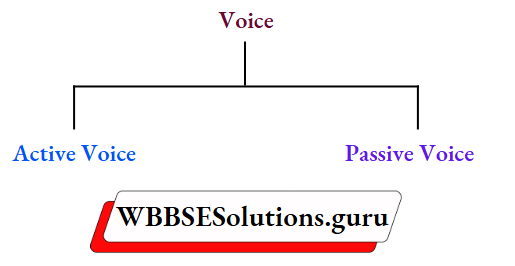
Voice দুই প্রকার : Active ও Passive:

WBBSE Solutions For Class 8 English Functional Grammar Chapter 7 Voice Active Or Passive Voice

Subject বা কর্তা যখন নিজেই কাজটি করে, তখন সেই Sentence-এর Verb-টির Active Voice হয়। When the Subject of the sentence is the ‘doer’ or ‘actor’, the Verb is Active.

নীচের উদাহরণগুলি দেখো:

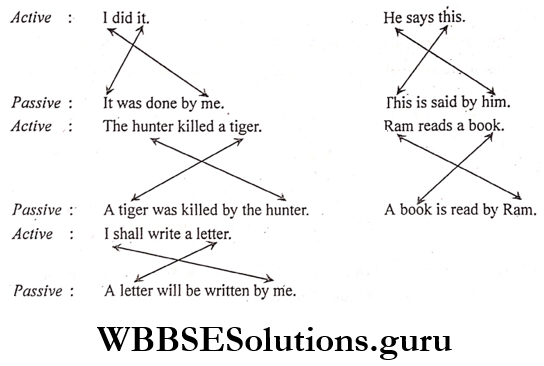
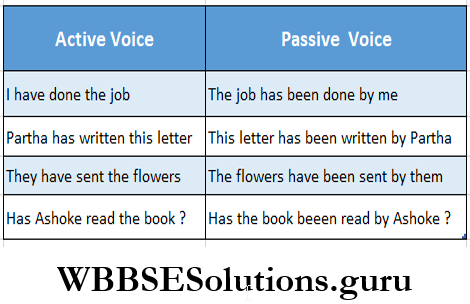
Active Voice      –   Passive Voice

I saw the tiger    –   The tiger was seen by me.

I did it                –   It was done by me.

He says this       –  This is said by him.

উপরের ‘I saw the tiger’ এই বাক্যে saw এই Verb-টির Active Voice হয়েছে। সেরূপ, I did it, He says this—এই sentence-গুলিতে Verb গুলির Active Voice হয়েছে।

যখন Object-টি Subject-এ পরিণত হয়ে প্রকৃত Subject-এর উপর কাজ করে তখন Verb-টির Passive Voice হয়। When the Subject of the sentence is “acted upon”, the Verb is Passive.

পূর্বের ‘The tiger was seen by me’ এই বাক্যে see – এই verb-এর Passive Voice হয়েছে। অনুরূপভাবে It was done by me, This is said by me, This is said by him-sentence- verb-4 Passive Voice হয়েছে।

WBBSE Chapter 7 Voice Active Voice-কে Passive Voice-এ করবার নিয়ম।

  1. Active Voice- Object টি  – Passive Voice –  Subject  – এ
  2. Active Voice-  Subject  টি – Passive, Voice- Object – এ
  3. Verb-টি Past Participle form-এ পরিবর্তিত করে তার পূর্বে “to be” verb-এর আবশ্যকীয় form বসাতে হয়।

নীচের sentence গুলি লক্ষ্য করো :

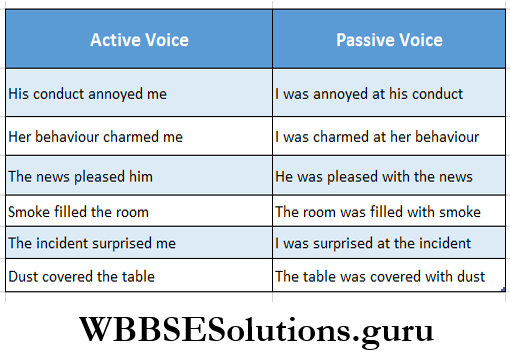
WBBSE Solutions For Class 8 English Functional Grammar Chapter 7 Voice Active Or Passive Voice Sentence

Active voice- it, this, tiger, book, letter ও I—এগুলি Objects, 4 I, he, hunter,

Subjects. Passive it,This,Tiger,Book,Letter.SubjectsI, he, hunter, Ram ও I—এগুলি Objects-এ পরিণত হল এবং এদের পূর্বে by বসল।

মনে রাখবে : Active Voice-এর Subject যদি কোনো ব্যক্তি (person) না হয়, তা হলে by ছাড়া অন্য কোনো preposition যোগ করতে হয়। যথা :

WBBSE Solutions For Class 8 English Functional Grammar Chapter 7 Voice Active And Passive Voice

বে এর ব্যতিক্রম আছে, যেমন :

Active: The fire destroyed the building.

Passive: The building was destroyed by fire.

Note : অনেক সময় Passive voice-এ Object-টি উহ্য থাকে :

  • It is said (by men) that he will come.
  • My book has been lost (by me).
  • The curfew was lifted last night.
  • The lion is called the king of beasts. The window pane has been broken.
  • He was known as Masterda.

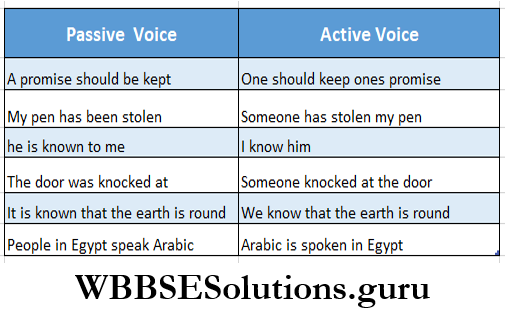
Active-এ sentence-গুলি এরূপ হবে :

  • Men say that he will come.
  • I have lost my book.
  • The city police lifted the curfew last night.
  • People call the lion the king of beasts.
  • Someone has broken the window pane. People knew him as Masterda.

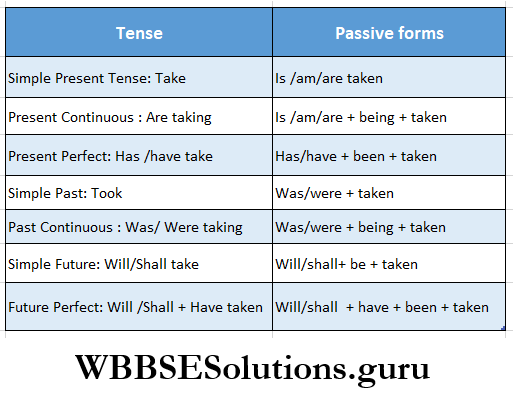
Active Voice C Passive Voice- Verb-47 Tense-97 রূপান্তর:

WBBSE Solutions For Class 8 English Functional Grammar Chapter 7 Voice Tense And Passive Voice

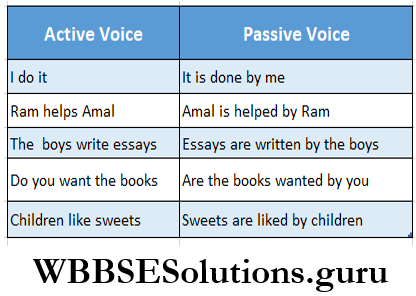
WBBSE Chapter 7 Voice Simple Present

WBBSE Solutions For Class 8 English Functional Grammar Chapter 7 Voice Active And Passive Voice Of Simple Present

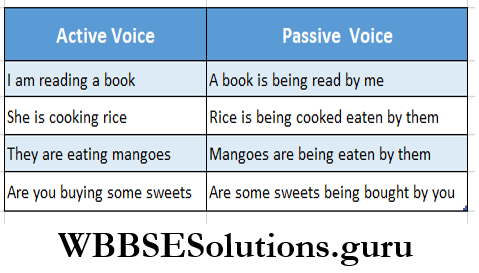
WBBSE Chapter 7 Voice Present Continuous

WBBSE Solutions For Class 8 English Functional Grammar Chapter 7 Voice Active And Passive Voice Of Present Continuous

WBBSE Chapter 7 Voice Present Perfect

WBBSE Solutions For Class 8 English Functional Grammar Chapter 7 Voice Active And Passive Voice Of Present Perfect

WBBSE Chapter 7 Voice Simple Past

WBBSE Solutions For Class 8 English Functional Grammar Chapter 7 Voice Active And Passive Voice Of Simple Past

WBBSE Chapter 7 Voice Past Continuous

WBBSE Solutions For Class 8 English Functional Grammar Chapter 7 Voice Tense And Passive Voice Of Past Continuous

WBBSE Chapter 7 Voice Simple Future

WBBSE Solutions For Class 8 English Functional Grammar Chapter 7 Voice Active And Passive Voice Of Simple Future

Object – Transitive Verb – Voice:

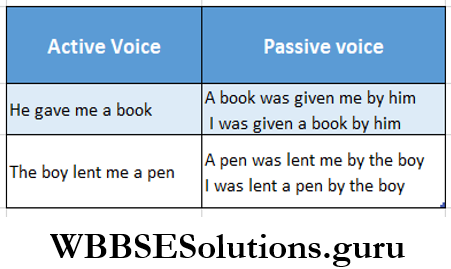
Active Voice-এ verb-এর দুটি Object (Direct ও Indirect Object) থাকলে যে-কোনো একটি Object-কে Subject করে অপরটিকে Object-রূপেই রাখতে হয়।

WBBSE Solutions For Class 8 English Functional Grammar Chapter 7 Voice Transitive Of Object

Imperative Sentence- Passive:

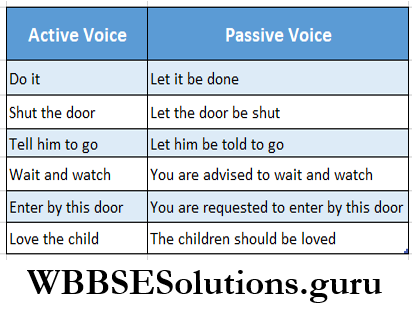
Imperative sentence-কে Active থেকে Passive-এ রূপান্তরিত করতে হলে, প্রথমে let শব্দ দিয়ে sentence আরম্ভ করে verb-টিকে Passive করতে হবে। এ ছাড়া কোনো কোনো ক্ষেত্রে অন্য উপায়ে নতুন word সংযোজন করেও Passive করা হয়। যথা :

WBBSE Solutions For Class 8 English Functional Grammar Chapter 7 Voice Active And Passive Voice Of Imperative Sentence

Note : উপরের উদাহরণগুলি থেকে বুঝবে Intransitive verb-এর Object না থাকাতে তার Passive voice হয় না।

WBBSE Chapter 7 Voice Miscellaneous Examples

WBBSE Solutions For Class 8 English Functional Grammar Chapter 7 Voice Miscellaneous

Passive Voice-এর ব্যবহার :

সাধারণত কোনো ঘটনা বা দুর্ঘটনার বর্ণনা (reporting an event or accident), বা কোনো প্রক্রিয়া বর্ণনা করবার (process description) জন্য verb-এর এই voice ব্যবহৃত হয়।

1. Event:

  • The ball was hit hard but it was caught by Kapil Dev.
  • A new world record was created in 100 m. men’s event.
  • The ball was pitched on the middle stump. Sunil saw the ball and it was hit hard.
  • The speech was made by the Prime Minister in a meeting.

2. Accident:

In a car accident last night two people were killed. The car was chased by the local people. The driver was caught and handed over to the police.

3. Process:

The fruit is cut to pieces and kept separately. Some water is boiled. The cut pieces are dropped into the boiling water.

“Was hit”, “Was caught”, “Was created”, “Was handed over”, “Was hit”, “Was made”, “Were killed”, “Was chased”, “Was caught”, “Is cut”, “Is boiled”, “Dropped”  verb- কোনো কর্তা বা subject বসেনি – কারণ তা অপ্রয়োজনীয়। ফলে লেখাগুলি শ্রুতি মধুর হয়েছে। প্রকৃতপক্ষে বেশির ভাগ ক্ষেত্রেই Passive voice-এর বাংলা ভালো শোনায় না, এবং সেইজন্য বাংলায় এর বেশি প্রচলন নেই। কিন্তু ইংরাজিতে এর প্রচলন বেশি।

WBBSE Chapter 7 Voice Miscellaneous Examples Worked Out

Fill in the blanks with suitable forms of the verbs given within brackets in :

1. This story was told (told) to me earlier.

2. This book was written (write) by a famous author. He was awarded (award) a prize for writing

3. The people were pleased (please) and all the books were sold (sold).

4. After the accident, the lorry was driven (drive) away very fast but soon it was stopped (stop) by the local people after a long chase.

5. This watch is made (made) in India. It Is praised (praise) all over the world.

6. The catch was taken (take) nicely by Arun. But the spectators were shocked (shocked) to see their hero out for only one run.

7. First, the oranges are delivered (deliver) to the factory where they are sorted (sorted) to remove the rotten ones. Then they are cleaned (clean). After that they Are crushed (crush).

8. The fishermen in our country The nets catch(catch) fish in nets are made (make) of strings. The nets are carried (carry) in boats to sea. The nets do not sink (not sink) to the bottom of the sea because they are held (held) up by pieces of cork.

WBBSE Solutions For Class 8 English Functional Grammar Chapter 7 Voice

Turn the following sentences from Active to Passive voice:

1. Simple Present Tense :

Question 1. Sita makes tea.
Answer: Tea is made by Sita

Question 2. They sell toys.
Answer: Toys are sold by them

Question 3. The boy opens the door.
Answer: The door is opened by the boy

Question 4. She calls us.
Answer: We are called by her

Question 5. Everybody respects him.
Answer: He is respected by everybody

Question 6. They learn Hindi.
Answer: Hindi is learned by them

Question 7. Does he help his father?
Answer: Is his father helped by him?

Question 8. The guard rings the bell.
Answer: The bell is rung by the guard

Question 9. She teaches us English.
Answer: English is taught by her.

Question 10. Mohan writes a letter.
Answer: A letter is written by Mohan.

Question 11. Abdul cleans the room.
Answer: The room is cleaned by Abdul.

Question 12. We do it.
Answer: It is done by us.

Question 13. He buyws a pen
Answer: A pen is bought by him.

Question 14. I like the boy.
Answer: The boy is liked by me.

Question 15. Do all the boys buy books?
Answer: Are books bought by all the boys?

Question 16. The farmer feeds the cow every day.
Answer: The cow is fed by the farmer every day.

WBBSE Class 8 English Functional GrammarWBBSE Class 8 English Reading Skills
WBBSE Solutions For Class 8 EnglishWBBSE Solutions For Class 8 Maths


2. Simple Past Tense :

Question 1. You did it.
Answer: It was done by you.

Question 2. I read the book.
Answer: The book was read by me.

Question 3. He ate an apple.
Answer: An apple was eaten by him.

Question 4. They opened the door.
Answer: The door was opened by him.

Question 5. We bought a book.
Answer: A book was bought by us.

Question 6. The cat killed rats.
Answer: Rats were killed by the cat

Question 7. The teacher punished him.
Answer: He was punished by him

Question 8. He invited us.
Answer: We were invited by him

Question 9. She made tea
Answer: Tea was made by her.

Question 10. Abdul cleaned the room.
Answer: The room was cleaned by Abdul.

Question 11. Amita sang a song.
Answer: A song was sung by Amita.

Question 12. They won the match.
Answer: The match was won by them.

Question 13. Ram stole the bicycle.
Answer: The bicycle was stolen by Ram.

Question 14. I asked a question.
Answer: A question was asked by me.

Question 15. The teacher called us.
Answer: We were called by the teacher.

Question 16. Did you draw the picture?
Answer: Was the picture drawn by you?

3. Simple Future Tense :

Question 1. Sukhen will help me.
Answer: I shall be helped by Sukhen.

Question 2. They will build a house.
Answer: A house will be built by them.

Question 3. The teacher will punish Arun.
Answer: Arun will be punished by the teacher.

Question 4. We shall tell the truth.
Answer: The truth will be told by us.

Question 5. The girl will shut the door.
Answer: The door will be shut by the girl.

Question 6. He will tell a story.
Answer: A story will be told by him.

Question 7. She will cook rice.
Answer: Rice will be cooked by her.

Question 8. Will you do the job?
Answer: Will the job be done by you?

Question 9. The boys will read the book
Answer: The book will read by the boys

Question 10. Amal will post the letter.
Answer: Amal will post the letter

Question 11. I shall drive the car.
Answer: The car will be driven by me.

Question 12. Shall I ask a question?
Answer: Will a question be asked by me?

Question 13. The servant will clean the room.
Answer: The room will be cleaned by the servant.

Question 14. Everyone will like you.
Answer: You will be liked by everyone.

Question 15. We shall spend the money.
Answer: The money will be spent by me.

Question 16. The man will carry the box.
Answer: The box will be carried by the man.

4. Present Continuous Tense :

Question 1. He is doing the work.
Answer: The work is being done by him.

Question 2. They are reading a novel.
Answer: A novel is being read by them.

Question 3. She is singing a song.
Answer: A song is being sung by her.

Question 4. Arati is writing a letter.
Answer: A letter is written by Arati.

Question 5. The boys are cutting the trees.
Answer: The trees are being cut by the boys.

Question 6. They are watching us.
Answer: We are being watched by them.

Question 7. The girl is drawing a sketch.
Answer: A sketch is being drawn by the girl.

Question 8. The man is catching the ball.
Answer: The ball is being caught by the man.

Question 9. We are buying some sweets.
Answer: Some sweets are being bought by us.

Question 10. Are you telling the truth?
Answer: Is the truth being told by you?

5. Present Perfect Tense:

Question 1. I have done the work.
Answer: The work has been done by me.

Question 2. Partha has written the letter.
Answer: The letter has been written by Partha.

Question 3. He has sold the car.
Answer: The car has been sold by him.

Question 4. She has lost the books.
Answer: The books have been lost by her

Question 5. The man has killed the tiger.
Answer: The tiger has been killed by the man.

Question 6. I have read the book.
Answer: The Book has been read by me

Question 7. They have helped me.
Answer: I have been helped by them.

Question 8. She has washed the clothes.
Answer: The clothes have been washed by her.

Question 9. My brothers have brought this dog.
Answer: This dog has been brought by my brothers.

Question 10. Have they told this story?
Answer: Has this story been told by them?

6. Past Continuous Tense :

Question 1. I was doing the work.
Answer: The work was being done by me.

Question 2. Sandip was writing a letter.
Answer: A letter was being written by Sandip.

Question 3. He was reading the book.
Answer: The book was being read by him.

Question 4. They were calling me.
Answer: I was being called by them.

Question 5 . Were the boys throwing stones?
Answer: Were stones being thrown by the boys?

Question 6. She was washing the clothes.
Answer: The clothes were being washed by her.

Question 7. You were drawing a sketch.
Answer: A sketch was being drawn by you.

Question 8. They were cutting the tree.
Answer: The tree was being cut by them.

Question 9. The teacher was teaching English.
Answer: English was being taught by the teacher.

Question 10. The boys were pulling the cart.
Answer: The cart was being pulled by the boys.

Change the verbs in the following sentences from Passive Voice into Active Voice:

Question 1. He was elected king.
Answer: They elected him king.

Question 2. The dog is called Don.
Answer: We call the dog Don.

Question 3. Arabic is spoken in Egypt.
Answer: People in Egypt speak Arabic.

Question 4. The door was knocked at.
Answer: Someone knocked at the door.

Question 5. My book has been lost.
Answer: I have lost my book.

Question 6. By whom was this book written?
Answer: Who wrote this book?

Question 7. He was called a fool.
Answer: They called him a fool.

Question 8. Vitamins are needed for the growth of our body.
Answer: We need vitamins for the growth of our body.

Question 9. I was punished.
Answer: They punished me.

Question 10. Promises should be kept.
Answer: One should keep one’s promise.

Question 11. The castle was built in 1690.
Answer: They built the castle in 1690.

Question 12. Nothing can be gained without labor.
Answer: One can gain nothing without labor.

WBBSE Solutions For Class 8 English Functional Grammar Chapter 1 Countable And Uncountable Nouns

WBBSE Chapter 1 Countable And Uncountable Nouns

তোমরা পূর্বে পড়েছ যে Noun পাঁচ প্রকার :

  1. Proper Noun
  2. Common or Class Noun
  3. Collective Noun
  4. Material Noun
  5. Abstract Noun

Read And Learn More WBBSE Class 8 English Functional Grammar

আরও এক প্রকারে Noun দুই ভাগে ভাগ করা যায় :

  1. Countable Nouns
  2. Uncountable Nouns

WBBSE Solutions For Class 8 English Functional Grammar Chapter 1 Countable And Uncountable Nouns

WBBSE Chapter 1 Countable Nouns

যে সমস্ত Nouns এক, দুই, তিন করে গোনা যায় তাদেরকে Countable Nouns বলে।

যথা: boy, apple, men, tree, house, etc. Countable Noun- সাধারণত , pural form হয়। Common Noun ও Collective Noun -গুলি Countable হয়।

এদের পূর্বে  Singular- a,  অথবা an বসে না।  plural-  many, a few, few, several, etc.বসে।

যথা: a cat, a school, a boy, an umbrella, many cows, few books, several boys.

Countable Nouns: Countable Nouns are those that can be counted. Only countable nouns have a plural form and can be used with the indefinite article (a, an) in the singular or many, few, a few, several, etc. in the plural.

WBBSE Class 8 English Functional GrammarWBBSE Class 8 English Reading Skills
WBBSE Solutions For Class 8 EnglishWBBSE Solutions For Class 8 Maths


WBBSE Chapter 1 Uncountable Nouns

যে Noun-গুলোকে এক, দুই, তিন করে গোনা যায় না তাদেরকে Uncountable Nouns বলে।

যথা: : water, air, grass, glass, wood, sand, etc.

এই Noun-গুলি গোনা না গেলেও এদের পরিমাপ করা যায়। এদের কোনো plural form হয় না এবং এদের পূর্বে a অথবা an বসে না। পরিমাণ বোঝাতে এদের পূর্বে much, little ইত্যাদি বসে।

যথা:  much sugar, little water, etc.

Uncountable Nouns:  Uncountable Nouns stand for something that cannot be counted though they can be measured. Such nouns have no plural forms and are not used with the indefinite article. They may be preceded by much, little, etc. to denote amount or quantity.

WBBSE Solutions For Class 8 English Functional Grammar Chapter 3 Uses Of Some Any Everybody Every One Anything Everything Something And Somebody

WBBSE Chapter 3 Uses Of Some

  • Some— কোনো কিছু, কিছুটা, কিছু
  • Some food—কিছুটা খাবার
  • Some money—কিছু টাকা
  • Some man — কোনো লোক
  • Some men —কিছু লোক
  • Some children—কিছু শিশু

 WBBSE Chapter 3 Uses Of Any

  • Any—যে কোনো
  • Any girl (বা girls ) – কোনো মেয়ে (বা মেয়েরা )
  • Any book (বা books)—কোনো বই (বা বইগুলি )
  • Any boy—যে কোনো একটি বালক
  • Any two boys— যে কোনো দুইটি বালক
  • Any house — যে কোনো বাড়ি
  • Any three houses—যে কোনো তিনটি বাড়ি

Read And Learn More WBBSE Class 8 English Functional Grammar

Any-এরপর singular ও plural দুইই হতে পারে। নীচের উদাহরণগুলি লক্ষ্য করো :

  • Please give me some food — আমাকে কিছু খাবার দাও।
  • Do you want any sweet ? – তুমি কি কোনো মিষ্টি নেবে ?
  • I don’t have any book(s) — আমার কোনো বইই নেই।
  • I shall buy some clothes — আমি কিছু জামা কাপড় কিনব।
  • There are some books on the table—টেবিলের উপরে কিছু বই আছে।
  • Has he got any friends ? — তার কি কোনো বন্ধু আছে?
  • Why didn’t you buy any food ? – তুমি কোনো খাবার কেনোনি কেন ?
  • Can you lend me some money ? — আমাকে কিছু টাকা ধার দিতে পার কি ?
  • Some people do not like him — কিছু লোক তাকে পছন্দ করে না।
  • Any boy can do the sum – যে কোনো বালক অঙ্কটি করতে পারবে।
  • Would you like some coffee ? – তুমি কি একটু কফি নেবে ?

WBBSE Solutions For Class 8 English Functional Grammar Chapter 3 Uses Of Some Any Everybody Every One Anything Everything Something And Somebody

WBBSE Chapter 3 Uses Of Everybody Everyone, Anything And Everything

  1. Everybody— প্রত্যেকে, প্রত্যেক লোক, সবাই, Everyone — প্রত্যেকে
    • Everybody ও Everyone ব্যক্তি সম্বন্ধে ব্যবহৃত হয়। এরা singular এবং এদের পরে singular- verb বসে।
  2. Anything — কোনো কিছু, যে কোনো কিছু, একটুও
    • Anything 3 Everything বস্তু সম্বন্ধে ব্যবহৃত হয়।
  3. Everything—প্রত্যেকটি বস্তু, সবকিছু
    • Everything singular এবং এর পরে singular verb বসে।
WBBSE Class 8 English Functional GrammarWBBSE Class 8 English Reading Skills
WBBSE Solutions For Class 8 EnglishWBBSE Solutions For Class 8 Maths


নীচের উদাহরণগুলি লক্ষ্য করো :

  • Everybody / Everyone was present there — সেখানে প্রত্যেকেই বা সবাই উপস্থিত ছিল।
  • Everybody / Everyone enjoyed the party— পার্টিটা সবাই উপভোগ করেছিল।
  • Everybody / Everyone in this class has done well in the examination — এই ক্লাসের প্রত্যেকেই বা সবাই পরীক্ষায় ভালো করেছে।
  • Everybody / Everyone needs friends — প্রত্যেকেরই বন্ধু দরকার।
  • Everything went wrong yesterday — গতকাল সবকিছুই গণ্ডগোল হয়ে গেল।
  • I will do everything to help you — তোমাকে সাহায্য করার জন্য আমি সবকিছুই করব।
  • Have you got everything you need ? – তোমার যা দরকার সব পেয়েছ কি ?
  • I do not know anything in this matter— আমি এই ব্যাপারে কিছু জানিনা ।
  • I was angry but I did not say him anything— আমার রাগ হয়েছিল কিন্তু আমি তাকে কিছু বলিনি।
  • There is not anything in the bag— এই ব্যাগে কিছুই নেই।
  • Are you doing anything on Sunday ? – তুমি কি রবিবার কিছু করছ ?
  • I am hungry, I can eat anything you give— আমার খুব খিদে পেয়েছে, যা কিছু দেবে আমি খেতে পারি।
  • You can take anything you like — যা কিছু তোমার পছন্দ তুমি নিতে পার।

WBBSE Chapter 3 Uses Of Something And Somebody

  1. Something—কিছু, কোনো কিছু
    • Somebody : A person but we do not know who.
  2. Somebody—কেউ
    • Something : A thing but we do not know what.

নীচের উদাহরণগুলি লক্ষ্য করো :

  • The girl has got something in her bag — মেয়েটির ব্যাগে কিছু আছে ।
  • Give him something to eat — তাকে কিছু খেতে দাও।
  • He said something but I did not understand it. – সে কিছু বলল কিন্তু আমি তা বুঝতে পারি নি।
  • Something happened to him yesterday — গতকাল তার কিছু হয়েছে।
  • Somebody is coming this way — এদিকে কেউ আসছে।
  • I saw somebody standing under the tree—গাছের নীচে কেউ দাঁড়িয়ে আছে দেখলাম।

WBBSE Solutions For Class 8 English Functional Grammar Chapter 5 Shall And Will

WBBSE Chapter 5 Shall And Will

পূর্বে তোমরা পড়েছ shall, will, be, have, May ও do প্রভৃতি যখন অন্য Verb-এর সাহায্যকারীভাবে ব্যবহৃত হয়, তখন তাদেরকে Auxiliary Verbs বলে। এখানে “shall” “will”-এর ব্যবহার প্রণালী দেওয়া হল।

নীচের Sentence গুলি লক্ষ্য কর :

  1. I shall go—আমি যাব (শুধু ভবিষ্যৎ বোঝায়)।
  2. I will go—আমি যাবই (বক্তার দৃঢ় সঙ্কল্প বোঝায়)।
  3. You will go—তুমি, যাবে (শুধু ভবিষ্যৎ বোঝায়)।
  4. You shall go – তুমি যাবেই (বক্তার আদেশ বোঝায়)।
  5. He will go—সে যাবে (শুধু ভবিষ্যৎ বোঝায়)।
  6. He shall go—সে যাবেই (বক্তার আদেশ বোঝায়)।

সুতরাং মনে রেখো :

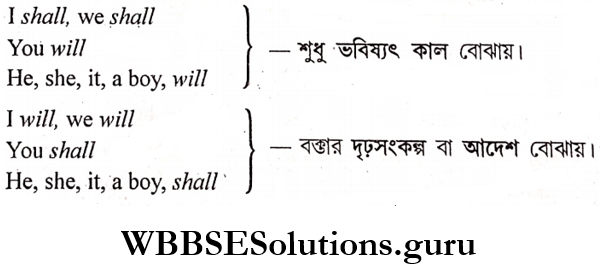
  1. শুধু ভবিষ্যৎ কাল বোঝাতে First person-এ “shall” এবং Second ও Third Person – এ “will” বসে।
  2. বক্তার অঙ্গীকার, দৃঢ়সংকল্প, আদেশ বা হুমকি (Threat) বোঝাতে First Person-এ “will” এবং Second ও  Third Person-এ “shall” বসে।

Read And Learn More WBBSE Class 8 English Functional Grammar

নীচের Table-টি স্মরণে রেখো :

WBBSE Solutions For Class 8 English Functional Grammar Chapter 5 Shall And Will Persons

WBBSE Solutions For Class 8 English Functional Grammar Chapter 5 Shall And Will

Interrogative Sentence – এ:

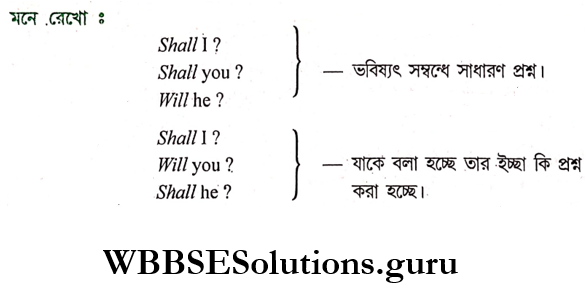
বা প্রশ্নবোধক বাক্যে শুধু ভবিষ্যৎ কাল সম্বন্ধে সাধারণ জিজ্ঞাসা বোঝাতে First ও Second Person-এ shall এবং Third Person-এ will বসে। কিন্তু যাকে বলা হচ্ছে তার ইচ্ছা কি জানবার জন্য First 3 Third Person-এ shall এবং Second Person এ will বসে।

WBBSE Solutions For Class 8 English Functional Grammar Chapter 5 Shall And Will Interrogative Sentence

WBBSE Solutions For Class 8 English Functional Grammar Chapter 5 Shall And Will Interrogative Sentence.

Interrogative-এ “will I ?” কখনো হয় না।

WBBSE Class 8 English Functional GrammarWBBSE Class 8 English Reading Skills
WBBSE Solutions For Class 8 EnglishWBBSE Solutions For Class 8 Maths


Examples of Interrogative:

  1. The school shall be closed tomorrow — নিশ্চয়তা বোঝায়। সুতরাং শুধু কর্তৃপক্ষ স্থানীয় কেউ ছাড়া এটা বলতে পারে না ।
  2. The school will be closed tomorrow — যে কেউ বলতে পারে।
  3. You or he shall be punished বক্তা ভয় দেখাচ্ছে।
  4. You or he will be punished – সাধারণ মন্তব্য, শাস্তি দেওয়া সম্বন্ধে বক্তার কোনো হাত নেই।

WBBSE Solutions For Class 8 English Functional Grammar Chapter 4 Verbs Principle And Auxillary Transitive And Intransitive

WBBSE Chapter 4 Verbs Principal And Auxiliary

Verbs প্রধানত দুইভাগে বিভক্ত :

  1. Principal
  2. Auxiliary

যে সকল verb স্বাধীনভাবে বসতে পারে তাদেরকে Principal Verb বলে।:

যথা : I saw him. He lives here.

Read And Learn More WBBSE Class 8 English Functional Grammar

যে verb স্বাধীনভাবে বসে না, শুধু অন্য verb-এর voice, mood, tense ইত্যাদি গঠনে সাহায্য করে তাকে Auxiliary (R) Verb:

যথা : be, have, shall will,do, may

  • I am helped by him.
  • He has gone.
  • I shall do it.
  • He will run.
  • He does not know me.
  • We eat that we may live.

am helped, has gone, shall do, will run, does know, may live   help, go, do, run, know live-31 Am, has, shall, will, does মাত্র—তাদের নিজস্ব কোনো অর্থ নেই। may

Auxiliary verb-গুলি কখনো কখনো Principal Verb-এর মতোও ব্যবহৃত হতে পারে।:

যথা : I am happy. He has a dog. I did it.

WBBSE Solutions For Class 8 English Functional Grammar Chapter 4 Verbs Principle And Auxillary Transitive And Intransitive

WBBSE Chapter 4 Verbs Transitive And Intransitive

তোমরা বাংলায় পড়েছ যে ক্রিয়াগুলি (verbs) সাধারণত দুই ভাগে বিভক্ত :–সকর্মক (Transitive) ও অকর্মক (Intransitive)। ইংরাজিতেও সেইরূপ verb-গুলি সাধারণত Transitive ও Intransitive—এই দুই ভাগে বিভক্ত।

WBBSE Chapter 4 Verbs Transitive Verbs

He loves me – I saw him – He did it.

উপরের sentence-গুলিতে me, him ও it, যথাক্রমে loves, saw এবং did — এই তিনটি verb-এর object. সুতরাং এই verb-গুলি Transitive.

যে Verb-এর object (কর্ম) আছে, তাকে Transitive Verb বলে। Verbs which require objects are called Transitive Verbs.

WBBSE Class 8 English Functional GrammarWBBSE Class 8 English Reading Skills
WBBSE Solutions For Class 8 EnglishWBBSE Solutions For Class 8 Maths


নীচে এইরূপ আরো কতকগুলি Transitive verbs-এর উদাহরণ দেওয়া হল :

WBBSE Solutions For Class 8 English Functional Grammar Chapter 4 Verbs Principal And Auxiliary Transitive And Intransitive Transitive verb

WBBSE Chapter 4 Verbs Intransitive Verbs

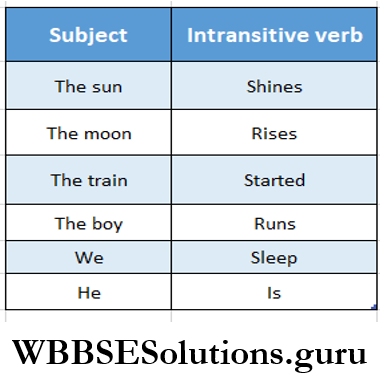
I run he sleeps

উপরের sentence-গুলিতে run ও sleep এই verb-গুলির কোনো object নেই। তবুও sentence-গুলির অর্থ সম্পূর্ণ হয়েছে। এজন্য এরা Intransitive verbs.

যে Verb-এর object নেই, তাকে Intransitive Verb বলে। Verbs which do not take objects are called Intransitive Verbs.

নীচে এইরূপ আরও কতকগুলি Intransitive verbs-এর উদাহরণ দেওয়া হল :

WBBSE Solutions For Class 8 English Functional Grammar Chapter 4 Verbs Principal And Auxiliary Transitive And Intransitive Intransitive Verb

মনে রেখো, Verb-এর উপরে কি? (What?) বা (কাকে ?) (Whom ?) প্রশ্ন করলে যে উত্তর পাওয়া যায় সেটাই object.

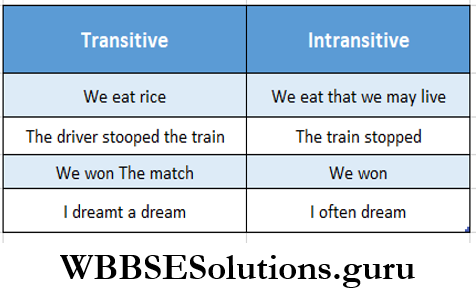
একই Verb কখনও Transitive কখনও Intransitive ভাবে ব্যবহৃত হতে পারে। যথা :

WBBSE Solutions For Class 8 English Functional Grammar Chapter 4 Verbs Principal And Auxiliary Transitive And Intransitive Transitive And Intransitive Verbs