- Writing Skill Describing A Process
- Writing Skill Dialogues And Conversations
- Writing Skill Letter Writing



Para 1
Para 2
Para 3
Para 4
Summary (সারাংশ): In the poem ‘Mild the Mist upon the Hill the poet describes the surrounding landscape and tells about the great pleasure, she enjoys watching it.
Read And Learn More WBBSE Class 9 English Reading Skill
The blue mist that surrounds the distant mountains indicates that there would be no rain the next day.
She remembers the secure life she lived under the care of her father in his house.
She enjoys looking at the sweet, blue mist upon the mountain chain on the distant horizon.
The dews on the green grass look like morning tears. Scents of passing fragrances make her feel dreamy. All these make her feel nostalgic for the days of her childhood.
Tick the correct answer from the given alternatives:
Question 1. The mist was upon the-
Answer: Hill
Question 2. The sorrow of the day is described as-
Answer: Silent
Question 3. The hall door mentioned in the poem is-
Answer: 4. Old
Question 4. The poet watches the cloudy-
Answer: Evening
Question 5. The color of the mist is-
Answer: 4. Blue
Question 6. The damp stands on the-
Answer: 4. Grass
Answer the following questions within twenty-five words:
Question 1. Where does the poet see herself when she thinks of her childhood?
Answer: When the poet thinks of her childhood, she sees herself in her father’s house near the old hall door under the safe shelter of his father with love and care.
Question 2. What did the poet watch on the ‘cloudy evening’?
Answer: The poet watched the onset of a cloudy evening with blue mists of summer cloud covering the mountain ranges on the horizon. Damp standing on the long grasses was also seen.
Identify the following sentences as simple, compound, and complex:
Question 1. He is too short to climb the wall.
Answer: Simple sentence.
Question 2. The sky was blue and the sun shone bright.
Answer: Compound sentence.
Question 3. The old man who lived in a village believed that the earth was flat.
Answer: Complex sentence.
Question 4. Leaving a job midway is not a good practice.
Answer: Simple sentence.
Question 5. Last week I met a friend who gave me a bag which is brown in color.
Answer: Complex sentence.
Do as directed:
Question 1. The question was so easy that everyone could answer it. (Change into a simple
sentence)
Answer: The question was too easy for everyone to answer it.
Question 2. A friend in need is a friend indeed. (Change into a complex sentence)
Answer: One who is a friend in need is a friend indeed.
Question 3. Pollution is one of the most severe threats to our beautiful planet. (Change into a compound sentence)
Answer: Our planet is beautiful, but pollution is one of the most severe threats to it.
Question 4. Do or die. (Change into a complex sentence)
Answer: If you do not do it, you die.
Question 5. He was confused and stopped working. (Change into a simple sentence)
Answer: Being confused he stopped working.
Mild the mist upon the hill,
Telling not of storms tomorrow;
No; the day has wept its fill,
Spent its store of silent sorrow.
Oh, I’m gone back to the days of youth,
I am a child once more;
and ‘neath my father’s sheltering roof,
And near the old hall door.
Read the above text and answer the following questions.
Tick the correct answer from the given alternatives:
Question 1. The mist upon the hill is-
Answer: 3. mild
Question 2. The mist foretells that the next day there would be
Answer: 3. Bright weather
Question 3. The day described in the poem was-
Answer: 1. Full of rain
Question 4. The poet remembers her-
Answer: 2. Days of youth
Question 5. The ‘roof’ mentioned in the second para stands for-
Answer: 3. Protection
Question 6. In her imagination, the poet has gone to her-
Answer: 2. Father’s house
Answer the following questions within fifteen words:
Question 1. What does the mild mist signify?
Answer: The mild mist signifies that there will be no storms tomorrow.
Question 2. Why has the day wept its fill?
Answer: The day has wept its fill to spend its store of silent sorrow.
Question 3. What does the poet recollect and what does she want now?
Answer: The poet recollects her days of youth and wants to be a child once more.
Question 4. What comes to her mind now about her childhood?
Answer: The poet now imagines living beneath her father’s sheltering roof near the old hall door.
Question 5. What is the state of feeling in the poet’s mind?
Answer: The poet feels very nostalgic for her youthful days and wants to be a child once again.
Answer the following questions within twenty-five words :
Question 1. Why did the poet think that there would not be any rain tomorrow?
Answer: Mild mist hanging over the hill indicates that there will be no storm tomorrow. Throughout the day there has been heavy rain, so it would not rain tomorrow.
Question 2. What does the poet mean by saying that ‘the day has wept its fill, Spent its store of silent sorrow’?
Answer: Through these lines, the poet says that it has rained throughout the day, and a silent day full of sorrow is over.
Question 3. Why does the poet think that her father’s roof was sheltering?
Answer: The poet recalls her happy childhood days. She was under the care and protection of her father. So she described her father’s roof as sheltering.
I watch this cloudy evening fall,
After a day of rain:
Blue mists, sweet mists of summer pall The horizon’s mountain chain.
The damp stands in the long, green grass As thick as morning’s tears;
And dreamy scents of fragrance pass That breathe of other years.
Read the above text and answer the following questions.
Tick the correct answer from the given alternatives:
Question 1. The evening the poet watches is-
Answer: 2. Cloudy,
Question 2. The cloudy evening comes down-
Answer: On a rainy day
Question 3. The poet sees a chain of
Answer: 1. Mountains
Question 4. The damp stands on the
Answer: 2. Green grass
Question 5. Damp on the grass is referred to as-
Answer: 4. Morning tears
6. The scent of the fragrance was-
Answer: 3. Dreamy,
Answer the following questions within fifteen words:
Question 1. What does the poet watch?
Answer: The poet watches the fall of a cloudy evening after a day of rain.
Question 2. What season does the poet speak of here?
Answer: The poet speaks of the summer season here.
Question 3. What was observed by the poet in the horizon’s mountain chain?
Answer: In the horizon’s mountain chain, the poet observed blue and sweet mists of summer covering them.
Question 4. What are the morning tears?
Answer: The dew drops standing on the long, green grass have been termed as morning tears.
Answer the following questions within twenty-five words:
Question 1. What does the poet see in the evening?
Answer: The poet sees the onset of a cloudy evening after a day of rain, and blue, sweet summer mists falling on the mountain chain on the horizon.
Question 2. What does the poet compare the damp with and why?
Answer: The poet compares the damp with morning tears because it looks like tears as it stands in the long, green grass.
Question 3. What effect do the scents of the passing fragrance have on the poet?
Answer: The scents of the passing fragrance make the poet feel dreamy and remind her of the joyful days of her childhood.
Section 1: (Tom always found Sid slept on.)

Section-2: (Tom groaned louder…………had rushed to cal help)
Section-3: (Tom’s imagination was working………. than that in my toe.)
Read And Learn More WBBSE Class 9 English Reading Skill
Section 4: (“Your tooth indeed………. and admirable way.)
Summary: This is the story of a naughty boy Tom who finds routine school life disgusting and seeks an excuse to skip school. He first tries to be sick with stomach trouble.
But the symptoms soon vanish. He then considers his loose tooth to be because of his sickness.
But soon he discards it as he knows that Aunt Polly would definitely pull it out and he will be hurt. He then thinks of a certain disease.
But he remembers a doctor’s opinion that a certain ailment could lay up a patient in bed for three days and make him lose a finger. He then starts groaning in pain feigning a sore toe and pretending to be dying. Everybody gets scared.
But Aunt Polly very easily detects his prank and orders him to stop groaning. When Tom tells about his toothache, Aunt Polly pulled the loose tooth out with the help of a silk thread. This creates a gap in the front upper row of his teeth.
Tick the correct answer from the given alternatives:
Question 1. Tom Felt Miserable On The Morning Of-
Answer: 2. Monday
Question 2. If Aunt Polly Was To Know That Tom Had A Loose Tooth, She Would-
Answer: 3. Surely Pull It Out
Question 3. Tom Drew His Sore Toe From Under The-
Answer: 1. Sheet
Question 4. Sid Flew Down The Stairs To Call-
Answer: Aunt Polly
Question 5. The Thread That Mary Got For Aunt Polly Was Made Of-
Answer: 3. Silk
Answer the following questions within fifteen words:
Question 1. Which one of Tom’s teeth had come loose?
Answer: One of Tom’s upper front teeth had come loose.
Question 2. How are Sid and Mary related to Tom?
Answer: Sid is Tom’s brother and Mary is Tom’s cousin.
Question 3. Why did Tom ask Sid not to stir him?
Answer: Tom asked Sid not to stir him because he pretended to be seriously ill and he would be killed if shaken.
Question 4. Why did Tom pretend his toe was paining?
Answer: Tom pretended that his toe was paining because he did not want to go to school.
Answer the following questions within twenty-five words:
Question 1. What did Tom remember hearing from a doctor?
Answer: Tom remembered hearing from a doctor that there was a certain ailment that could force a patient to lie in bed for three days, and he would lose a finger.
Question 2. How did Aunt Polly react to the news that Tom was dying?
Answer: When Aunt Polly heard that Tom was dying, she could not believe it. She rushed upstairs to see Tom and became nervous and anxious. Her face grew pale and her lips trembled.
Question 3. How was Tom’s loose tooth taken out?
Answer: Aunt Polly tied one end of a silk thread to Tom’s tooth and the other end to the bedpost. Then by pulling the thread she extracted the tooth.
Do as directed:
Question 1. Rafique was running fast. (Change into an Interrogative sentence).
Answer: Was Rafique running fast?
Question 2. The boy would never forget the exciting incident. (Change into an Affirmative sentence)
Answer: The boy would always remember the exciting incident.
Question 3. We had a wonderful time last evening. (Change into an Exclamatory sentence)
Answer: What a wonderful time we had last evening!
Question 4. He loves to play football. (Change into an Interrogative sentence)
Answer: Does he love to play football?
Question 5. Rina tried all her plans. (Change into a Negative sentence)
Answer: Rina left none of her plans untried.
Question 6. Shut the door, Robin. (Change into an Assertive sentence)
Answer: Robin was asked to shut the door.
Replace the underlined words with suitable phrasal verbs from the list given below. Change the form of verbs where necessary. There is one extra phrasal verb in the list:
Question 1. The enemy surrendered without a fight.
Answer: The enemy gave in without a fight.
Question 2. The child was cured in a month.
Answer: The child came round in a mouth.
Question 3. The police investigated the case.
Answer: The police looked into the case.
Question 4. Puja could understand what her sister said.
Answer: Puja could make out what her sister said.
Question 5. The old man could not remember his childhood experiences.
Answer: The old man could not call up his childhood experiences.
List of phrasal verbs: look into, make out, look for, come round, give in, call up’
1. Tom always found Monday mornings to be miserable. Monday began another week’s slow suffering in school.
Tom lay thinking. Presently, he wished that he was sick: then he could stay home from school.
He investigated his body with the hope of finding some ailment. He thought that he had found symptoms of stomach trouble. He began to grow hopeful.
However, the symptoms soon grew feeble and wholly went away.
Tom thought further. Suddenly he discovered something. One of his upper front teeth was loose.
He felt lucky. He was about to groan when it occurred to him that if Aunt Polly was to know she would surely pull it out and that would hurt.
Tom thought he would hold the tooth in reserve for the present. He remembered hearing from a doctor that a certain ailment could lay up a patient for three days and make him lose a finger.
He eagerly drew his sore toe from under the sheet and held it up for inspection.
He did not know the necessary symptoms. However, it seemed like a good chance. Tom fell to groaning.
But his brother Sid slept on. Read the above text and answer the following questions.
Tick the correct answer from the given alternatives:
1. For Tom Monday was miserable because-
Answer: 2. The week’s suffering in school began on Monday
Question 2. Tom wished that-
Answer: 1. He was sick
Question 3. The symptoms of stomach trouble-
Answer: 3. Disappeared
Question 4. One of the upper front teeth of tom was-
Answer: 2. Loose
Question 5. Tom did not tell anybody about his tooth problem for fear of-
Answer: 1. Aunt Polly
Question 6. From under the sheet, Tom drew-
Answer: 2. Medicines
Answer the following questions within fifteen words:
Question 1. Why did Tom think Monday mornings to be miserable?
Answer: Tom felt that the week’s slow suffering in school began on Monday. So he thought that Monday morning brought misery for him.
Question 2. Why did Tom wish to be sick?
Answer: Tom wished to be sick so that he could stay at home and not have to go to school.
Question 3. Why did Tom investigate his body?
Answer: Tom investigated his body with the hope of finding some ailment that would prevent him from going to school.
Question 4. Why did Tom keep his tooth problem unknown?
Answer: Tom kept his tooth problem unknown for fear of Aunt Polly.
Question 5. Why was he afraid of Aunt Polly?
Answer: He was afraid of Aunt Polly because if she knew about Tom’s loose tooth, she would hurt him by pulling it out.
Question 6. Why did Tom start groaning?
Answer: Tom started groaning to indicate that he felt great pain from his sore toe.
Answer the following questions within twenty-five words:
Question 1. How did Tom feel on Monday mornings and what did he do and why?
Answer: Tom found Monday mornings miserable because from this day the week’s slow suffering in school started. He wished to be sick so that he could stay at home and avoid going to school.
Question 2. What did he discover suddenly? Why didn’t he groan?
Answer: Tom discovered suddenly that one of his upper front teeth was loose. He was about to groan but stopped doing that fearing that if Aunty Polly knew that she would hurt him by pulling out the tooth.
Question 3. “It seemed like a good chance.”-What seemed to be a good chance?
Answer: Tom found after inspection that he had a sore toe. It seemed to be a good chance for him to avoid going to school with an injured leg.
2. Tom’s imagination was working perfectly by now and his groans had gathered a genuine tone.’
Meanwhile, Sid flew downstairs and said: “Oh, Aunt Polly, come! Tom’s dying!
“Dying?”
“Yes. Don’t wait, come quick.”
“What rubbish! I don’t believe it.”
She flew upstairs with Sid and Mary, Tom’s cousin. Her face grew pale and her lips trembled. When she reached the bedside, she gasped out :
“Tom! Tom, what’s the matter with you ?”
“Oh, auntie, I’m-”
“What is the matter with you child?”
“Oh, auntie, my toe is paining.”
The old lady sank into a chair. She laughed a little, then cried a little.
Then she said:
“Tom, what a shock you did give me! Now shut up the nonsense and get out of this.” The groans ceased.
The toe pain vanished. Tom felt a little foolish and said, “Aunt Polly, how my toothaches! The pain is more than that in my toe.”
“Your tooth, indeed! What’s the matter with your tooth?”
“One of them is loose and it aches awfully.”
“There, there, now don’t begin that groaning again. Open your mouth.
Your tooth is loose but you’re not going to die for that. Mary, get me a silk thread.
Tom said: “Oh, please Auntie, don’t pull it out. It doesn’t hurt anymore. Please Auntie, I don’t want to stay hoi. “from school.”
“So all this was because you wanted to stay home from school and go fishing? Tom, Tom, I love you so much and you try to break my heart in every way with your naughtiness!”
By this time the dental instrument was ready. The old lady fastened one end of the silk thread to Tom’s tooth and the other end to the bedpost.
She pulled and the tooth hung dangling by the bedpost. Tom now had a gap in his upper row of teeth.
This enabled im to smile in a new and admirable way.
Read the above text and answer the following questions.
Tick the correct answer from the given alternatives:
Question 1. Sid went downstairs and told int Polly that Tom was-
Answer: 2. Dying
Question 2. Aunt Polly came upstairs.
Answer: 4. With Sid and Mary
Question 3. Mary was Tom’s
Answer: 3. Cousin
Question 4. Tom initially told aunt polly that he had-
Answer: 1. Pain in the toe
Question 5. Aunt Polly could make out that Tom was telling something that was-
Answer: 3. Nonsense
Question 6. Aunt Polly asked Mary to get her-
Answer: 3. A silk thread
Answer the following questions within fifteen words:
Question 1. What was Aunt Polly’s immediate reaction, when Sid told her that Tom was dying?
Answer: Aunt Polly reacted by saying that what Sid had said about Tom was all rubbish and she did not believe that.
Question 2. What did Tom say to Aunt Polly when she met him?
Answer: Tom told her that his toe was paining.
Question 3. When did Tom cease to groan?
Answer: Tom ceased to groan when Aunt Polly discovered his prank and scolded him for pretending to be ill.
Question 4. Why did Tom feel a little foolish?
Answer: Tom ceased to groan when Aunt Polly discovered his prank and scolded him for pretending to be ill.
Question 5. What was the reason for Tom feigning that he had toe pain?
Answer: Tom feigned suffering from toe pain so that he could stay at home and not have to go to school.
Question 6. What did Aunt Polly use to take out the loose tooth?
Answer: Aunt Polly used a silk thread to take out the loose tooth.
Answer the following questions within twenty-five words:
Question 1. When did Tom’s toe pain vanish?
Answer: When Aunt Polly realized that Tom was feigning toe pain only to avoid going to school she asked him to shut up the nonsense. Tom’s toe pain vanished immediately.
Question 2. How did Tom defend his illness when his earlier trick of toe pain failed?.
Answer: His earlier trick of toe pain failing, he offered the excuse that one of his teeth was loose and was aching awfully, much more than that in his toe.
Question 3. How do we know about Aunt Polly’s affection for Tom?
Answer: Aunt Polly was very affectionate towards Tom. She rushed upstairs and grew pale, and her lips trembled to see Tom suffering from pain. She immediately arranged to pull out Tom’s aching tooth for his relief.
Question 4. What effect did the pulling of the tooth have on Tom’s face?
Answer: After pulling out the loose tooth, a gap was formed in Tom’s front upper row of teeth. This enabled him to smile in a new and admirable way.
Stanzas:1-2 (lines: I saw three……..to a rich country)
Stanzas: 3-4:(lines:the second turned………..docks shone frostily)

Stanzas: 5-6 (lines: the northern sky………..for a long journey)

Summary: The poet here presents the journies of three ships in the sea in different directions as emblematic of our life’s endless struggle to attain our goals.
Read And Learn More WBBSE Class 9 English Reading Skill
The first ship sailed westward over the tumultuous sea and drifted to a rich country far away. The second ship moved eastward in an unfriendly natural condition.
Driven by the merciless wind it was anchored in the sea as a captive. While the two returned ultimately with mixed experiences, the third one sailed towards the north and faced challenges in the ‘unforgiving’ sea.
But it continued its long onward journey for attaining its goal.
Tick the correct answer from the given alternatives:
Question 1. The number of ships sailing by were-
Answer: 1. Three
Question 2. The wind carried the first ship to a-
Answer: 3. Rich country
Question 3. The second ship turned towards the-
Answer: East
Question 4. The decks of the third ship shone-
Answer: 2. Frostily
Question 5. The northern sky rose over the-
Answer: 1. Unfruitful sea
Question 6. The third ship was rigged for a-
Answer: 1. Long journey
Answer the following questions within twenty-five words:
Question 1. What did the wind do to the second ship?
Answer: As the second ship turned towards the east over the turbulent sea, it was hunted like a beast by the wind and kept anchored in the sea like a prisoner.
Question 2. Give any two points of difference between the journey of the third ship and the other two ships.
Answer: The first and the second ships returned after the voyage, but the third ship continued its journey. Unlike the first and the second ships, only the third ship was equipped for a long journey.
Replace the underlined words with suitable phrasal verbs given in the list below. Change the form if necessary. There are two extra phrasal verbs:
Question 1. The child resembles its grandfather.
Answer: The child takes after their grandfather.
Question 2. They published a magazine recently.
Answer: They brought out a magazine recently.
Question 3. My mother taught me not to disrespect anyone.
Answer: My mother taught me not to look down upon anyone.
Question 4. We should abolish bad habits.
Answer: We should give up bad habits.
Question 5. A new university was built at Coochbehar.
Answer: A new university was set up at Coochbehar.
Phrasal verbs: bring out, set up, put up, run after, give up, look down upon, take after.
Do as directed:
Question 1. The man was so weak that he could not walk. (Rewrite using ‘too’)
Answer: The man was too weak to walk.
Question 2. Titir is one of the most intelligent girls in the class. (Rewrite using the positive degree of the underlined adjective)
Answer: Very few girls in the class are as intelligent as Titir.
Question 3. As soon as he reached home, it started raining heavily. (Change into a negative sentence)
Answer: No sooner did he reach home than it started raining heavily.
Question 4. Why cry over spilt milk? (Change into an assertive sentence)
Answer: It is no use crying over spilt milk.
Question 5. Blood is thicker than water. (Change into an interrogative sentence)
Answer: Is not blood thicker than water?
Question 6. He told a lie intentionally. (Rewrite using the noun form of “intention”.)
Answer: He told a lie with an intention.
Question 7. Run fast or you will be late. (Change into a complex sentence)
Answer: If you do not run fast, you will be late.
Question 8. The reporter made the news public. (Rewrite using the verb form of ‘public’)
Answer: The reporter publicized the news.
I saw three ships go sailing by,
Over the sea, the lifting sea,
And the wind rose in the morning sky,
And one was rigged for a long journey.
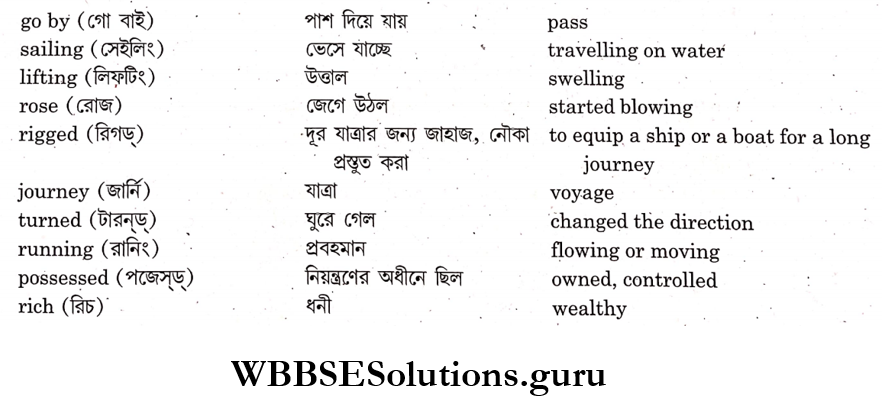
The first ships turned towards the west,
Over the sea, the running sea,
And by the wind was all possessed And carried to a rich country.
The second turned towards the east,
Over the sea,
the quaking sea And the wind hunted it like a beast To anchor in captivity.
Read the above stanzas and answer the following questions.
Tick the correct answers from the given alternatives:
Question 1. The poet saw the ships go sailing by-
Answer: 1. In the morning
Question 2. The first ship turned towards-
Answer: 2. West
Question 3. The number of ships equipped for a long journey was-
Answer: 4. One
Question 4. The second ship was sailing over a sea that was-
Answer: 2. Quaking
Question 5. The second ship was hunted by-
Answer: 3. The wind
Question 6. The first ship was helped by-
Answer: 3. The wind
Question 7. The second ship was hunted like-
Answer: 1. A beast
Answer the following questions within fifteen words:
Question 1. What did the poet see?
Answer: The poet saw three ships go sailing over the swelling sea.
Question 2. How many amongst the ships were equipped for a long journey?
Answer: Only one of the three ships was equipped for a long journey.
Question 3. In what direction did the first ship turn?
Answer: The first ship turned towards the west.
Question 4. Where did the first ship reach ultimately?
Answer: The first ship reached a rich country ultimately.
Question 5. In which direction did the second ship move?
Answer: The second ship moved towards the east.
Question 6. What was the nature of the sea as the second sea turned towards the east?
Answer: When the second sea turned east, the sea was quite turbulent.
Question 7. What happened to the second ship?
Answer: The unfriendly wind hunted the ship like a beast and kept it anchored in the sea.
Answer the following questions within twenty-five words:
Question 1. How was the sea over which the first ship and the second ship set off?
Answer: The first ship was faced with a running sea and the second ship with a stirring sea.
Question 2. What happened to the first ship?
Answer: As the first ship turned towards the west, the favourable wind carried it to a rich country.
Question 3. How did the behaviour of the sea towards the first ship and the second ship differ?
Answer: The sea behaved very friendly with the first ship and took is to a rich country, but during the sailing of the second ship, it was quaking and unfriendly resulting in the wind hunting it like a beast and anchoring it in captivity.
The third ship drove toward the north,
Over the sea, the darkening sea,
But no breath of wind came forth,
And the decks shone frostily.
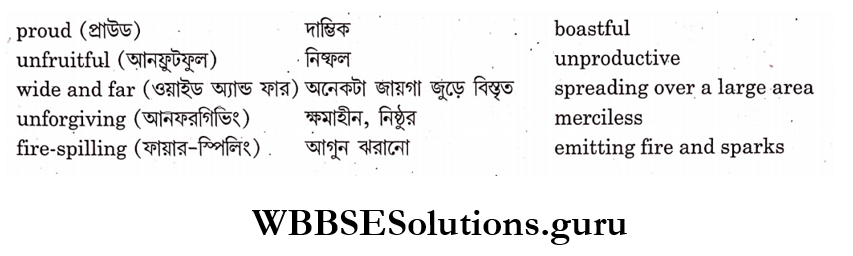
The northern sky rose high and black Over the proud unfruitful sea, East and west the ships came back Happily or unhappily.
But the third went wide and far
Into an unforgiving sea
Under a fire-spilling star,
And it was rigged for a long journey:
Read the above stanzas and answer the following questions.
Tick the correct answers from the given alternatives:
Question 1. The third ship sailed-
Answer: 3. Nothward
Question 2. The sea over which the third ship was moving was-
Answer: 2. Calm and Very cool
Question 3. The decks of the third ship shone-
Answer: 3. Frostily.
Question 4. The northern sky looked-
Answer: 2. Black
Question 5. The number of ships that came back was-
Answer: 1. Two
Question 6. The ship that did not return was the-
Answer: 3. Third ship
Question 7. The third ship was equipped to-
Answer: Go on a long voyage
Answer the following questions within fifteen words:
Question 1. Which ship drove towards the north?
Answer: The ship that drove towards the north was the third one.
Question 2. How was the northern sky?
Answer: The northern sky rose high and black over the proud unfaithful sea. It looked ominous.
Question 3. Which of the three ships returned eventually?
Answer: The two ships that had moved eastwards and westwards returned eventually.
Question 4. In what state of mind did the east and west ships come back?
Answer: The East and the West ships came back happily or unhappily.
Question 5. Where did the third ship go?
Answer: The third ship went far and wide into the unforgiving sea.
Answer the following questions within twenty-five words:
Question 1. Describe the journey of the third ship.
Answer: The third ship was rigged for a long journey. So it went far and wide into the unforgiving sea in the scorching sun unaided by any wind.
Question 2. What does the poet mean by a “fire-spilling” star?
Answer: By a “fire-spilling” star the poet tries to highlight the great hurdles and unfavourable situations the third ship has to overcome on its long journey to the north.
Question 3. What speciality did the poet observe in the ships on the sea?
Answer: The poet observed that out of the three ships sailing in the sea, only one the third -was equipped for a long journey.
Stanza:1:(Sun-warmed…….reeling by)

Stanza:2:(Head down………..to see him pass.)

Stanza:3:(What track……………with him as he went.)
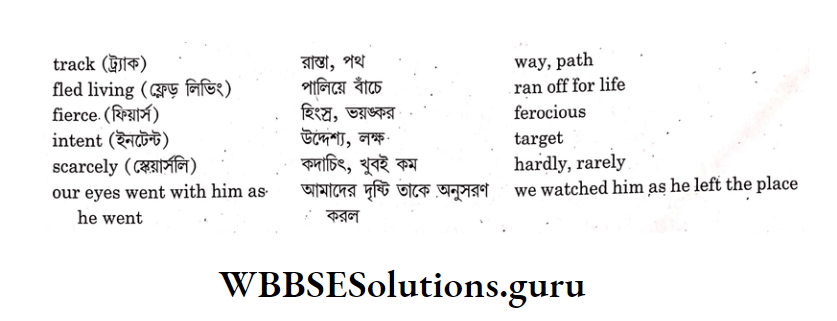
Stanza:4:(cold, dark and splendid………..and went on.)
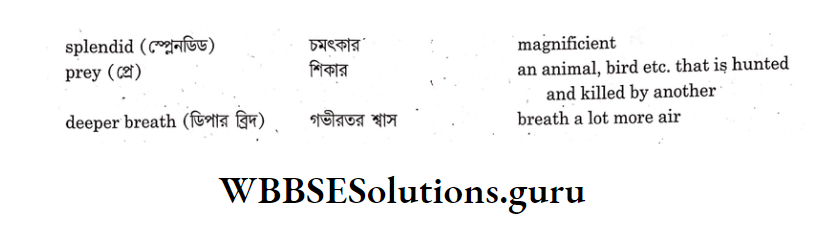
Summary: The poet and her companion while strolling in the pleasant autumn weather one day suddenly come across a snake that is on a hunting spree.
Looking ferocious with flickering tongues it moves into the parting grass in search of prey taking no notice of the onlookers.
Read And Learn More WBBSE Class 9 English Reading Skill
The author and her mate are simply spellbound seeing its beauty with the diamond-shaped scales on its body glazing under the bright sunlight.
The onlookers, oblivious of its real intention, simply follow its graceful movement almost in a spell.
At last, when, the snake disappears into the grassland in search of prey, the author and her mate realise the deadly nature of the snake.
Finally, they get rid of their spell and breathe a great sigh of relief. Looking at each other and taking a deep breath, they continue walking to start a new day.
Tick the correct answer from the given alternatives:
Question 1. The poet was sun-warmed under the gentlest sky of—
Answer: 3. Autumn
Question 2. The colour of the snake was—
Answer: 1. Black
Question 3. The tongue of the snake was—
Answer: 2. Flickering
Question 4. Question the shape of the snake’s scale was like—
Answer: 3. Diamond
Question 5. According to the poet, the intent of the snake was—
Answer: 4. Fierce
Question 6. The snake finally disappeared into the—
Answer: 2. Grass
Answer the following questions within twenty-five words
Question 1. How did the snake appear as it was moving through the grass?
Answer:
The snake looked cold, dark and splendid with the sun glazing over its diamond-shaped scales as it was moving through the grass on the trail searching for its prey with head down and tongue flickering.
Question 2. What did the poet and her companions do when the snake was gone?
Answer:
After the snake was gone, the poet and her companions took a deeper breath with a sense of relief, looked at each other and then moved on.
Rewrite the following sentences as directed:
Question 1. How happy we are here (change into an assertive sentence)
Answer: We are very happy here.
Question 2. Everybody knows the name of Tagore, (change into an interrogative sentence)
Answer: Who does not know the name of Tagore?
Question 3. The painting is very beautiful, (change into an exclamatory sentence)
Answer: How beautiful the painting is
Question 4. Can we ever forget our childhood days? (change into an assertive sentence)
Answer: We can never forget our childhood days.
Rewrite the following sentences as directed :
Question 1. We are proud of our heritage, (use the noun form of proud)
Answer: We take pride in our heritage.
Question 2. We should have sympathy for the poor, (use the adjective form of sympathy)
Answer: We should be sympathetic to the poor.
Question 3. His success was due to his labour, (use the verb form of labour)
Answer: He laboured to achieve success.
Question 4. The song of the nightingale is very sweet, (use the adverb form of sweet)
Answer: The nightingale sings very sweetly.
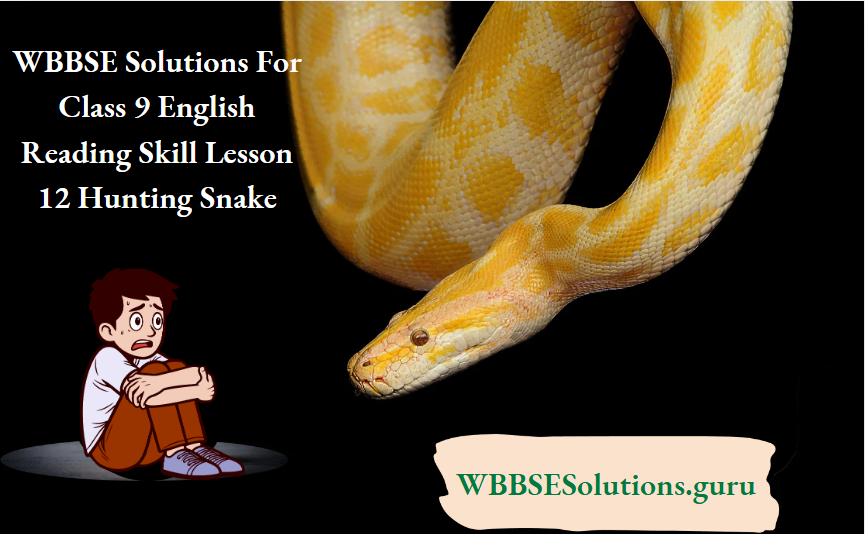
Sun-warmed in the late season’s grace
Under the autumn’s gentlest sky
We walked and froze half through a pace.
The great black snake went reeling by.
Head down, tongue flickering on the trail
He quested through the parting grass.
Sun glazed his curves of diamond scale
And we lost breath to see him pass.
Tick the correct answer from the given alternatives :
Question 1. The season mentioned in the poem is—
Answer: 1. Autumn
Question 2. The poet was walking—
Answer: 3. With a companion
Question 3. The poet and her companion froze—
Answer: 3. Seeing a number of snakes
Question 4. When the poet saw the snake it was—
Answer: 3. Day time
Question 5. The snake had—
Answer: Diamond scale
Question 6. The tongue of the snake was—
Answer: 1. Going in and out
Question 7. The size of the snake was—
Answer: 2. Great
Question 8. The food of the snake was hidden—
Answer: 2. In the grass
Answer the following questions within fifteen words :
Question 1. How was the weather when the poet and her companion were taking a walk?
Answer: The season was the late autumn. The weather was sun-warmed with a clear gentle sky.
Question 2. Why did the poet and her companion stop halfway through a pace?
Answer: The poet and her companion stopped halfway when they saw a big black snake passing by.
Question 3. Where did the snake search for its prey?
Answer: The snake searched for its prey in the parting grass.
Question 4. What was the reaction of the poet and her companion when they saw the snake passing?
Answer: The poet and her companion lost breath to see the great black snake passing.
Answer the following questions within twenty-five words :
Question 1. Describe the movement of the snake.
Answer: The snake was a big, black one. It was reeling as it moved, and its diamond-shaped scales were glazing during its curved movement.
Question 2. Give a description of the appearance of the snake.
Answer: It was a big, black snake who was always on the hunt, moving in curves with its head down and tongues flickering up in search of food through the parting grass.
Section-1: (the young seagull……….. Circled around proudly.)
Section – 2 : (the sun was now………. Food maddened him. )
Read And Learn More WBBSE Class 9 English Reading Skill

Section 3: (“Ge, ga, ga”, he cried……made his first flight.)
Summary (সারাংশ): The story is about a young seagull’s fear of flying lest his wings should fail to support him, and his ultimate success of making his first flight after a series of encouragement, coaxing, and enticement from his parents and siblings.
While his two brothers learned the art of flying and fishing with their parents, he did not have the courage to fly like them. While his brothers and sister were flying and eating, he remained within his hole and suffered from starvation. He had to depend on others for food.
Once his mother picked up a piece of fish and flew very close to him.
He felt excited and moved forward. But surprisingly she halted at a distance almost within the reach of his beak.
Maddened by hunger, the young seagull dived at the fish and began to fall downwards.
Flapping his wings he started soaring upwards and uttered a joyous scream. His near and dear ones were also flying close by, and when they saw him flying, they also responded by expressing joy.
Ultimately the young seagull landed on the sea and began floating when his belly touched the water. His entire family started screaming and praising him for making his first flight.”
Tick the correct answer from the given alternatives:
Question 1. At night the seagull slept in a little-
Answer: 1. Nest
Question 2. The ledge faced the-
Answer: 2. South
Question 3. The color of the seagull’s body was-
Answer: 4. Blue
Question 4. The two brothers and the sister of the seagull were lying on the
Answer: 2. Plateau
Question 5. The mother seagull had picked up a piece of-
Answer: 3. Fish
Answer the following questions within fifteen words:
Question 1. What was the first catch of the seagull’s older brother?
Answer: The first catch of the seagull’s older brother was a herring fish.
Question 2. Why did the seagull feel the heat?
Answer: The seagull felt the heat because he had not eaten anything since the previous nightfall.
Question 3. Why did the seagull dive at the fish?
Answer: Maddened by hunger, the seagull dived at the fish which was almost within his reach.
Question 4. What happened when the seagull soared upwards?
Answer: When the seagull soared upwards, he uttered a joyous scream and saw his father, mother, and his two brothers and sister also soaring up with him.
Answer the following questions within twenty-five words:
Question 1. Why was the seagull afraid when he ran forward to the brink of the ledge?
Answer: When the seagull ran forward to the brink of the edge, he saw the vast expanse of the sea stretched miles down beneath. He was afraid knowing sure that his wings would never support him to fly.
Question 2. What were the seagull’s two brothers and sister doing on the plateau?
Answer: He saw his two brothers and his sister lying on the plateau. They were dozing, with their heads sunk into their wings.
Question 3. What happened after the seagull’s feet sank into the sea?
Answer: After the seagull’s feet sank into the sea, his belly touched the sea water and he sank no further. He was floating on water, and his family started rejoicing on his first flight.
Change the parts of speech of the given words in the chart:


Rewrite the sentences changing the form of the underlined words as directed:
Question 1. He is known for his honesty. (Change into adjective form)
Answer: He is known as an honest person.
Question 2. She spoke with kindness. (Change into adverb form)
Answer: He spoke kindly.
Question 3. The sun shone brightly. (Change into noun form)
Answer: The sun shone with brightness.
Question 4. She gave a wise judgment. (Change into verb form)
Answer: He judged wisely.
1. The young seagull was alone on his ledge. His two brothers and his sister had already flown away the day before. He had been afraid to fly with them.
When he had run forward to the brink of the ledge he became afraid. The great expanse of the sea stretched down beneath, and it was miles down.
He felt certain that his wings would never support him. So he bent his head and ran away back to the little hole where he slept at night.
His father and mother had come around calling to him shrilly. But for the life of him he could not move.
That was twenty-four hours ago. Since then nobody had come near him.
The day before, he had watched his parents flying about with his brothers and sister.
They were teaching them the art of flight and how to dive for fish.
He had seen his older brother catch his first herring, while his parents circled around proudly.
Read the above text and answer the following questions.
Tick the correct answer from the given alternatives:
Question 1. The seagull was on his ledge-
Answer: 2. With his brother
Question 2. The young seagull had-
Answer: 3. Two brothers and a sister
Question 3. The young seagull was afraid to fly because-
Answer: He felt his wings would not be able to support him,
Question 4. His brothers and sisters had flown away-
Answer: 2. The previous day
Question 5. Nobody had come near the young seagull for-
Answer: 2. Twenty-four hours
Question 6. The seagull’s parents taught their children-
Answer: 4. The art of flying and diving for fish
Answer the following questions within fifteen words:
Question 1. What was the young seagull afraid of?
Answer: The young seagull was afraid of flying with his two brothers and his sister.
Question 2. Why did he run away back to the hole?
Answer: The ran away back to the hole being certain that his wings would never support him if he tried to fly.
Question 3. What did the young seagull observe when he came forward to the brink of the ledge?
Answer: Coming to the brink of the ledge he observed the vast expanse of the sea stretched miles below.
Question 4. What did the older brother catch?
Answer: His older brother caught a herring fish.
Question 5. Why did the seagull’s parents feel proud?
Answer: The seagull’s parents felt proud because their older son had caught a herring.
Answer the following questions within twenty-five words:
Question 1. Why was the young seagull afraid to fly along with his two brothers and sister?
Answer: The young seagull was afraid to fly with his two brothers and his sister because he knew that he would get no support from his wings in trying to fly.
Question 2. What were the seagull’s parents doing the day before?
Answer: The day before, the seagull’s parents were flying about with their two sons and daughter. They were busy teaching them the art of flying and catching fish.
Question 3. What made the parents feel proud of and how did they express their delight?
Answer: The parents felt proud of their older son for catching his first herring. They expressed delight by circling around him.
2. With a loud scream he fell outwards and downwards into space. Then terror seized him and his heart stood still. But it only lasted a moment.
The next moment he felt his wings spread outwards. The wind rushed against his breast feathers, then under the stomach and against his wings.
He could feel the tips of his wings cutting through the air. He was not falling headlong now.
He was soaring gradually downwards and outwards. He was no longer afraid. Then he flapped his wings once and he soared upwards. He uttered a joyous scream and flapped them again.
He soared higher. His mother flew past him, her wings making a loud noise.
He answered her with another scream. Then his father flew over him, screaming. Then he saw his two brothers and his sister flying around him.
He saw a vast green sea beneath him, and he turned his beak sideways and crowed amusedly.
His parents and his brothers and sister had landed on this green floor in front of him.
They were beckoning to him, calling shrilly. He dropped his legs to stand on the green sea.
His feet sank into the sea, and then his belly touched it and he sank no further.
He was floating on it. And around him his family was screaming, praising him.
He had made his first flight.
Read the above text and answer the following questions.
Tick the correct answer from the given alternatives:
Question 1. While falling downwards into space, initially the seagull was seized by-
Answer: 3. Terror
Question 2. The panic of falling lasted for-
Answer: 1. A moment
Question 3. While falling the seagull could feel-
Answer: 2. The tips of his wings cut through the air
Question 4. The flapping of wings helped the seagull to-
Answer: 3. Soar upwards
Question 5. While flying the seagull first saw his-
Answer: 1. Mother
Question 6. The green floor means the
Answer: 3. The sea
Question 7. All his family members called him in a voice that was-
Answer: 1. Shrill
Question 8. The seagull did not sink further when-
Answer: 4. His belly touched the sea
Question 9. The seagull finally made his first-
Answer: 2. Flying in the air
Answer the following questions within fifteen words:
Question 1. How did the young seagull feel immediately after jumping downwards into space?
Answer: Immediately upon jumping downward into space, a terror seized him and his heart stood still.
Question 2. When did the seagull feel no longer afraid?
Answer: When the seagull felt the tips of his wings cutting through the air, he became sure that he was flying and would not fall headlong now. He then felt no longer afraid.
Question 3. When did the seagull utter a joyous scream?
Answer: When the seagull started soaring upwards by flapping his wings, he became very confident about flying and uttered a joyous scream.
Question 4. What did the seagull see beneath him?
Answer: The seagull saw a vast green sea beneath him that looked like a green floor.
Question 5. Who was flying over the young seagull?
Answer: The seagull’s father was flying over him.
Question 6. What did the seagull’s parents and his brothers and sister do when they landed on the green sea in front of him?
Answer: They all beckoned. to him, calling him shrilly in great delight.
Question 7. How did the seagull finally float on the sea?
Answer: The seagull dropped his legs on the seawater. His feet sank into the sea. His belly then touched the water and he started floating without sinking further.
Question 8. How did his family members greet him when the seagull made his first flight?
Answer: When the seagull made his first flight successfully, his family members greeted him by screaming and praising him.
Answer the following questions within twenty-five words:
Question 1. What happened when the seagull jumped into space?
Answer: As the seagull fell into space, he was seized with terror and his heart stood still. But that was for only a moment. Next moment his wings spread outwards and he felt that he could fly.
Question 2. How did the seagull start flying?
Answer: Soon after jumping into space, the seagull’s wings spread outwards, and the wind rushed against his breast feathers and then under the stomach and against his wings. Instead of falling headlong, he started soaring upwards.
Question 3. What did the seagull find his near ones doing when he soared upwards?
Answer: The seagull soared upwards, he saw his mother flying past him, her wings making a loud noise. His father flew over him screaming and his two brothers and his sister were flying around him.
Question 4. What message does the author convey in the story?
Answer: The author conveys the message that fear and hesitation must be conquered if we want to achieve anything of significance, like the young seagull who had to have confidence in himself and be brave in order to fly.
Section: 1:(On September 30, 1659………..desolate island.)
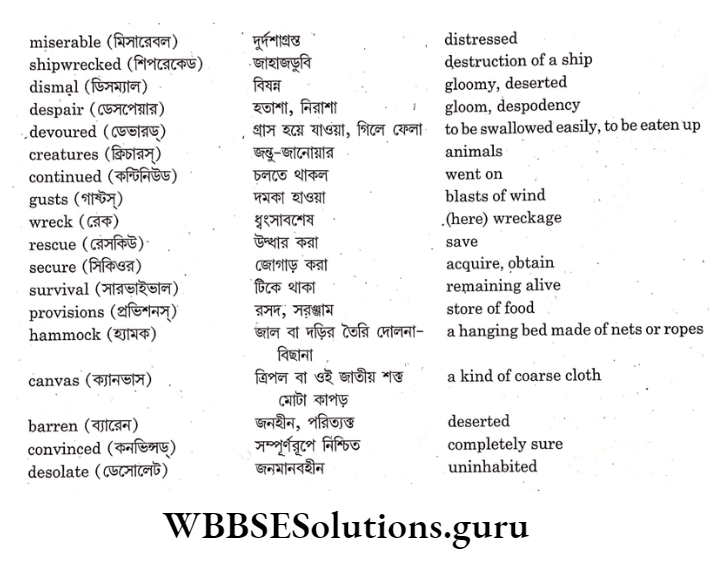

Section:2:(I searched long……….Knife for everyday)
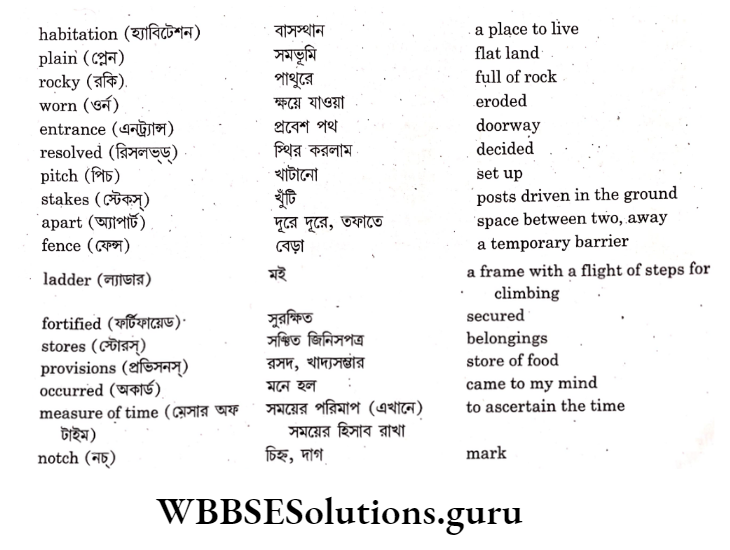
Section:3:(After a long spell of rain…………………the day before.)
Section:4:(On 15th of July……………..days on this island)
Summary: This is the story of Robinson Crusoe, a sailor, who was caught.. a violent storm and was shipwrecked.
He landed on a desolate island and tried to adjust himself to utter loneliness on the island being sure that he will have to live there for the rest of his life.
Read And Learn More WBBSE Class 9 English Reading Skill
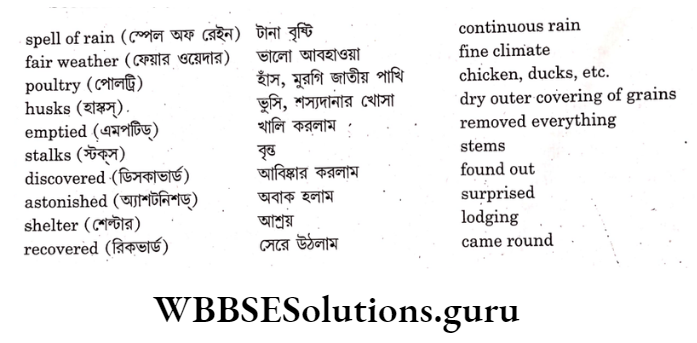
He collected some wood, cable, strings, nails, food, gun, etc., and some tent materials from the wrecked ship. He built a tent with fencing all around to have a safe habitation.
He collected juicy fruits, and freshwater from the nearby flat green area beside a small river, and made a lamp using a tallow, clay pot, and a wick.
He started counting his days by marking a notch every day on a post with a knife.
Looking forward to getting rescued someday by a passing vessel, he spent a whole year on the unknown, desolate island.
Tick the correct answer from the given alternatives
Question 1. Robinson Crusoe was shipwrecked in-
Answer: 1. 1659
Question 2. Robinson Crusoe used canvas to make a-
Answer: 3. Tent
Question 3. The distance between the stakes robinson crusoe drove into the ground was-
Answer: 4. Four inches
Question 4. Crusoe saw some fair weather in the month of
Answer: 2. November
Question 5. The journey homeward with the fruit parcel took Crusoe-
Answer: Three days
Answer the following questions within fifteen words:
Question 1. What name did Crusoe give to the dismal island?
Answer: Crusoe named the dismal island where he got shelter after the shipwreck the Island
of Despair.
Question 2. Where did he pitch the tent?
Answer: He pitched the tent on a flat green land, just before a hollow of a rising hill.
Question 3. How did Crusoe go over the fence?
Answer: Crusoe used a short ladder to go over the fence.
Question 4. Why did he keep a journal?
Answer: He kept a journal to keep records of his everyday activities and engagements.
Answer the following questions within twenty-five words:
Question 1. What were the items Robinson Crusoe’ collected from the wrecked ship?
Answer: From the wrecked ship Robinson Crusoe collected some wood, cable, string, a knife, nails, and a gun. He also collected a hammock, some canvas, some ink, paper, and some money too.
Question 2. How did Crusoe keep track of the number of days he spent on the island?
Answer: Crusoe used to keep track of the number of days he spent on the island by cutting a mark every day on a large post with his knife.
Question 3. In what way did Crusoe make himself a lamp?
Answer: Crusoe collected a little tallow and a small clay dish to which he added a wick. In this way, he made a lamp for himself.
Underline the adverbs and state their kinds
Question 1. It is too hot today.
Answer: too-Adverb of Degree; today-Adverb of Time.
Question 2. The girl seldom visits my house.
Answer: seldom-Adverb of Frequency.
Question 3. He searched everywhere for the book.
Answer: everywhere-Adverb of place.
Question 4. The boy runs fast.
Answer: fast-Adverb of Manner.
Underline the clauses in the following sentences and state what kind of clauses they are:
Question 1. She asked me what my name was.
Answer:
Question 2. He is a friend who has always helped me.
Answer:
Question 3. Please enter the room when you are asked to.
Answer:
Question 4. That he will win is known to us.
Answer:
Identify the following sentences as simple, complex, and compound
Question 1. They predicted that it would rain.
Answer: Complex sentence.
Question 2. The weather was fine, and the children went out to play.
Answer: Simple sentence
Question 3. Ravi woke up early but he could not reach school on time.
Answer: Compound sentence.
Question 4. After finishing his work, my father returned home.
Answer: Simple sentence
Do as directed:
Question 1. Tatar hoped to do well in the examination. (change into a complex sentence)
Answer: From the wrecked ship Robinson Crusoe collected some wood, cable, string, a knife, nails, and a gun. He also collected a hammock, some canvas, some ink, paper, and some money too.
Question 2. The Headmistress arrived and the meeting began. (change into a complex sentence)
Answer: Crusoe used to keep track of the number of days he spent on the island by cutting a mark every day on a large post with his knife.
Question 3. Ayesha was surprised when she heard the news. (change into a simple sentence)
Answer: Crusoe collected a little tallow and a small clay dish in which he added a wick. In this way, he made a lamp for himself.
You must work hard to be successful in life. (change into a compound sentence)
Underline the adverbs and state their kinds:
Question 1. It is too hot today.
Answer: too-Adverb of Degree; today-Adverb of Time.
Question 2. The girl seldom visits my house.
Answer: seldom-Adverb of Frequency.Answer: seldom-Adverb of Frequency.
Question 3. He searched everywhere for the book.
Answer: everywhere-Adverb of place.
Question 4. The boy runs fast.
Answer: fast-Adverb of Manner.
Underline the clauses in the following sentences and state what kind of clauses they are:
Question 1. She asked me what my name was.
Answer:
Question 2. He is a friend who has always helped me.
Answer:
Question 3. Please enter the room when you are asked to.
Answer:
Question 4. That he will win is known to us.
Answer:
Identify the following sentences as simple, complex, and compound:
Question 1. They predicted that it would rain.
Answer: Complex sentence.
Question 2. The weather was fine, the children went out to play.
Answer: Simple sentence
Question 3. Ravi woke up early but he could not reach school on time.
Answer: Compound sentence.
Questions 4. After finishing his work, my father returned home.
Answer: Simple sentence
Do as directed:
Question 1. Tatar hoped to do well in the examination. (change into a complex sentence)
Answer: Tatar hoped that he would do well in the examination.
Question 2. The Headmistress arrived and the meeting began. (change into a complex sentence)
Answer: When the Headmistress arrived, the meeting began.
Question 3. Ayesha was surprised when she heard the news. (change into a simple sentence)
Answer: Hearing the news Ayesha was surprised.
Question 4. You must work hard to be successful in life. (change into a compound sentence)
Answer: You must work hard, otherwise you will not be successful in life.
1. On September 30, 1659, I, miserable Robinson Crusoe, being shipwrecked during a violent storm, came on shore on this dismal island.
I call it the Island of Despair. I was almost dead and the rest of my ship’s company was drowned.
I had neither food, house nor clothes. I feared I would be devoured by wild beasts. When night came, I slept in a tree for fear of wild creatures. It rained all night.
The rain continued through the next day with gusts of wind. Only a wreck of my ship was to be seen at low water.
I swam to the wreck to rescue and secure for my survival some food and other provisions.
I was able to collect some wood, cable, string, a knife, nails, and a gun.
I also collected a hammock and some canvas with which I made a tent. I got some ink and paper.
I also found some money, but they were useless to me on this barren island. I was some hundred leagues out of the ordinary course of the trade of mankind.
I was convinced I had to spend the rest of my life alone on this wild, desolate island.
Read the above text and answer the following questions.
Tick the correct answer from the given alternatives:
Question 1. The reason for the shipwreck robinson crusoe suffered from was-
Answer: 2. A violent storm
Question 2. Robinson feared that he would-
Answer: 1. Be eaten up by wild beasts
Question 3. After being shipwrecked, Robinson came to a-
Answer: 2. Deserted island
Question 4. In the shipwreck everybody on the ship other than Robinson-
Answer: 1. Was drowned
Question 5. On the first night, Robinson slept-
Answer: 2. On a tree
Question 6. Robinson swam to the wreck to-
Answer: 1. Salvage some of his belongings and food
Question 7. The wreck of the ship could be seen-
Answer: 3. At low water
Question 8. In the barren land, the thing that was useless to Robinson was-
Answer: 4. Money
Answer the following questions within fifteen words:
Question 1. When did the shipwreck occur?
Answer: The shipwreck occurred on September 30, 1659.
Question 2. What happened to the ship after it had faced the violent storm?
Answer: After it had faced the violent storm the ship was sunk with all its cargo and men excepting Robinson Crusoe.
Question 3. What did Crusoe have with him when he came on the shore of the dismal island?
Answer: Crusoe had neither food, house nor clothes with him when he came on the shore of the dismal island.
Question 4. Where did Crusoe sleep at night and why?
Answer: Crusoe feared that he would be eaten up by wild beasts and so to avoid them he slept on a tree.
Question 5. Why did he swim to the wrecked ship?
Answer: Crusoe swam to the wreck ship to retrieve some food and other provisions for his survival.
Question 6. How did he make a tent?
Answer: He made a tent with a hammock and some canvas that he had collected from the wreck of the ship.
Question 7. What was he convinced of?
Answer: He was convinced of spending the rest of his life alone on the wild, desolate island.
Answer the following questions within twenty-five words :
Question 1. What happened to Robinson Crusoe during the sea voyage?”
Answer: During the sea voyage, Crusoe’s ship was caught in a violent storm suffering a total shipwreck. Somehow he managed to reach a dismal island all alone and he was almost dead.
Question 2. Why did he call the island the Island of Despair?
Answer: After the shipwreck, he somehow reached the shore of the deserted island all alone. He had no food, shelter, or and clothes no proper environment for living. Finding no hope, he called the island the Island of Despair.
Question 3. Why was the money useless to him?
Answer: Crusoe landed in a barren land without any ordinary course of the trade of mankind. There was nothing to purchase there. So the money was useless to him.
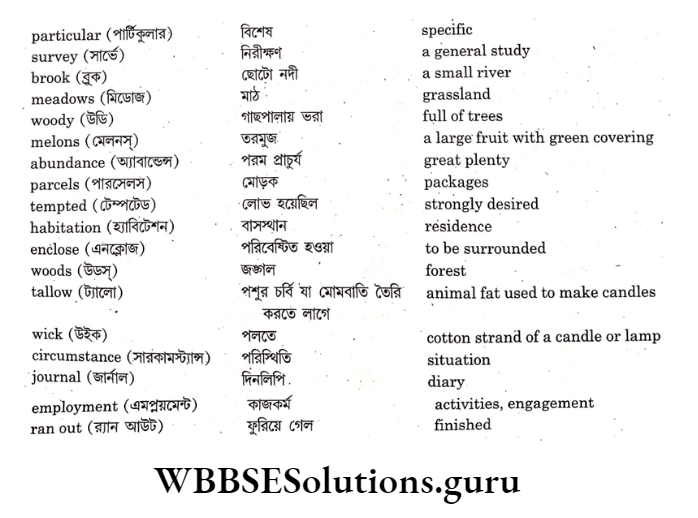
2. On the 15th of July I took a more particular survey of the island. Around two miles up, I found a brook with pleasant meadows by its bank, plain, smooth, and covered by grass.
In a woody part, I found melons in great abundance and grape trees. The grapes were ripe and rich.
Further into the land, I found a great number of cocoa, orange, and lemon trees.
I carried great parcels of fruit homeward and the journey took me three days.
I was tempted to transfer my habitation to this valley of fruits. I did not, because I still hoped to be rescued by some passing ship on the sea.
I did not want to enclose myself in hills and woods. I stayed in view of the sea. Ten months had passed since I had set foot on this island.
Previously I had no lamp after dark. I collected a little tallow and a small clay dish. To this, I added a wick. I had thus made myself a lamp.
I now began to seriously consider the circumstance I was reduced to. I decided to describe my state of affairs in writing.
I began to keep a journal of every day’s employment. I could not include all particulars because gradually I ran out of ink.
I found, by the notches I cast on the post, it was September 30th again. I had spent three hundred and sixty-five days on this island.
Read the above text and answer the following questions.
Tick the correct answer from the given alternatives:
Question 1. After surveying the island Robinson found-
Answer: 3. A brook two miles up
Question 2. In a woody part of the island, he found
Answer: 1. Melons and grape trees
Question 3. On his journey back home, he carried great parcels of—
Answer: 2. Fruits
Question 4. Robinson was tempted to shift his habitation-
Answer: 2. To the valley of fruits
Question 5. Finally, he began to live in the-
Answer: 3. Woods
Question 6. To prepare a lamp, he used-
Answer: 3. Animal fat
Question 7. To record his daily activities and engagements, he began to keep a-
Answer: 1. Journal
Answer the following questions within fifteen words:
Question 1. When did Crusoe take a survey of the island?
Answer: Crusoe took a more particular survey of the island on the 15th of July.
Question 2. Give a description of the brook and its surroundings.
Answer: The brook was two miles up from the seashore with pleasant meadows by its bank, plain, smooth, and covered by grass.
Question 3. Name the fruits that were found on the island.
Answer: Fruits like melon, grapes, oranges, and lemons were found on the island.
Question 4. How long did Robinson take to reach home?
Answer: Robinson took three days to reach home after completing his survey of the island and going around the fruit orchids.
Question 5. What things were collected by Robinson to make a lamp?
Answer: Robinson collected a little tallow, a small clay dish, and a wick to make a lamp.
Question 6. Where did Robinson keep the record of his activities on the island?
Answer: Robinson kept a record of his activities on the island in a journal.
Question 7. Why could not Crusoe write all particulars in his journal?
Answer: Crusoe could not write all particulars in the journal because gradually he ran out of ink.
Question 8. How did he know that his one-year stay on the island had been completed?
Answer: Looking at the notches he had cast on the post, he concluded that it was September 30th again and his one-year stay on the island had been completed.
Answer the following questions within twenty-five words:
Question 1. What did Crusoe find in his more particular survey of the island?
Answer: During his survey of the island Crusoe found a brook with pleasant meadows by its bank, plain, smooth, and covered by grass. He also found melons and grapes in a woody part. Further into the land, he found a great number of cocoa, orange, and lemon trees.
Question 2. Why did he not ultimately transfer his habitation?
Answer: Crusoe did not transfer his habitation because the disliked enclosing himself in hills and woods. Besides, he still hoped to be rescued by some passing ship on the sea. So he wanted to stay close to the sea.
Section:1: (I was on my way………….may be visible.)

Section: 2:(just then the train…………….at the man’s feet.)
Read And Learn More WBBSE Class 9 English Reading Skill

Section:3:(while all this………..bather’s loin Cloth.)
Section:4:(The people on the Platform……………with its left hand.)

Section:5:(The spectators shouted……………finally dropped off.)

Section:6:(Sethji turned round……………..became more uncomfortable.)
Tick the correct answer from the given alternatives:
Question 1. The author was on his way from Faizabad railway station to-
Answer: 3. Lucknow
Question 2. From the water pump the passengers were filling up their-
Answer: Earthen pitchers
Question 3. The gentleman who came up to the author’s compartment looked like a-
Answer: 1. Businessman
Question 4. The price the vendor asked for the bananas was-
Answer: 1. Two annas
Question 5. The author drew the cartoon of-
Answer: 4. Sethji
Answer the following questions within fifteen words:
Question 1. Where did the young monkeys sit?
Answer: The young monkeys sat on the main branches of the neem and tamarind trees.
Question 2. What did the monkey do to the loin cloth of the pious person?
Answer: The monkey snatched away the loincloth of the pious person and went up the neem tree carrying it.
Question 3. What did Sethji’s luggage include?
Answer: Sethji’s luggage included a big steel trunk, several small baskets, and a brass jug.
Question 4. Why, according to the fruit vendor, were the monkeys disturbing the passengers?
Answer: According to the fruit vendor, the monkeys were disturbing the passengers because they were hungry.
Answer the following questions within twenty-five words:
Question 1. What was the businessman wearing?
Answer: The businessman was wearing a white muslin dhoti, a delicate tunic, and an embroidered cap on his head.
Question 2. What did the monkey do after accepting the fruit vendor’s bargain?
Answer: On accepting the fruit vendor’s bargain after some hesitation, the monkey took over the bananas from him with his right hand and released the embroidered cap with its left hand.
Question 3. How did the whole amusing episode end?
Answer: The whole amusing episode ended in a bitter sense of grievance against the rich businessman for being so hard on the generous-hearted fruit vendor.
Fill in the blanks with appropriate articles and prepositions:
The sun rises in the east.
The dog jumped over the log.
I love to watch a one-day match.
Besides a pen, Tiya also has an eraser.
Change the voice of the following sentences:
Question 1. Mr. Khan is known to me.
Answer: I know Mr. Khan.
Question 2. Trina had composed a poem.
Answer: A poem had been composed by Trina.
Question 3. I will always remember you.
Answer: You will be always remembered by me.
Question 4. They have made him the President of the club.
Answer: He has been made the President of the club by them.
Fill in the blanks with the appropriate form of the given verbs in brackets:
Change the mode of narration in the following sentences
Question 1. Rahul said, “Alas! Brazil has lost the match.”
Answer: Rahul exclaimed with sorrow that Brazil had lost the match.
Question 2. “Let us go for a walk,” said Shabnam to Chandni.
Answer: Shabnam proposed to Chandni that they should go for a walk.
Question 3. “Good morning, madam,” said the students to the teacher.
Answer: Addressing their teacher as madam, the students wished her good morning.
Question 4. My father said to me, “Do not pluck flowers.”
Answer: My father ordered me not to pluck flowers.
I was on my way from Faizabad railway station to Lucknow. I had arrived at the station half an hour in advance of the time for the train’s departure.
I sat on a bench watching the monkeys frolicking on the trees and on the open platform.
The monkeys descended now and then to collect half-sucked mango stones and the remains of food from the platform.
The younger monkeys sat on the boughs of neem and tamarind trees, ready to jump after any food that may be visible.
Just then the train was announced by the ringing of the station bell. I concentrated on securing a seat for myself on the train. I got a window seat overlooking the platform.
Some other passengers joined me in the compartment. We were all sweating from the rising heat of the summer.
Several passengers were busy filling up their small earthen pitchers from a water pump.
I was struck by the genius of a monkey in snatching away the loincloth of a pious person who was taking a bath under the pump. A great deal of general amusement was caused by this incident.
The bather then requested the monkey to return his loin cloth. The monkey was generous and threw it down from the neem tree at the man’s feet.
Read the above text and answer the following questions.
Tick the correct answer from the given alternatives:
Question 1. The author undertook the journey-
Answer: 2. By train
Question 2. The author arrived at the station-
Answer: 1. Half an hour earlier
Question 3. The author was watching some-
Answer: 3. Monkeys
Question 4. The monkeys collected-
Answer: 1. Mango stones and food remains
Question 5. The train’s arrival was indicated by-
Answer: 3. Ringing of the station bell
Question 6. Some passengers were busy-
Answer: 4. Collecting water in earthen pitchers
Question 7. The monkey snatched from the person-
Answer: 2. His loin cloth
Question 8. The pious person was-
Answer: 1. Taking a bath
Answer the following questions within fifteen words:
Question 1. Where was the author going?
Answer: The author was going from Faizabad railway station to Lucknow.
Question 2. What did he watch sitting on a bench?
Answer: Sitting on a bench the author was watching the monkeys frolicking on the trees and on the open platform.
Question 3. Why did the monkeys come down from the trees?
Answer: The monkeys came down from the trees occasionally to collect half-sucked mango stones and remainders of food from the platform.
Question 4. Where did the author sit in the compartment?
Answer: The author sat on a window seat overlooking the platform.
Question 5. What was the pious man doing?
Answer: The pious man was taking his bath under the water pump on the platform.
Question 6. What request did the pious man make to the monkey?
Answer: The pious man requested the monkey to return his loin cloth.
Question 7. What was the monkey’s reaction to the pious man’s request?
Answer: The monkey reacted to the pious man’s request by throwing down his loin cloth from the neem tree at his feet.
Answer the following questions within twenty-five words:
Question 1. Why and when did the author reach the station and what did he do after that?
Answer: The author reached the Faizabad railway station half an hour earlier than the scheduled time of the train’s departure for traveling to Lucknow. After reaching there he sat on a bench.
Question 2. What were the monkeys doing on the platform?
Answer: The monkeys were coming down occasionally from the trees to collect half-sucked mango stones and scraps of food from the platform.
Question 3. How did the pious man lose and get back his loin cloth?
Answer: When the pious man was taking a bath under a pump, a monkey snatched his loin cloth. Later on request from him, the monkey returned it to him.
Question 4. What was the cause for a great deal of amusement on the platform?
Answer: A great deal of amusement was caused because a monkey snatched away the loincloth of a pious man while he was taking a bath under the pump.
2. While all this was going on, I noticed a gentleman come up to our compartment. He looked like a businessman.
He was dressed in a white muslin dhoti, a delicate tunic, and an embroidered cap on his head.
A porter was carrying his luggage which included a big steel trunk, several small baskets, and a brass jug. The man was shouting at the porter to hurry up with the luggage.
Suddenly a monkey leaped down from the top of our compartment and snatched away the fine embroidered cap of the businessman. The monkey then climbed up the neem tree.
“What have you done, monkey!” The businessman shouted, in utter confusion.
His round and smug face was covered with perspiration. He ran towards the tree over the pump and stood threatening the monkey.
However, the more he shouted at the monkey, the remoter the monkey became. It was the same monkey that had snatched the bather’s loin cloth.
Read the above text and answer the following questions.
Tick the correct answer from the given alternatives:
Question 1. The gentleman who came to the compartment looked like a-
Answer: 2. Businessman
Question 2. The gentleman was dressed in
Answer: 3. A muslin dhoti and
Question 3. The luggage of the gentleman was carried by-
Answer: 3. A Porter
Question 4. The monkey leaped down from the-shed
Answer: 3. Top of the compartment
Question 5. The monkey took away the businessmen-
Answer: 2. Embroidered
Question 6. After snatching away the cap, the monkey climbed up-
Answer: 1. The neem tree
Question 7. The businessman’s face was covered with-
Answer: 1. Sweat
Question 8. When the businessman shouted at the monkey, it-
Answer: 2. Went further away
Answer the following questions within fifteen words:
Question 1. Describe the gentleman who entered the compartment.
Answer: The gentleman looked like a businessman and was dressed in a white muslin dhoti, a delicate tunic, and an embroidered cap on his head.
Question 2. Why was the man shouting at the porter?
Answer: The man was shouting at the porter to hurry up with the luggage.
Question 3. What did the monkey do?
Answer: The monkey suddenly leaped down from the top of the compartment and snatched away the embroidered cap of the businessman.
Question 4. Where did the monkey go after taking away the businessman’s cap?
Answer: The monkey climbed up the neem tree after taking away the businessman’s cap.
Question 5. How did the businessman react after the monkey snatched away his cap?
Answer: Utterly confused and his face covered with sweat, the man ran towards the tree and started shouting and threatening the monkey.
Answer the following questions within twenty-five words:
Question 1. What did the author notice?
Answer: The author noticed a gentleman coming to their compartment. He looked like a businessman and was wearing a white muslin dhoti and a fine tunic. He also had an embroidered cap on his head.
Question 2. What did the man do to ensure the security of his luggage?
Answer: A porter was carrying his luggage. He did not want to miss them. So he shouted at the porter and asked him to hurry up with the luggage.
Question 3. What happened to his cap?
Answer: Suddenly money leaped down from the top of their compartment and then snatching away the fine embroidered cap of the businessmen it climbed up the neem tree.
Question 4. How did the businessman try to retrieve his cap from the monkey?
Answer: The businessman ran towards the neem tree and began to shout at the monkey to retrieve his cap. But as he threatened the monkey more, the monkey moved further away from him.
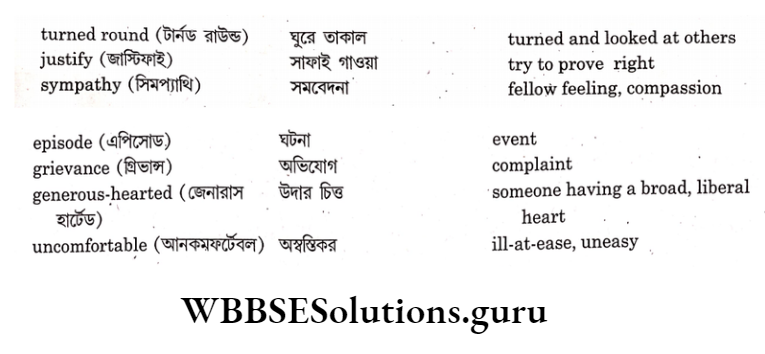
3. The people on the platform were much amused by the plight of the businessman.
He looked with a piteous and hopeless expression on his face. Meanwhile, a fruit hawker had come forward, pushing his little cart.
He told Sethji that he would rescue the cap. The businessman seemed slightly relieved.
The vendor went ahead, dangling a couple of bananas at the monkey with his right hand. He stretched out his left hand for the cap. The monkey seemed to hesitate.
“Ao, ao, come down,” the vendor coaxed the monkey. He lifted the bananas higher up. The -monkey responded by climbing down cautiously to a branch near the vendor.
The whole platform became silent and waited, with bated breath, for the impossible to happen.
The vendor cooed in a soft voice, Ao, ao, to the monkey. The monkey, looking at this side and that, accepted the bargain.
It took over the bananas with its right hand and released the embroidered cap, slightly crumpled, with its left hand.
Read the above text and answer the following questions.
Tick the correct answer from the given alternatives:
Question 1. The person who came forward to rescue the cap from the monkey was a—
Answer: 3. Fruit hawker
Question 2. On getting the assurance from the hawker, the businessman seemed to be-
Answer: 2. Slightly relieved
Question 3. The hawker was carrying his wares in a-
Answer: 1. Cart
Question 4. The hawker offered the monkey some-
Answer: 1. Bananas
Question 5. Seeing the hawker offering it bananas the monkey-
Answer: 3. Seemed to hesitate
Question 6. The monkey took over the bananas with his-
Answer: 1. Right hand
Question 7. All people on the platform watched the scene-
Answer: 3. Silently
Answer the following questions within fifteen words:
Question 1. Who came forward to help the businessman?
Answer: A fruit hawker came forward to help the businessman by rescuing his cap from the monkey.
Question 2. Why did the businessman feel slightly relieved?
Answer: The businessman was missing the cap badly, and so he felt slightly relieved hoping to get it back as assured by the hawker.
Question 3. How did the hawker try to rescue the cap?
Answer: The hawker dangled a couple of bananas at the monkey enticing it to take them in exchange for returning the cap.
Question 4. How did the monkey respond to the hawker’s call?
Answer: The monkey responded by climbing down to a branch near the vendor.
Question 5. What did the monkey do ultimately?
Answer: The monkey ultimately accepted the hawker’s bargain. He took the bananas with his right hand and released the cap with his left hand.
Answer the following questions within twenty-five words:
Question 1. Why did the people on the platform feel much amused?
Answer: All the people on the platform watched the monkey snatching away of the cap and the businessman’s vain attempt to get it back by threatening the monkey. They were, therefore, much amused seeing the plight of the businessman.
Question 2. How did the people on the platform react to the hawker’s efforts to rescue the cap?
Answer: The people were watching the hawker trying to rescue the cap. But they were so struck dumb with surprise that they became silent and waited with bated breath for the hawker’s success which seemed very hard and almost impossible.
Question 3. How was the cap recovered by the hawker?
Answer: Enticed by the hawker’s dangling bananas and yielding to his coaxing, the monkey came down to a lower branch. He then took the bananas from the hawker in his right hand and released the cap to him with his left hand.
4. Sethji turned round to all of us and began to justify himself, “If he did not want to help me to get my cap back, he should not have offered the monkey the bananas. I did not ask him to help..”
I felt that all the other passengers had sympathy for the poor vendor. The whole amusing episode had ended in a bitter sense of grievance against the rich businessman who had been so hard on the generous-hearted fruit vendor.
I drew a cartoon of Sethji and showed my drawing to all the other passengers except him. Everyone laughed. The more we laughed, Sethji became the more uncomfortable.
Read the above text and answer the following questions.
Tick the correct answers from the given alternatives:
Question 1. Sethji turned round and began to-
Answer: 4. Talk about his cap
Question 2. He said that he-
Answer: 1. He did not ask the vendor to help him
Question 3. The passengers were sympathetic towards-
Answer: 1. The poor vendor
Question 4. The author showed the cartoon to-
Answer: 4. All other passengers except Sethji
Question 5. Seeing the other fellow passengers laughing, Sethi-
Answer: 4. Became angry
Answer the following questions within fifteen words
Question 1. How did the other passengers feel about the poor vendor?
Answer: The other passengers were sympathetic to the poor vendor.
Question 2. Who drew Sethji’s cartoon?
Answer: The author himself drew Sethji’s cartoon.
Question 3. How did the amusing incident end?
Answer: The amusing incident ended in a bitter sense of grievance against the rich businessman.
Question 4. How did the passengers react to seeing the cartoon of Sethji?
Answer: Seeing Sethji’s cartoon, all the other passengers started laughing.
Question 5. Why did Sethji feel uncomfortable?
Answer: Sethji felt uncomfortable because he was sure that the cartoon showed something funny and satirical about him.
Answer the following questions within twenty-five words
Question 1. How did Sethji try to justify himself?
Answer: Sethji tried to justify himself by saying that he did not ask for any help from the vendor to get his cap back. So he should not have offered the bananas to the monkey.
Question 2. How did the amusing episode end in a bitter sense of grievance against the rich businessman?
Answer: The amusing episode ended in a bitter sense of grievance against the businessman when everybody saw him becoming so hard on the generous-hearted fruit vendor who, of his own, rescued his cap by offering his bananas to the monkey.
Question 3. What picture of the businessman do you get from the story?
Answer: The story reveals that though rich, the businessman was a very miser, selfish, and ungrateful person.