
Chapter 4 Verbs And Verbals A VERBS
Definition: A verb is a word used to express action, a state of being, or having something.
The present grammarians, have, therefore, divided the verbs into two main groups according to their functions
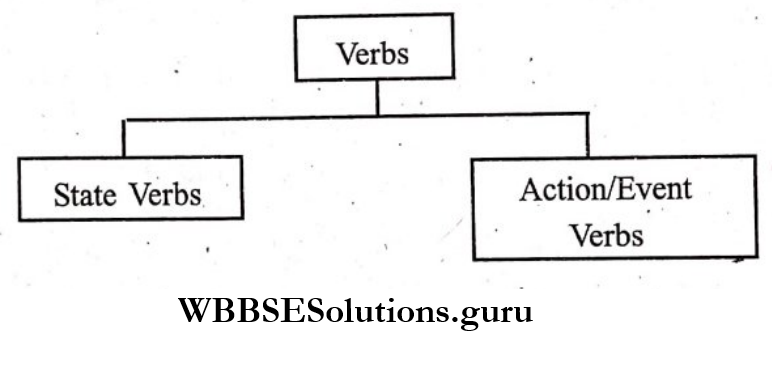
State Verbs: Verbs that continue over a period and need not have a well defined beginning or end, are called State Verbs (যে Verb দ্বারা কিছুকাল ধরে কাজ চলছে বোঝায় অথচ তার নির্দিষ্ট কোনোও আরম্ভ বা শেষ হবার অবস্থা বোঝায় না তাকে State Verb বলা হয়। ) Examples: know, smell, forget, etc. I know him. He forgets everything. The coffee tastes good.
Read And Learn More WBBSE Class 9 English Functional Grammar
Action/Event Verbs: Verbs of a single occurrence with a definite beginning or an end is called Action/Event Verbs (যে Verb দ্বারা কোনো একটি নির্দিষ্ট আরম্ভ এবং শেষ আছে এমন কোনো কাজ বা ঘটনা Event Verb).
Examples: get, come, run, eat, read, play, etc. Come in, please. I play football. The cat jumped over the wall.
Principal Verb: When a verb is used independently, it is called a Principal or Main verb: Call, go, work, etc.
Auxiliary Verb: When a verb is used only to help some other verb to form voices, moods, and tenses, it is called a helping verb or auxiliary verb.
The only verbs that can be so used are: can, be, have, shall, will, may, and do.
But some of the helping verbs can be used alone as main verbs, but when they are used with another verb after them, they are helpers.
- Sonia and Roop have a pet dog. (have the main verb)
- Sonia and Roop have bought a pet dog. (have is a helper for the main verb buy)

Chapter 4 Verbs And Verbals Tenses
Principal/Main Verbs I am happy. He has a dog. You may go. He did it.
The Tense is the change of form in a verb to express the time of an action.
There are three principal tenses:
- The Present Tense describes an action in the present time: I go. He writes. They are playing.
- The Past Tense describes an action in the past time: I went. He wrote. They were playing.
- The Future Tense describes an action in future time:
- I shall go. He will write. They will be playing.
Verbs are divided into two classes according to the way in which they form their Past
Tense and Past Participle:
Strong verbs: Those verbs that form their past tense by changing an inside vowel of the.
Present, but never by addition of a suffix (কেবল ভিতরের কোনো vowel পরিবর্তন করে যেসব verb-এর Strong Verbs) are called Strong Verbs.
The past Participle may, however, some Past Tense times end in -en and -n: sing, sang, sang, drive, drove, driven.
Weak verbs: Those verbs that form their past tense by adding -ed, -d, or -t, with or without a change of the inside vowel are called Weak Verbs: ( verb-4-ed, -d, -t যোগ করে Past Tense হয় তারা Weak Verbs):
Leap, leaped, leaped; dream, dreamt, dreamt.
Formerly, Strong verbs were called Irregular, and Weak verbs were called Regular. But these names are misleading and have been given up now.
Some Weak verbs ending in -d or -t in the Present Tense:
Have the same form in three tenses:
- cut, cut, cut; cost, cost, cost; hit, hit, hit;
- let, let, let; put, put, put.
Change the -d of the Present into the Past and the Past Participle:
- bend, bent, bent; build, built, built; lend, lent, lent;
- send, sent, sent; spend, spent, spent; etc.
Only shorten the vowel in the Past Tense and the Past Participle:
- bleed, bled, bled; fed, fed, fed; meet, met, met.
The Present, Past, and Past participle forms of some verbs are given below. These may be read carefully for use in the framing of sentences:
Present- Past – Past Participle
- Am, হওয়া- was- been
- Abide, থাকা, বাস করা- abode- abode
- Arise, ওঠা- arose- arisen
- Ask, জিজ্ঞাসা করা – asked – asked
- Awake, জাগানো- awoke – awoke, awaked
- Be, হওয়া- was, were – been
- Bear (to carry); বহন করা – bore -borne
- Bear (to give birth to), প্রসব করা- bore – born
- Beat, মারা – beat – beaten
- Become, হওয়া – became – become
- Beget, জন্ম দেওয়া – begot – begotten, begot
- Begin, আরম্ভ করা – began – begun
- Bend, নত হওয়া – bent – bent
- Bid (command), আদেশ করা- bade – bidden
- Bid (offer)- bid – bid
- Bind, বাঁধা – bound – bound
- Bite, কামড়ান- bit- bitten, bit
- Bleed, রক্তপাত হওয়া- bled – bled
- Blow, বাতাস বহা- blew- blown
- Break, ভাঙ্গা -broke – broken
- Breed, জন্ম দেওয়া – bred- bred
- Bring, আনা – brought – Brought
- Build, তৈরি করা – built – built
- Burn, পুড়ে যাওয়া – burnt – burnt
- Burst, ফেটে যাওয়া – burst – burst
- Call, ডাকা – called – called
- Cast, ছুঁড়ে দেওয়া – cast – cast
- Catch, ধরা – caught – caught
- Clothe, পোশাক পরানো- clothed, clad – clothed, clad
- Chide (to rebuke), তিরষ্কার করা – chid – chidden, chid
- Choose, বেছে নেওয়া – chose – chosen
- Cling, লেগে থাকা- clung – clung
- Come, আসা – came – come
- Cost, দাম লাগা – cost – cost
- Creep, হামাগুড়ি দেওয়া – crept – crept
- Cry, কাঁদা – cried – cried
- Cut, কাটা – cut – cut
- Dare (to venture), dared, durst – dared
- Dare (to challenge), প্রতিদ্বন্দ্বিতা করতে আহবান করা – dared – dared
- Deal, আচরণ করা- dealt – dealt
- Die, মৃত্যু হওয়া – died – died
- Dig, খনন করা – dug- dug
- Do, করা – did – done
- Draw, আঁকা – drew – drawn
- Dream, স্বপ্ন দেখা – dreamed, dreamt- dreamed, dreamt
- Drink, পান করা – drank – drunk
- Drive, গাড়ী চালানো – drove- driven
- Dwell, বাস করা – dwelt – dwelt
- Eat, খাওয়া – ate – eaten
- Fall, পড়ে যাওয়া – fell – fallen
- Feed, খাওয়ানো – fed – fed
- Feel, বোধ করা – felt – felt
- Fell (to cause to fall), ফেলে দেওয়া – felled – felled
- Fight, যুদ্ধ করা – fought -fought
- Find, দেখা, খুঁজে পাওয়া – found – found
- Flee, পালিয়ে যাওয়া – fled – fled
- Fling, নিক্ষেপ করা – flung – flung
- Flow, বয়ে যাওয়া – flowed – flowed
- Fly, উড়া – flew – flown
- Forbid, নিষেধ করা – forbade – forbidden
- Forget, ভুলে যাওয়া – forgot – forgotten
- Get, পাওয়া – got – got
- Give, দেওয়া – gave – given
- Go, যাওয়া – went – gone
- Grave (to engrave) – graved – graved
- Grind, গুঁড়া করা – ground – ground
- Grow, জন্মানো, বড়ো হওয়া – grew – grown
- Hang (to suspend),- hung -hung
- Hang (to take life by hanging), ফাঁসি দেওয়া – hanged – hanged
- Has, have, থাকা – had – had
- Hear শোনা – heard – heard
- Help, সাহায্য করা- helped – helped
- Hide, লুকানো- hid – hid
- Hit, আঘাত করা – hit – hit
- Hold, ধরা – held – held
- Hurt, আঘাত করা- hurt – hurt
- Keep, রাখা – kept – kept
- Kneel, হাঁটু গেড়ে বসা – knelt – knelt
- Know, জানা – knew – known
- Lay (to put), -laid – laid
- Lead, পথ দেখানো – led – led
- Lean, হেলান দেওয়া – leant, leaned -leant, leaned
- Leap, লাফ দেওয়া -leapt, leaped – leapt, leaped
- Learn, শেখা- learned, learned- learned, learned
- Leave, ত্যাগ করা – left – left
- Lend, ধার দেওয়া বা করা – lent – lent
- Let, অনুমতি দেওয়া – let – let
- Lie (to rest), থাকা – lay – lain
- Lie (to speak falsely), – lied – lied
- Light, জ্বালানো, অবতরণ করা, – lighted, lit- lighted, lit
- Loose (to make less tight loosed loosed
- Lose, হারানো – lost- lost
- Make, তৈরি করা -made -made
- Mean, বোঝা – meant – meant
- Meet, সাক্ষাৎ করা – met – met
- Melt, গলে যাওয়া বা গলানো – melted – melted
- Mow, ঘাস কাটা – mowed – mowed, mown
- Pass, পাশ করা – passed -passed, -past
- Put, রাখা – put – put
- Read, পড়া – read – read
- Pay, দেওয়া, শোধ করা Play, খেলা – played – played
- put – put – put
- Rid (make free ), মুক্ত করা rid, ridded rid Ride, ঘোড়ায় চড়া
- Saw, করাত দিয়ে কাটা sawed sawed, sawn
- Say, বলা said See, দেখা
- Seek, খোঁজা
- Sell, বিক্রি করা
- Send, পাঠানো
- Set, বসানো
- Sew, সেলাই করা
- Shake, বাঁকানো
- Shed, বাড়ানো
- sewed, sewn (COD)
- Shine, কিরণ দেওয়া
- Shoot, গুলি করা, তীর ছোড়া
- Show, দেখানো – showed, shown
- Shrink, সংকুচিত হওয়া – shrunk – shrunk
- Shut বন্ধ করা – shut – shut
- Sing, গান গাওয়া – sang – sung
- Sink, ডুবা – sank – sunk
- Sit, বসা – sat – sat
- Slay, হত্যা করা – slew – slain
- Sleep, ঘুমানো – slept
- Slid, গড়িয়ে যাওয়া – slid – slid
- Smell, ঘ্রাণ নেওয়া – smelt
- Stick, – stuck – stuck
- Sting, – stung – stung
- Stride – strode stridden
- Strike – struck struck
- Swear – swore sworn
- Sweep, – swept – swept
- Swell – swelled swollen .
- Swim, – swam swam
- Swing, swang swang
- Take -took – taken
- Teach- taught – taught
- Tear – tore – tom
- Tell – told – told
- Think – thought – thought
- Throw – threw – threw
- Thrust -thrust – thrust.
- Tread -trod trod – trodden
- Wake (rise from sleep)- woke -waked
- Wake (rouse from sleep) waked – woken woked
- Wear – wore – worn
- Weave- wove -woven
- Weep – wept – wept
- Wet – wetted, wet -wetted, wet
- Win- won – won
- Work -worked – worked
- Write – wrote -written
Chapter 4 Verbs And Verbals Recapitulation Of Some Tense Forms
You have already read in Art. 82 that there are three principal tenses: Past, Present and Future. Each of these principal tenses has four forms :
- Indefinite – perfect
- Continous – Perfect Continuous
Present Indefinite Tense or Simple Present Tense:
- Form:1 speak
- They speak English. She speaks
- Negative: I do not speak English.
- Interrogative: Do you speak English?

But more often, the present continuous tense is used in such cases: It is raining. He is walking.
Present Continuous Tense:
(কোনো কাজ বর্তমানে চলছে এবং এখনো শেষ হয়নি বোঝালে verb-এর এই tense হয়।)
(Verb form am/is/are + verb + ing)
Form:
- I am playing.
- He is playing.
- They are playing.
- You are playing.
Negative: You are not playing.
Interrogative: Are you playing?

Past Perfect Tense: This tense expresses an action completing before another past ac- tion. (কোনো অতীত ক্রিয়ার পূর্বে আর একটি ক্রিয়া সম্পন্ন হলে অধিকতর অতীত ক্রিয়াটি বোঝাতে) : (Verb form : had + Past Participle form of verb)
- He had left before I came.
- He had come before I did.
আমি যাবার পূর্বেই সে চলে গিয়েছিল। আমি আসবার পূর্বেই সে এসে গিয়েছিল।
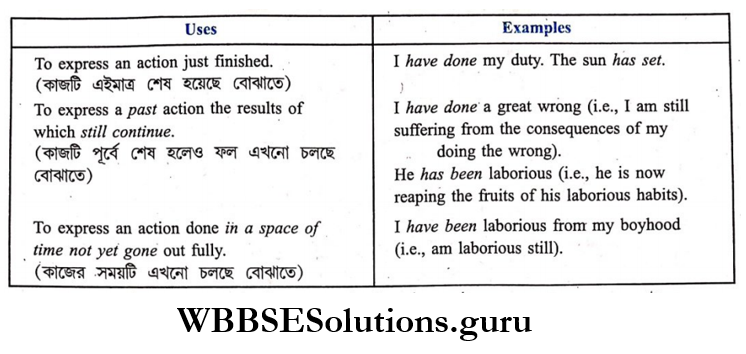
If the sentence contains “before” or “after”, Past Perfect Tense stands before “before” but after “after” (Sentence-এ যদি before বা after ব্যবহার করতে হয়, তবে Past Perfect Tenseটি before-এর পূর্বে (before ) ও after-এর পরে (after বসে).
He had come before I reached here.
- He left after I had gone away.
(Before ‘before’, after ‘after’ –এই ছড়াটি মনে রাখলেই আর কোনো অসুবিধা হবে না।)
Past Perfect Continuous Tense: This tense denotes that an action had been going at or before some point of time in the past.
(একটি অতীত কালের পূর্ব হতে আর একটি কাজ চলছিল এই অথে অধিকতর অতীত কালটি বোঝাতে): (Verb form : had + been + verb + ing)
- I had been working when he came. যখন সে এসেছিল আমি তখন কাজ করছিলাম।
Future Indefinite Tense:
This tense denotes an action that will happen in the future (ভবিষ্যতে কোনো কাজ হবে Form
- I shall go.
- You will go.
- He will go.
- I shall do it.
- He will come here.
Negative:
- He will not come here.
Interrogative:
- Will he come here?
Future Continuous Tense: This tense represents an action as going on at some future time (ভবিষ্যতে কোনো কাজ চলতে থাকবে বোঝাতে) :
(Verb form: will/shall +be+ verb + ing) I shall be sleeping at that time.
Chapter 4 Verbs And Verbals Examples Worked Out
Fill in the blanks with the appropriate Simple Present (Present Indefinite) or Present Continuous form of the verbs given in brackets:
Examples
- Her examination begins (begin) tomorrow.
- The girls playing (play) in the field now.
- She usually goes (go) to school by bus.
- It was very humid yesterday, but it raining (rain) now.
- The train to Delhi leaves (leave) at 8 p.m.
- The sun (rises) in the east and sets (set) in the west.
- He is writing (write) a letter to his father.
- He can’t go now as he feels (feel) unwell.
- Iron melts (melt) at a high temperature.
- What are you reading (read) now?
- The boys swim (swim) in the pool. I (hear) their shouts.
Fill in the blanks with the appropriate Present Perfect or Present Perfect Continuous Tense form of the verbs given in brackets:
- I have never seen (see) a crocodile before.
- He has shown (show) me the letter.
- It has been raining (rain) since morning.
- They have been watching (watch) TV since 5 p.m.
- We have not heard from you for a long time
- I have bought (bought) a new bicycle recently.
- I have lost (lose) my dog.
- The water has been boiling (boil) for a long time.
Fill in the blanks with the appropriate Simple Past (Past Indefinite) or Past Continuous Tense form of the verbs given in brackets:
- He was walking (walk) in the field.
- She was working (work) in the kitchen when (meet) her.
- It was raining (rain) heavily when he came (Come)
- The boys were playing (play) in the garden (fall) down.
- He never wanted (want) to know who (be).
- I saw (see) you yesterday when you running (run) after the bus.
- I went to his house and found that he was still working (work) on the painting.
Fill in the blanks with the appropriate Simple Past (Past Indefinite) or Present Perfect Tense form of the verbs given in brackets:
- He was walking (walking) in the field.
- She was working (work) in the kitchen when I met her.
- It was raining(rain) heavily when he came.
- The boys were playing (play) in the garden when the tree fell down.
- He never (want) wanted to know who she was.
- I saw (see) you yesterday when you were running after the bus
- I went to his house and found that he was still working on the painting (work) On the painting
Fill in the blanks with the appropriate Simple Past or Past Perfect Tense form of the verbs given within brackets:
- He went out (go) half an hour ago and has not returned till now.
- I saw (see) the match yesterday.
- My sister has written (written) many stories; she wrote this one only yesterday.
- I thought (think) him to be a good man, but I have changed my opinion now.
- He had closed (close) the door before he saw me
- After the teacher had gone (go) we left the room.
- When we reached (reach) the station, the train had already arrived (arrive).
- He felt (feel) weak because he had not eaten for two days.
- I thanked (thank) him for what he had done.
- The sun had set (set) when the fanners returned home.
Fill in the blanks with the correct form of verbs given in brackets:
- I saw (see) him a week ago.
- We came (come) to this town in 1960 and have been living here since then.
- He was reading a book when you came in.
- He passed (pass) the Madhyamik examination in 1996.
- Her father had died (die) before the doctor arrived.
- Einstein discovered (discover) the Theory of its Relative
- It has been raining (rain) continuously since this morning.
- We play (play) football every day.
- My brother is going to school now. He will return in the afternoon.
- Arun went to Dr. Roy’s house to meet him but Dr. Roy vra.s out to see a patient.
- I had written (write) to him before you met him.
- Who was talking (talk) to you when I met you this morning?
Fill in the blanks with the correct verb form from the alternatives given in brackets:
1. A strong wind has been blowing (blew, is blowing, has been blowing) since last night.
2. I shall tell him about the incident when he rings (will ring, rings, is ringing) me.
3. I received She (have received, had received, received) your letter yesterday.
4. She left(has left, left, had left) this place fifteen minutes ago.
5. The accident occurred (occurred, has occurred, occurs) at 10.30 this morning.
6. The carpenter has been working (is working, has been working, worked) for the last three hours.
7. The Ganga flows (flows, is flowing, has been flowing) between the two cities, Kolkata and Howrah.
8. We have not seen (did not see, ‘have not seen, had not seen) him for a month.
9. He visits (is visiting, visits) the temple every day.
10. We have been living (live, have been living) here since 1948.
11. I have not written (have not written, did not write, shall not be the letter till today.
12. I have not seen (did not see, have not seen, do not see) him since we. (have left college.
13. They met (have met, met, were meeting) him last week.
14. I See (am seeing, see, have been seeing) a beautiful sight.
15. He has shown (showed, has shown, had shown) me the picture just now.
16. He Meets (meets, is meeting) me regularly at my chamber.
17. Mr. Sen (leave) the office before we had left reached (had reached, reached, were reaching) there.
18. I have been working (am working, have been working, work) on this project for the last two years.
19. We had left came (have left, had left, left) the hall when they (came, had come, have come).
20. I do not think he attend (attended, has attended, had attended) the meeting yesterday.
Chapter 4 Verbs And Verbals B Verbals Participles
Participles are the forms of Verbs behaving both like an adjective and a verb. Participles are of two kinds:
Present Participles express an action going on and not completed (PG. DE FACE), and are formed by adding -ing to the verb.
Form: root verb + ing.
- I have been playing. [play (root verb) + ing]
- They will be writing. [write (root verb) + ing]
Past or Perfect Participles express an action completely (GT ER FRA) and are formed by adding -ed, -d, -t, -en, or -n to the root verbs.
- I have cleaned my room. [clean (root verb) + ed]
- We have heard the story. [hear (root verb) + d]
- The boys have learned their lesson.[learn (root verb) + t]
- He has broken the window pane. [break (root verb) + en]
- I have shown him this picture. [show (root verb) + n]
Participles can be used like
Adjectives before nouns:
- pleasing memory -walking sticks
- charming scenery -crooked person
- learned men -defeated soldiers
- fallen trees -a living creature
- Predicatively, to complete the sentence:
- The scenery looks charming. She appears to be learning.
- We saw him running away. The chair lay broken into pieces.
Absolutely, as :
- God willing, we shall do it tomorrow.
- This done (having been done), they all left the place.
- The dinner (being) over, and the party broke up.
Perfect Participles are used to show that one action was completed before another started. Examples:
- Having spent five years in England, I know Englishmen rather well. (Because I spent five years in England.
- Having reached the station, they found the train had already left. (When they reached the station…..)
Chapter 4 Verbs And Verbals Gerunds
A Gerund is a noun-verbal in -ing.
Look at the following sentences:
- He is fond of reading.
- He is fond of reading books.
In the first sentence, ‘reading’ is used only as a Noun-objective case, governed by the preposition of.
In the second sentence, ‘reading’ does the function of both Noun and Verb-as a Noun it is an object to the preposition of, and as a verb, it has its object books.
So in the above two sentences, the word ‘reading’ formed of a verb acts only as a Noun or as both Noun and Verb.”
A word formed by adding -ing to a verb, which does the work of a Noun or a Noun and Verb combined is called Gerund.
Uses of Gerund:
- As the subject of a verb: Walking is a good exercise.
- As the object of a verb: I learn drawing. Stop playing.
- As the object of a preposition: He is fond of riding.
- As a complement: It is a capital saying.
- As a part of a compound noun: A sleeping room; drinking water; a walking stick; laughing gas.
A Gerund may also take an object:
I am fond of reading books. He likes playing tennis.
Examples given in above should be carefully distinguished from participial adjectives in -ing, as in ‘a sleeping dog’, or ‘singing birds’.
The examples mean a room for sleeping, water for drinking, and a stick for walking (or, to walk with), where sleeping, drinking, and walking are nouns and are, therefore, to be classed as gerunds.
Present Participles and Gerunds distinguished.
A present participle is a verb and an adjective combined.
But it is primarily an adjective, qualifying a noun, though it takes an object after it when formed from a transitive verb.
I found him reading, or reading a book. Playing tennis, he gained death.
A Gerund is a verb and noun combined. But it is primarily a noun and is used as an ordinary noun in a sentence-i.e.,
as subject, object, complement-and may also have an object like a verb when it is formed from a transitive verb: His reading is bad.
He is engaged in reading a book. Seeing is believing. He is fond of playing football.
Chapter 4 Verbs And Verbals The Infinitive
The infinitive is formed by adding to, expressing, or understanding, before a verb.
- He came to play.
- Learn to read.
- I saw him (to) go.
The Infinitive with ‘to’ is used:
- As the subject of a verb: To err is human.
- As the object of a verb: He likes to swim.
- He taught me to play the piano.
- As the complement of a verb: He seems to be rich. I saw him go. I ordered him to be punished.
to express purpose, cause, condition, or results and may be attached:
- Adverbially to a verb: He came to see me. It came to pass. We eat to live.
- Adverbially to an adjective: I am sorry to hear this. He is ready to go. I am anxious to learn.
- Adjectively to a Noun: I have a house to let. Here is a chair to sit on.
- Absolutely or parenthetically to a sentence: To tell the truth, I do not trust him. To be brief, I am ruined.