
WBBSE Class 9 Fundamentals Of History Chapter 3 Europe In The 19th Century: Conflict Of Monarchical And Nationalist Ideas Long Answer Questions
Question 1. What were the factors responsible for the growth of nation-states in Europe?
Answer:
The factors responsible for the growth of nation-states in Europe
The concept of nation-states in Europe goes back to the Middle Ages when powerful monarchs established them in England and France. However, the nation-states and nationalism of the 19th Century had strong differences both qualitatively and fundamentally from earlier times. Several factors combined to provide the thrust to form nation-states in Europe in this period.
- The decline of feudalism and the weakening of the feudal lords encouraged the monarchs to grow strong and pave the path for the development of nation-states.
- The relationship between the Christian Church and the monarchs also changed and during this period the Church instead of challenging the monarchs provided them help and support.
- The growth of the rich middle-class people who provided economic help to the kings further helped in the rise of nation-states. Thus a new political system was created which helped in the emergence of nation-states.
Question 2. Why was there a conflict between monarchical and nationalist ideals after 1815?
Answer:
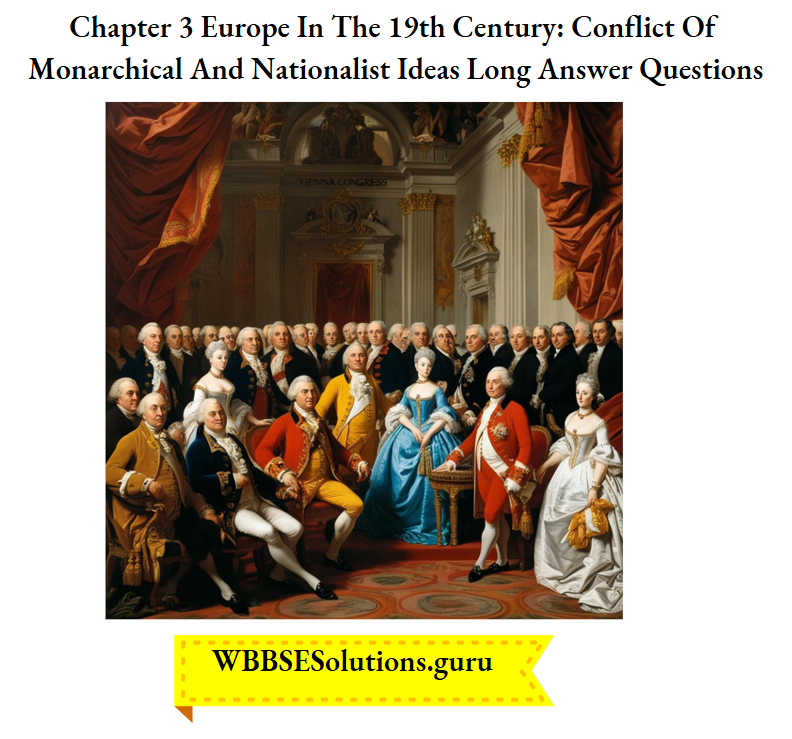
The fall of Napoleon Bonaparte in 1815, gave birth to two contradictory ideals – the forces of conventionalism and the change or in other words the conflict between monarchical and nationalist ideals. To re-draw the map of Europe after the fall of Napoleon the powerful leaders of Europe met at the Vienna Congress in 1815.
Though the conference was organized to decide on the fate of the countries affected by Napoleon’s aggression in reality the leaders were guided by their self-interests. The Vienna Congress completely ignored the sentiments of the people and re-installed the age-old monarchies in the respective countries. (Bourbons in France).
The French Revolution struck a blow to the autocratic rulers, church, and feudalism on one hand, on the other reaped the ideas of democracy, nationalism, and liberalism.
The countries like Italy and Germany who suffered due to the arrangements of the Vienna Congress also developed a strong feeling of nationalism. Despite all these, the people nurtured a strong feeling for monarchy and the Republic that was formed after the French Revolution in France failed to come up as an alternative to the monarchy.
This contradiction between monarchical and republican ideals became all the more evident when the people of France and Europe rejected absolute monarchy and not monarchy as a concept.
Read And Learn Also WBBSE Class 9 Fundamentals Of History Long Answer Questions
Question 3. What were the objectives of the Vienna Congress of 1815?
Answer:
The Objectives Of The Vienna Congress Of 1815
The downfall of Napoleon led to the international conference of the European powers at Vienna in 1815, which was attended by all except the Pope and the Sultan of Turkey.
The main purpose of this conference was
- The Reconstruction of Europe
- To establish peace and maintain the status quo
- To compensate the countries affected by French aggression.
To achieve these, the leaders of the conference, headed by Prince Metternich, the Chancellor of Austria, adopted three basic principles.
- The Principle of Legitimacy- this re¬introduced the pre-revolutionary era in Europe and reinstated the old monarchs and monarchies (Bourbon in France) who were driven out and deprived of their power; application of this principle also established the dominance of Austria over Italy and Germany.
- The Principle of Compensation- this aimed to compensate the states like England, Austria, Prussia, Russia, and Sweden who suffered greatly due to Napoleon’s aggression and at the same time rewarded those who allied to form a resistance against him.
- The Principle of Balance of Power- this was aimed to ensure that neither France nor any other power in Europe became too strong to disrupt the peace and equilibrium.
WBBSE Class 9 Fundamentals Of History Chapter 3 Europe In The 19th Century Question 4. Explain the ” Principle of Legitimacy “
Answer:
Principle of Legitimacy
The first international conference of the world was held in 1815 in Vienna where all the European powers except the Pope and the Sultan of Turkey were present to discuss the reconstitution of Europe. The leaders of the Vienna Conference headed by Prince Metternich, the Chancellor of Austria agreed to adopt three basic principles
- The Principle of Legitimacy
- The Principle of Compensation
- The Principle of Balance of Power.
The Principle of Legitimacy implied the restoration of the monarchs and monarchies who were exterminated by Napoleon or those who ruled before the Revolution in France(1789). As a result, the Bourbon Dynasty in France, Spain, Sicily, and Naples the Savoy Dynasty in Savoy, Sardinia, and Piedmont, the Orange Dynasty in Holland, and the rule of Pope in Central Italy were established.
Italy and Germany were brought under Austrian domination, Belgium was joined to Holland by force, and Norway was added to Sweden. In these cases, however, the Principle of Legitimacy gave way to the self-interests of the leaders of the Vienna Congress.
Question 5. Explain ” The Principle of Compensation”
Answer:
The Principle of Compensation
The first international conference of the world was held in 1815 in Vienna where all the European powers except the Pope and the Sultan of Turkey were present to discuss the reconstitution of Europe. The leaders of the Vienna Conference headed by Prince Metternich, the Chancellor of Austria agreed to adopt three basic principles
- The Principle of Legitimacy
- The Principle of Compensation
- The Principle of Balance of Power.
The Principle of Compensation stated that countries like England, Austria, Russia, Prussia, and Sweden which had suffered heavily due to Napoleonic wars must be adequately compensated. In reality, however, it was the Big Fours who benefitted the most—Austria was compensated with Lombardy and Venetia of North Italy, parts of Poland, Tyrol, and the Illyrian provinces. Prussia received Northern Saxony along with Westphalia, the Confederate of the Rhine, and Poland.
The Grand Duchy of Warsaw was shared between Austria, Prussia, and Russia. It was from this period Russia made her influence felt in European politics and England obtained several military and trade centers outside Europe.
Question 6. Explain “The Principle of Balance of Power”
Answer:
The Principle of Balance of Power
The first international conference of the world was held in 1815 in Vienna where all the European powers except the Pope and the Sultan of Turkey were present to discuss the reconstitution of Europe.
The leaders of the Vienna Conference headed by Prince Metternich, the Chancellor of Austria agreed to adopt three basic principles
- The Principle of Legitimacy
- The Principle of Compensation
- The Principle of Balance of Power.
The primary aim of this principle was to achieve a condition of peace and equilibrium in Europe. It also tried to ensure that France must be kept in control so that it did not disturb the European order created in 1815 in the coming years. To maintain the security of Europe, France was now encircled by some powerful states.
In the north of France, Holland was created by Belgium and England, the Rhine states were merged with Prussia in the eastern borders of France, Savoy and Genoa situated in the south of France to Piedmont worked as a buffer against France and in the south-east, a few French districts were added to Switzerland to create a strong front. These diplomatic steps against France by Austria adopted at the Vienna Conference made Alison Philips comment that ” Austria could swim like a fish in the sparkling whirlpool.”
WBBSE Class 9 Fundamentals Of History Chapter 3 Europe In The 19th Century Question 7. In what ways was the Vienna Congress of 1815, successful?
Answer:
The Vienna Congress of 1815 was attended by almost all the European powers but it was essentially Austria, Prussia, Russia, and France who dominated it. Although in many instances, the reactionary leadership and their antipathy towards the contemporary trends (democracy, nationalism, liberalism), earned this convention many criticisms in the words of the famous historian David Thomson, “On the whole, it was a reasonable and statesmanlike arrangement.”
It was the first international conference of not only Europe but of the whole world ( only the Pope and the Sultan of Turkey did not attend this conference), and it was successful in establishing a period of peace for about 40 years in the European continent.
The Vienna Congress failed to fulfill the aspirations of the common people but it was successful in abolishing the system of slavery by passing a resolution. The principles of the Vienna Congress like Legitimacy’ and “Compensation” to a large extent helped in the reconstruction of Europe in the post-Napoleonic era.
Vienna Congress provided the basis on which the “League of Nations” and the “UNO” were formed in the times to come. Finally, the attitude adopted by the leaders of this Congress towards France for its aggression was followed more harshly by the future leaders at the time of the Treaty of Versailles towards Germany in 1919 for disturbing the peace in Europe.
Question 8. Write a note on the Holy Alliance(1815)
Answer:
Holy Alliance(1815)
The Holy Alliance was a coalition that linked the great powers of Russia, Prussia, and Austria. It was made at the behest of the pious ruler of Russia, Czar Alexander I, and signed in Paris on 26th September 1815. The main purpose of the alliance was to promote the influence of Christian principles in the affairs of the nations in Europe.
According to the terms of the “Holy Alliance ” all the kings of Europe will be united by the feeling of brotherhood, the kings would consider their subjects as their children rule them with love, and maintain peace and justice.
Alexander, I was perhaps influenced by the visionary Barbara Juliane von Krudener which prompted him to advocate the “Holy Alliance” The Prince of Britain, the Ottoman sultan and the Pope did not sign in this ” Holy Alliance”. Both Metternich of Austria and Castlereagh of Britain considered the “Holy Alliance” as an insignificant and ephemeral association.
Question 9. What were the results of the Metternich System?
Answer:
The results of the Metternich System
In the period from 1815 to 1848, the destiny of Europe was determined by the astute Austrian Chancellor, Prince Klemons von Metternich, and the oppressive measures adopted by him are known as the Metternich System. Metternich a reactionary and conservative leader by nature was a firm believer of autocracy, the divine right theory of kingship, feudalism, and the authority of the Catholic church.
He completely ignored the revolutionary ideals of the French Revolution (1789) like democracy, nationalism, and liberalism, and considered them as chaotic and anarchic. To check the spread of the revolutionary ideas and establish his conservatism and status quo, he had ably stalled Europe from getting younger by 33 years.
A conservative by nature he retained the old framework of Europe without making any age-appropriate modifications and tried to suppress those newly sprouted hopes and aspirations which were bound to succeed. Ultimately, Metternich who earned the title ” Father of European Conservatism”, failed miserably. In 1848, the February Revolution brought an end to the Metternich System and Metternich had to leave Austria and seek asylum in England.
Question 10. What were the results of the July Revolution of 1830 in France?
Answer:
The results of the July Revolution of 1830 in France
The declaration of the four autocratic ordinances by the Bourbon monarch Charles X in July 1830, led to revolts in France followed by the dethronement of Charles X and the proclamation of Louis Philippe of the Orleans dynasty as the constitutional monarch.
As a result of the revolt the monarchy that was established represented the people and upheld democratic ideas like equality, secular rule personal and constitutional freedom. The clergy, the aristocracy, and the nobility who used to enjoy unlimited privileges during the old regime were deprived of those rights.
The rich bourgeoisie gained more power and that is why the July Monarchy is also called the ‘Bourgeois Monarchy ‘. The July Revolution had its impact felt in many countries of Europe like Spain, Germany, England, Portugal, Belgium, Switzerland, etc., but it succeeded in meeting the expectations of only the Belgians.
However, it must be admitted that the July Revolution struck a blow to the Metternich System and paved the path for a greater Revolution in 1848. According to the great historian, Fisher, ‘the flying sparks set off by the great furnace of Paris, fell on the logs in Concert-ruled Europe’ the’ outcome of which was like a forest fire.
WBBSE Class 9 Fundamentals Of History Chapter 3 Europe In The 19th Century Question 11. How do you associate Raja Rammohan Roy with the July Revolution?
Answer:
The 19th Century witnessed the spread of the lofty ideals of the French Revolution namely democracy, nationalism, and liberalism to other countries of the world. Raja RammohonRoy, the “first modern man of India” was an ardent advocate of the French Revolution and was extremely happy to learn about the success of the July Revolution of 1830 in France. To him, the July Revolution marked the triumph of liberty.
He supported freedom everywhere and even went ahead to a French warship during his sea voyage to pay tribute to the national flag of France. Raja Ram Mohan Roy who was totally against monarchy and absolutism discussed with everyone the success of the French in the July Revolution. The new king of France, Louis Philippe not only accorded him a great ovation he also invited Raja Rammohon Roy for dinner with him.
Question 12. What was the significance and impact of the February Revolution of 1848 in France?
Answer:
The significance and impact of the February Revolution of 1848 in France
The February Revolution that took place in France in 1848 is regarded as one of the most significant revolutions that had taken place in the world. It started with the dethronement of Louis Philippe and the dismissal of his Prime Minister Guizot and the subsequent declaration of the “Second French Republic” by the Republican and the Socialist leaders. Lamartine became the president of the provisional republican government and a Constituent Assembly was formed based on universal suffrage.
As a result of the February Revolution the supremacy of the rich bourgeois was curtailed and the poor, ordinary people could exercise their political rights through universal suffrage. Louis Napoleon, the nephew of Napoleon Bonaparte was elected as the President of France for the next four years. Unfortunately, however, in December 1852, Louis Napoleon -established a monarchy and put an end to the “Second French Republic”. Louis Napoleon took the title of Napoleon 3 and established the “Second Monarchy” in France.
Question 13. What were the causes of the failure of the February Revolution of 1848 in France?
Answer:
The causes of the failure of the February Revolution of 1848 in France
The February Revolution of 1848 in France was a significant event in the history of Europe. This event marked the end of monarchy and the suzerainty of the republic In France. But the success of the February Revolution was short-lived and many factors contributed to its failure. The middle class who form the backbone of any revolution was not strong and stable in France.
The differences between the diverse races, and the varied national aspirations further weakened the movement. The absence of able leadership was yet another cause of the failure of the Revolution of 1848 The Revolution inspired nationalist movements in 15 countries of Europe like Germany, Italy, Hungary, Bohemia, etc but these nations failed to attain a strong feeling of unity among themselves. The fatal pandemic of “plague” also came in the way of the Revolution of 1848.
Question 14. Write a note on Mazzini and his ” Young Italy”.
Answer:
Mazzini
Born on June 22nd, 1805, a Genoese by birth, Giuseppe Mazzini the great revolutionary was the prophet of the Italian unification movement. He was opposed to terrorist activities and wanted to motivate the patriotic feelings of the Italians by arousing the youths upon whom he had immense faith. Keeping in mind his goal of unification of Italy, he founded the Young Italy in 1831, where any man up to the age of 40 could be a member.
Mazzini made the members of Young Italy understand that their religion and patriotism were inextricably intertwined and that to oust Austria from Italy they would depend on themselves and no foreign powers. He wanted the young members to spread the feeling of nationalism and patriotism across the cities and villages of Italy. Although Mazzini and his Young Italy failed to achieve their end but made a great contribution in making the Italians realize that their unification was not impossible.
WBBSE Class 9 Fundamentals Of History Chapter 3 Europe In The 19th Century Question 15. Write a note on the Quadruple Alliance.
Answer:
Quadruple Alliance
The Quadruple Alliance was a treaty that was signed by the Allied powers namely Austria, and Russia. Prussia and Great Britain on November 1815 at Paris. This alliance was made to prevent any recurrence of French aggression and oppose any moves made by Napoleon and his descendants to re-occupy the throne of France. They wanted to strictly maintain the peace situation which was agreed upon unitedly by them during the Vienna Conference.
To prevent any aggressive move by France, the Allied powers even agreed to engage 60,000 men in the field. The Allied powers also decided to meet occasionally to discuss European problems and strictly enforce the implementation of the decisions of the Vienna Congress. The Quadruple Alliance was the continuation of the Treaty of Chaumont of 1814 where the Allied powers promised to vanquish France and remain united for twenty years to keep France in control.
Question 16. What were the causes behind the rise of Balkan nationalism?
Answer:
The causes behind the rise of Balkan nationalism
The population of the Balkan region, a part of the Turkish empire comprised an amalgamation of different communities and races like the Greeks and Egyptians. Albanians etc. They had diverse religions(Christians and Muslims), languages, and cultures yet a sense of nationalism developed in them possibly being inspired by the French Revolution. The people of the Balkans were ruled through military force by their Turkish ruler which created bitterness among both the ruler and the ruled.
The Christians in the Balkan region were greatly oppressed by the Sultans of Turkey and naturally, they had no allegiance towards the Turkish empire. Later as the administration and the army of the Sultan of Turkey became weak the Balkan people severed their ties with Turkish rule and made attempts to establish individual sovereignty.
In the face of inhuman torture Greece revolted and became independent in 1830, Egypt in 1841, and Moldavia, Wallachia, and Serbia also achieved partial independence. The nationalist uprisings also spread across the regions like Romania, Bulgaria, Sarajevo, and some other areas of the Balkan region.
Question 17. Write in brief about Garibaldi’s contribution to the unification of Italy.
Answer:
Garibaldi’s contribution to the unification of Italy
Giuseppe Garibaldi, the lion-hearted patriot, was a loyal follower of Mazzini and a member of his Young Italy. In 1860 when the people of Naples and Sicily of Southern Italy rebelled against the reactionary rule of Francis II and approached Garibaldi to help them, he readily agreed.
It is said that Italy was united by the heart of Mazzini, the sword of Garibaldi, and the brain of Cavour. Garibaldi who was a great general was never in favor of any political compromise and emphasized the strength of blood and sword. The volunteers of Garibaldi, known as the ‘ Red Shirts’, led an expedition called the “Expedition of the Thousands” to Sicily.
Almost single-handedly he fought and united northern and southern Italy. His volunteer guerilla soldiers also captured Lombardy for Piedmont. Cavour who was apprehensive of the increasing power of Garibaldi prevented him from launching an attack on Rome. Garibaldi accepted Cavour’s proposal and handed all the conquered provinces to Victor Emmanuel II who later became the King of united Italy.
Question 18. Write a note on the Frankfurt Parliament.
Answer:
Frankfurt Parliament
The February Revolution of France in 1848 inspired nationalist movements in fifteen countries of Europe including Germany. The German nationalist leaders who were highly motivated established a Parliament in Frankfurt in 1848, where the members were elected through universal adult suffrage.
About 586 German representatives were elected and the Frankfurt Parliament was given the task –
- To frame a constitution of Germany
- To unite the people both in terms of political unity and liberty
- Establish a government based on popular support instead of absolute monarchy.
The members of the Frankfurt Parliament offered the crown of a united Germany to Frederick William of Prussia. Frederick William declined this offer. On the contrary, Frederick William wanted to achieve the unification of Germany on his own and refused to accept the German crown as a gift from the representatives of the people.
WBBSE Class 9 Fundamentals Of History Chapter 3 Europe In The 19th Century Question 19. What were the similarities and dissimilarities between the July Revolution of 1830 and the February Revolution of 1848?
Answer:
The July Revolution of 1830 and the February Revolution of 1848, both of them took place in France. The impact of the July Revolution was felt beyond France in many of the countries in Europe, similarly, the February Revolution inspired nationalist movements in 15 European countries.
The July Revolution wanted to put an end to the autocratic rule of the French monarchs and establish a constitutional monarchy. The February Revolution wanted to put an end to monarchical rule and establish republican rule in France.
The July Revolution received the support of the wealthy bourgeois of France while the February Revolution was the movement of the common people and the intellectuals. However, both movements ultimately failed. However, the impact of the July Revolution lasted longer than the February Revolution.
Question 20. What were the causes of the Crimean War (1854 to 1856)?
Answer:
The causes of the Crimean War (1854 to 1856)?
The British historian, A.J.P Taylor argued that the Crimean War to a certain extent was predestined and had deep-rooted causes. The war started on the simple question of establishing the right to the Christian Church of Jerusalem by both the Greek Christians supported by Russia and the Roman Catholics supported by France.
On one hand lay the expansionist motive of the Russian Czar Nicholas I and on the other hand was the political ambition of Napoleon III who nurtured the idea of reviving the French glory by avenging the Moscow expedition of Napoleon the Great. The increasing desire of Czar Nicholas I to occupy Turkey alarmed all three European powers namely England, Austria, and France.
To maintain peace in Turkey and contain Russian expansion the “Vienna Note” was drawn by Austria, England, and France. The ” Vienna Note” acknowledged Russian authority on the Greek Orthodox Church in Turkey but at the same time asked Russia to withdraw her other claims on Turkey. Russia rejected the proposals rightly and as a consequence England and France declared war against Russia supporting Turkey. Thus began the Crimean War of 1854.
Question 21. Write a note on the Treaty of Paris. (1856)
Answer:
Treaty of Paris. (1856)
The Crimean War (1854 tol856) ended with the signing of the Treaty of Paris between Russia on one side and France, Great Britain, Sardinia- Piedmont, and Turkey on the other hand. Austria who was preoccupied with her internal issues remained neutral and only rendered moral support to Turkey.
The sudden expiry of Czar Nicholas I created an atmosphere of peace leading to the signing of the Treaty of Paris. (1856).
Britain, France, and Austria took up the responsibility of maintaining the independence and territorial integrity of Turkey. Both Russia and Turkey returned to their conquered territories. Russia’s claim over the Greek Christians was removed and Russia was made to assure to stay away from the internal affairs of Turkey. The Sultan of Turkey also had to promise to improve the conditions of the Christians who were living there in Turkey.
Question 22. What do you know about Florence Nightingale?
Answer:
Florence Nightingale
The Crimean War (1854 to 1856) was fought between England, France, and Turkey on one side and Russia on the other side. At that time the conditions of the hospital in the Crimean peninsula were terrible. Hearing about this horrible situation, Sidney Herbert British statesman, asked Florence Nightingale to immediately rush to the war front to treat the wounded soldiers.
Florence Nightingale led a team of nurses and went to the front where she set up a clean hospital providing good medical care. Florence and her team worked very hard and saved the lives of many soldiers. Florence Nightingale is regarded as the founder of modern nursing. It is said that at night Florence went round the wards of the hospital, carrying a lamp in her hand and enquiring about the comforts of the wounded soldiers. For, this act of kindness the soldiers gave her the name, “The Lady with the Lamp”.
Question 23. Write about Greek nationalism and Philike Hetairia.
Answer:
Greek nationalism and Philike Hetairia
The ideals of the French Revolution namely democracy, nationalism, and liberalism inspired many European nations. Thus in the 19th Century, a Greek nationalist awakening took place, in which two great Greek scholars Adamantios Kores and Constantine Rhigas played a commendable role.
The secret -societies were formed and the cultivation of Greek language, history, and culture was initiated. HetairiaPhilike a secret society was formed by a Greek merchant called Skoufas in 1814, in the Russian city of Odessa for revolutionary movements. HetairiaPhilike set up many branches all over Greece and thousands of members enrolled in this society Prince Ypsilanti was its President.
Ypsilanti was however captured by the Turkish troop, in Rumania, a province of the Turkish empire while organizing a revolt and imprisoned in Austria. At last, it was in 1830, that Greece became independent.
WBBSE Class 9 Fundamentals Of History Chapter 3 Europe In The 19th Century Question 24. What were the reasons behind the abolition of serfdom in Russia?
Answer:
The reasons behind the abolition of serfdom in Russia
Russia in the mid-19th Century was under autocratic and feudal rule marked by ” tyranny, injustice, and corruption”. The society was divided into two groups, a few aristocrats and a large majority comprising almost three-fourths of the population peasantry; again half of the peasantry was composed of the “serfs”. ‘Serfdom’ which formed the basis of Russian social and economic structure existed nowhere else in Europe in the mid-19th Century.
The Russian serfs were subjected to acute oppression by their masters, deprived of all socio-political rights, and treated as personal property of their masters and all these tarnished the image of Russia and reduced their dignity to the outside world. The need for factory workers with the rise of Russian industries, the frequent peasant uprisings, and the writings of the intellectuals like Tolstoy, and Gogol about the miseries of the serfs provided impetus for the abolition of this system.
The need for abolition of this system became all the more evident after the Crimean War which depicted how the weak and poor serfs who served as Russian soldiers were a burden to the Russian empire. Finally, it was Czar Alexander II who realized the irrelevance of the system of serfdom and finally abolished it by signing the ‘Edict of Emancipation’ in 1861.
Question 25. Briefly discuss the Vienna Congress of 1815.
Answer: The downfall of Napoleon led to the convention of an international conference of all European powers (except the Pope and the Sultan of Turkey) at Vienna, the capital of Austria in 1815. Despite the pan-European nature of the conference it was the ‘Big Four’ namely Austria, Prussia, England, and Russia dominated the conference and Prince Metternich, the Chancellor of Austria presided over it.
The main participants of the Vienna Conference were King Francis I and Metternich from Austria, Czar Alexander I and Count Nesselrode from Russia, Prime Minister Castlereagh, and Arthur Wellesley from Great Britain and Frederick William III and Prince Hardenberg of Prussia and Talleyrand from France.
The primary objectives of the Vienna Conference were:
- Reconstruction of the map of Europe was altered due to the aggressions executed to fulfill the imperialist motives of Napoleon.
- The re-establishment of the pre – Revolutionary condition in Europe by bringing back the old monarchs and monarchies ousted by Napoleon
- Compensation of the states affected by the Napoleonic wars
- Maintaining the balance of power in Europe and preventing France from making any further resurgence
To give shape to these objectives three principles were adopted by the leaders of the Vienna Congress namely
- The Principle of Legitimacy
- The Principle of Compensation
- The Principle of Balance of Power.
The Principle of Legitimacy,re-established the Bourbon rule in France, the Orange dynasty in Holland, Savoy dynasty in Sardinia -Piedmont but it failed to apply the policy judiciously everywhere. As a result, Italy and Germany were brought under Austrian domination, and Belgium was added to Holland by force -thus displaying the fact that the Principle of Legitimacy was largely guided by the self-interests of the leaders of the Vienna Congress.
The Principle of Compensation also rewarded the allies who were instrumental in bringing about the fall of Napoleon. Thus Austria acquired Venetia and Lombardy in North Italy, Tyrol, Illyria, and Salzburg, Prussia got 2/5th of Saxony,l/4th of Westphalia, Confederation of Rhine states, and Poland and the Grand Duchy of Warsaw was shared among Austria, Russia, and Prussia.
The Principle of the Balance of Power was followed in such a way that France would not be able to disturb the peace and equilibrium of Europe. France was encircled by a security system joining- Belgium to Holland, the Rhine districts to Prussia, some of the south-eastern French districts to Switzerland, Savoy and Genoa to Piedmont.
The Vienna Congress was an event of great importance in the history of Europe. It failed to assess the prevailing trend of the time and ignored the lofty ideals of the revolution like democracy, nationalism, and liberty but never executed any vindictive measures over the vanquished power. An atmosphere of peace lasted for 40 years after this conference.
It is said that the Vienna Congress provided the base upon which the League of Nations and UNO were formed in the future. Finally, in the words of historian, David Thomson, the Vienna Congress made ” a reasonable and statesman-like arrangement.”
Question 26. Critically assess the Metternich System.
Answer: Prince Metternich, the Chancellor of Austria was a firm believer in conservatism, opposed to any kind of progress, and outrightly rejected the concepts of democracy and nationalism. He followed an oppressive system called the ” Metternich System” to maintain a position of status -quo in Europe and rejected any forms of reforms. He curbed the freedom of speech and press and imposed restrictions on schools and colleges to restrict the growth of any revolutionary ideas in Austria and Germany.
He followed the policy of ‘Divide and Rule ‘ to drive the people against each other in Austria and suppress the growth of nationalism. Following the Principles of Legitimacy Compensation and Balance of Power he was able to re-construct the pre-revolutionary period in Europe. He compensated the allies who helped to defeat Napoleon with territorial gains. He also ably managed to prevent France from making any resurgence and disturbing the peace of Europe.
Metternich a reactionary and conservative leader by nature was a firm believer of autocracy, divine right theory of kingship, feudalism, and the authority of the Catholic church. He completely ignored the revolutionary ideals of the French Revolution (1789) like democracy, nationalism, and liberalism, and considered them as chaotic and anarchic.
To check the spread of the revolutionary ideas and establish his conservatism and status quo, he had ably stalled Europe from getting younger by 33 years. Yet it must be admitted that he ensured a period of peace for about 40 years in Europe, leading to the development of culture and education.
The hegemony of Austria was also made possible because of his able statesmanship. He retained the old framework of Europe without making any age-appropriate modifications and tried to suppress those newly sprouted hopes and aspirations that were bound to succeed. Ultimately, Metternich who earned the title ” Father of European Conservatism”, failed miserably. In 1848, the February Revolution brought an end to the Metternich System and Metternich had to leave Austria and seek asylum in England.
Question 27. How did the conflict between monarchy and nationalism give rise to the July Revolution of 1830 in France?
Answer: The July Revolution of 1830 was a significant event in the revolutionary history of France. Following the Principle of Legitimacy, as adopted by the leaders of the Vienna Congress the Bourbon monarchy was re-established in France, much to the dislike of many who were opposed to absolute monarchy.
Louis XVIII ascended the French throne and soon issued a Constitutional Charter where he reserved the highest position for himself but completely ignored the interests of the common people. In the meantime, the aristocrats nobles, and clergies who returned to France rejected the ideals of revolution and demanded their past privileges, through the Ultra-Royalist Party.
Soon the Liberal and Republican parties opposed the Ultra Royalists and France was caught t in a situation of extreme contradictions. Assessing the prevalent situation Louis XVIII undertook the middle path and wanted to establish a constitutional monarchy in France. The reign of Louis XVIII was more or less peaceful but trouble arose after his death when his brother Charles X, a great reactionary assumed power.
Charles X abandoned the middle path followed by Louis XVIII and re-instated autocracy, aristocracy, and supremacy of the Catholic Church. Further, he appointed Polignac, a reactionary person as his prime minister. Charles X issued four autocratic ordinances on July 1830 in which he suspended the Constituent Assembly, banned the freedom of the press, changed the voting system, and announced a day of election by reducing the number of voters.
No sooner was the ordinances declared than the people of Paris rose in rebellion under Adolphe Thiers. This incident known as the July Revolution led to the dethronement of Charles X and the proclamation of Louis Philippe of the Orleans dynasty as the constitutional monarch of France.
As a result of the July Revolution, the attempt to re-establish the old regime in France failed and the wealthy bourgeois community gained power. The impact of the revolution of 1830 in France had its influence on many countries of Europe.
WBBSE Class 9 Fundamentals Of History Chapter 3 Europe In The 19th Century Question 28. What was the significance of the February Revolution of 1848 in France? Can it be considered a revolution that affected the whole world?
Answer: The February Revolution that took place in France in 1848 is regarded as one of the most significant revolutions that had taken place in the world.
It started with the dethronement of Louis Philippe and the dismissal of his prime minister Guizot and the subsequent declaration of the “Second French Republic” by the Republican and the Socialist leaders. Lamartine became the president of the provisional republican government and a Constituent Assembly was formed based on universal suffrage. As a result of the February Revolution the supremacy of the rich bourgeois was curtailed and the poor, ordinary people could exercise
their political rights through universal suffrage. Louis Napoleon, the nephew of Napoleon Bonaparte was elected as the President of France for the next four years. Unfortunately, however, in December 1852, Louis Napoleon reestablished the monarchy and put an end to the “Second French Republic”. Louis Napoleon took the title of Napoleon III and established the “Second Monarchy” in France. The February Revolution had inspired nationalist movements in 15 countries of Europe and historian Eric Hobsbawm felt that this revolution had a worldwide impact.
This argument can be contested based on the following reasons
- The revolution was limited to Europe only.
- The revolution was able to create a furor initially no doubt but it failed to sustain its success and in places like Italy Germany and some provinces of Austria the movements failed.
- The extent of the movement was not the same in every part of Europe and each of these uprisings was guided by their motives.
- The nationalist movements were yet to become strong enough to win a victory over their reactionary opponents.
In the end, it can be said that the legacy of the French Revolution(1789) that tried to re¬construct the socio-political framework of Europe had to a certain extent become successful by the establishment of the “Second Republic” after the February Revolution of 1848.
Question 29. What was the role of Count Cavour in the Italian unification movement?
Answer:
The role of Count Cavour in the Italian unification movement
The main figure behind the Italian unification movement was Count Camillo Benso di Cavour, an engineer by profession who later joined the ministry in Piedmont-Sardinia his birthplace, and in 1852 rose to the position of the Prime Minister. Cavour who was a strong believer of constitutional monarchy wanted to achieve the unification of Italy under the leadership of Victor Emmanuel II the king of Piedmont- Sardinia.
He wanted to eradicate Austria from Italy and created international awareness on the question of the unification of Italy by regularly publishing articles in the journals of France and England. Cavour knew it too well that without foreign help unification of Italy was impossible and so he allied with the English and the French against Russia in the Crimean War. As a result, at the Paris Peace Conference, he raised the question of the Italian unification problem and won the sympathy of both France and England.
Cavour also concluded the Treaty of Plombieres with the French emperor Napoleon III in 1858 and when Austria attacked Piedmont-Sardinia in 1859, the French army seized Lombardy and Sardinia from Austria and gave it to Italy leading to united north Italian states.
Cavour also united the central states of Italy like Parma, Modena, Tuscany, and Romana with Piedmont- Sardinia by popular votes and pacifying Napoleon III by giving him Savoy and Nice. Another referendum on 18th September 1860 led to the joining of the Southern states of Naples and Sicily to the northern states of Piedmont- Sardinia. Thus almost the whole of Italy barring Rome and Venice was united and in 1861, Victor Emmanuel II was declared the ” King of Italy”.
It was in 1861only Count Cavour had an untimely death at the age of 51. Later in 1866, when Austria was defeated at the Battle of Sadowa, Venetia became a part of Italy. In 1870 Italy supported Prussia in the Franco-Prussian war. When France was defeated in the Battle of Sedan it had to withdraw the French army from Rome. As a result, Rome came within Italy and fulfilled the dream of the Italian unification of Cavour, in 1870, almost after nine years of his death.
Question 30. Write a note on the Italian unification movement.
Answer:
Italian unification movement
The unification of Italy in 1870 was a matter of singular importance in the history of Europe. Napoleon conquered Italy in 1796 and brought it under one rule and as a consequence, a feeling of nationalism and pride in their glorious past awakened in the minds of the Italians.
The Austrian Chancellor, Prince Metternich reduced Italy to a mere “Geographical Expression” through the application of the principles of the Vienna Congress which hurt the Italian sentiments deeply and they became determined to unify their country by eliminating the foreign domination over them.
To achieve her objective, several secret societies were formed in Italy of which the” Carbonari” was the foremost—but lack of popular support, able leadership, and improper planning ended the terrorist rebellions of the “Carbonari” in a failure. After this, it was Mazzini, the great patriotic leader who had deep faith in the youths who rejected all acts of terrorism and formed his “Young Italy” with the same view of unifying Italy.
Mazzini tried to arouse public opinion and spread feelings of patriotism and nationalism among all but his efforts did not yield any immediate result. Count Cavour who was made the Prime Minister of Piedmont-Sardinia by Victor Emmanuel in 1852, led the unification movement of Italy.
Cavour realized that to bring about unification
- Austria must be ousted
- The question of the Italian problem must become an international issue.
Cavour wrote regularly in the journals of England and France, sided with these countries in the Crimean War, and won their sympathy for Italy in the Paris Peace Conference(1856). By signing the Treaty of Plombieres (1858) with Napoleon III he managed to earn his support against Austria and by the Peace of Villafranca (1859) Austria had to cede Lombardy to Piedmont. Cavour also united the Central Italian states like Parma, Modena, Tuscany, and Romana with Piedmont by appeasing Napoleon III. (received Savoy and Nice).
In 1860, a great uprising occurred in Naples and Sicily against the reactionary Bourbon rule and the rebellions approached the ‘lion-hearted’ patriotic general and nationalist Giuseppe Garibaldi for his assistance. Garibaldi with his volunteers the “Red Shirts” occupied Naples and Sicily which were then joined to Piedmont. Victor Emmanuel II soon occupied all the Papal states except for Rome.
Thus by 1861, almost the whole of Italy barring Venetia and Rome were unified and Victor Emmanuel II was declared the King of Italy. In 1866, after the Battle of Sadowa, Venetia was joined to Italy, and in 1870 after the Battle of Sedan, Roma was occupied by Italy. Thus the heart of Mazzini, the brain of Cavour, and the sword of Garibaldi ultimately led to the unification of Italy in 1870.
WBBSE Class 9 Fundamentals Of History Chapter 3 Europe In The 19th Century Question 31. How was the unification of Germany achieved by Bismarck?
Answer: Otto von Bismarck was appointed as the Prussian Prime Minister in 1861 by William I the King of Prussia. Bismarck a staunch supporter of monarchy despised democracy and wanted to achieve the unification of Germany through military expertise. He waged three wars in the period between 1864 to 1870 to attain the unification of Germany.
‘ In 1864, the war between Denmark and Prussia started on the question of Holstein and Schleswig, where Austria supported Bismarck and Denmark was defeated. By the Treaty of Gastein (1865), Schleswig and Holstein were ceded to Prussia and Austria respectively. Within two years of the war with Denmark ‘ disagreements started between Prussia and Austria and in 1866 in the Battle of Sadowa, Austria was defeated by Prussia resulting in the Treaty of Prague.
By this treaty, the German confederation that was formed in 1815 was nullified and Prussia organized the whole of northern and southern Germany under her leadership. However the Southern territories of Germany were still under French domination, and within four years after the Austro-Prussian War in 1870, a war between France and Prussia ensued which is known as the Battle of Sedan.
France was defeated by Prussia in this battle and the Treaty of Frankfurt was signed in 1871. By this treaty, France had to give Metz and Alsace-Lorraine to Prussia along with huge war indemnities. Thus the unification of Germany was attained by Bismarck and the king of Prussia became the emperor or ‘Kaiser” of unified Germany.
Question 32. What were the causes behind the Crimean War (1854)? State the significance of this war.
Answer: The British historian, A.J.P Taylor argued that the Crimean War to a certain extent was pre-destined and had deep-rooted causes.
The war started on the simple question of establishing the right to the Christian Church of Jerusalem by both the Greek Christians supported by Russia and the Roman Catholics supported by France. On one hand lay the expansionist motive of the Russian Czar Nicholas I and on the other hand was the political ambition of Napoleon III who nurtured the idea of reviving the French glory by avenging the Moscow expedition of Napoleon the Great.
The increasing desire of Czar Nicholas I to occupy Turkey alarmed all three European powers namely England, Austria, and France. To maintain peace in Turkey and contain Russian expansion the “Vienna Note” was drawn by Austria, England, and France. The ” Vienna Note” acknowledged Russian authority on the Greek Orthodox Church in Turkey but at the same time asked Russia to withdraw her other claims on Turkey.
Russia rejected the proposals rightly and as a consequence England and France declared war against Russia supporting Turkey, leading to the beginning of the Crimean War (1854 to 1856).
The Crimean War had great significance in the history of Europe.
- In the very first place, it provided the foundation on which the unification of both Germany and Italy became possible.
- It marked the end of Russian aggression in Turkey and in fact, Russia had to return to Turkey the Turkish regions which she had previously occupied.
- It also left an impact on international politics. As Russia’s aggression was checked in Europe she now shifted her focus on Central Asia. This in its turn hampered the security and safety of the British Empire in India.
- Internally too Russia became weak and disgusted by the weak but oppressive Czarist rule a large number of the Russian people revolted and insisted the government bring reforms.
- It was as a result of such uprisings, finally, Czar Alexander II introduced some liberal reforms in Russia.
- The growth of Balkan nationalism was also a result of the Crimean War.
Question 33. How was Germany unified?
Answer: The leaders of the Vienna Congress(1815) aimed to bring back the pre-revolutionary era in Europe as much as possible and as a result just like Italy, Germany was also divided into 40(nearly)small states, most of them in control of Austria. The customs union or Zollverein through which all the German states agreed to follow a uniform tariff policy laid the foundation stone of the unification of Germany.
spired by the February Revolution of 1848 e German nationalist feelings awakened and the German nationalists called for a Parliament of the representatives in Frankfurt. This Parliament framed a constitution to establish political unity and liberty and a popular government instead of an absolute monarch in Germany.
Then in 1862. King William I the king of Prussia appointed an able politician Otto von Bismarck as his Prime Minister who wanted to unify Germany by following both his blood and iron and coal and iron policy.
Between 1864 to 1870 he undertook three wars
- The War with Denmark(1864)
- The Austro- Prussian War(1866)
- The Franco-Prussian War(1870).
In the Danish war. Bismarck managed to get Austria on his side and when Denmark was defeated she had to cede Schleswig and Holstein to Prussia and Austria respectively. In 1866, the Austro-Prussian war arose out of certain disagreements between the two, and Austria was completely defeated by Prussia. As a result, the small German states in northern Germany came under Prussian control.
Finally, in the Battle of Sedan in 1870, France was defeated by Prussia. The Treaty of Frankfurt was signed in 1871 which ended the war. France gave Metz and Alsace-Lorraine to Prussia along with a huge war indemnity. Thus the dream of unification of Germany was achieved and William I became the “Kaiser” or emperor of unified Germany.
Question 34. What were the causes of the weakness of the Turkish empire in the 19th Century?
Answer: The Ottoman Empire which was named after one of their Amirs, Othman comprised of an extensive region including vast areas of Asia, Africa, and Europe. In the beginning, till the 15th to early 17th Centuries, the Ottoman empire was extremely strong but the decline started from the end of the 17th Century. Turkey being ruled by the Muslim clerics lagged behind the other European countries in all respects – social, economic, military, and administration. Turkey was a loose bond of various religious and ethnic groups often hostile to each other.
The Turkish rulers instead of making any reforms oppressed their subjects adopted no welfare measures, and did not even bother to improve or modernize their military strength. The weak, unworthy Turkish leaders even lacked the power to control internal rebellion or external invasions and as a result, it was regarded as the ‘Sick man of Europe’.
In the Balkan region, a part of the Ottoman empire, lived the Greeks, Romanians, Serbs, Albanians, and others who were Christians by faith and nursed grudges against their Muslim ruler. Sensing the weakness of the Ottoman Empire they started their liberation movements. The expansionist and imperialist powers like Britain, and Russia. Prussia further exposed the economic weakness of Turkey.
Taking advantage of the deplorable condition of Turkey, Russia wanted to push its frontiers into the Ottoman Empire on the pretext of saving the Balkan nationalists. This aggression of Russia was thwarted by Britain, Austria, and France and eventually gave birth to the problem known as the”Eastern Question”.
Ultimately, when Russia captured Moldavia and Wallachia these European powers protested, claiming to maintain the unity of Turkey. But all these great powers of Europe were guided by their selfish motives. As a result of this political situation, war was declared against Russia by England and France in 1854. This war is known as the Crimean War.
Question 35. What were the main features of the “Edict of Emancipation” of Czar Alexander II?
Answer: Russia experienced an autocratic and feudal rule in the middle of the 19th Century.
The society was divided into two –
- A handful of the aristocrats
- The peasants of which half were the serfs.
When Czar Alexander II came to power there were about 400 peasant uprisings (during the first six years of his rule) which strengthened the serfs’ demand for freedom. In such a situation Czar Alexander II signed the “Edict of Emancipation” on 19th February 1861.
The ” Edict of Emancipation” or the ” Emancipation Statute ” had the following features
- The Russian serfs became free and they were no longer tied to their feudal lords under any bondage.
- They were given the same civil rights as the peasants.
- The serfs were free to own their property, engage in business, and get married at their own will.
- A substantial amount of the land of the nobles would be distributed to the peasantry and the serfs would acquire 50% of the land that they used to cultivate for their lords.
- The Czarist government also gave compensation money to the landlords on behalf of the peasants.
- The peasants would pay back the money in 49 installments.
- The installments would be collected by the ‘mirs’ and deposited into the government treasury.
- Czar Alexander II is regarded as ‘Czar the Liberator’ for abolishing serfdom in Russia.
Question 36. Critically evaluate the ‘Emancipation Statute’ of Czar Alexander 2
Answer: In 1861, Czar Alexander II, signed the ‘Emancipation Statute’ which led to the abolition of serfdom in Russia and earned him the title ‘Czar the Liberator’. Thus the serfs became free and enjoyed all civil rights like the peasants. They were not obligated to their lords anymore, could possess property, get married on their will, and also engage themselves in any business. The serfs got 50% of the land that they used to cultivate for their lords for themselves. The Government paid the money to the landlords on behalf of the serfs.
The serfs were to pay back that money through 49 installments to the government. The land that the serfs received was fixed by the magistrates called Arbiters of Peace. On a general note, it can be stated that the ‘Emancipation Statute’ yielded positive results. The financial condition of the government improved as the prices of land escalated and the revenues collected from the peasants were good.
The agricultural produce increased largely and provided an impetus to the trade. Industrial growth also occurred following the abolition of serfdom and the serfs got employment in the factories and mines. Though the “Emancipation Statute’ was a significant event in the history of Russia bringing in the modern age and rise of capitalism it was not above criticism.
The 360-page draft of the ‘Emancipation Edict’ was too complicated for the masses or the peasants to understand. The Statute failed to improve the condition of the peasants in reality and their hopes and aspirations could not be fulfilled by Czarist rule. This became only possible after the fall of the Czarist rule in Russia.