
Detailed Solutions for WBBSE Class 9 Fundamentals Of History Chapter 2 LAQs
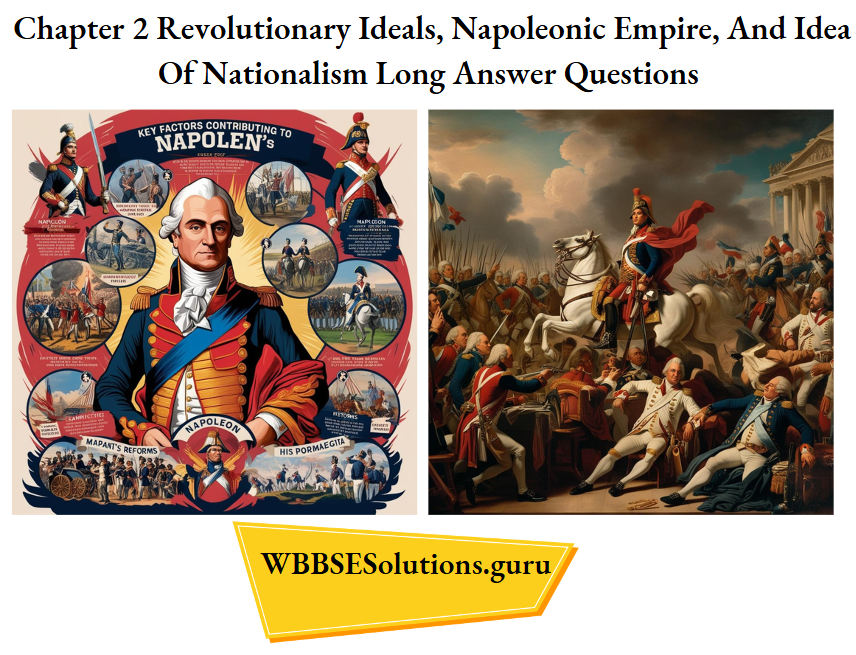
WBBSE Class 9 Fundamentals Of History Chapter 2 Revolutionary Ideals, Napoleonic Empire, And Idea Of Nationalism Long Answer Questions
Question 1. Write in short about how Napoleon came to power in France.
Answer:
Napoleon came to power in France
A new Government known as the Directory came to power in 1795 in France after the end of the Reign of Terror (1793 to 1794) but the Directory was not efficient enough to handle the dangers it was facing and entrusted Napoleon Bonaparte an able general to resolve all the problems.
Early in his life, Napoleon welcomed the French Revolution, he completed his education in the military academies of Paris and Brienne and joined the French artillery at the age of 17 as a Lieutenant. He successfully regained the Toulon Harbour from the English in 1793 and rose to the post of Brigadier. Further, on 5Ih October 1795, he saved the National Convention from the attack of a rowdy mob with the help of his soldiers and got elevated to the post of a Major General and was entrusted with the charge of the internal army of the French and the responsibility of commanding the troop to Italy.
Read And Learn Also WBBSE Class 9 Fundamentals Of History Long Answer Questions
The chaos and disorder that was rampant at the time of the Rule of the Directory caused great disappointment among the French and taking advantage of this chaotic condition, Napoleon overthrew the rule of the Directory on 9,h November 1799.
A new system of administration known as the Consulate was established where the whole authority to rule the country rested on Napoleon who became the First Consul. In 1802, Napoleon became the Consul for life, and in 1804 by a Senate-proposed plebiscite, he became the Emperor of the French.
Question 2. How did Napoleon become the Emperor of the French?
Answer:
WBBSE Class 9 Fundamentals Of History Chapter 2 Napoleon Became The Emperor Of the French
Napoleon Bonaparte was born on 15th August 1769, in Corsica, and after completing his education in the military academies of Paris and Brienne, he joined the French artillery in the post of Lieutenant at the age of 17. During the rule of the Directory (1795 to 1799), his military efforts saved France from attacks from other European countries and he was elevated to the post of a Major General in France.
Prompted by the prevalent lawlessness and chaotic condition and the frustration of the French on the Rule of the Directory provided Napoleon the opportunity to put an end to the Rule of the Directory on 9th November 1799. He introduced a new administrative system known as the Consulate and then became the First Consul for ten years.
He signed the Treaty of Amiens with England and broke the Second European Coalition that was formed against France and this gave him huge popularity among the French people. Enthused by all those events in 1802, he revised the Constitution and made himself the Consul for life.
In 1804 by a plebiscite sponsored by the Senate, he assumed the position of the Emperor of the French and successfully established another dynastic monarchy in France. Later he stated —‘ I found the Crown of France lying on the ground and I picked it up with my sword.’
Detailed Answers For Wbbse Class 9 History Chapter 2 Revolutionary Ideals, Napoleonic Empire, And Idea Of Nationalism
Question 3. What were the causes of the success of Napoleon?
Answer:
The causes of the success of Napoleon
The Reign of Terror was followed by the Rule of Directory (1795 to 1799) in France which failed to solve the prevalent task of meeting the challenges it was facing. This disappointed the French people largely who were tired of lawlessness, chaos, disorder, and bloodshed and wanted to find a savior who would put an end to this anarchy.
It was in this situation Napoleon Bonaparte who joined the French artillery as a Lieutenant and rose to the post of Major General through his successes in saving France from the attack of the other European countries dared to overthrow the rule of the Directory on 9,h November 1799.
Napoleon’s personality, his ability as a soldier, his ambition and political foresight, and his confidence earned him great popularity among the French. His policy of administration through the Consulate also earned him fame among the common people of France as he followed the principle of Authority from above and confidence from below’.
Napoleon’s respect for the ideals of revolution especially equality and fraternity also attracted the attention of the people who soon put their trust in him. The Treaty of Amiens with England and the destruction of the Second European Coalition against France helped him to get the support of the French and subsequently helped him to rise to power.
Finally, it has to be mentioned that the despair that loomed large after the Revolution of 1789 was ended by Napoleon through his revolutionary ideas, unique techniques of warfare, unscrupulous ambitions, and opportunist mentality. According to Riker–‘ It was hope that made the Revolution, it was despair that led it at the feet of Napoleon”.
WBBSE Class 9 Fundamentals Of History Chapter 2 Question 4. Can Napoleon be called the ‘ Child of the Revolution’?
Answer:
‘Napoleon himself, even in his wildest moments of renunciation, always acknowledged his debt to the Revolution’ George Rude ‘Revolutionary Europe 1783-1815’, Napoleon Bonaparte supported primarily the two ideals of the French Revolution namely equality and fraternity and destroyed the ideal of liberty for he believed that the French loved equality and not liberty.
He called himself the ” Child of the Revolution ‘and tried to give equality to all through his most important and glorious achievement, ‘Code Napoleon’. The Code provided equality in legal matters, religious tolerance, abolition of feudal privileges, individualism, recognized rights to property, uniform taxation policy, etc. Career was open to talents and every individual irrespective of his birth could attain high posts based on merit and qualification.
Napoleon was regarded as ‘ the sword of the Revolution’ for wherever his troops went the ‘Ancien Regime’ collapsed, feudalism was destroyed, the hegemony of the Church was curbed and the middle class and the peasants received support. Although he respected the three ideals of the French Revolution, he truncated one of its most important aspects- Liberty, believed in absolute monarchy and established his empire with his despotic outlook, centralized the administrative types of machinery of the Government, had absolute control of education, destroyed individual freedom and freedom of press and speech and sent his critics to prison arbitrarily.
The judicial and executive powers were vested upon him and he lived a life of luxury in the palace of Tuileries like the Bourbon Monarchs. Thus, to achieve power he became unscrupulous and killed the principles of the revolution to meet his selfish motives. According to Trotsky Napoleon himself destroyed the revolution through his military power.
Revolutionary Ideals Explained For WBBSE Class 9 History Students Revolutionary Ideals, Napoleonic Empire, And Idea Of Nationalism
Question 5. What was Code Napoleon?
Answer:
Code Napoleon
Before the Revolution of 1789, France had as many as 360 laws which were contradictory and arbitrary at the same time. At the time of the National Convention and the Directory efforts that were made to achieve a uniform civil code were not successful and when Napoleon came to power he appointed a Commission with four eminent lawyers who worked tirelessly for four years and finally drew up a set of laws in 1804, which was christened in 1807 as ‘Code Napoleon’ by Napoleon Bonaparte.
The Code was comprised of 2287 articles and provided equality in legal matters, endorsed religious tolerance, individualism, abolition of feudalism, right to property, and so on. Careers were open to talents and no individual was deprived based on his birth. The Code helped to achieve a uniform taxation system. Code Napoleon became so famous that later many countries in Europe adopted its main precepts.
The Code emphasized Roman laws no doubt but brought authoritarianism along with it. The women were demoralized by making them subservient to men -denying them the rights to family property, individual earnings, and the right to charity, etc. The Code even deprived the workers of their power to bargain and form trade unions. No doubt the Code Napoleon touched upon all the aspects of French life yet it went against the two ideals of the Revolution- Liberty, and Equality.
Idea Of Nationalism Class 9 History Battle Of Trafalgar
Question 6. Write a note on the Battle of Trafalgar.
Answer:
The Battle of Trafalgar took place between the naval powers of England and France on 21″ October 1805 and in this battle, France was completely defeated by the British fleet under the command of Admiral Nelson. For a long France and Britain were going through a tiff as Britain refused to hand over Malta to France according to the Treaty of Amiens. Napoleon’s appeal to Britain to take action against their press which was spreading wrong ideas about him fell on deaf ears and that too infuriated Napoleon.
In 1803 the British navy confiscated a commercial vessel of France and in retaliation, the French government imprisoned around 1000 British travelers who visited France. Napoleon also captured Naples and Hanover and gathered a large army at Boulogne to attack England.
The Spanish fleet that wanted to join the French was prevented by Admiral Nelson and the battle that ensued was a disaster for France. England’s victory at Trafalgar not only made her the undisputed master of the seas it also made Napoleon realize that he would never be able to defeat England in a direct war and he also gave up the idea of defeating the English navy.
WBBSE Class 9 Fundamentals Of History Chapter 2 Question 7. What was Napoleon’s role in German unification?
Answer:
Napoleon’s role in German unification
Napoleon’s expeditions had indirectly ignited the fires of nationalism in the conquered territories like Germany. Napoleon started exercising great control over Germany after defeating Austria and Prussia and started reorganizing the country which was at that time suffering greatly due to an internal crisis. Germany was divided into 300 small kingdoms which were part of the Holy Roman Empire and Napoleon reorganized them into 39 states and established a Federal Diet with a majority of the Protestants.
Napoleon formed a monarchist kingdom with Bavaria and a few nearby kingdoms and formed the States of Wurttemberg and Baden as vassal states of France. He also formed the Confederation of the Rhine with Bavaria, Baden, Wurttemberg, Saxony, and 28 other small states. The kingdom of Westphalia was formed with Hanover, Brunswick, and Hesse, and parts of Poland and Russia were brought under the Grand Duchy of Warsaw.
Napoleon introduced his land reform measures and Code Napoleon to rule the country efficiently but indirectly his measures gave birth to the concept of Pan -the German nation. According to Lipson, Napoleon was the real creator of modern Germany.
Idea Of Nationalism Class 9 History Revolutionary Ideals, Napoleonic Empire, And Idea Of Nationalism
Question 8. How did Napoleon unite Italy?
Answer:
Napoleon’s imperial reconstruction was felt most strongly in Italy. Napoleon defeated repeatedly the kings of the Habsburg dynasty of Austria who ruled over northern and central Italy and this naturally brought great changes there. He won great successes in 1796-97 in his Italian invasions. Milan and Lombardy were transformed to the Cisalpine Republic during the rule of the Directory and in 1805 it became the kingdom of Italy with Napoleon as the king.
Tuscany, Piedmont, and Genoa came under French rule and in 1809 the papal kingdom and the regions on the Adriatic coast also accepted the supremacy of the French. King Ferdinand II of the Bourbon Dynasty was also ousted from Naples and it now came to be ruled by France.
Napoleon put an end to feudalism in Italy and established the ideals of the French Revolution. He also abolished serfdom and many of the unjust taxes like a religious tax from Italy and eradicated the privileged class from the Italian society.
To modernize Italy, Napoleon asked his brother Joseph whom he made the ruler of Naples, to introduce Code Napoleon.
Question 9. What is ‘Legion of Honour’?
Answer:
Legion of Honour
The Legion of Honour is the highest French order of merit for military and civil achievements. In 1802, Napoleon introduced this special title to honor people with exceptional talents both civilians and military personnel. This special title of honor was conferred to distinguished artists, writers, scientists, and army generals.
Though it was introduced by Napoleon Bonaparte the later French governments retained this order of merit. The followers of the Legion wore a small white enameled cross hanging on a red silk ribbon as a symbol of public gratitude. From India, Satyajit Ray, and Soumitra Chatterjee received the Legion of Honour from the French Government.
Napoleonic Empire WBBSE Napoleon’s Russian Campaign
Question 10. Analyse Napoleon’s Russian campaign.
Answer:
By the Treaty of Tilsit( 1807), Napoleon Bonaparte of France and Czar Alexander of Russia entered into a friendly relationship which unfortunately did not last long, and very soon Napoleon turned against the Czar as the latter refused to follow the terms of the Continental System. As a result in 1812, Napoleon collected around 6,75,000 strong soldiers from nearly 20 countries of Europe such as France, Holland, Poland, Austria, Prussia, Italy, and Switzerland, and built his “Grand Army” and launched an attack on Russia. 26th June 1812).
The Russian troops instead of combating Napoleon’s army in open warfare, kept, retreating deep into the country and following the “Scorched Earth” policy destroyed roads and bridges, burnt houses, crops, farms, towns, food, clothes, etc and poisoned water supplies, thus making the situation extremely vulnerable for the Grand Army.
It was only in Borodin, that Napoleon achieved success but he lost as many as 30,000 of his soldiers too. At Moscow, the Russian General followed a new tactic and lured the French army to chase the Russians into the interiors of Russia, and again following the “Scorched Earth” policy left the Grand Army in a deplorable condition.
Napoleon along with his army waited at Moscow anticipating the Czar’s appeal for peace but that never happened for the Czar by that time had shifted his base to St.Petersburg and made preparations to attack the “Grand Army”. Last, but not least the inclement weather, particularly the severe cold of Russia and the breakout of the disease “Typhus” brought disaster to the French army. When Napoleon ordered his army to withdraw from Moscow on 19 October, less than 10000 soldiers were left.
Napoleonic Empire WBBSE Consequences Of Napoleon’s Invasion Of Russia
Question 11. What were the consequences of Napoleon’s invasion of Russia?
Answer:
Napoleon’s expedition to Russia in 1812 with his “Grand Army” not only ended in a failure it also left a far-reaching impact. First of all, Napoleon failed to assess the new military tactics that were adopted by the Russian Genera! Kutuzov and it was only after reaching Moscow he understood their real strategy. But it was too late then and the Russian policy of Scorched Earth, the disease typhus, and the inclement Russian weather especially the severe cold dwindled Napoleon’s Grand Army to less than 10000.
The Russian campaign thus destroyed not only his military strength it also the glorious and invincible image of Napoleon. His failures inspired his enemies and the countries of Central Europe united themselves to achieve independence and liberation.
The Russian and the Prussian armies together also started a war against France to achieve their independence. The expenses of war being high Napoleon used to impose taxes on the common people of France who resented it very much. The failure of Napoleon encouraged them to raise their voice against French exploitation and they rose against Napoleon.
WBBSE Class 9 Fundamentals Of History Chapter 2 Question 12. Why did the people of the Iberian Peninsula oppose Napoleon?
Answer:
The popular rise that took place in Portugal and Spain against France in 1808 is known in history as the Peninsular War. To fight against the French both Portugal and Spain who were suffering greatly took the help of the British troops under John Moore and Arthur Wellesley and launched a combined battle against Napoleon.
On signing the Berlin Decree, Napoleon compelled the king of Portugal to suspend trade relations with Britain who was her ally. When Portugal refused to accept this term Napoleon secretly made a treaty with Spain and attacked Portugal, thereby earning the wrath of the Portuguese people Spain not only did Napoleon expect to own its navy he also expected the support of the common people for his campaign.
He removed the king of Spain Charles IV, his son Ferdinand, and minister Godoy and established dynastic rule of his family by making his brother Joseph Bonaparte the king of Spain. This infuriated the Spaniards and hundreds and thousands of peasants and the common people of Spain joined the army to fight the French menace.
The revolutionary organization Junta with its center at Cadiz, sprang up in different regions of Spain and dedicated themselves completely to fight against Napoleon and his army. Succumbing to the opposition of the Spanish people Joseph Bonaparte had to leave Spain forever. Ultimately in 1814, Arthur Wellesley with the help of the Spanish guerrillas defeated the French in the Peninsular War.
Class 9 History Nationalism And Napoleon Concordat Of 1801
Question 13. Write a note on Concordat of 1801.
Answer:
The agreement that Napoleon made with the Pope in 1801 is known as the Concordat and according to Historian Cobban, The concept was a great victory for Bonaparte and a master stroke of policy. Immediately after the Revolution of 1789, there was the reconstitution of the GalicanChurch by the Constituent Assembly, and the church was made subservient to the state through the ‘Civil Constitution of the Clergy.
This naturally gave birth to a bitter relationship between the Pope and the State which came to an end when Napoleon signed a treaty with Pope Pius VII in 1801, to achieve not just a religious benefit but a major political advantage. By the Concordat of 1801, the rights of the Church were kept intact and the Pope got back the right to appoint Bishops of his choice and all the clergies would receive their salaries from the state and take an oath of loyalty to the state. Catholic religion could be practiced freely in France and a major civil war in France on the grounds of religion was avoided.
Sunday was declared a day of holiday in France by the wish of the Pope and the spirit of religious tolerance and the dependence of the Church on the state resulted in creating an atmosphere of peace and unity in France. To put it in the words of Napoleon himself, “Skillful conquerors do not get entangled with priests. They can both contain them and use them.”
Class 9 History Nationalism And Napoleon Orders In Council
Question 14. What do you mean by, Orders in Council?
Answer:
The Orders in Council of 1807 were issued by the Privacy Council of the United Kingdom in retaliation to the Berlin Decree ( 1806) and Milan Decree (1807) of Napoleon by which the whole of the British Isles and her colonies were put under blockade. Napoleon warned the neutral countries not to enter into the ports of Britain and her allies and all the goods seized from the British and the neutral vessels were burnt.
By implementing the Orders in Council, Britain in turn imposed a blockade on France and her allies. Britain also prohibited the neutral countries from importing goods from France or her allied ports or colonies. If any country failed to abide by this norm their commodities were captured and confiscated. If any neutral country wished to establish commercial relations with France, they had to first visit a British port and secure a license for payment of a very high amount of money.
Significance Of The Treaty Of Tilsit
Class 9 Fundamentals Of History Chapter 2 Question 15. What is the significance of the Treaty of Tilsit?
Answer:
The Treaty of Tilsit 1807 was signed between the Russian Czar Alexander I and Napoleon Bonaparte of France and a friendly relation was established between the two which unfortunately did not last very long. According to Riker, Tilsit was in a sense, the turning point of his (Napoleon’s) fortunes.
The Czar entered into the treaty as he wanted to divide Turkey and occupy Constantinople with Napoleon’s help. But he soon realized that Napoleon had no such intentions of dividing Turkey and his disillusionment with the treaty began. Napoleon also provided no help to Russia during her war with Turkey and Sweden.
It became evident to the Czar that Napoleon was only trying to reduce Russia to a vassal state. The Treaty of Tilsit helped destroy the Third European Coalition against France and glorified the image of Napoleon who could now channel his energy and attention towards the Western Front.
He was able to keep Russia as a neutral power and successfully divide Prussia into Westphalia and the Grand Duchy of Warsaw. The efforts of the exiled Prussian patriot, Stein who was at that time residing in Moscow, and the British ambassadors convinced the Russian leaders and the Czarto to join anti-Napoleon forces. As a result, the Czar decided to reconsider his treaty with Napoleon.
100 Days Rule Of Napoleon
WBBSE Class 9 History Chapter 2 important questions Question 16. Write about the 100-day rule of Napoleon.
Answer:
Napoleon Bonaparte was defeated by his enemies on March 1814 and after signing the Treaty of Fontainebleau on 6lfl April he left France. Exiled to Elba, Napoleon was not discouraged instead he dreamt of getting back his empire and remained aware and alert of the prevalent situation in Europe and France.
After around ten months, on March 1815, he gathered around 1050 soldiers and occupied the throne of Paris. The moment he arrived Louis XVIII abdicated the throne and escaped to England. For 100 days from 20th March to 29th June 1815, Napoleon reigned in France with the support of the bourgeoisie.
After Napoleon’s defeat in March 1814, the Bourbon King Louis XVIII who ascended the throne of France was not well accepted by the middle class and also the peasants for fear of losing their benefits. The army disliked him for his pacifying tendencies and the peasants feared that once again feudalism and exploitation of the Church would resume under the rule of a Bourbon monarch. The emigrant aristocrats and nobles also returned to France and claimed their lost property.
Further, the people of France had little faith in the promise of Louis XVIII to maintain the status- quo, and the victorious allies met at Vienna and planned to bring back the pre-revolutionary situation in Europe. It was under such circumstances that Napoleon made a comeback.
WBBSE Class 9 History Chapter 2 Treaty Of Campo Formio
WBBSE Class 9 History Chapter 2 important questions Question 17. Write a note on the Treaty of Campo Formio.
Answer:
The Treaty of Campo-Formio was signed between Napoleon Bonaparte and Count Philip von Cobenzl as representatives of France and Austria on 18th October 1797. This treaty was followed by the armistice of Leoben, which was forced on the Habsburgs by Napoleon’s win in Italy. The Treaty put an end to the First European Coalition against France and left Great Britain alone fighting against France.
According to the Treaty, a Congress at Rastatt was held to negotiate a final peace agreement for the Holy Roman Empire. Secretly, Austria promised to work with France to certain ends at the Congress. The Treaty also brought to an end the Republic of Venice, which was disbanded and partitioned by both the French and the Austrians. However, the Congress failed to gain peace and on March 1799, France once again declared war on Austria.
WBBSE Class 9 History Chapter 2 Nationalistic Reactions Against The Napoleonic Empire
Question 18. Give an account of the nationalistic reactions against the Napoleonic empire.
Answer:
In 1804, Napoleon Bonaparte became the Emperor of France and established a large empire by conquering Germany, Italy, Holland, Spain, Portugal, Switzerland, Prussia, Denmark, and Naples. In these countries, he spread the lofty ideals of equality and fraternity of the French Revolution but denied the ideal of Liberty.
The entire concept of hegemony of one united nationalist the French over the other united nationalist ideas of Europe lead to a nationalist reaction against the Napoleonic Empire. Most of the conquered countries refused to accept the sovereignty of Napoleon and called him with hatred the Crowned -Jacobin for his aggressiveness.
The spirit of nationalism started developing fast and strong and the people of Spain even began organizing revolutionary councils and national guards. Their spirit influenced the Dutch, Germans, Swiss, Italians Poles, and others who started a formidable struggle for liberation. His attempts to destroy the local culture, tradition, and language freedom of individuals and establishment of French traditions and culture made him all the more unpopular.
The Germans also with the help of Prussia. Russia and Austria started their war of liberation at a time when Napoleon was consolidating himself in France. Teachers, students, peasants, nobles, and clergies in Germany were united in their fight against Napoleon. In short,t the autocratic rule of Napoleon paved the path for nationalist reactions in Europe.
WBBSE Class 9 History Chapter 2 Orders In Council
Class 9 Fundamentals Of History Chapter 2 Question 19. Write a note on the Battle of Waterloo.
Answer:
Battle of Waterloo
Napoleon stayed at Elba for about ten months and keenly observed the events and situation of France and Europe in 1815 he came to France and established his reign of 100 days (20’h March 1815 to 29th June 1815) with his faithful soldiers and with the support of the bourgeoisie. As soon as the news of his return spread the allies forgot all their differences and united themselves to crumble him completely.
The Allies condemned Napoleon for disturbing the peace and decided to launch an attack on France from three sides. The Allies organized the two armies under the Duke of Wellington and Marshall Blucher of Prussia. Marshall Blucher was defeated at Ligny while Arthur Wellesley gathered a huge army to launch an attack on Napoleon on the plains of Waterloo. On 18,h June 1815, Napoleon was defeated under the joint attack of the Duke of Wellington and the Prussian General Blucher.
Napoleon and his soldiers fought bravely but were completely defeated. In the Battle around 6000 Prussian soldiers, 13000 British soldiers, and 37000 French soldiers were lost. The Battle of Waterloo sealed the fate of Napoleon.
Revolutionary Ideals In WBBSE History Napoleon Was The “Child Of The Revolution And Destroyer Of The Revolution”
Question 20. Napoleon was the “Child of the Revolution and destroyer of the Revolution” Explain
Answer:
Napoleon Bonaparte supported Answer: primarily the two ideals of the French Revolution namely equality and fraternity for the people in France and destroyed the ideal of liberty in France because he felt that the French people were not yet ready for the liberty as promised by the French revolution but ready to endorse the idea of equality.
The Code Napoleon that he drew up rightfully accords him the title of “Child of the Revolution”. The Code provided equality to French citizens in legal matters, religious tolerance, abolished feudal privileges, recognized individualism and rights to property, uniform taxation policy, and other reforms ensuring equal rights for all. Careers became open to talents and every individual irrespective of his birth could attain high posts based on merit and qualification.
Napoleon is regarded as ‘the sword of the Revolution’ for wherever his troops went the ‘Ancien Regime’ collapsed, feudalism was destroyed, the hegemony of the Church was curbed and the middle class and the peasants received support. Although he respected the three ideals of the French Revolution, he truncated one of its most important aspects- Liberty, he practiced Absolute Monarchy centralized the administrative machinery of the Government, had absolute control over education, destroyed individual freedom and freedom of press and speech and sent his critics to prison arbitrarily.
The judicial and executive powers were vested upon him and he lived a life of luxury in the palace of Tuileries like the Bourbon monarchs. In the years following the imposition of the Continental System, his empire lost its earlier liberal look and assumed a despotic and coercive form. To retain power, he compromised on the principles of the Revolution to meet his imperialist ambitions.
According to Trotsky Napoleon himself destroyed the revolution through his military power. In 1804 Napoleon became the emperor of France, thereby reinstating monarchical rule in France. His rule gradually assumed the characteristics of a dictatorial regime.
By placing his family members in positions of high office Napoleon trampled on the democratic principles of the Revolution. Till 1809, Napoleon was indeed a Liberator carrying the flag of France and ideals of Revolution across Europe, namely Italy and Germany. But as soon as his conquests assumed an imperialistic overtone the Child of the Revolution became the ‘destroyer of the revolution’.
Revolutionary Ideals In WBBSE History Internal Reforms Instituted By Napoleon
Question 21. Discuss the internal reforms instituted by Napoleon.
Answer:
The internal reforms instituted by Napoleon
In 1804, Napoleon Bonaparte became the Emperor of France through a Senate-proposed plebiscite and soon took charge of setting up an efficient administration and reforms.
His internal reforms can be divided into two categories
- A centralized administrative system for the welfare of France
- Reforms in the law and order system, education, economy, etc.
Napoleon used the Constitutional power of the Consulate and established a dictatorship in the guise of democracy in France—he denied the sovereign powers to the National Convention and stopped appointing government officials based on election, they were now selected through recommendation, and all public represented organization were terminated, press was censored, critics were imprisoned arbitrarily.
In short, all powers were usurped by him, and the lofty ideal of Liberty of the French Revolution was completely ignored. He provided equality and admired talents but refused to honor liberty. The most important achievement of Napoleon was the establishment of Equality in the French Society through his Code Napoleon which earned him the epithet, Justinian II. Code Napoleon comprising 2287 articles brought equality in legal matters, religious tolerance, abolition of feudalism, individualism, and recognition of rights to property.
To achieve economic progress in France, in 1800 he founded the Bank of France, ordered the government departments to reduce their expenses, started the system of audit in every government sector, did not impose further tax, and concentrated on the collection of the existing tax. He even gave the power to issue currency notes to the Central Bank of France. Napoleon also drew up an educational policy by which every commune had to set up a primary school, a teacher training school, and technical and military schools.
He also established around 29 Lycees or residential semi-military schools and founded the University of France in 1808. Many institutes were opened for carrying out research and higher studies. Napoleon also divided France into eighty-three departments where officers of the departments were referred to as
- Prefects
- Sub Prefects
- Mayor etc.
He also established the Louvre Museum and built 229 military roads and Alpine roads. Napoleon brought reforms in religion too. By Concordat he also resolved the problem between the State and the Pope and allowed the French to freely practice the Catholic religion.
Apart from all these he also repaired and built the bridges, roads, parks, and palaces in France and introduced the system of conferring the title of Legion of Honour to exceptionally talented persons in various spheres of life both military and civilian. To put it in his own words Napoleon’s reforms were of greater significance than the forty wars he fought.
Revolutionary Ideals In WBBSE History The ImportanceOf Code Napoleon
Class 9 Fundamentals Of History Chapter 2 Question 22. Discuss the Importance of Code Napoleon.
Answer:
The most significant and glorious achievement of Napoleon was the formulation of Code Napoleon in 1804. The Code was divided into five parts namely Civil Code, Criminal Code, Commercial Code, Penal Code, etc.
Code Napoleon which was a synthesis of the French rituals and heritage of the French Revolution and Roman orders and customs was composed of 2287 articles.
Code Napoleon, championed the ideal of Equality of the French Revolution, ushered inequality in legal matters, freedom of thought and religion, abolition of feudalism, recognition of property rights and secularization of the states, and above all individualism. It guaranteed civil liberties and ensured that careers were open to talents irrespective of one’s birth. It protected the interests of the peasants and the Bourgeoisie.
Code Napoleon became the permanent legacy of the French Revolution and many countries of Europe adopted the main precepts of this Code Lefebvre had called this Code the “Bible of the French Society”. The Code however was not free from flaws
- It strengthened authoritarianism
- It undermined the status of the women in French Society— the women were made subservient to men by law,
- The workers were not given bargaining power and trade unions were banned.
Despite its limitations, it has to be admitted that the Code Napoleon was simply a work of great achievement as it touched upon every sphere of French life. According to David Thomson, the Code Napoleon had put France on the road to the rule of law.
Idea Of Nationalism Class 9 history The Failure Of Napoleon
Question 23. What were the factors that contributed to the failure of Napoleon?
Answer:
The factors that contributed to the failure of Napoleon
Napoleon Bonaparte is regarded as one of the greatest generals of the world who rose to the position of Emperor from a Lieutenant by sheer dint of his ambition and talent. But his success was short-lived. Napoleon’s rise to power was essentially based on his military strength and not on political foresight. His unsalable lust for power and conquest brought disaster to him as he failed to achieve the natural allegiance of the people he conquered.
Napoleon’s empire was based on his military ability and he ruled the people through ‘ Dictatorship in the guise of Democracy’, ignoring the basic tenets of the French Revolution ( Equality, Fraternity, Liberty). As a result, the moment his military weaknesses were exposed, rebellions started occurring. His military strength fell short of the naval power of Britain and his army though largely consisted of Dutch, French, Italian, German, Spanish, and other European nationalities was not cohesive. This was a major demerit of his military force which he probably failed to realize.
The Continental System that he introduced against England also contributed to his fall. The nationalist uprising in Spain also spread its influence on other European nations and hastened the fall of Napoleon. It was admitted by Napoleon himself that the Spanish ulcer brought about his ruin. Napoleon’s Moscow expedition was yet another blunder in which he not only lost a vast majority of soldiers of his Grand Army it also gave a fatal blow to his military power and prestige.
Another factor that made his fall inevitable was his conflict with the Pope, as a result of which the Catholics started opposing him. The defeat in the Battle of Trafalgar, in the Battle of Nations, ruined his military image, and the myth of his invincibility was broken, thereby landing him in the face of an open challenge of the allies.
Finally, on 18″‘ June 1815, Napoleon’s fate was sealed in the Battle of Waterloo, where the Duke of Wellington and General Blucher defeated Napoleon and his soldiers. Napoleon was exiled to the island of St Helena where he breathed his last on 5th May 1821 at the age of 52.
Question 24. What do you understand by the Continental System? How did it contribute to the fall of Napoleon?
Answer:
Idea of nationalism Class 9 History Continental System
Realizing the invincibility of the British navy, in 1806 Napoleon decided to find an alternative way of attacking Britain through a policy of Economic Blockade. This policy known as the Continental System aimed to destroy the trade and commerce of England. To this effect Napoleon issued the Berlin Decree in 1806, to create a naval blockade against England.
The vassal countries were asked to stop the entry and movement of British ships around their ports. The Milan Decree of 1807 ensured that if any vessel of any country tried to reach England with commercial motives then it would be confiscated by France. He forced the European countries to participate in this blockade much to their inconvenience and dislike.
The Continental System of Napoleon ended in failure leading to a wide range of problems across Europe including France. Firstly, Napoleon needed a very strong navy to make this Economic Blockade against England successful, which he lacked. Secondly, British goods were cheap and easily available and met the daily requirements of the common people of Europe. As a result of the blockade the prices of essential commodities like tea, coffee, and sugar shot up leaving the people in the face of severe hardship.
This situation, naturally caused a huge consternation and the suffering countries now started disregarding the Continental System which in turn infuriated Napoleon who waged wars against Spain, Portugal, and Russia. Holland and even the Papal country. Napoleon’s attack on the Pope won him the wrath of the Catholics and the whole of Europe started condemning him for disturbing the peace as well as for the challenges they were facing.
The condition became such that the Allies now decided to unite and launch a combined attack against Napoleon. To be precise, the Continental System of Napoleon not only ended in a failure it also hastened his downfall.
Idea Of Nationalism Class 9 History Continental System
Question 25. Why did Napoleon introduce the Continental System?
Answer:
Continental System
Napoleon Bonaparte tried several times to defeat England in a direct war which ended in disaster. So he decided to adopt an indirect method to weaken Great Britain through a system of Economic Blockade or economic warfare. Keeping this idea in mind Napoleon introduced the Continental system in 1806. Napoleon believed that if the countries in Europe stopped having commercial relations with England her economy would be ruined.
So he issued the Berlin Decree in 1806 prohibiting the vassal countries from allowing the movement or entry of any British ships around their ports. The Milan Decree of 1807 declared that if any ship of any country tried to reach England that ship would be confiscated. Napoleon’s idea was that if the British goods were not exported, very soon she would be bankrupt, her factories would be ruined and the entire commercial community of England would suffer a terrible setback.
Napoleon expected that the Economic Blockade would break the backbone of the British economy and it would no longer be in a position to wage a war or help her allies. In reality, however, the Continental System strengthened the British economy and hastened the downfall of Napoleon Bonaparte.
Question 26. Why did the Continental System of Napoleon fail?
Answer:
Napoleon’s policy of striking the British economy through an ‘Economic Blockade’, is known as the Continental System which failed due to multiple factors- The Economic Blockade led to a great crisis in France itself and her economy suffered greatly. Prices of daily commodities soared high, there was retrenchment and unemployment problem and the French people had to bear the cost of war in the form of additional tax burden.
This made the people of France oppose the dictatorial rule of Napoleon. Most of the European countries who depended on Britain for their articles of daily use like tea, sugar, coffee, etc at a cheap price faced great hardship due to the Continental System of Napoleon. They became extremely agitated and decided to voice their protest against Napoleon.
The French Navy of Napoleon was no match to the British naval force who were regarded as the ‘Queen of the Seas’ and it became impossible for France to control the smuggling of British goods to different parts of Europe.
Spain and Portugal being tired of this French menace joined hands with England against France and it was the Spanish Ulcer that contributed largely to the fall of Napoleon. Further, Napoleon lost the support of the Catholics in Europe when he imprisoned the Pope and captured his kingdom for his refusal to accept the Continental System.
In reality, the Continental System strengthened the British economy for the blockade helped her in finding a market beyond Europe. Finally, when the Czar of Russia refused to abide by the Continental System of Napoleon, he made the most daring decision of his life by invading Russia in 1812 with his Grand Army.
His Russian expedition ended in a failure destroying his military power and personal image. Thus the Continental System of Napoleon was a great proof of Napoleon’s inability to be an astute statesman.
Class 9 Fundamentals Of History Chapter 2 Question 27. Why did Napoleon’s Moscow expedition fail? How did it contribute to the downfall of Napoleon?
Answer:
Napoleon Bonaparte undertook the Moscow expedition in 1812 with his Grand Army which failed due to various reasons- As a commander of the French army Napoleon made certain serious mistakes—
- He did not make adequate arrangements before undertaking this expedition
- He failed to assess the geographical factors like the vastness of the country and the inclement weather, especially the severe Russian cold
- He did not make enough provisions for food, clothes, and war materials for the Grand Army in the belief that the war would be over in a short period.
The new war strategy and tactics of the Russian General Kutuzov baffled Napoleon’s army and the Grand Army was forced to enter deep into the interiors of Russia without having the faintest idea of the dangers that lay ahead.
The Russians followed the ‘Scorched Earth’ policy and destroyed roads and bridges, burnt food, crops, houses, towns, clothes, and everything, poisoned water, and lured the French soldiers to enter deep inside the Russian empire.
This dealt a severe blow to the Grand Army which suffered from many-sided attacks in the form of shortage of food, inclement Russian weather, and the threat of the Russian military onslaught.
While Napoleon was busy in Russia, two conspirators Malet and Lafon spread the rumor that Napoleon had died in Russia. Hearing this, Napoleon made an immediate return to France.
As a consequence, the myth of Napoleon’s military invincibility was shattered and the whole of Europe like Russia, Prussia, and England unitedly launched the ‘Battle of Nations’ against France.
People of France as well as the countries. conquered by France could no longer bear the ever-escalating tax burden to meet the war expenses of Napoleon and protested against such exploitation. The Moscow expedition is regarded as the ‘swan song ‘ of Napoleon’s imperialism.
Question 28. Give an account of the reactions of people against the Napoleonic Empire.
Answer:
Revolutionary Ideas Explained For WBBSE Class 9 History Students Reactions Of People Against The Napoleonic Empire
Napoleon Bonaparte became the Emperor of France in 1804 and built a huge empire by conquering Italy, Germany, Prussia, Russia, Holland, Switzerland, Denmark, Spain, Portugal, and Naples. But his empire was short-lived and he had to face the nationalist uprisings of different countries conquered by him.
The people of the defeated countries never accepted Napoleon wholeheartedly and always regarded him as a foreigner.
The Spaniards got united against him formed the Juntas and refused to accept the dynastic monarchy that Napoleon wanted to establish in Spain by crowning his brother Joseph.
The spirit of nationalism infected the countries like Holland, Belgium, Germany, Italy, Portugal, and Switzerland. They all now started resenting the French rule.
At a time when Napoleon was busy consolidating himself in France, the Germans with the help of Russia, Prussia, and Austria staged their war of liberation. The people of Holland dethroned the Prince of Orange and the Italian provinces also started revolting against Napoleon.
The French also protested against Napoleon because of his policy of forced recruitment. Further, Napoleon lost the confidence and support of the Catholics of Europe when he imprisoned the Pope and occupied his kingdom in Rome. The whole Christian world condemned Napoleon for his imperialist outlook and tyrannical actions.